How we make this list: we compare pricing pages, product documentation and public user reviews. Ratings come from G2, Capterra or Trustpilot, with the date we checked them.
What is the best clinical documentation improvement software in 2026?
Solventum 360 Encompass CDI is the best clinical documentation improvement software in 2026 for large hospitals, because it combines computer-assisted CDI, coding, and auditing in one platform with worklist prioritization driven by clinical logic. AGS Health is the strongest alternative for health systems that want AI chart review with over 100 query templates and built-in encoders.
Key takeaways
- Solventum 360 Encompass CDI leads for large hospitals that want CDI, coding, and audit in a single system.
- Waystar CDI suits hospitals that want fast physician query responses, with vendor-reported response times under 24 hours.
- Every vendor in this guide uses quote-only pricing, so budget for a sales-led quote and a multi-week implementation.
- Nuance CDI works best when the goal is better physician documentation at the point of care through voice and ambient capture.
- AGS Health and Dolbey Fusion CDI suit teams that want query volume handled with clear prioritization and audit trails.
How does clinical documentation improvement software improve coding accuracy and cut denials?
Clinical documentation improvement software improves coding accuracy by reading the patient chart, flagging gaps between the clinical evidence and the written record, and turning those gaps into queries a physician can answer before the claim goes out. A CDI specialist no longer has to read every chart in full. The software ranks charts by likely impact, so the team reviews the records that matter first. A small share of charts usually holds most of the missed diagnoses.
The query workflow is the core of the product. A good CDI tool drafts the query, attaches the clinical evidence that supports it, sends it to the physician inside the EHR, and tracks the response. Quick answers give coders a complete record and a code set that matches the care given. Slow or unanswered queries stall CDI programs, so look for response tracking, escalation rules, and mobile query answers in any demo. Waystar reports a 98 percent physician response rate for its CDI product, which shows what a tight query loop can do.
Denials fall when documentation supports the codes on the claim. Payers deny claims when the record does not justify the diagnosis, the severity level, or the procedure. CDI software attacks that problem before billing by checking for missing specificity, conflicting notes, and absent complications or comorbidities. AGS Health reports a 30 to 50 percent reduction in denials for its CDI customers, and IMO Health reports a 68 percent reduction in denied claims from in-workflow prompts. Treat vendor figures as reported customer results, not a promise for your hospital.
How much does clinical documentation improvement software cost?
Every vendor in this guide hides its price behind a quote, so there is no public price list to compare. Pricing is normally set by bed count, annual discharges, the number of CDI specialists and coders, and which modules you license. A small community hospital with one CDI specialist will pay far less than a multi-facility health system licensing CDI, computer-assisted coding, auditing, and denial management together. Expect an annual subscription plus first-year implementation, training, and EHR interface fees. Ask for the full first-year cost in writing, including interface build and template setup.
A worked example shows how buyers should test the return. Take a 300-bed hospital with 10,000 admissions a year. Waystar reports 2 million dollars of incremental revenue captured per 10,000 admissions for its CDI product, based on its own customer analysis. Matching that reported figure would mean a gross gain of about 2 million dollars a year. Now subtract the costs. Suppose the annual subscription is 400,000 dollars, implementation and training add 120,000 dollars in year one, and one added CDI specialist costs 110,000 dollars a year. Year one costs would total about 630,000 dollars against a 2 million dollar reported gain, leaving about 1.37 million dollars. Those numbers are illustrative only, because no vendor publishes a price. Build the same math from your own denial rate and case mix index, and require the vendor to put its outcome assumptions in the contract.
The right pick depends on hospital size, EHR, and whether the bigger problem is physician documentation, query speed, or pre-bill denials. Large academic centers usually need a full platform, while smaller hospitals get more value from a focused tool. Use the table below to narrow the list to two or three vendors, then run a demo with your own charts.
| Tool | Best for | Starting price | EHR integration | Query workflow |
| Solventum 360 Encompass CDI | Large hospitals, full platform | Quote | Epic, Oracle Health, MEDITECH | Prioritized worklists, CAPD |
| Waystar CDI | Fast physician query responses | Quote | Major EHRs | Mobile queries, under 24 hours |
| Nuance CDI, Dragon Copilot | Physician documentation | Quote | 200 plus EHRs | Real-time CAPD prompts |
| Dolbey Fusion CDI | CDI, coding, audit on one engine | Quote | Major EHRs | CDI Alerts, shared queries |
| Streamline Health eValuator | Pre-bill review, denial prevention | Quote | Coded encounters | Flagged encounter routing |
| AGS Health CDI | Scaling CDI, high volumes | Quote | Epic, MEDITECH, athenahealth | 100 plus query templates |
| Optum Enterprise CAC and CDI 3D | Optum revenue cycle customers | Quote | Major EHRs | Denial risk work queues |
| IMO Health Core | Diagnosis specificity in the EHR | Quote | Major EHRs via API, FHIR | Pre-bill coding prompts |
What should you check before you buy clinical documentation improvement software?
Start with your EHR. Ask whether the tool reads notes, labs, and orders in real time or in overnight batches, because batch feeds delay queries and let charts reach coding before CDI has reviewed them. Ask which EHR versions are supported and who builds and pays for the interface. Request a live demo using de-identified charts from your own hospital, not the vendor sample set.
Check the query workflow in detail. Find out who can create and send queries, whether physicians can answer from a mobile device, and how unanswered queries escalate. Ask how it handles compliant query wording, because leading queries create audit risk. Confirm the reporting tracks query rate, response rate, agreement rate, case mix index movement, and denial rate by reason. Finally, confirm the contract terms: price per year, what counts as a user, renewal increases, data ownership, and exit terms. Get reference customers with a similar size and payer mix, and call them.
Quick comparison
| Tool | Best for | Starting price | Free plan |
|---|
 Solventum 360 Encompass CDI | Large hospitals and health systems that want CDI, computer-assisted coding, and auditing in one platform | quote (pricing is not published on the vendor site; checked 11 Nov 2026) | No free plan |
 Waystar CDI | Hospitals that want AI-prioritized CDI queries with fast physician response times | quote (pricing is not published on the vendor site; checked 11 Nov 2026) | No free plan |
 Nuance CDI (Microsoft Dragon Copilot) | Physician documentation at the point of care through voice and ambient capture | quote for the CDI suite (pricing is not published on the vendor site; checked 11 Nov 2026) | No free plan |
 Dolbey Fusion CDI | Mid-size to large hospitals that want CDI, coding, and auditing on one engine | quote (pricing is not published on the vendor site; checked 11 Nov 2026) | No free plan |
 Streamline Health eValuator | Pre-bill coding review and denial prevention before claims go out | quote (pricing is not published on the vendor site; checked 11 Nov 2026) | No free plan |
 AGS Health Computer-Assisted CDI | Large health systems scaling CDI across high patient volumes | quote (pricing is not published on the vendor site; checked 11 Nov 2026) | No free plan |
 Optum Enterprise CAC and CDI 3D | Health systems already using Optum revenue cycle products | quote (pricing is not published on the vendor site; checked 11 Nov 2026) | No free plan |
 IMO Health Core | Improving diagnosis specificity and problem lists inside the EHR | quote (pricing is not published on the vendor site; checked 11 Nov 2026) | No free plan |
Is your product missing or out of date?
We review this list regularly. Vendors can request a listing, send updated pricing or ask about featured placement.
#1
Solventum 360 Encompass CDI
Best for: Large hospitals and health systems that want CDI, computer-assisted coding, and auditing in one platform
Visit solventum.com
Starting pricequote (pricing is not published on the vendor site; checked 11 Nov 2026)
Free planNo free plan
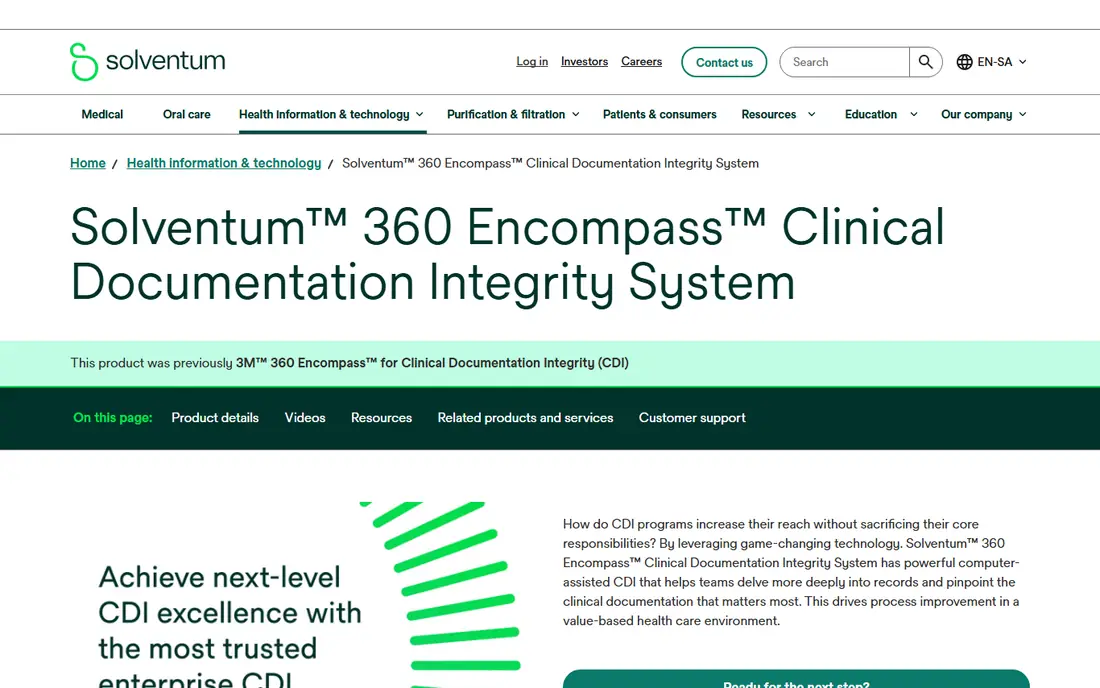
Solventum 360 Encompass CDI was formerly 3M 360 Encompass, after 3M Health Information Systems became Solventum. Its prioritization engine reads unstructured notes and ranks cases by focus DRGs, length of stay, severity of illness, risk of mortality, and patient population. It flags documentation that shows clinical indicators without a matching diagnosis, and it surfaces quality indicators in real time. It suits large hospitals that can staff a full CDI program and want one vendor across coding and audit.
What we like- CDI, coding, and audit tools in one workspace
- Worklist prioritization with stated clinical logic
- Quality flag detection for readmissions
Watch out for- A large enterprise platform with a long implementation and heavy training needs, and smaller hospitals may find the combined suite more than they need
#2
Waystar CDI
Best for: Hospitals that want AI-prioritized CDI queries with fast physician response times
Visit chartwisemed.com
Starting pricequote (pricing is not published on the vendor site; checked 11 Nov 2026)
Free planNo free plan
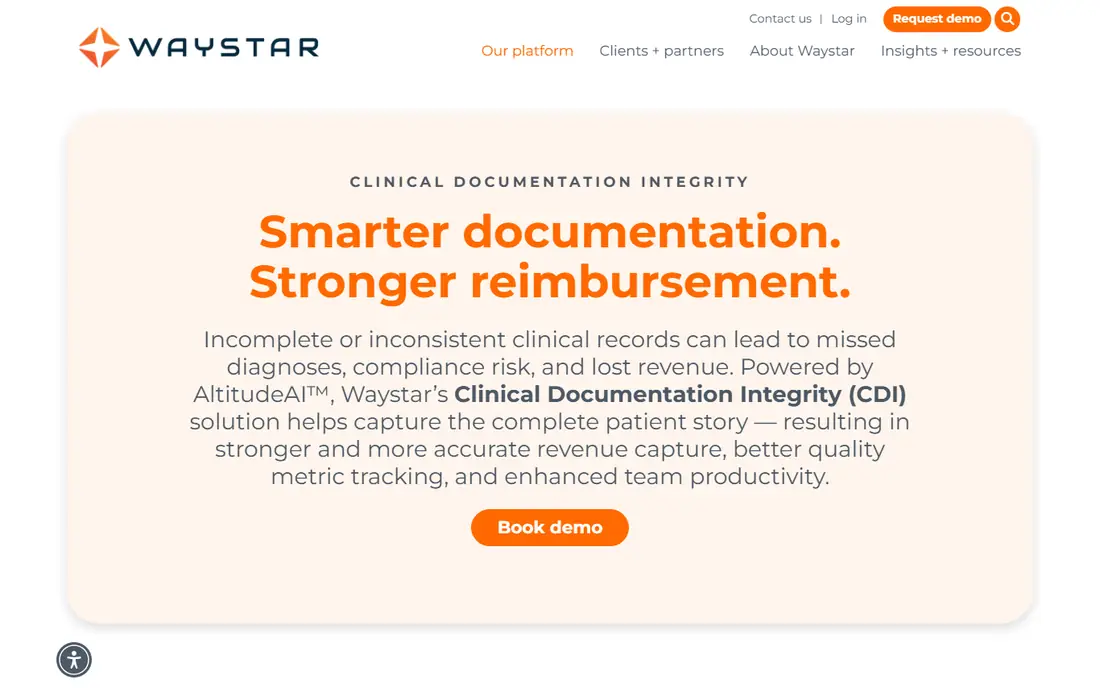
Waystar CDI is the current home of two older CDI names, Iodine Software and ChartWise, both of which now sit inside Waystar. The ChartWise site now opens the Waystar CDI page, and the Iodine Software site redirects to the Waystar home page. AltitudeAI focuses CDI specialists on cases with documentation gaps and adds specificity before billing. Waystar reports a 98 percent physician response rate, query responses in under 24 hours, and 2 million dollars of incremental revenue per 10,000 admissions, based on its own customer studies.
What we like- Strong query response results reported by the vendor
- EHR integration without workflow disruption
- CDI sits inside a broad revenue cycle platform
Watch out for- CDI is sold as part of a broad revenue cycle platform, so buyers who want a standalone CDI tool may face bundling pressure, and pricing requires a sales conversation
#3
Nuance CDI (Microsoft Dragon Copilot)
Best for: Physician documentation at the point of care through voice and ambient capture
Visit nuance.com
Starting pricequote for the CDI suite (pricing is not published on the vendor site; checked 11 Nov 2026)
Free planNo free plan
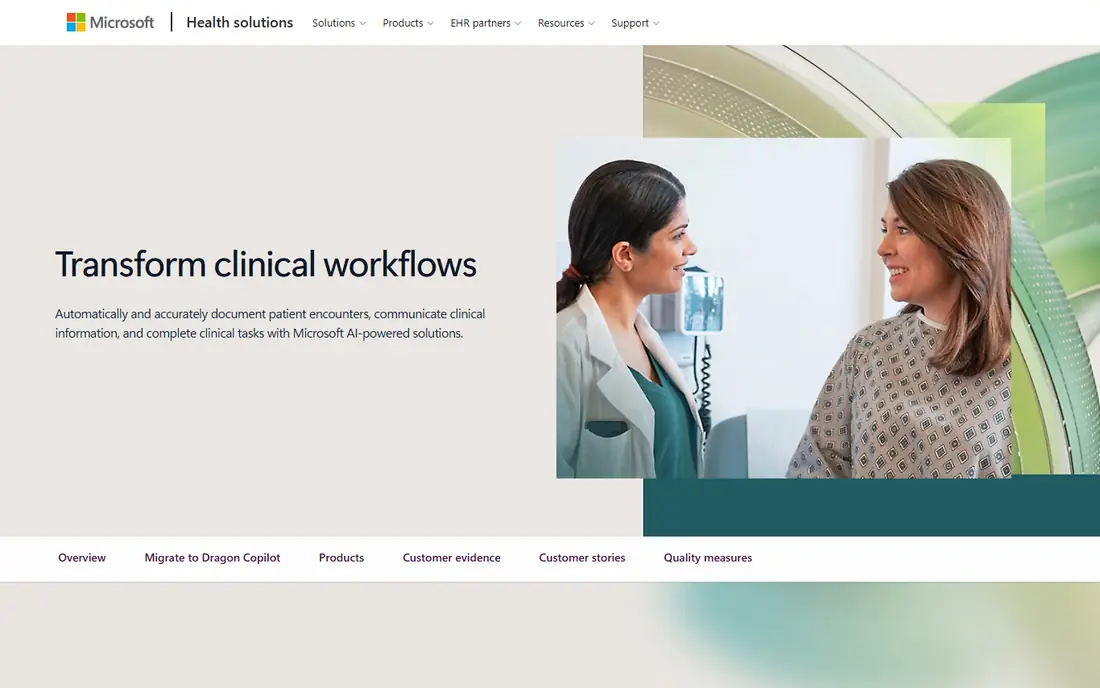
Nuance, now a Microsoft company, approaches CDI from the physician side rather than the CDI specialist side. Dragon Medical Advisor gives real-time feedback while physicians document, flagging vague or incomplete notes before they reach the CDI queue. Dragon Copilot combines Dragon Medical One dictation with generative AI to draft notes from the encounter. Nuance reports that clinicians using its ambient tools save about five minutes per encounter on average, based on a 2024 survey of 879 clinicians. Third-party listings report Dragon Medical One starting at 99 dollars per user per month, but that figure is unverified on the vendor page and covers dictation, not the full CDI suite.
What we like- Ambient and voice capture reduces typing and after-hours charting
- Integrates with more than 200 EHR systems
- Microsoft Azure hosting with HIPAA controls
Watch out for- CDI value depends on physician adoption of voice and ambient capture, and the product line has changed names several times, which complicates long-term planning
#4
Dolbey Fusion CDI
Best for: Mid-size to large hospitals that want CDI, coding, and auditing on one engine
Visit dolbey.com
Starting pricequote (pricing is not published on the vendor site; checked 11 Nov 2026)
Free planNo free plan
Dolbey Fusion CDI sits inside Fusion CAC, a single platform that joins computer-assisted coding, CDI, quality review, and auditing. Its CDI Alerts feature uses AI and machine learning to spot potential documentation gaps before a CDI specialist reviews the chart, then ranks the worklist so specialists start with high-impact cases. Evidence markers sit in the chart, which speeds up query creation and supports each question. Coding, CDI, and auditing teams work on the same encounter at the same time in separate workspaces, with a shared provider query module.
What we like- CDI Alerts flag gaps before a specialist opens the chart
- Coding, CDI, and auditing share one workspace
- Named Best in KLAS for computer-assisted coding since 2017
Watch out for- The interface and reporting feel dated next to newer cloud-first rivals, and autonomous coding gains vary by chart type
#5
Streamline Health eValuator
Best for: Pre-bill coding review and denial prevention before claims go out
Visit streamlinehealth.net
Starting pricequote (pricing is not published on the vendor site; checked 11 Nov 2026)
Free planNo free plan
Streamline Health eValuator is a pre-bill coding analysis tool that reviews every coded encounter before the claim is released. Its AI rules engine checks codes, charges, and DRG assignment, then routes flagged encounters to coding or CDI staff with a confidence rating and an estimated financial impact. Streamline Health was acquired by MDaudit, and eValuator now sits inside the MDaudit Platform as a pre-bill module. The vendor reports eValuator clients captured a combined 243.9 million dollars of measurable financial impact in 2025, and one customer validated 31 million dollars of added cash impact.
What we like- Reviews 100 percent of encounters before billing instead of a sample
- Encounter-level financial impact estimates
- Cloud based with no IT burden
Watch out for- Its pre-bill focus means it catches problems late in the workflow rather than at the point of documentation, and it works best paired with a separate CDI query tool
#6
AGS Health Computer-Assisted CDI
Best for: Large health systems scaling CDI across high patient volumes
Visit agshealth.com
Starting pricequote (pricing is not published on the vendor site; checked 11 Nov 2026)
Free planNo free plan
AGS Health Computer-Assisted CDI is a module of the AGS AI Platform that analyzes digital patient charts with AI, natural language processing, and machine learning, then suggests queries where documentation is missing or unclear. Charts are prioritized by suggested queries, and real-time EHR synchronization lets CDI teams work alongside physicians in the record. The library of over 100 query templates speeds up query creation, and charts with open queries can be held from coding so nothing is missed. AGS Health reports a 3 to 7 percent case mix index increase and a 30 to 50 percent denial reduction, based on its own customer results.
What we like- Intelligent worklists prioritize charts by query potential
- Over 100 query templates
- Built-in encoder and DRG grouper
- Real-time quality alerts for HACs, PSIs, and readmissions
Watch out for- Limited public user reviews make independent comparison hard, and implementation can take several weeks
#7
Optum Enterprise CAC and CDI 3D
Best for: Health systems already using Optum revenue cycle products
Visit business.optum.com
Starting pricequote (pricing is not published on the vendor site; checked 11 Nov 2026)
Free planNo free plan
Optum Enterprise CAC and CDI 3D runs on Optum Clinical Language Intelligence, which reads medical records and suggests complete and accurate codes. The CDI 3D module automates case finding, flags records with documentation gaps, and prioritizes CDI work by impact, with flexible work queue settings. A separate module identifies cases at risk for denial so hospitals can target pre-bill audits. The platform also includes LYNX outpatient infusion charging, a medical reference engine, and Power BI dashboards. Note that the vendor page shows a 0 dollar figure in its structured product data, which is a placeholder and not a real price.
What we like- 100 percent concurrent automated record review
- Denial-risk module targets pre-bill audits
- Single platform for coding and CDI
Watch out for- The suite is built for large Optum customers, so standalone CDI buyers may pay for modules they do not use, and there is no public pricing
#8
IMO Health Core
Best for: Improving diagnosis specificity and problem lists inside the EHR
Visit imohealth.com
Starting pricequote (pricing is not published on the vendor site; checked 11 Nov 2026)
Free planNo free plan
IMO Health Core, formerly Intelligent Medical Objects, works inside the EHR to make physician documentation more specific at the point of care. Its terminology covers clinical terms, synonyms, and local wording, mapped to ICD-10-CM, SNOMED CT, and CMS HCC, with updates five times a year. Pre-bill prompts flag errors such as non-primary problems in the primary position, unspecified laterality, and Excludes1 violations, and the tool flags unaddressed hierarchical condition categories that affect risk scores. IMO Health reports a 33 percent improvement in visit diagnosis specificity and a 68 percent reduction in denied claims through in-workflow prompts.
What we like- Terminology mapped to ICD-10-CM, SNOMED CT, and HCC code sets
- Pre-bill prompts catch unspecified and non-primary codes
- Problem list cleanup with medication and lab context
Watch out for- It improves terminology and specificity but is not a full CDI query management system, so teams still need separate query tracking
Frequently asked questions
What does clinical documentation improvement software do?
Clinical documentation improvement software reads patient charts, finds gaps between the clinical evidence and the written record, and turns those gaps into queries for the physician. It ranks charts by impact, tracks query responses, and helps coders assign codes that match the care given. The goal is a complete record that supports correct reimbursement, accurate quality scores, and fewer denied claims.
How much does clinical documentation improvement software cost?
Enterprise CDI software is quote-only, with no public price list from any vendor in this guide. Price is normally set by bed count, annual discharges, user count, and modules licensed, with an annual subscription plus first-year implementation and interface fees. Ask each vendor for the full first-year cost in writing.
Does clinical documentation improvement software integrate with Epic and Oracle Health?
Most enterprise CDI tools integrate with Epic, Oracle Health, and MEDITECH through HL7 interfaces, APIs, or EHR workflows. Real-time feeds matter, because overnight batches delay queries and let charts reach coding first. Confirm which EHR versions are supported, who builds the interface, and whether query answers flow back into the EHR.
How long does it take to implement clinical documentation improvement software?
Implementation usually takes several weeks to a few months, depending on EHR interface work, query template setup, and team training. Large platforms such as Solventum 360 Encompass and Optum CDI 3D take longer because they cover coding and auditing as well. Ask for a dated implementation plan and the go-live support included in the price.
Can clinical documentation improvement software reduce claim denials?
Yes, when the query loop is fast and physicians answer before billing. CDI software cuts denials by making sure the record supports the diagnosis, severity level, and procedure on the claim. AGS Health reports a 30 to 50 percent denial reduction and IMO Health reports a 68 percent reduction in denied claims, based on vendor customer data. Track denial rate by reason before and after go-live.
Sources we checked (8)
- https://www.solventum.com/en-sa/home/health-information-technology/solutions/360-encompass-cdi/
- https://www.chartwisemed.com/
- https://www.nuance.com/healthcare/provider-solutions.html
- https://www.dolbey.com/solutions/coding/fusion-cdi/
- https://streamlinehealth.net/evaluator/
- https://www.agshealth.com/ai-platform/computer-assisted-cdi/
- https://business.optum.com/en/operations-technology/revenue-cycle-management/medical-coding/enterprise-cac-cdi.html
- https://www.imohealth.com/imo-core/
Is your product missing or out of date?
We review this list regularly. Vendors can request a listing, send updated pricing or ask about featured placement.

Shihab Mia · Founder, Rankite
Shihab has 5+ years in B2B and SaaS SEO. He writes Rankite's software buying guides from pricing pages, documentation and public user reviews. More about Shihab.