How we make this list: we compare pricing pages, product documentation and public user reviews. Ratings come from G2, Capterra or Trustpilot, with the date we checked them.
Key takeaways
- Gremlin is the strongest all-round managed platform, but its price is quote only and third-party figures conflict.
- AWS Fault Injection Service and Azure Chaos Studio both charge $0.10 per action-minute.
- Chaos Mesh, LitmusChaos and Chaos Toolkit are free and open source under the Apache 2.0 licence.
- Harness Chaos Engineering is the commercial product built on LitmusChaos.
- Steadybit is the most visual paid option, but it does not publish a price on its own site.
What is chaos engineering software?
Chaos engineering software injects faults into a running system on purpose, then measures whether the system recovers the way it should. Typical faults include killing pods or instances, adding network latency, filling disks, stopping services, and simulating a failed availability zone. A good tool lets you define a steady state hypothesis first, run the fault inside a blast radius you control, watch metrics during the run, and roll back automatically if the system crosses a safety limit. Without that structure, fault injection is just breaking things. The main split is between managed platforms such as Gremlin and Steadybit, cloud services such as AWS Fault Injection Service and Azure Chaos Studio, and open source Kubernetes tools such as Chaos Mesh and LitmusChaos.
How much does chaos engineering software cost?
Chaos engineering software costs anything from nothing to several thousand dollars a month. Open source tools cost nothing in licence fees. Chaos Mesh, LitmusChaos and Chaos Toolkit are free under the Apache 2.0 licence, and you pay only for the infrastructure they run on and the engineering time to operate them. Cloud services charge by the minute. AWS Fault Injection Service and Azure Chaos Studio both charge $0.10 per action-minute on their vendor pricing pages, checked 20 November 2026, plus $0.10 per additional account for AWS FIS, and $5 per experiment report for AWS FIS. A ten minute experiment with five parallel actions costs about $5 on either service. Managed platforms charge a subscription or a custom quote. Gremlin and Harness do not publish a price, while third-party listings report Steadybit at $1,250 per month per team.
If your workloads run mainly on Kubernetes, start with Chaos Mesh or LitmusChaos. Both are CNCF incubating projects, both define faults as Kubernetes custom resources, and both are free and open source. Chaos Mesh is the simpler choice when you want a broad fault library, scheduled experiments and a dashboard, and you are comfortable operating a controller inside your cluster. LitmusChaos is the stronger choice when you want a visual experiment builder, a public library of ready-made faults called ChaosHub, resilience probes, and scoring for each experiment. Harness Chaos Engineering is the commercial version of LitmusChaos, so it makes sense when you already use Harness and want support and a managed control plane. Gremlin also works on Kubernetes, but it fits better when you need one tool for Kubernetes plus virtual machines and serverless.
How do you run chaos experiments safely in production?
Safe chaos experiments start small and grow only when the evidence supports it. Begin in staging, pick one service that is not customer facing, and define the steady state you expect, such as error rate below a set threshold and response time within a set budget. Set a blast radius limit, a time limit, and an automatic abort condition tied to real metrics, then run the smallest fault that can prove or disprove your hypothesis. Tell the on-call team the experiment is running, and keep the run short enough that a rollback is fast. Review the results, fix the weakness, and repeat the experiment to confirm the fix. Only then move to production, with faults that already passed in staging. Never run an experiment during a product launch, a traffic peak, or an active incident.
Quick comparison
| Tool | Best for | Starting price | Free plan |
|---|
 Gremlin | Platform and SRE teams needing one managed chaos platform for mixed infrastructure | Quote, no published price, third-party figures conflict, from about $1,000 to $3,750 per month | 30-day free trial, no credit card required, never auto-converts |
 Chaos Mesh | Kubernetes teams that want a free, open source chaos platform with a broad fault library | Free, open source under the Apache 2.0 licence, with no paid hosted edition | Free, the full open source version with no feature paywall |
 LitmusChaos | Kubernetes teams that want a free open source platform with a visual builder, a fault library and resilience scoring | Free, open source under the Apache 2.0 licence, commercial support through Harness by quote | Free, the full open source version with no feature paywall |
 Steadybit | SRE and DevOps teams that want a visual, beginner friendly chaos platform with automated vulnerability discovery | Quote, no price on the vendor site, while third-party listings report $1,250 per month per team | A free plan limited to 1 team is reported by third parties, with no current terms published |
 Harness Chaos Engineering | Teams already using Harness that want chaos engineering with governance, policy controls and a managed control plane | Quote, the Free plan is $0 and includes Litmus Chaos, while paid plans are contact sales | Free plan, $0, includes Litmus Chaos, with community support and 2,000 cloud credits per month |
 AWS Fault Injection Service | AWS teams that want pay-as-you-go fault injection with no subscription and no platform to operate | $0.10 per action-minute, checked 20 November 2026, plus $0.12 in GovCloud and $5 per report | No free plan, and no upfront costs or minimum fees |
 Azure Chaos Studio | Azure teams that want pay-as-you-go chaos experiments inside their existing Azure subscription | $0.10 per action-minute, checked 20 November 2026, pay as you go with no subscription | No free plan, and you pay only while actions run, so idle experiments cost nothing |
 Chaos Toolkit | Developers who want chaos experiments defined as code, stored in version control and run from the command line or CI | Free, open source under the Apache 2.0 licence, with no paid edition | Free, the full open source toolkit with no feature paywall |
Is your product missing or out of date?
We review this list regularly. Vendors can request a listing, send updated pricing or ask about featured placement.
#1
Gremlin
Best for: Platform and SRE teams needing one managed chaos platform for mixed infrastructure
Visit gremlin.com
Starting priceQuote, no published price, third-party figures conflict, from about $1,000 to $3,750 per month
Free plan30-day free trial, no credit card required, never auto-converts
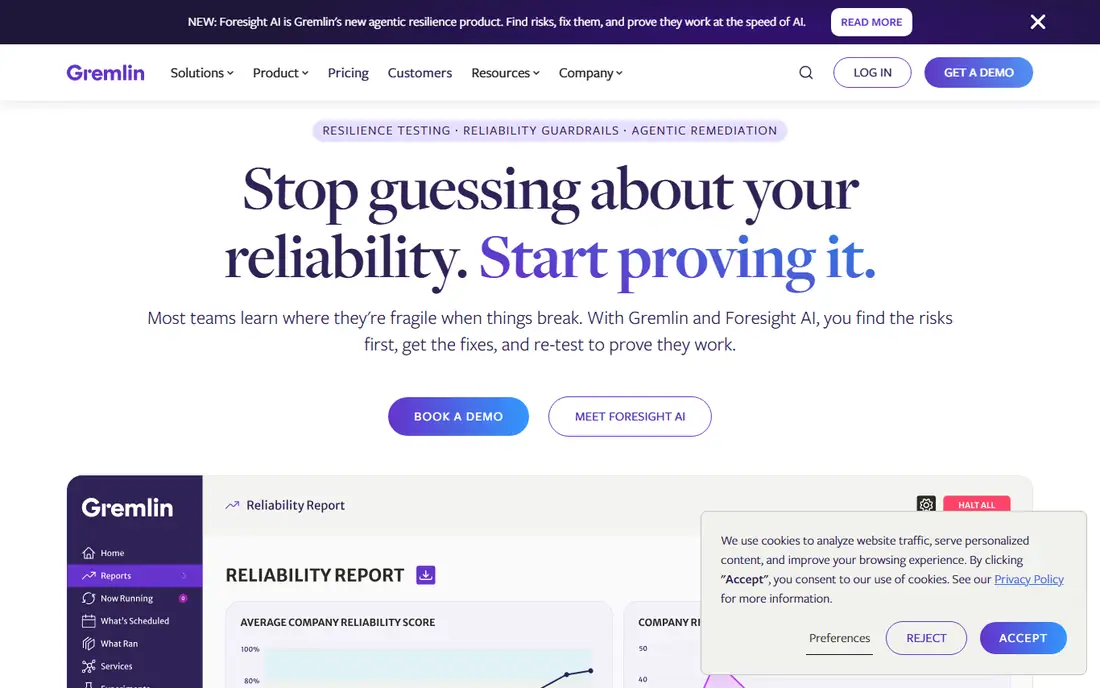
Gremlin is the commercial pioneer in this market, launched in 2016, and it is the most complete managed option for teams that run mixed infrastructure. You define services, run fault injection against them, and get a reliability score for each service. The fault library covers shutting down instances, killing processes, adding latency, filling disks and simulating failed dependencies. Foresight AI, a newer add-on priced per team, analyses results and suggests fixes. Treat any third-party price as unreliable and get a written quote.
What we like- Broadest coverage across mixed infrastructure, plus safety checks, guardrails and reliability scoring
Watch out for- Quote-only pricing needs a sales conversation, and an agent must be installed on every target
#2
Chaos Mesh
Best for: Kubernetes teams that want a free, open source chaos platform with a broad fault library
Visit chaos-mesh.org
Starting priceFree, open source under the Apache 2.0 licence, with no paid hosted edition
Free planFree, the full open source version with no feature paywall
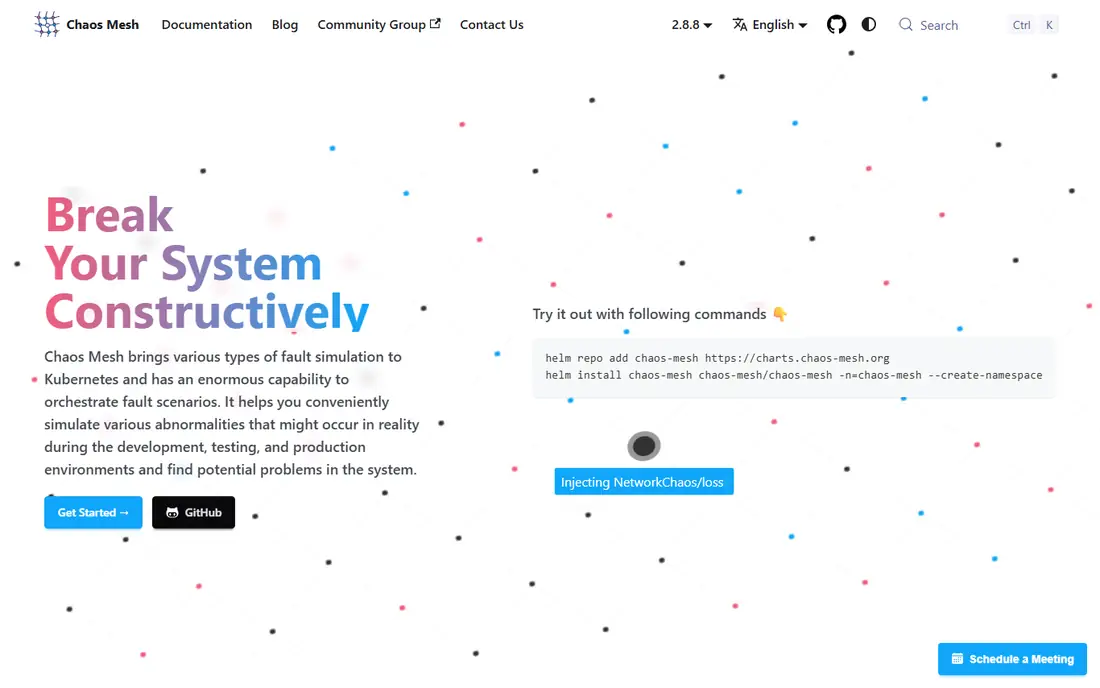
Chaos Mesh started at PingCAP as a test platform for the TiDB database, joined the CNCF in July 2020, and moved to incubating level in February 2022. It orchestrates faults across Kubernetes environments through a controller and a dashboard. You can schedule experiments, chain them into workflows with status checks, and verify the system recovered. Faults cover pod kills, network latency, disk pressure, time skew, DNS faults and JVM faults. There is no paid edition, so the question is whether your team has the capacity to run, upgrade and secure the platform yourself.
What we like- Free and open source, with faults defined as Kubernetes custom resources, so experiments live in version control
Watch out for- You operate the control plane yourself, with no vendor support contract
#3
LitmusChaos
Best for: Kubernetes teams that want a free open source platform with a visual builder, a fault library and resilience scoring
Visit litmuschaos.io
Starting priceFree, open source under the Apache 2.0 licence, commercial support through Harness by quote
Free planFree, the full open source version with no feature paywall
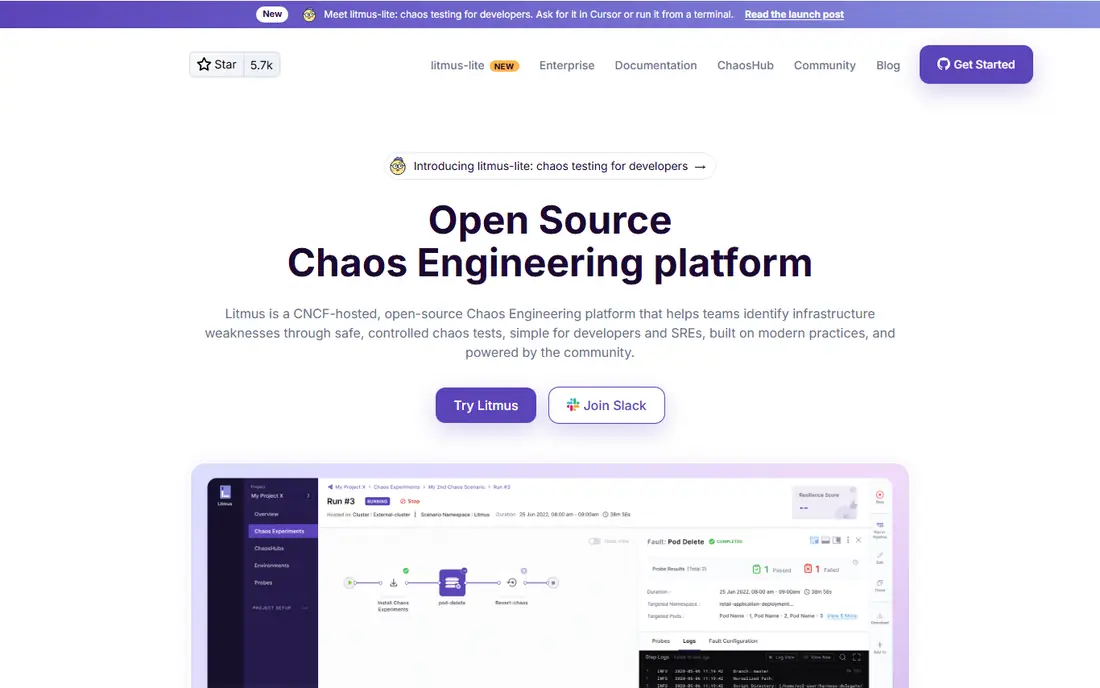
LitmusChaos began in 2017 at MayaData, joined the CNCF in 2020 and reached incubating level in January 2022. Harness acquired ChaosNative in March 2022, then donated the project to the CNCF, and now sells a commercial product built on Litmus. ChaosCenter is the control plane portal for building, scheduling and reviewing experiments, with agents and operators in each target cluster. ChaosHub supplies ready-made faults, and each run gets a resilience score based on its probes. It is the closest open source equivalent to a managed platform, and the cost is operational.
What we like- Visual builder in ChaosCenter, a public ChaosHub fault library, and resilience probes
Watch out for- ChaosCenter needs its own database plus agents in each cluster, and host-level OS faults are not included
#4
Steadybit
Best for: SRE and DevOps teams that want a visual, beginner friendly chaos platform with automated vulnerability discovery
Visit steadybit.com
Starting priceQuote, no price on the vendor site, while third-party listings report $1,250 per month per team
Free planA free plan limited to 1 team is reported by third parties, with no current terms published
Steadybit is a friendly chaos engineering platform, and the experiment editor puts faults, targets and safety checks on one screen. The platform can automatically identify weaknesses and suggest simulations, which lowers the learning curve for teams that are new to chaos engineering. Paid plans add unlimited users, targets and agents, plus role-based access control. Third-party listings agree on $1,250 per month per team for the Professional plan, but the figures cite vendor pages from 2023, and Steadybit does not publish a current price on its own site. Treat $1,250 as a reported figure and ask Steadybit for a written quote.
What we like- Visual editor that is easy to learn, with automated discovery of weaknesses and guided simulations
Watch out for- No published price, so you cannot budget without a quote, and it does not replace an observability tool
#5
Harness Chaos Engineering
Best for: Teams already using Harness that want chaos engineering with governance, policy controls and a managed control plane
Visit harness.io
Starting priceQuote, the Free plan is $0 and includes Litmus Chaos, while paid plans are contact sales
Free planFree plan, $0, includes Litmus Chaos, with community support and 2,000 cloud credits per month
Harness Chaos Engineering is the commercial product Harness built after acquiring ChaosNative in March 2022, now part of the wider Harness Resilience Testing offering. It takes the LitmusChaos open source project and adds a managed control plane, policy-driven governance, and integrations with the rest of the Harness platform, including continuous delivery and feature flags. That integration is the main reason to choose it. A team that already deploys through Harness can run chaos experiments in the same place, with the same identity and policy controls. Third-party data puts the median Harness buyer at about $48,350 per year for the whole platform, not the chaos module alone.
What we like- Built on LitmusChaos, with a mature fault library, ChaosCenter and policy-driven governance
Watch out for- Paid pricing is entirely sales negotiated, with no published figure for the chaos module
#6
AWS Fault Injection Service
Best for: AWS teams that want pay-as-you-go fault injection with no subscription and no platform to operate
Visit aws.amazon.com
Starting price$0.10 per action-minute, checked 20 November 2026, plus $0.12 in GovCloud and $5 per report
Free planNo free plan, and no upfront costs or minimum fees
AWS Fault Injection Service, known as AWS FIS, launched in March 2021 as part of AWS Resilience Hub. You define an experiment template, and AWS runs the faults, with stop conditions tied to CloudWatch alarms. Charges are based on action duration and account count, at $0.10 per action-minute plus $0.10 for each extra account. The charge is the same regardless of action type or affected resources. A five minute experiment with ten parallel actions costs about $5, which makes AWS FIS the cheapest way to start. One third-party comparison claims a free tier of 50 action-minutes per month, but the AWS pricing page lists none, so do not count on it.
What we like- True pay-as-you-go pricing with no subscription, fully managed, with deep IAM and CloudWatch integration
Watch out for- Only works inside AWS, and the fault catalogue is narrower than Gremlin
#7
Azure Chaos Studio
Best for: Azure teams that want pay-as-you-go chaos experiments inside their existing Azure subscription
Visit azure.microsoft.com
Starting price$0.10 per action-minute, checked 20 November 2026, pay as you go with no subscription
Free planNo free plan, and you pay only while actions run, so idle experiments cost nothing
Azure Chaos Studio is Microsoft's fully managed chaos engineering platform. You build experiments from a fault library, target Azure resources directly or install an agent on virtual machines, and run them with safety controls. Running an experiment can also trigger charges in other Azure services, for example if a fault causes auto scaling to add resources, so the experiment bill and the infrastructure bill are separate. The main limitation is scope. It is the natural choice inside an Azure estate, and a poor choice outside it. Older third-party comparisons still quote about $1.50 per experiment hour, but that does not match the current vendor pricing page, so use the vendor figure.
What we like- Same $0.10 rate as AWS FIS, fully managed inside Azure, with Azure Monitor integration
Watch out for- Only works inside Azure, and older $1.50 per hour figures are out of date
#8
Chaos Toolkit
Best for: Developers who want chaos experiments defined as code, stored in version control and run from the command line or CI
Visit chaostoolkit.org
Starting priceFree, open source under the Apache 2.0 licence, with no paid edition
Free planFree, the full open source toolkit with no feature paywall
Chaos Toolkit is the oldest style of tool on this list, and it is deliberately simple. It is a command line tool and an open API, built around experiment files written in JSON or YAML. Each file defines a steady state hypothesis, a method that injects faults, and a rollback step. Extensions add probes and actions for Kubernetes, AWS, Azure and Prometheus, and you install the ones you need with pip. Because experiments are plain files, they fit naturally into version control and CI pipelines. The trade-off is that it gives you the engine and not the platform, so there is no dashboard, no scheduler and no resilience score unless you build them.
What we like- Free and open source with a simple JSON or YAML format, and many free extensions
Watch out for- No web interface or managed control plane, so you build scheduling, reporting and guardrails yourself
Chaos engineering software compared
| Tool |
Starting price |
Free plan |
Best for |
| Gremlin |
Quote |
30-day trial |
Managed platform, mixed infrastructure |
| Chaos Mesh |
Free, open source |
Free, full version |
Kubernetes, zero licence budget |
| LitmusChaos |
Free, open source |
Free, full version |
Kubernetes, visual builder |
| Steadybit |
Quote (third-party listings report $1,250 per month per team) |
Free plan reported, 1 team |
Visual, beginner friendly |
| Harness Chaos Engineering |
Quote (Free plan $0) |
Free plan, $0 |
Harness users, governed testing |
| AWS Fault Injection Service |
$0.10 per action-minute |
No free plan |
AWS-only, pay-as-you-go |
| Azure Chaos Studio |
$0.10 per action-minute |
No free plan |
Azure-only, pay-as-you-go |
| Chaos Toolkit |
Free, open source |
Free, full version |
Chaos tests as code |
Frequently asked questions
What is the best chaos engineering software for beginners?
Gremlin and Steadybit are the easiest starting points, because both offer a managed control plane, a visual way to build experiments, and safety guardrails. Gremlin covers more infrastructure types, while Steadybit is the more visual of the two. If your budget is zero, start with LitmusChaos instead, since its ChaosCenter interface is close to a commercial product and the software is free.
Is there a free chaos engineering tool?
Yes, three tools on this list are free and open source under the Apache 2.0 licence. Chaos Mesh, LitmusChaos and Chaos Toolkit cost nothing in licence fees, and you can run unlimited experiments on your own infrastructure. Harness also offers a free plan that includes Litmus Chaos. The real cost of a free tool is the engineering time to install, upgrade, secure and operate it.
How much does Gremlin cost?
Gremlin does not publish a price on its pricing page, so the honest answer is quote only. Its pricing page asks you to request a custom quote, with a 30-day trial that never auto-converts. Third-party listings conflict, reporting figures from about $1,000 to $3,750 per month, so no single third-party figure is reliable. Ask Gremlin for a written quote based on your services and targets.
Should I use AWS Fault Injection Service or Azure Chaos Studio?
Use the one that matches your cloud. AWS Fault Injection Service is the right choice if your workloads run on AWS, and Azure Chaos Studio is the right choice if they run on Azure. Both charge $0.10 per action-minute on their vendor pricing pages, so price does not separate them. Neither tool tests workloads outside its own cloud, so multi-cloud teams should look elsewhere.
Can chaos engineering tools break production?
Yes, if they are used without limits, which is why every tool on this list should be used with a small blast radius, a time limit, and an automatic abort tied to real metrics. Start in staging, prove the fault is safe there, and only then run it in production with the on-call team informed. Managed platforms add guardrails and approval flows, while open source tools expect you to build those controls yourself.
How we picked
We picked the eight tools that cover the main ways teams buy chaos engineering software in 2026: Gremlin and Steadybit as managed platforms, Harness Chaos Engineering as a LitmusChaos module, AWS FIS and Azure Chaos Studio as pay-as-you-go services, and Chaos Mesh, LitmusChaos and Chaos Toolkit as free open source projects. Prices were checked against vendor pricing pages and current third-party reads on 20 November 2026. Where a vendor publishes no price, we say quote only and label third-party figures as reported, not as vendor prices. Prices are search-verified; homepages were not individually opened, so confirm the price before you buy.
Last verified: 20 November 2026
Sources we checked (8)
- https://www.gremlin.com/pricing
- https://www.cncf.io/projects/chaosmesh/
- https://devops.com/harness-readies-resilience-testing-platform-to-make-applications-more-robust
- https://www.saasworthy.com/product/steadybit
- https://www.usagepricing.com/blueprint/harness
- https://aws.amazon.com/cn/fis/pricing/
- https://azure.microsoft.com/en-us/pricing/details/chaos-studio/
- https://pypi.org/project/chaostoolkit/1.0.0rc4/
Is your product missing or out of date?
We review this list regularly. Vendors can request a listing, send updated pricing or ask about featured placement.

Shihab Mia · Founder, Rankite
Shihab has 5+ years in B2B and SaaS SEO. He writes Rankite's software buying guides from pricing pages, documentation and public user reviews. More about Shihab.