How we make this list: we compare pricing pages, product documentation and public user reviews. Rankite is independent; if a vendor ever pays for a featured spot, that listing is clearly labeled Partner.
Key takeaways
- Enterprise platforms (Watershed, Persefoni, Sweep) price by quote and typically cost tens to hundreds of thousands per year; mid-market tools are far more accessible.
- Greenly is the most approachable serious option for small and midsize companies, with plans listed from about $1,950 per user per year, and it merged with Normative in September 2026.
- Persefoni offers a genuinely free tier, making it the best way to start measuring emissions at no cost.
- EU companies facing CSRD reporting should shortlist Plan A and the combined Greenly-Normative platform for European framework support.
- Almost nobody publishes pricing in this category, so treat any figure as a starting point and get written quotes before budgeting.
Quick comparison
| Tool | Best for | Starting price | Free plan |
|---|
 Watershed Watershed | Large enterprise climate programs | See website (quote-based) | No (demo) |
 Persefoni Persefoni | Audit-grade data, free entry tier | See website (free tier available) | Yes (limited) |
 Greenly Greenly | SMB to mid-market, fast setup | From $1,950 per user/year | Free trial |
 Sweep Sweep | Supplier-heavy Scope 3 programs | See website (quote-based) | No (demo) |
 Plan A Plan A | EU companies, CSRD reporting | See website (quote-based) | No (demo) |
 Normative Normative | Science-based targets (now Greenly) | See website (now part of Greenly) | No |
 Emitwise Emitwise | Supply chain carbon data | See website (quote-based) | No (demo) |
 IBM Envizi IBM Envizi | Large enterprise ESG analytics | See website (quote-based) | No (demo) |
 Sustain.Life Sustain.Life | Accessible mid-market ESG | See website | Free trial |
Is your product missing or out of date?
We review this list regularly. Vendors can request a listing, send updated pricing or ask about featured placement.
The best carbon accounting software
Carbon accounting used to be a spreadsheet exercise done once a year for a sustainability report nobody read. That era is over. Regulations like the EU Corporate Sustainability Reporting Directive now require detailed emissions disclosures, large customers demand carbon data from their suppliers, and investors ask about climate risk on earnings calls. Companies that cannot measure their footprint are starting to lose business over it.
The software market has split accordingly. At the top, enterprise platforms handle complex multi-entity footprints and audit-grade reporting for public companies. In the middle, a new generation of tools promises a credible carbon footprint in weeks rather than months. Choosing the best carbon accounting software means matching the platform to your regulatory exposure, your company size, and how much of your emissions sit in your supply chain rather than your own operations.
Pricing transparency is the worst of any category in this guide: almost no vendor publishes prices. Figures below come from vendor pages and published third-party research, and should be confirmed directly before budgeting.
Starting priceSee website (quote-based)
Free planNo (demo)
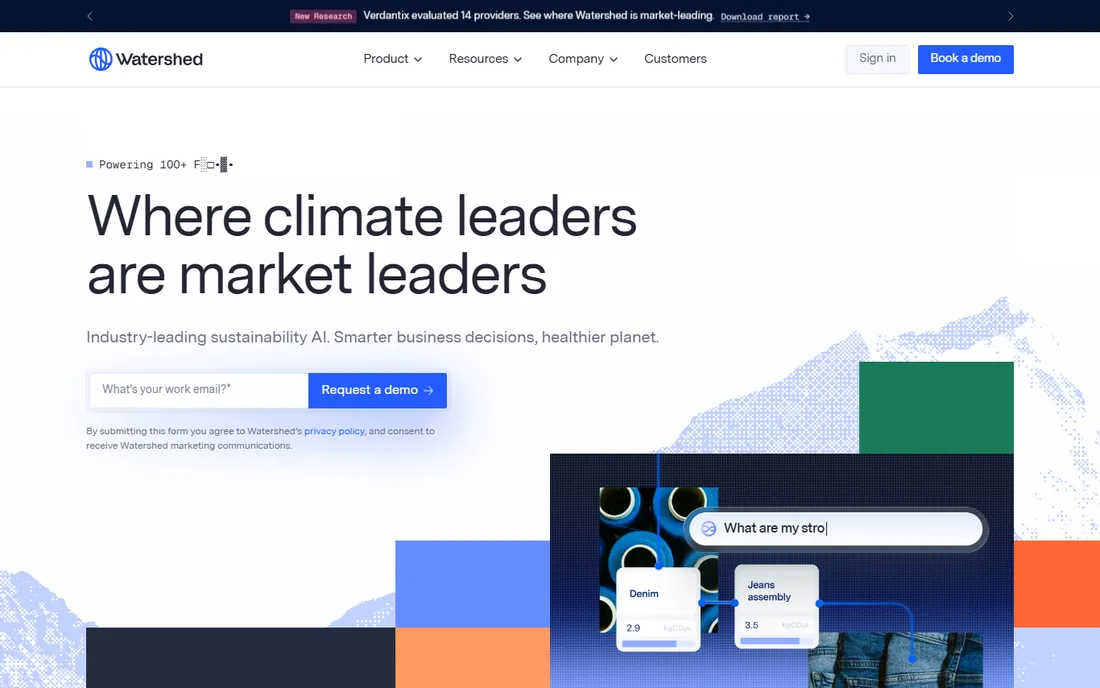
Watershed is the reference platform for large corporate climate programs, with customers including major retailers, logistics companies, and financial institutions. It ingests messy activity data (utility bills, travel records, procurement spend), cleans and maps it with AI assistance, and produces audit-ready footprints across Scopes 1, 2, and 3. The built-in marketplace for vetted carbon removal projects lets companies act on the numbers without a separate procurement process.
This is unambiguously enterprise software: third-party research puts typical deals in the tens to hundreds of thousands per year, and implementations involve real consulting effort. Smaller companies will find the sales process itself discouraging. But if you are a large company building a serious climate program with board-level visibility, Watershed is the platform most of your peers are evaluating.
What we like- Deep enterprise feature set with AI-assisted data cleanup
- Large emission factor database
- Carbon removal marketplace built in
Watch out for- Enterprise pricing far beyond small-company budgets
- Implementation is a major project
Starting priceSee website (free tier available)
Free planYes (limited)
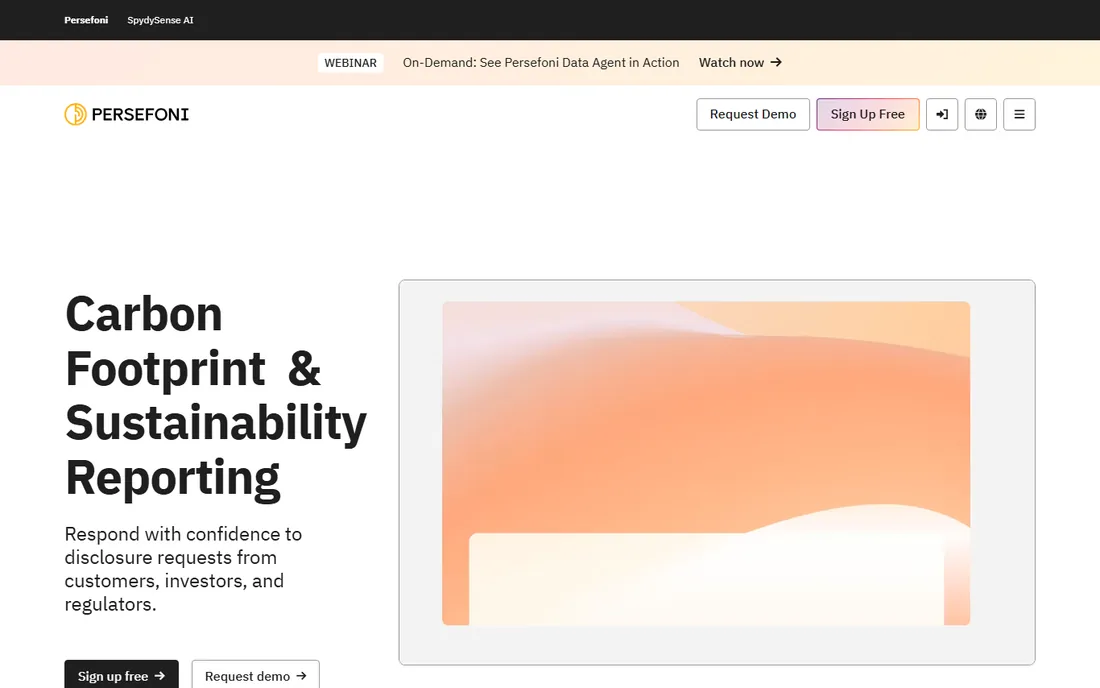
Persefoni stands out immediately for having a free tier in a category where free barely exists. The free PRO tier lets companies build a real carbon footprint without paying, which makes it the obvious starting point for anyone who wants to understand their emissions before committing budget. The paid ADVANCED tier adds deeper features plus a dedicated climate expert.
The platform emphasis is audit-grade data: every number carries a lineage from source to disclosure, which matters for financial institutions and regulated companies facing scrutiny. Reported enterprise pricing runs from roughly $55,000 to $250,000 per year, putting the full product firmly in enterprise territory. Start free, learn what you actually need, and only then talk to sales about the paid tier.
What we like- Free PRO tier lets you start measuring at no cost
- Strong audit trail and controls
- Popular with financial institutions
Watch out for- Full enterprise tier is quote-based and expensive
- Advanced features need the paid ADVANCED tier
Starting priceFrom $1,950 per user/year
Free planFree trial
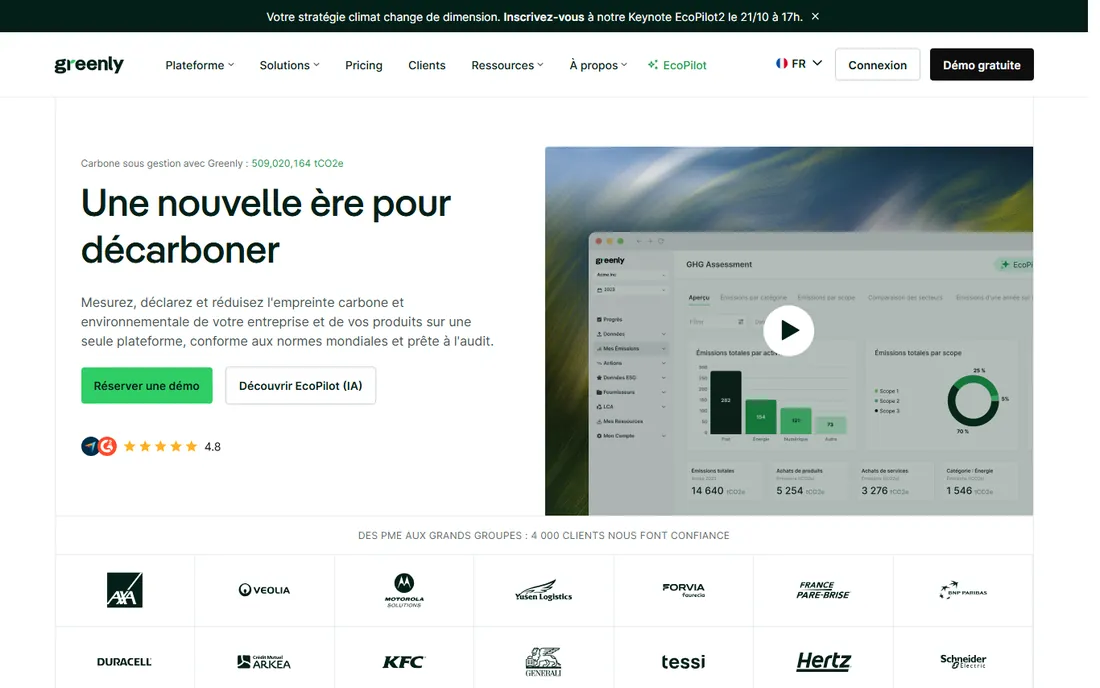
Greenly built its business on getting small and midsize companies to a credible carbon footprint quickly, and it remains the most accessible serious platform in this guide. Plans are listed from about $1,950 per user per year, the onboarding is guided by a real climate support team, and dashboards are clean enough to present directly to leadership.
The big 2026 news is the merger with Normative, announced in September, creating a combined company serving around 4,000 clients. Normative brought deep science-based target and FLAG (land sector) calculation expertise, which strengthens Greenly considerably for companies setting formal reduction targets. For a mid-market company doing its first serious footprint, especially in Europe, Greenly is now the default shortlist entry.
What we like- Designed for fast first footprints
- Dedicated climate support team
- Now combined with Normative science-based target expertise
Watch out for- Per-user pricing adds up for large teams
- Less suited to the most complex multi-entity enterprises
Starting priceSee website (quote-based)
Free planNo (demo)
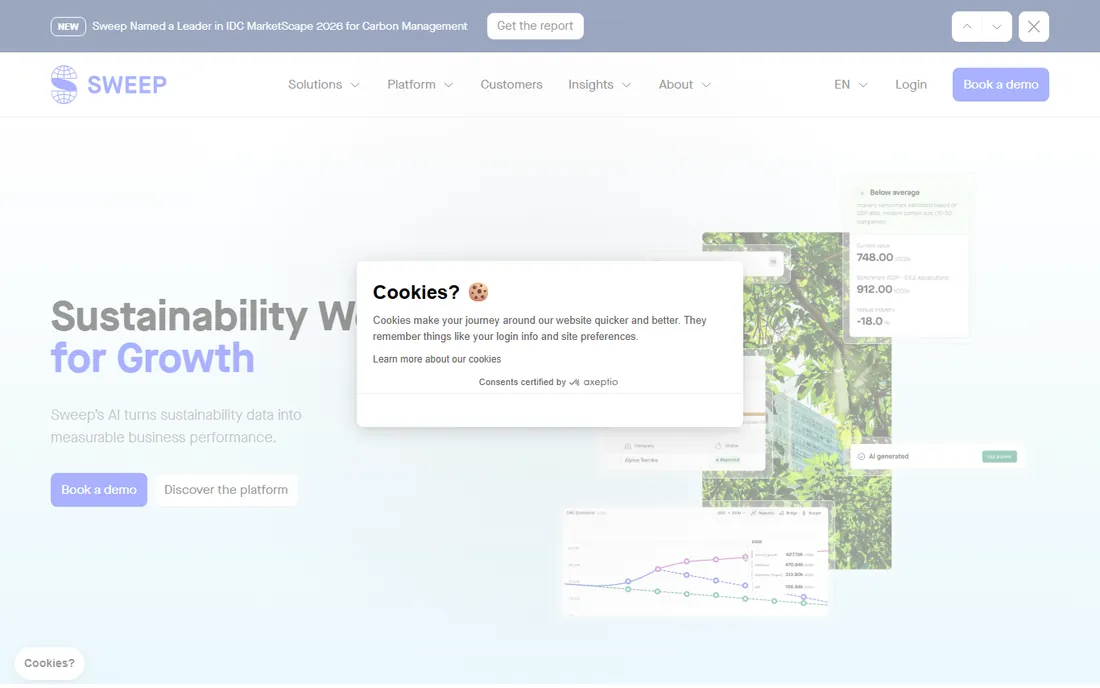
Sweep differentiator is reporting breadth: enter data once and satisfy CSRD, ISSB, GRI, SASB, CDP, and other frameworks from the same dataset. For companies facing multiple disclosure requirements, that consolidation alone justifies the platform. The supplier modules help companies collect emissions data across their value chain, which is where most corporate footprints actually live.
The company was named a leader in 2026 analyst evaluations of carbon management software, and its customer list skews toward large European enterprises and financial institutions. Pricing is quote-based, with a Starter package for smaller organizations. If your emissions are mostly Scope 3 and your reporting obligations span frameworks, Sweep deserves a demo.
What we like- Single-upload reporting across many frameworks (CSRD, GRI, CDP, and more)
- Strong supplier engagement modules
- Recognized by 2026 analyst reports
Watch out for- Quote-based enterprise pricing
- A lower-cost Starter package exists but details are thin
Starting priceSee website (quote-based)
Free planNo (demo)
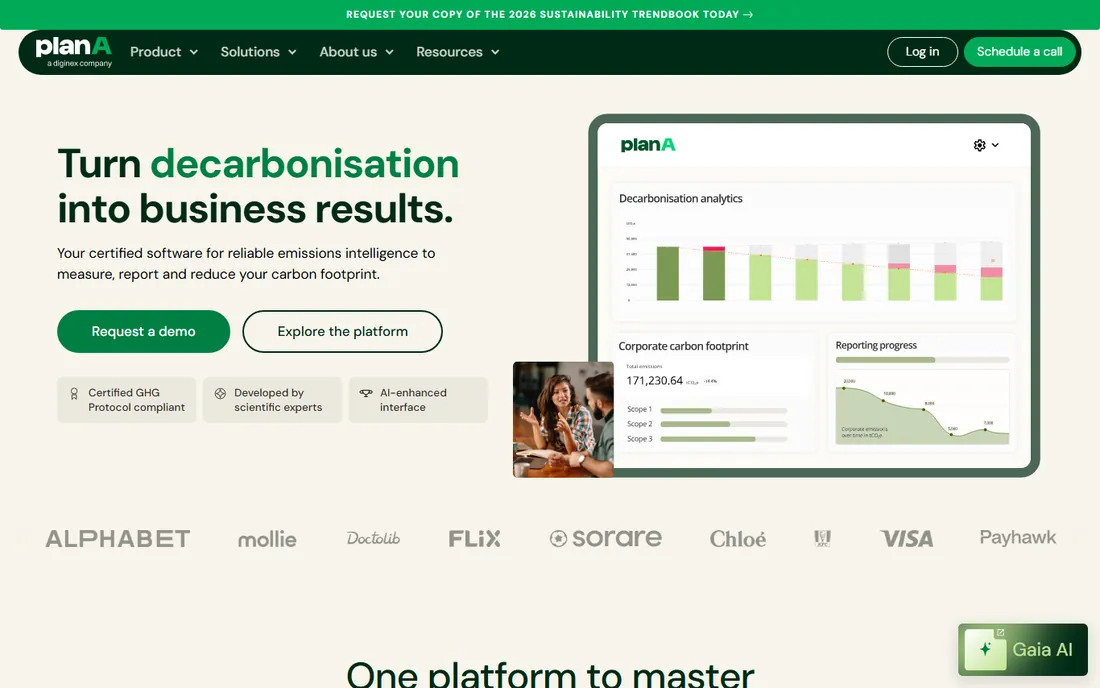
Plan A is a Berlin-born platform built for the European regulatory environment, which makes it a natural fit for companies navigating CSRD. It combines carbon accounting with broader ESG management, so the same platform handles emissions measurement, reduction planning, and disclosure preparation. The approach suits mid-market and larger European companies that need compliance-grade reporting without American enterprise pricing.
As with most of the category, pricing is quote-based and implementations involve onboarding support. US companies without European reporting obligations may find better-localized options elsewhere. But for EU-based firms that need CSRD-ready carbon management, Plan A local expertise is a genuine advantage over US-built competitors.
What we like- European regulatory expertise with CSRD focus
- Carbon plus broader ESG in one platform
- Strong mid-market to enterprise fit
Watch out for- Quote-based pricing
- Less presence outside Europe
Starting priceSee website (now part of Greenly)
Free planNo
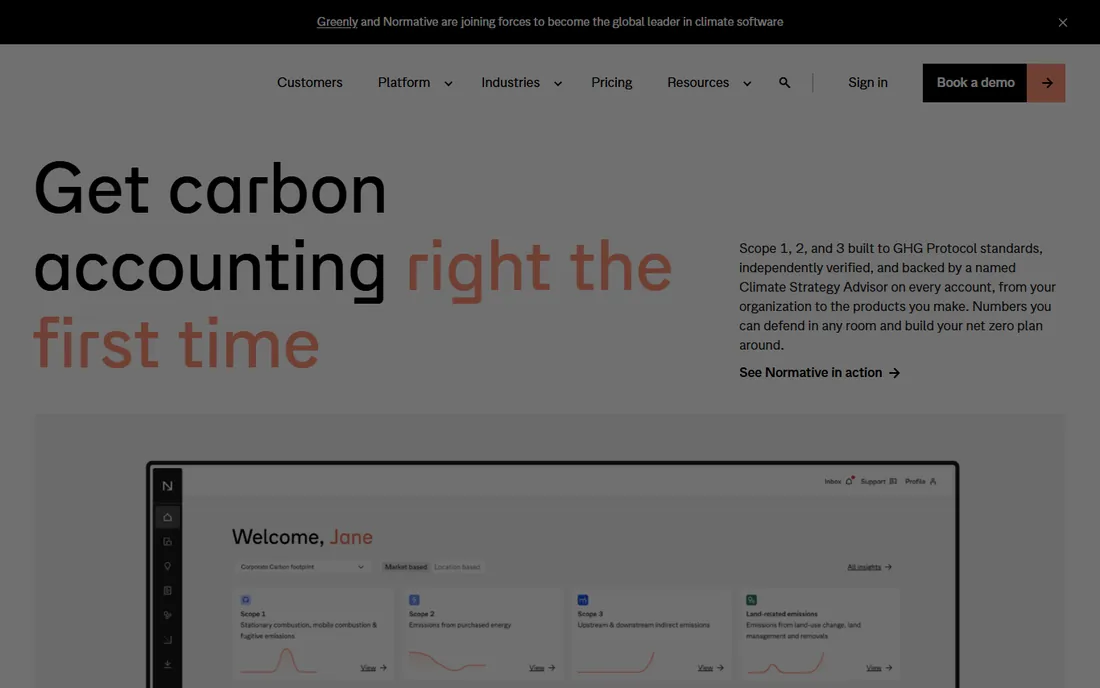
Normative earned its reputation on scientific rigor: its engine focused on accurate emission factors and science-based target setting, including automated FLAG calculations for land-intensive sectors. In September 2026, Normative merged with Greenly, and the combined company is integrating the two platforms.
For buyers, the practical advice is to evaluate the combined Greenly offering rather than Normative standalone, and to ask specifically which Normative features (FLAG automation, target-setting workflows) are live in the merged product today. The merger logic is sound: Greenly accessibility plus Normative rigor. Just confirm the integration timeline matches your reporting deadlines.
What we like- Deep expertise in science-based targets and emission factors
- Automated FLAG calculations
- Now backed by Greenly scale
Watch out for- Standalone product future unclear after the merger
- Evaluate through the combined Greenly offering
Starting priceSee website (quote-based)
Free planNo (demo)
Emitwise focuses on the hardest part of carbon accounting: getting emissions data out of your suppliers. Its platform automates supplier data collection, validates the numbers, and builds product-level carbon footprints from supply chain data. For manufacturers, retailers, and food companies whose footprint is overwhelmingly Scope 3, this specialization matters more than a generalist feature list.
The trade-off is breadth: Emitwise is not trying to be your CSRD reporting suite or your reduction-planning consultant. Pricing is quote-based and aimed at mid-market and enterprise buyers. If procurement owns your climate program and supplier engagement is the bottleneck, shortlist Emitwise. If you need full ESG reporting, pair it with or choose a broader platform.
What we like- Purpose-built for supplier carbon data collection
- Automates Scope 3 data gathering
- Strong for procurement-led programs
Watch out for- Quote-based pricing
- Narrower than full ESG platforms
#8
IBM Envizi
Best for: Large enterprise ESG analytics
Visit ibm.com
Starting priceSee website (quote-based)
Free planNo (demo)
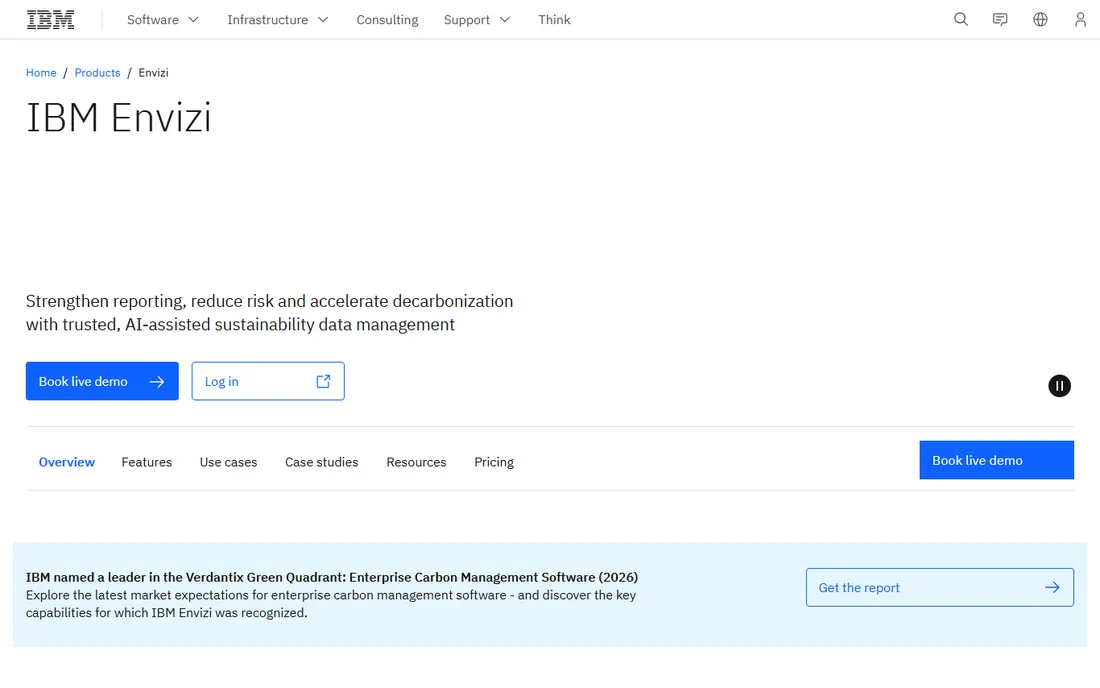
IBM Envizi (acquired by IBM) is the enterprise ESG data platform for organizations managing sustainability data at massive scale: hundreds of sites, dozens of indicators, multiple reporting frameworks. The analytics engine handles the complexity that breaks smaller tools, and IBM global services arm can implement it anywhere.
Everything about it is enterprise: quote-based pricing, multi-month implementations, and a feature set designed for sustainability teams of dozens. Companies below large-enterprise scale will find it heavy and expensive. But for global corporations that need one system of record for all ESG data with IBM standing behind it, Envizi is the institutional choice.
What we like- Enterprise-grade ESG data management
- Strong analytics across hundreds of indicators
- IBM enterprise support and services
Watch out for- Enterprise pricing and complexity
- Implementation is a major program
- Overkill below large-enterprise scale
Starting priceSee website
Free planFree trial
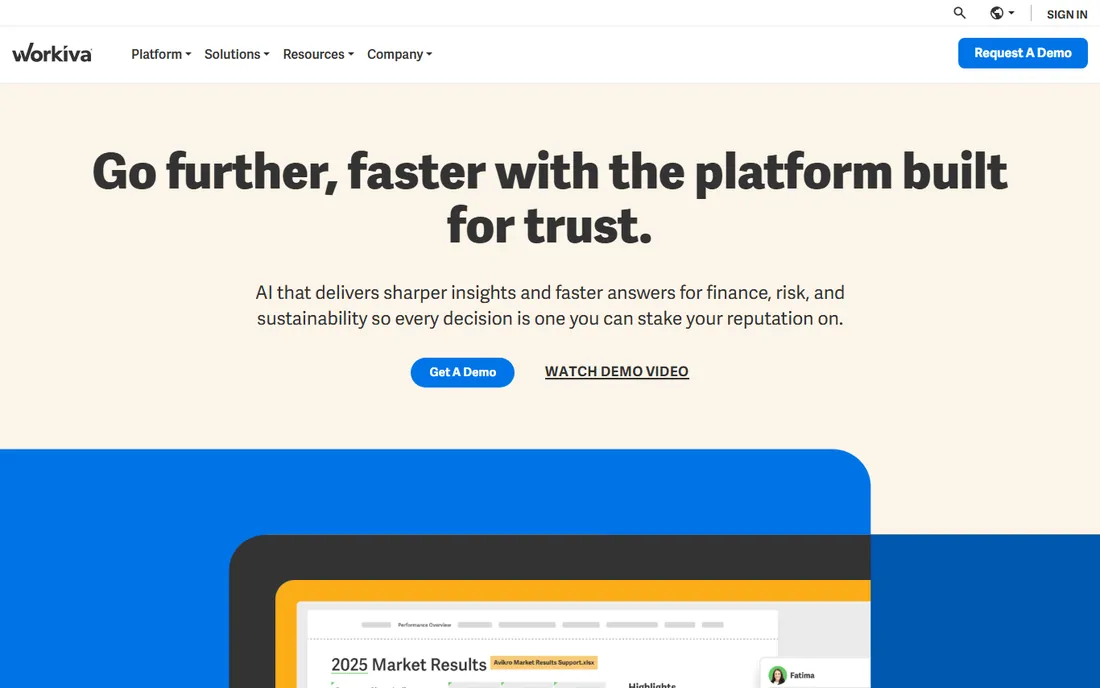
Sustain.Life positions itself as the accessible mid-market option: carbon accounting plus broader ESG management without enterprise pricing or enterprise sales cycles. A free trial lets teams evaluate the platform on real data, which is rare in this category.
The honest caveat is maturity: it lacks the depth of Watershed or Persefoni for complex footprints and the regulatory specialization of Plan A for CSRD. But for mid-market companies that need credible carbon and ESG management at a manageable price and pace, that trade-off is often correct. It is the pragmatic pick when the enterprise platforms are overkill and spreadsheets are no longer enough.
What we like- More accessible pricing than enterprise platforms
- Covers carbon plus broader ESG topics
- Free trial to evaluate
Watch out for- Less depth than enterprise specialists
- Smaller analyst and reviewer footprint
How this shortlist was assembled
We focused on platforms with real adoption in 2026, covering enterprise carbon management, mid-market tools, and SMB-accessible options, drawing on buyer guides, analyst evaluations (Verdantix, IDC), and sustainability community discussion. Pricing was checked against vendor pages and published third-party research from September 2026; because public price lists are essentially absent in this category, prices are marked "See website" wherever a figure could not be confirmed from a vendor page.
We weighted regulatory fit (especially CSRD), Scope 3 capabilities, and accessibility for smaller companies alongside raw feature depth. The Greenly-Normative merger was factored in as of its September 2026 announcement. No hands-on testing was performed; this is a research-based comparison.
What to check before you buy
Start with your reporting obligations, because they dictate the platform. A company facing CSRD needs different framework support than a US private company responding to customer questionnaires. List every disclosure you must or want to produce in the next two years, then verify each candidate supports them natively rather than through exports and manual work.
Next, assess your data reality. Carbon accounting platforms are only as good as the activity data you feed them: utility bills, travel records, procurement spend, supplier responses. Ask vendors exactly how data gets in, how much is automated, and what happens with gaps. A platform with brilliant analytics and no data is an expensive dashboard.
Finally, get the full commercial picture in writing: license basis (per user, per site, per entity), implementation and onboarding fees, the cost of adding entities as you grow, and renewal terms. In a quote-based category, the first quote is a starting negotiation position, not a price. Talk to at least three vendors and two reference customers before deciding.
Scopes 1, 2, and 3: what you are actually measuring
Carbon accounting organizes emissions into three scopes, and the distinction drives software choice. Scope 1 covers direct emissions from sources you own (company vehicles, on-site fuel). Scope 2 covers purchased energy (electricity, heating). Scope 3 covers everything else in your value chain: purchased goods, business travel, employee commuting, product use, and end-of-life.
For most companies, Scope 3 is 70 to 90 percent of the total footprint and nearly all of the measurement difficulty. That is why supplier-focused tools like Sweep and Emitwise exist, and why you should ask every vendor how specifically they handle Scope 3 data collection. A platform that only does Scopes 1 and 2 well is solving the easy tenth of your problem.
Frequently asked questions
What is carbon accounting software?
Carbon accounting software measures an organization greenhouse gas emissions across Scopes 1, 2, and 3, then supports reduction planning and regulatory reporting. It replaces spreadsheet-based footprint calculations with connected data, emission factor databases, and audit-ready disclosure outputs.
How much does carbon accounting software cost?
It ranges enormously. SMB tools start around $1,000 to $2,000 per year; mid-market platforms run from a few thousand to tens of thousands annually; enterprise platforms like Watershed and Persefoni typically cost tens to hundreds of thousands per year. Almost all enterprise pricing is quote-based.
What is the difference between carbon accounting and ESG software?
Carbon accounting focuses specifically on greenhouse gas measurement and reduction. ESG software covers the broader environmental, social, and governance agenda, including labor practices, board governance, and diverse disclosures. Many platforms now do both, but their depth varies by origin.
Do small businesses need carbon accounting software?
Increasingly, yes, if they sell to large enterprises or operate in regulated markets: supplier questionnaires and procurement requirements are pushing carbon disclosure down the supply chain. Persefoni free tier and affordable SMB tools make starting far cheaper than it used to be.
What is CSRD and does it affect my company?
The EU Corporate Sustainability Reporting Directive requires detailed sustainability disclosures from large companies operating in the EU, phased in from 2024 onward. Even non-EU companies can be affected through EU subsidiaries or as suppliers to reporting companies. If CSRD might touch you, choose a platform with native CSRD support.
Can carbon accounting software handle Scope 3 emissions?
The better platforms can, but Scope 3 remains the hardest part: it requires data from suppliers who may not measure their own emissions. Look for supplier engagement workflows, spend-based estimation methods for gaps, and clear audit trails. Ask vendors to demonstrate their Scope 3 process on a realistic example, not just describe it.
Sources we checked (6)
- https://kurums.com/carbon-accounting-software/
- https://www.capterra.ca/software/219931/greenly-climate-dashboard
- https://greenly.earth/en-us/blog/company-guide/the-5-best-carbon-accounting-softwares
- https://www.terrascope.com/blog/watershed-alternatives-for-food-supply-chains
- https://github.com/data-advantage/vibereference/blob/HEAD/content/devops-and-tools/carbon-accounting-esg-reporting-software.md
- https://www.hhc.earth/knowledge-base/articles/choosing-right-carbon-accounting-software-smes
Is your product missing or out of date?
We review this list regularly. Vendors can request a listing, send updated pricing or ask about featured placement.

Shihab Mia · Founder, Rankite
Shihab has spent more than a decade helping SaaS and e-commerce brands grow through search. He writes Rankite's software buying guides from pricing pages, documentation and public user reviews. More about Shihab.