How we make this list: we compare pricing pages, product documentation and public user reviews. Ratings come from G2, Capterra or Trustpilot, with the date we checked them.
Key takeaways
- Fidelity is the best overall beginner platform, with $0 stock and ETF commissions, fractional shares from $1, strong research, and retirement accounts.
- Charles Schwab is a close second, with $0 commissions, extensive education, and paper trading through thinkorswim for practice.
- Robinhood is the simplest first app, while Webull suits beginners who want charts, paper trading, and active-trading tools from the start.
- SoFi Invest and Public suit beginners who want automated investing or simple multi-asset accounts in one app.
- Commission-free does not mean cost-free: check options contract fees, spreads, account fees, and cash sweep terms before you fund an account.
Quick comparison
| Tool | Best for | Starting price | Free plan |
|---|
 Fidelity | Beginners who want one strong platform for investing and retirement | $0 commission | Yes |
 Charles Schwab | Beginners who want education and a practice account before risking money | $0 commission | Yes |
 Robinhood | Beginners who want the simplest mobile trading experience | $0 commission | Yes |
 Webull | Beginners who want advanced charts and paper trading for free | $0 commission | Yes |
 E*TRADE | Beginners who want balanced research, options tools, and Morgan Stanley insights | $0 commission | Yes |
 SoFi Invest | Beginners who want banking and investing in one app, with automated options | $0 commission | Yes |
 Public | Beginners who want simple multi-asset investing with recurring plans | $0 commission | Yes |
 Interactive Brokers | Beginners who plan to grow into global and advanced trading | $0 commission | Yes |
Is your product missing or out of date?
We review this list regularly. Vendors can request a listing, send updated pricing or ask about featured placement.
#1
Fidelity
Best for: Beginners who want one strong platform for investing and retirement
Visit fidelity.com
Starting price$0 commission
Free planYes
Fidelity is the safest default for a new investor, because it covers the whole journey in one place. You can open a brokerage account with no minimum, buy fractional shares from $1, and later add a Roth IRA, a traditional IRA, or a health savings account without switching firms. Research is genuinely strong, with analyst reports, screeners, and educational content that explain concepts rather than just listing tickers.
The breadth that makes Fidelity strong can also make it busy. A first-time user will see retirement planning, managed portfolios, and trading tools side by side, and it takes a week or two to learn where the basics live. That is a small price for a platform you are unlikely to outgrow. Start with Fidelity when you want a long-term home for both trading and retirement, not just a first app.
What we like- $0 commissions on US stocks and ETFs
- Fractional shares from $1
- Deep research and retirement accounts
Watch out for- App and website offer many features that can overwhelm at first
- Crypto access is separate
- Advanced trading tools are less central than at Schwab
#2Charles Schwab
Best for: Beginners who want education and a practice account before risking money1.5/5 on
Trustpilot (786 reviews, checked Oct 2026)
Visit schwab.com
Starting price$0 commission
Free planYes
Charles Schwab pairs a full-service brokerage with one of the best learning paths for beginners. Its education library covers investing basics, retirement planning, and market concepts in plain language, and thinkorswim paper trading lets you practice with real-time data before risking real money. That practice step matters: a beginner who learns order types in a paper account makes fewer costly mistakes in a live one.
The range of products can feel complex, since Schwab covers banking, retirement, managed portfolios, and active trading in one ecosystem. New users should start in the main Schwab app for simple investing and move to thinkorswim only when they want deeper charting. Schwab suits a beginner who wants to learn properly and grow into active trading over time.
What we like- $0 commissions on listed stocks and ETFs
- Extensive education library
- Thinkorswim paper trading with real-time data
Watch out for- Product range can feel complex at first
- Some advanced tools sit in thinkorswim, not the main app
- Branch and support experience varies
#3Robinhood
Best for: Beginners who want the simplest mobile trading experience3.9/5 on
Trustpilot (14,695 reviews, checked Oct 2026)
Visit robinhood.com
Starting price$0 commission
Free planYes
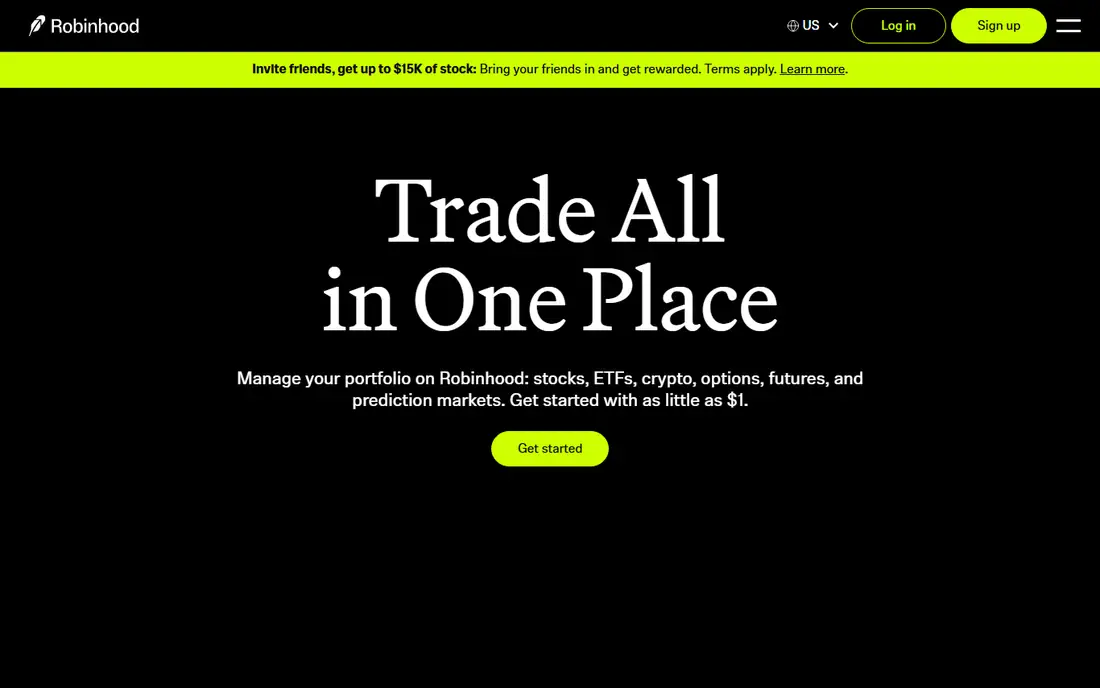
Robinhood remains the easiest app for a first trade. The interface strips trading down to a search, a price chart, and a buy or sell button, with fractional shares and recurring investments from $1. That simplicity helps a beginner who feels intimidated by a full brokerage website, and the app covers stocks, ETFs, options, crypto, and futures in one place.
Simplicity has a cost. Research tools are thinner than at Fidelity, Schwab, or E*TRADE, so a beginner who wants to study a company before buying will need outside sources. The app design can also encourage checking prices and trading often, which rarely helps long-term returns. Use Robinhood as a simple first account, and set a rule for yourself about how often you trade before you fund it.
What we like- Clean, simple mobile app
- $0 commissions on stocks, ETFs, and options
- Fractional shares and recurring investments from $1
Watch out for- Research is lighter than Fidelity or Schwab
- Interface can encourage frequent trading
- Gold subscription adds cost for extra features
#4Webull
Best for: Beginners who want advanced charts and paper trading for free1.2/5 on
Trustpilot (427 reviews, checked Oct 2026)
Visit webull.com
Starting price$0 commission
Free planYes
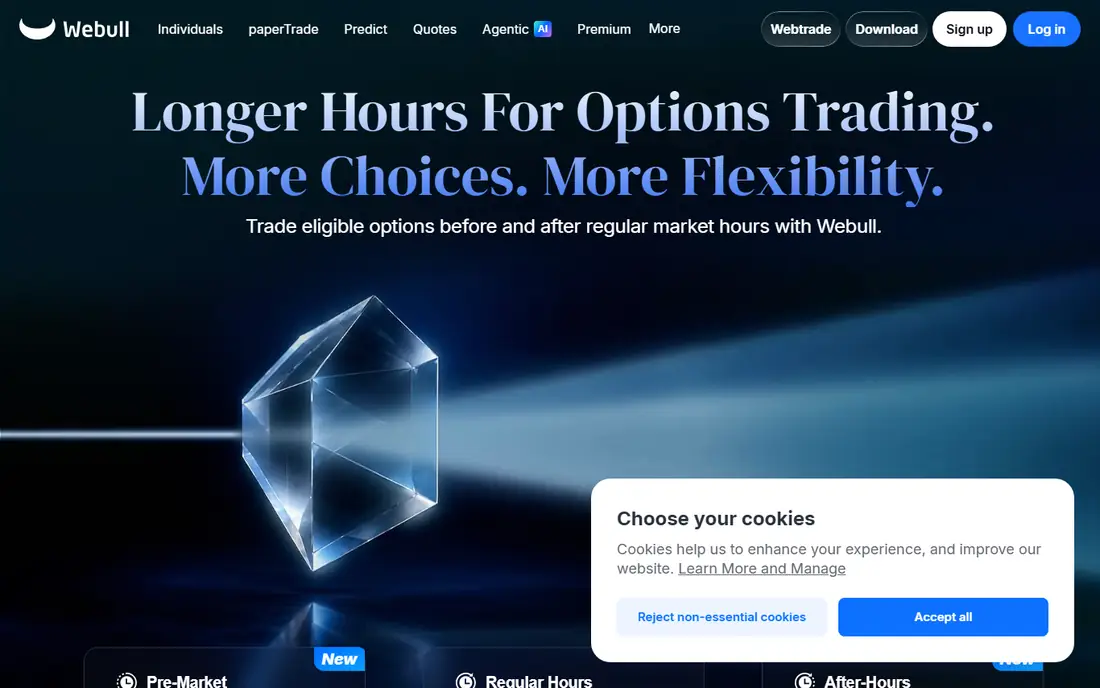
Webull is the free platform for a beginner who wants to learn active trading properly. Its charting tools, indicators, and Level 2 quotes go well beyond a simple price chart, and paper trading with real-time quotes lets you test strategies without risking money. The community and learning sections add context, though community ideas should be treated as discussion, not advice.
Webull is less natural for a simple retirement plan built on index funds, since it lacks the mutual fund depth and planning tools of Fidelity or Schwab. The interface is also busier than Robinhood, which can overwhelm a true first-timer. Choose Webull when you want to study charts and practice trading, and choose Fidelity when your main goal is a long-term retirement account.
What we like- $0 commissions on stocks, ETFs, and many options
- Strong charting and Level 2 data
- Paper trading with real-time quotes
Watch out for- Less suited to a simple fund-based retirement plan
- Interface is busier than Robinhood
- No mutual fund offering like Fidelity
#5E*TRADE
Best for: Beginners who want balanced research, options tools, and Morgan Stanley insights4.0/5 on
G2 (24 reviews, checked Oct 2026)
Visit etrade.com
Starting price$0 commission
Free planYes
E*TRADE, from Morgan Stanley, balances research and trading better than most beginner platforms. Its web platform is well regarded, its research draws on Morgan Stanley insights, and its options tools and education suit a beginner who wants to learn options carefully rather than jump in. Standard pricing shows $0 commissions on stocks, ETFs, and options, with a $0.65 per-contract fee for options, so check the current fee schedule for your trading style.
The design feels older than Robinhood or Public, and some banking features require Morgan Stanley accounts. Those are minor points next to the research depth. E*TRADE suits a beginner who values research and wants a platform that grows from first trades into options and retirement planning without switching firms.
What we like- $0 commissions on stocks, ETFs, and options
- Strong research and options education
- Well-regarded web platform
Watch out for- Options contract fees apply at $0.65 per contract in standard pricing
- Interface feels older than Robinhood
- Premium banking features need Morgan Stanley accounts
#6
SoFi Invest
Best for: Beginners who want banking and investing in one app, with automated options
Visit sofi.com
Starting price$0 commission
Free planYes
SoFi Invest is the all-in-one pick for a beginner who already banks with SoFi or wants one app for money and investing. Active investing lets you pick stocks and ETFs yourself, while automated investing builds and manages a portfolio for you, which suits a beginner who does not want to pick stocks at all. Fractional investing from $5 and no account minimum make starting easy.
The trade-off is depth. Research and trading tools are lighter than at Fidelity, Schwab, or E*TRADE, and SoFi offers no mutual funds. That matters less for a beginner focused on ETFs and automated portfolios, and more for an investor who wants deep company research. Choose SoFi when simplicity and automation matter most, and a specialist broker when research depth matters more.
What we like- $0 stock commissions
- Active and automated investing in one app
- Fractional investing from $5
- No account minimum beyond that
Watch out for- Research and trading tools are lighter than specialist brokers
- No mutual funds
- Cash sweep terms deserve a check
#7
Public
Best for: Beginners who want simple multi-asset investing with recurring plans
Visit public.com
Starting price$0 commission
Free planYes
Public aims to make multi-asset investing simple, with stocks, ETFs, bonds, Treasuries, options, and crypto in one app, plus recurring plans that automate regular investing. Its interface explains assets in plain language, and features such as investment plans help a beginner build a habit rather than chase single trades. IRA offers, including a match on some accounts, add value for retirement savers, though terms apply and should be read carefully.
Fees need attention. While stock and ETF commissions are $0, some plans, subscriptions, and asset types carry separate fees, so check the fee schedule for the assets you actually plan to trade. Public suits a beginner who wants one simple app for several asset types. It suits a research-heavy investor less well than Fidelity, Schwab, or E*TRADE.
What we like- Stocks, ETFs, bonds, Treasuries, and crypto in one app
- Recurring investment plans
- IRA match offers on some accounts
Watch out for- Some plans, subscriptions, and asset types carry separate fees
- Research is lighter than full-service brokers
- Newer platform than Fidelity or Schwab
Starting price$0 commission
Free planYes
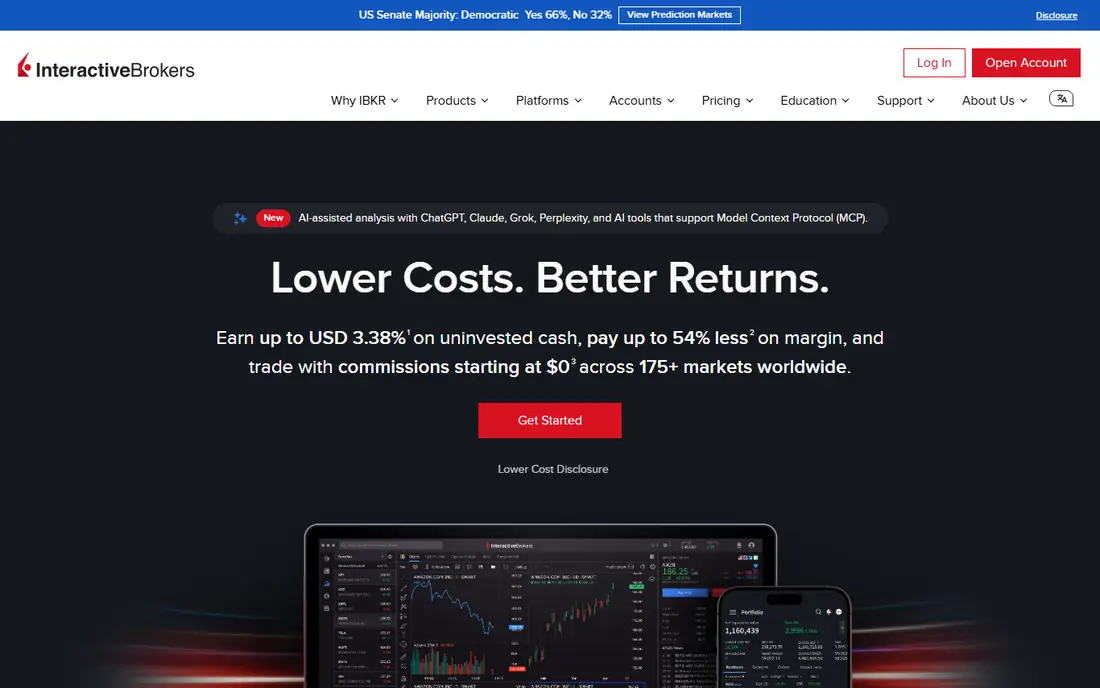
Interactive Brokers is the growth pick in this list, not the easiest first app. IBKR Lite offers $0 commissions on US stocks and ETFs for eligible clients, while the wider platform opens access to global markets, bonds, options, futures, and currencies that most beginner apps do not cover. Margin rates are also lower than at many rivals, which matters only if you borrow to trade, a practice beginners should avoid until they understand the risks.
The learning curve is real. IBKR platforms are built for professionals, with dense screens and many order types, and a beginner can feel lost without guidance. Start on IBKR Lite with simple stock and ETF trades, and use its education resources before touching advanced tools. Choose Interactive Brokers when you want one platform that will still suit you in five years, and choose Fidelity when you want the gentlest start.
What we like- IBKR Lite offers $0 US stock and ETF commissions
- Access to many global markets
- Low margin rates compared with rivals
Watch out for- Advanced tools create a steep learning curve
- Interface can overwhelm beginners
- Pro pricing is tiered and more complex
How we chose
We compared pricing pages, product documentation, and public reviews, and we checked each vendor homepage to confirm the platform still operates and serves US beginners. We favored platforms with $0 stock and ETF commissions, no account minimum or a low one, fractional shares, and education or paper trading, rather than platforms that sell complexity to new traders. Where fee sources disagreed, we used the most recent comparable figure and marked the rest for a check on the vendor fee schedule.
We also weighed habit over features. A beginner platform should make steady investing easy and impulsive trading hard, which is why education, paper trading, and recurring plans counted heavily. A platform with the best charts is a poor first choice if it pushes a new investor toward trades they do not understand.
Starting safely as a beginner
This is not financial advice. Trading and investing carry risk, including the possible loss of your entire investment, and past performance does not guarantee future results. Nothing in this article recommends buying or selling any specific stock, fund, or crypto asset. Consider speaking with a licensed financial adviser before investing, especially when retirement savings are involved, and never invest money you need for near-term expenses.
Start with an amount you can afford to lose and a plan you can explain in one sentence, such as a diversified ETF bought monthly for retirement. Use paper trading on Schwab or Webull for a month before risking real money, and learn order types, especially the difference between market and limit orders, before your first trade. Avoid margin borrowing as a beginner: borrowed money amplifies losses as well as gains, and margin interest adds a cost that is easy to overlook.
Finally, check the full fee schedule, not just the $0 commission headline. Options contract fees, spreads on crypto, account transfer fees, and cash sweep rates all affect returns. Set a review date every six months to check whether your platform still fits your goals, and switch if your needs change, since transferring a brokerage account is a standard process.
Frequently asked questions
Which trading platform is best for beginners?
Fidelity is the best overall pick for most US beginners, with $0 commissions, fractional shares from $1, strong research, and retirement accounts. Charles Schwab is a close second for education and paper trading, while Robinhood is the simplest first app. The right choice depends on whether you want retirement planning, learning tools, or the simplest mobile experience.
How much money do I need to start trading?
Most platforms in this list have no account minimum, and fractional shares let you start with $1 at Fidelity and Robinhood, or $5 at SoFi. You do not need thousands of dollars to start, but you should only invest money you can afford to leave invested for years. Start small, learn the platform, and add regularly rather than funding a large amount at once.
Is commission-free trading really free?
Stock and ETF trades are $0 commission at all platforms here, but other costs remain. Options contracts often carry a per-contract fee, crypto trades include spreads, and margin borrowing charges interest. Cash sweep rates and account fees also vary, so read the full fee schedule before funding an account. Commission-free means no commission on the trade itself, not no costs at all.
Should beginners use paper trading first?
Yes, if your platform offers it. Schwab paper trading through thinkorswim and Webull paper trading both use real-time data, so you can practice order types, chart reading, and position sizing without risking money. Treat paper trading seriously: track your reasons for each trade, and only move to real money when you can explain your plan and your exit rule.
Are my investments protected if a broker fails?
US brokerages in this list are members of SIPC, which protects securities and cash up to $500,000, including a $250,000 limit for cash, if a brokerage firm fails financially. SIPC does not protect against market losses, so a falling stock price is still your loss. Confirm SIPC membership on the broker site and keep records of your holdings.
What should beginners avoid in their first year?
Avoid margin borrowing, concentrated bets on single stocks, frequent trading based on social media tips, and options strategies you cannot explain. Focus on diversified ETFs, regular contributions, and learning, rather than trying to beat the market quickly. If a trade idea comes from a stranger online, treat it as a prompt for research, not as advice.
Sources we checked (9)
- https://www.fidelity.com
- https://www.schwab.com
- https://robinhood.com
- https://www.webull.com
- https://www.etrade.com
- https://www.sofi.com/invest
- https://public.com
- https://www.interactivebrokers.com
- https://rankite.com/blog/best-trading-app-for-beginners
Is your product missing or out of date?
We review this list regularly. Vendors can request a listing, send updated pricing or ask about featured placement.

Shihab Mia · Founder, Rankite
Shihab has 5+ years in B2B and SaaS SEO. He writes Rankite's software buying guides from pricing pages, documentation and public user reviews. More about Shihab.