How we make this list: we compare pricing pages, product documentation and public user reviews. Rankite is independent; if a vendor ever pays for a featured spot, that listing is clearly labeled Partner.
Key takeaways
- Most bar inventory software costs $249 or more per month per location, so the cheapest option is rarely the point; fit is.
- The best bar inventory software for a single bar (Partender, Bar Cop) looks different from the best pick for a multi-location group (BevSpot, BinWise).
- Published prices are rare in this category: only WISK, MarketMan, and Bar Cop state starting prices openly.
- Counting discipline matters more than features; software finds the leaks, but someone still has to count every bottle weekly.
- If wine drives your margins, a wine-first platform like BinWise beats a general F&B tool.
Quick comparison
| Tool | Best for | Starting price | Free plan |
|---|
 Partender Partender | Bars and nightclubs that want the fastest possible count with a Bluetooth scale | See website | No |
 WISK WISK | Bars and restaurants that want real-time POS integration and variance reports | $249/month (beverage, single venue, billed annually) | No |
 BevSpot BevSpot | Multi-location operators that want inventory, ordering, and recipe costing in one system | See website | No |
 Bar Cop Bar Cop | Independent owner-operators who want inventory plus the rest of the back office | $249/month per location | 30-day trial |
 MarginEdge MarginEdge | Restaurants and bars that want invoice automation feeding live recipe costs | See website | No |
 MarketMan MarketMan | Operators who want AI-assisted ordering and openly published pricing | $249/month (Starter) | No |
 AccuBar AccuBar | Hotels, casinos, and multi-property hospitality groups | See website | No |
 BinWise BinWise | Wine-forward programs, fine dining, and venues that need a digital wine list | See website | No |
 BlueCart BlueCart | Operators that want wholesale ordering tied to their inventory data | See website | No |
Is your product missing or out of date?
We review this list regularly. Vendors can request a listing, send updated pricing or ask about featured placement.
The best bar inventory software
#1
Partender
Best for: Bars and nightclubs that want the fastest possible count with a Bluetooth scale
Visit partender.com
Starting priceSee website
Free planNo
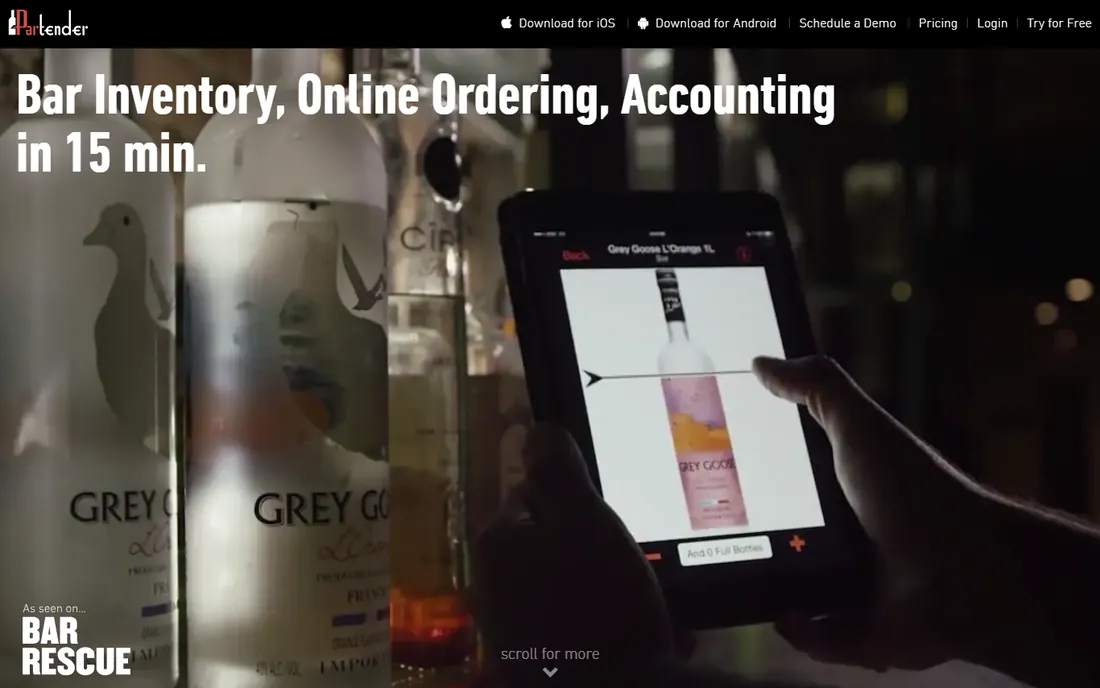
Partender built its name on one idea: counting a bar should take minutes, not hours. The system pairs a Bluetooth scale with the app, so staff weigh partial bottles instead of eyeballing fill levels, and the software converts weight into ounces on hand. That design is why high-volume bars keep choosing it despite the lack of public pricing.
The tradeoff is specialization. Partender is a bar tool first, which means restaurants that need recipe costing, food inventory, or invoice processing will need a second system. If your operation is drinks-led and your team dreads count night, that focus is a feature rather than a flaw.
What we like- Built specifically for bars
- Wireless scale speeds up partial-bottle counts
- Pour cost and variance reporting
- Multi-location support
Watch out for- Bar-focused, so weak on food inventory
- The scale is extra hardware
- Pricing is not published
#2
WISK
Best for: Bars and restaurants that want real-time POS integration and variance reports
Visit wisk.ai
Starting price$249/month (beverage, single venue, billed annually)
Free planNo
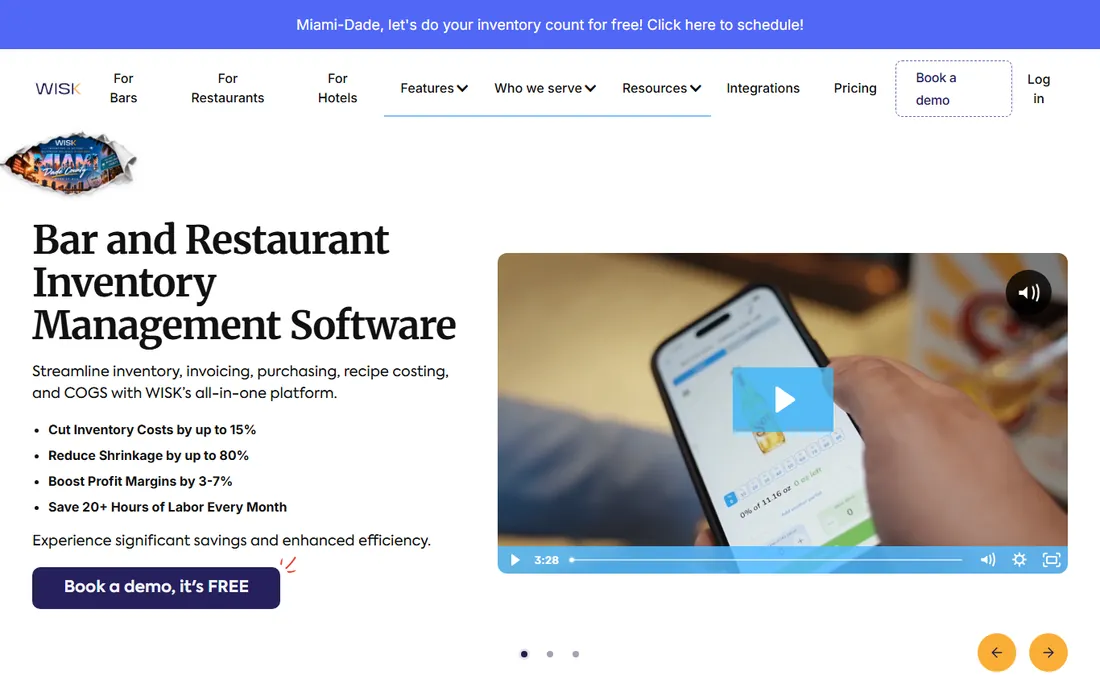
WISK is the most automation-forward option on this list. The vendor's own FAQ confirms there is no free trial, which tells you something about how the product is sold: through demos and consultations rather than self-serve signups. Once running, it connects sales data from your POS directly to inventory, so variance shows up as over-pour, waste, or theft rather than as a shrug.
Pricing is published on wisk.ai/price, a rarity in this category. The beverage-only plan for a single venue runs $249 per month on annual billing, with a combined food and beverage bundle at $399 per month. Bars that also run a kitchen should price the bundle rather than assume the beverage plan will stretch.
What we like- Integrates with 60+ POS systems at no extra cost
- AI invoice scanning
- Recipe and menu costing
- Multi-user counting
Watch out for- No free trial, demos only
- Pricing climbs as venues and features are added
- Setup takes real effort
#3
BevSpot
Best for: Multi-location operators that want inventory, ordering, and recipe costing in one system
Visit bevspot.com
Starting priceSee website
Free planNo
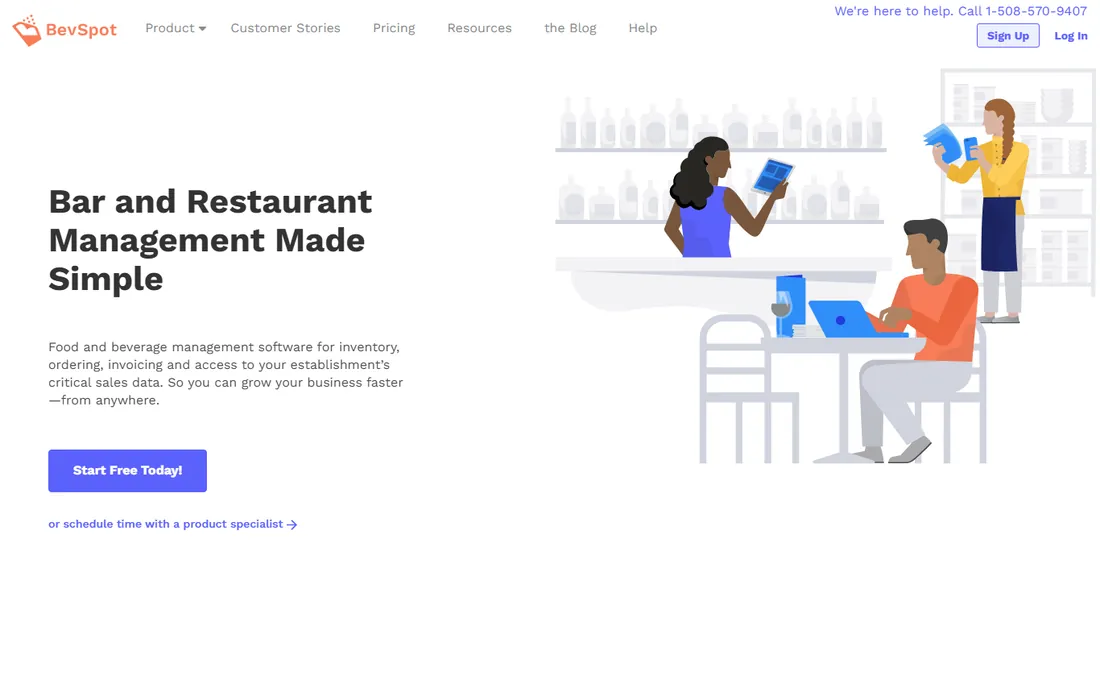
BevSpot sits in the middle of the market: bigger than a bar-only app, more approachable than an enterprise suite. The ordering features are the standout, with Smart Cart filling carts from weekly usage and pars so reordering stops being guesswork. The vendor reports a 70 percent average reduction in time spent on inventory, which is plausible given how much of count night is usually data entry.
The catch is pricing opacity. BevSpot does not publish plans, so budgeting requires a sales conversation. Groups with several locations usually get the most value here, since the reporting is designed to compare sitting inventory and COGS across sites.
What we like- Smart Cart ordering based on usage and pars
- Shelf-to-sheet counting
- Offline mode
- Strong analytics
Watch out for- No public pricing
- Built for F&B groups, so a single small bar may pay for more than it uses
#4
Bar Cop
Best for: Independent owner-operators who want inventory plus the rest of the back office
Visit barcop.com
Starting price$249/month per location
Free plan30-day trial
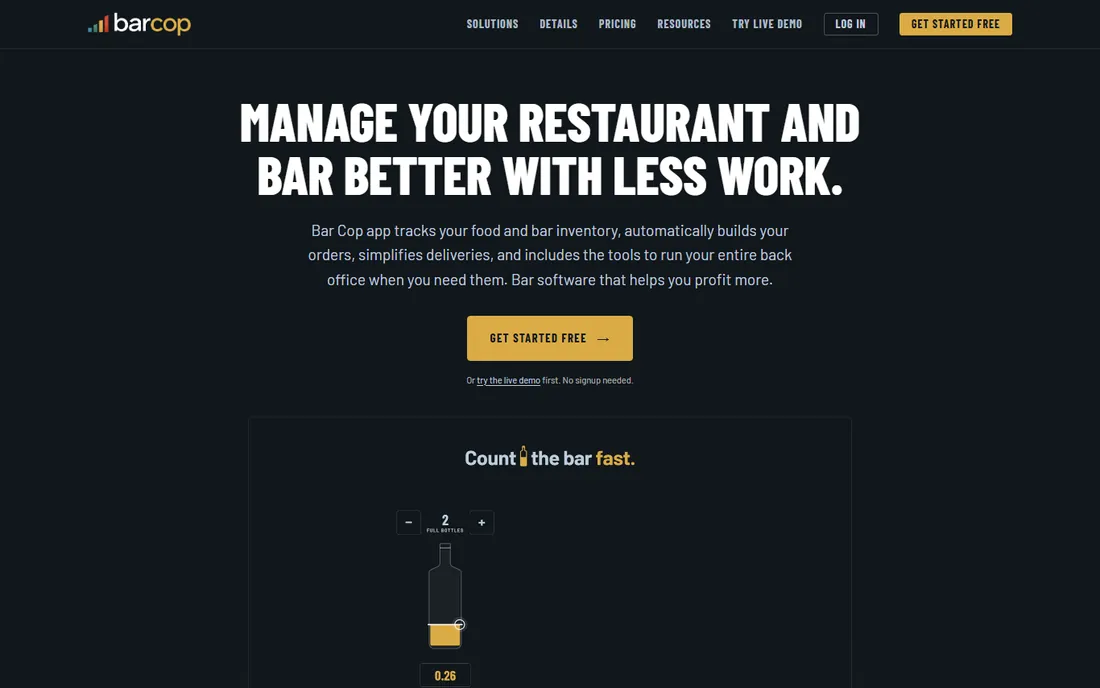
Bar Cop is the veteran pick, online since 2004, and it takes a different approach from everyone else here. Instead of integrating with your POS, it reads the sales report your POS already exports, which means there is nothing to integrate and no compatibility risk. Counting uses on-screen fill sliders rather than a scale, so there is no hardware purchase.
What makes it unusual is scope. The same subscription covers beverage and food inventory, labor and scheduling, shift cash and over-short, menu pricing, a cash-flow forecast, event bookings, and week-end books. The vendor states one price of $249 a month per location with no contract and no setup project. Owner-run bars that currently juggle spreadsheets for all of this get the most for their money.
What we like- Eight tools in one system, including labor, scheduling, and cash books
- Works with any POS by reading exported sales reports
- No scale hardware to buy
- No contract
Watch out for- Older interface
- No live POS sync
- One flat price with no lighter tier
#5
MarginEdge
Best for: Restaurants and bars that want invoice automation feeding live recipe costs
Visit marginedge.com
Starting priceSee website
Free planNo
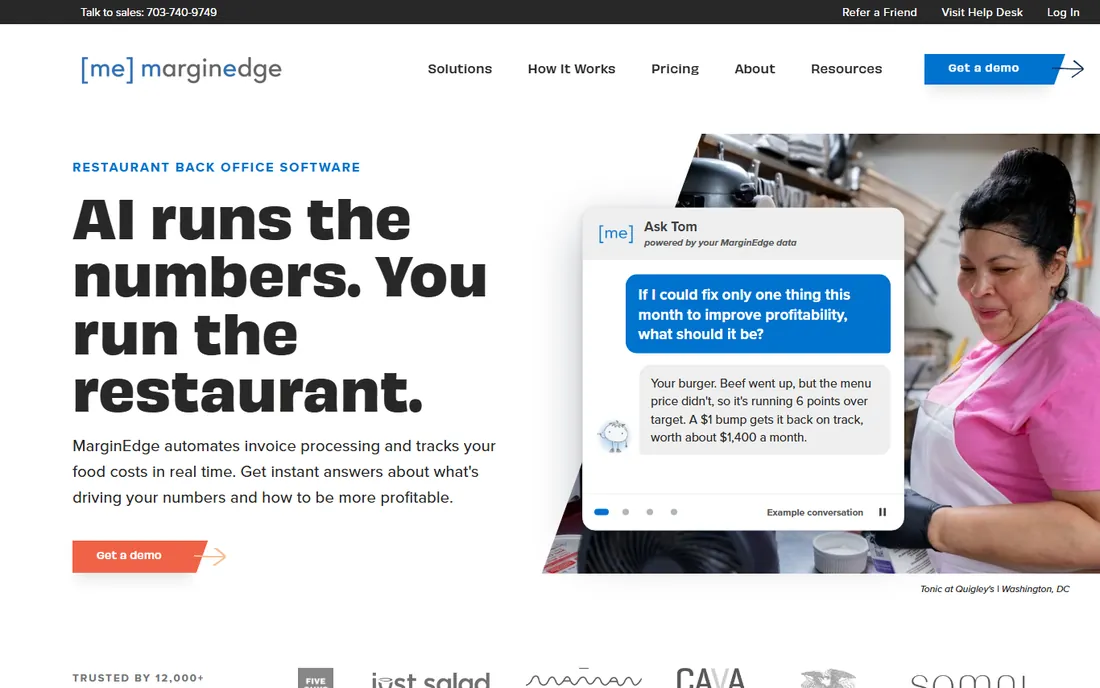
MarginEdge attacks the problem from the invoice side rather than the counting side. Invoices get scanned and coded automatically, which keeps recipe costs current without manual price updates. For bars with a serious cocktail program, live ingredient pricing makes menu engineering honest instead of approximate.
Like most of this category, MarginEdge keeps pricing behind a sales conversation. Its strength is clearly the finance and accounting side of the operation, so bars that already have counting handled and mainly need cost visibility will find the most value. Note: we could not load the MarginEdge homepage directly during research, so treat the site URL as best-verified rather than confirmed.
What we like- Automated invoice processing
- Bill pay and accounting integrations
- Theoretical vs actual food cost tracking
Watch out for- Pricing is not published
- Food-cost orientation can leave bar-specific workflows thinner
#6
MarketMan
Best for: Operators who want AI-assisted ordering and openly published pricing
Visit marketman.com
Starting price$249/month (Starter)
Free planNo
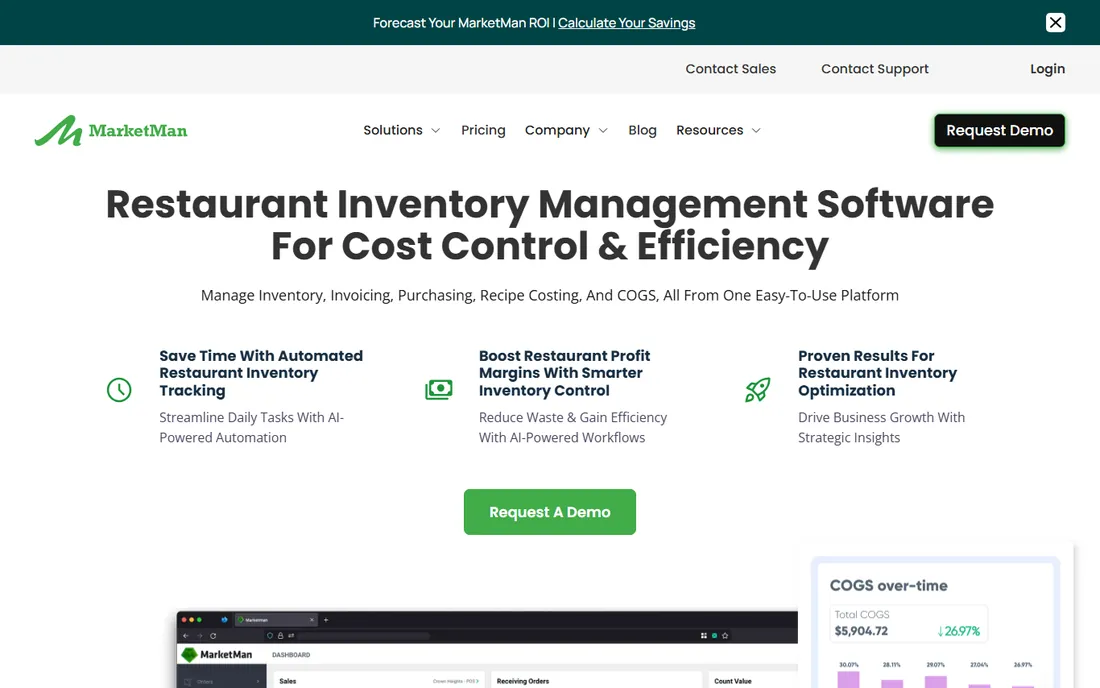
MarketMan is the rare vendor in this space that puts prices on its homepage: Starter at $249 per month for independent operators, Growth at $299, and Enterprise from $449. That transparency alone makes shortlisting easier, because you can rule tiers in or out before talking to sales. The platform covers inventory, invoicing, purchasing, recipe costing, and COGS in one place.
The feature set leans toward full restaurant operations, with AI-powered ordering, order-by-recipe, and actual-versus-theoretical reporting. Bars are well served but not the center of the design. Single-location bars should check that Starter's limits, such as one vendor EDI integration and 50 invoice scans per month, fit their volume before committing.
What we like- Published pricing with three tiers
- Smart Ordering with predictive analytics
- Unlimited invoice scanning on Growth
- Mobile apps for counting
Watch out for- General F&B focus rather than bar-first
- Advanced features sit in higher tiers
- Implementation typically takes 2 to 4 weeks
#7
AccuBar
Best for: Hotels, casinos, and multi-property hospitality groups
Visit accubar.com
Starting priceSee website
Free planNo
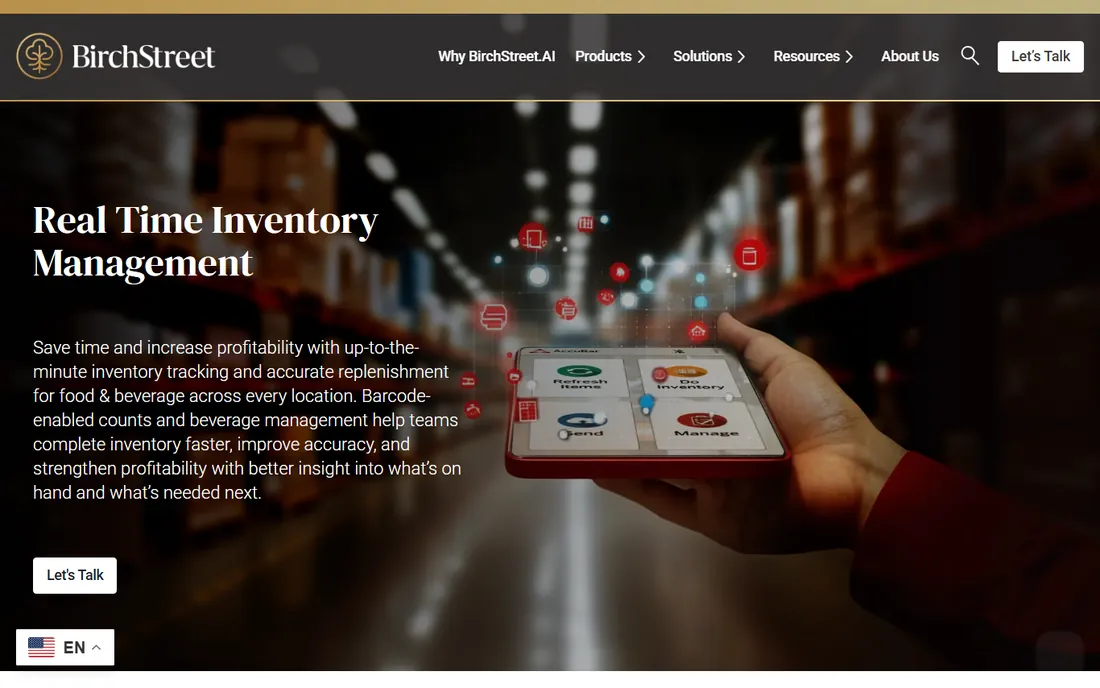
AccuBar has been in beverage inventory since 2001 and was acquired by BirchStreet Systems, which now runs accubar.com as part of its hospitality operations platform. The core method is barcode scanning: staff scan full and partial bottles with phones or Bluetooth scanners, and the system calculates what is on hand from the barcode data.
This is a heavyweight option. Perpetual inventory, multi-outlet tracking, and receiving workflows suit hotels and casino groups with complex beverage programs. A single bar will find it expensive and more complex than needed, and pricing is quote-based, so expect an enterprise sales process.
What we like- Barcode-scanner counting workflow
- Perpetual inventory with variance reporting
- Decades serving hospitality
- Now backed by BirchStreet
Watch out for- Enterprise-oriented and quote-priced
- Overkill for a single neighborhood bar
- Brand is transitioning after acquisition
#8
BinWise
Best for: Wine-forward programs, fine dining, and venues that need a digital wine list
Visit home.binwise.com
Starting priceSee website
Free planNo
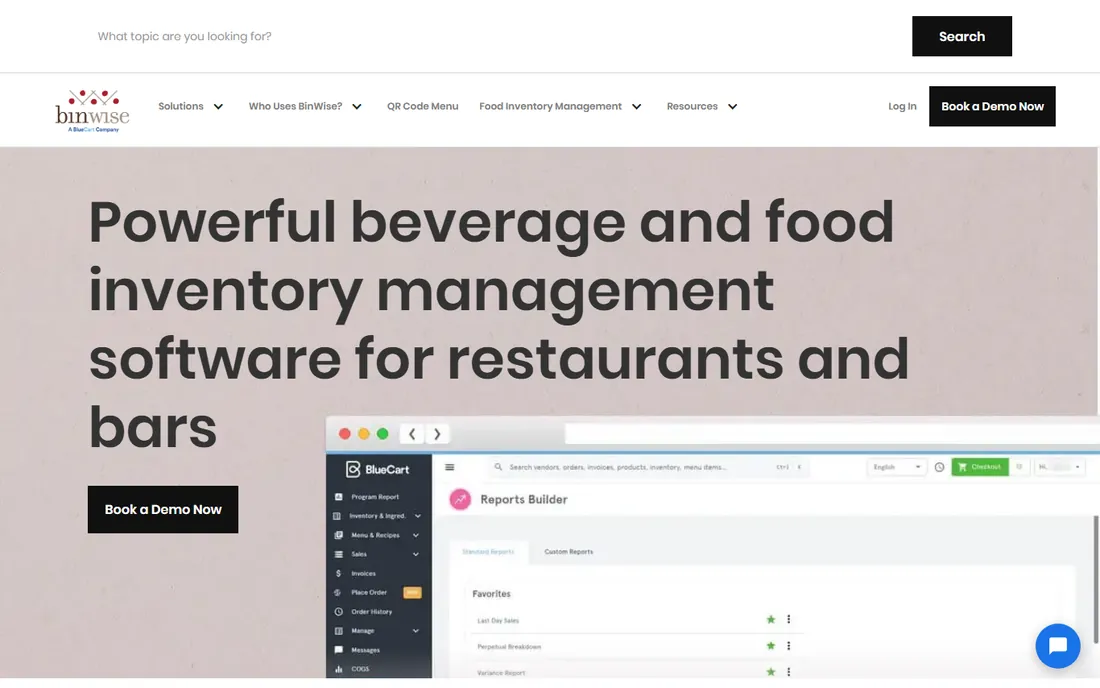
BinWise is the wine program specialist. Beyond standard beverage inventory, it offers cellar tracking, aging reports, and SproutQR, which builds digital wine lists synced to live inventory. The vendor says inventory time drops by up to 85 percent, mostly by eliminating manual entry and counting errors through POS integration.
The company is now integrated with BlueCart, which adds food inventory and the Endless Aisle ordering marketplace to the beverage core. That makes BinWise a plausible single system for fine dining rooms where both the cellar and the kitchen need attention. Pricing is quote-based, and the product clearly targets serious programs rather than casual bars.
What we like- BinScan 2.0 mobile scanner
- Cellar tracking and aging reports
- SproutQR digital wine lists
- Integrated with BlueCart ordering
Watch out for- Quote-based pricing
- Fine-dining orientation can feel heavy for casual bars
#9
BlueCart
Best for: Operators that want wholesale ordering tied to their inventory data
Visit bluecart.com
Starting priceSee website
Free planNo
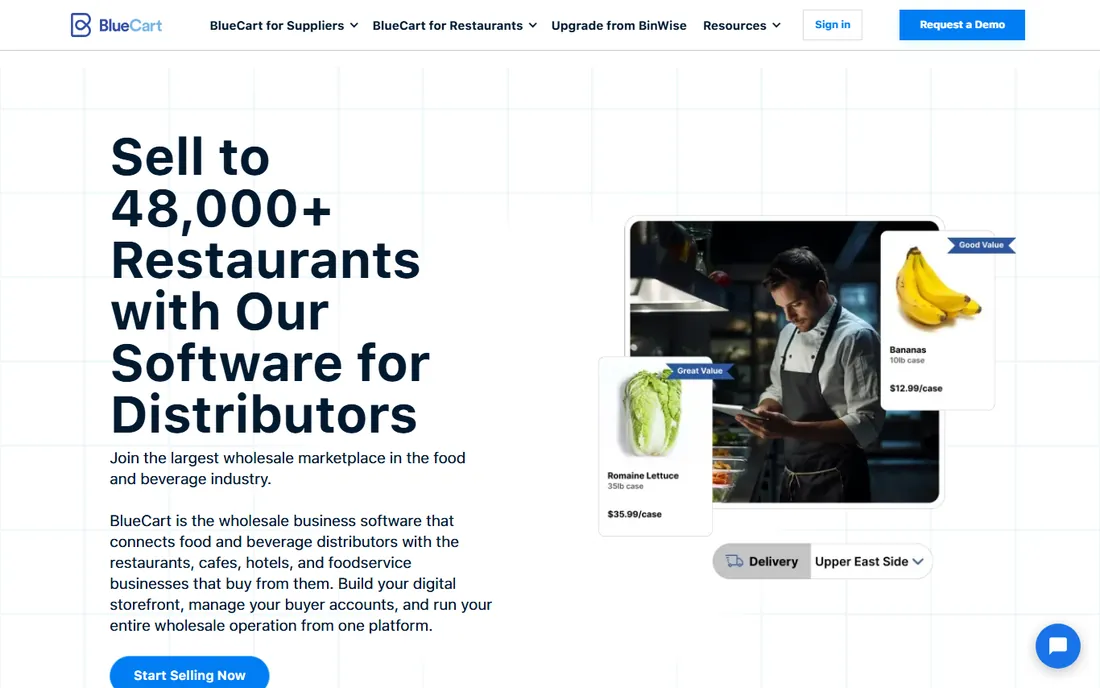
BlueCart is included here with a caveat: it is primarily wholesale software for distributors, not a bar inventory counter. It earns its place because of the BinWise integration, which lets orders placed through BlueCart flow into BinWise for inventory reconciliation and costing. The Endless Aisle marketplace connects buyers with food and beverage vendors in their delivery area.
For a bar, BlueCart makes sense as the ordering half of a BinWise pair rather than as a first purchase. The vendor's FAQ mentions a $200 one-time Endless Aisle setup fee for vendors, but buyer-side pricing for operators is quote-based. If your pain is procurement rather than counting, start here; if it is counting, start with one of the tools above.
What we like- Endless Aisle marketplace with thousands of vendors
- Order management and invoicing
- Integrates with BinWise
- Per-account catalogs and pricing
Watch out for- Distributor-oriented at its core
- Not a standalone inventory counter
- Buyer-side pricing is quote-based
Frequently asked questions
How does bar inventory software calculate pour cost?
It compares what was sold (from your POS) against what was used (from inventory counts), then divides the cost of product consumed by beverage revenue. A well-run bar usually targets 18 to 24 percent for liquor, though targets vary by concept and market.
Does bar inventory software work with my POS?
Most platforms integrate with major POS systems; WISK lists 60+ integrations and BevSpot, BinWise, and MarketMan all connect sales data for variance reporting. Bar Cop is the exception: it reads the sales report your POS exports, so it works with any POS without an integration.
How much does bar inventory software cost?
Expect around $249 per month per location as a floor: WISK, MarketMan Starter, and Bar Cop all start there. Most other vendors quote custom pricing based on locations, venues, and modules, so budget $250 to $500 per location per month until you get a quote.
Do I need a scale to count inventory?
It depends on the method. Partender is built around a Bluetooth scale for weighing partial bottles. AccuBar uses barcode scanning. Bar Cop uses on-screen fill sliders, and BevSpot uses shelf-to-sheet counting. No single method is mandatory.
How often should a bar take inventory?
Weekly is the standard recommendation across vendors. Shorter intervals make it easier to spot variance from over-pouring, waste, or theft before it compounds. Larger operations sometimes count monthly, but weekly is the norm for bars.
Can bar inventory software handle multiple locations?
Yes, most platforms support multi-location reporting, with BevSpot and BinWise particularly oriented toward groups. Pricing is usually per location, so confirm how the vendor prices additional sites before you commit.
How to choose the best bar inventory app for your operation
Start with your concept. A drinks-led bar with no kitchen should shortlist bar-first tools like Partender or Bar Cop, while a restaurant with a bar needs a full F&B platform like MarketMan, MarginEdge, or WISK. Buying a restaurant suite for a cocktail bar means paying for modules you will never open.
Next, check the counting method against your staff. A scale is fast but requires hardware and training; barcode scanning needs labeled bottles and compatible scanners; fill sliders need nothing but a phone. The best method is the one your team will actually use every week, because skipped counts make any software useless.
Then look at POS compatibility before anything else. Live sales integration is what turns counts into variance reports, which is where the money is. If your POS is not on a vendor's integration list, ask whether they can read its exported sales reports, as Bar Cop does, or cross that vendor off.
Finally, get pricing in writing. Only three tools in this guide publish starting prices, and per-location fees, onboarding charges, and hardware costs can push the real number well above the headline. Ask for the total first-year cost including setup, hardware, and any per-location fees, then compare.
Pour cost: the one number that decides whether the software pays for itself
Pour cost is the share of beverage revenue that goes to the product in the glass, and it is the metric every tool on this list is built to move. A bar pouring at 28 percent that gets down to 22 percent has recovered six points of margin, which for a bar doing $50,000 a month in beverage sales is $3,000 a month back. That math is why $249 a month for software is cheap if the counting actually happens.
The software contributes in two ways. First, it makes the number visible: variance reports show the gap between what should have been poured and what was actually used, broken down by product. Second, it makes the number honest: invoice scanning keeps costs current, so the pour cost reflects what you paid this week, not what you paid last quarter.
Set the target before you buy. Agree on a pour cost goal with your bar manager, pick the tool that reports it most clearly, and review the variance report in the same meeting every week. Software that nobody reviews is just an expensive spreadsheet.
How we chose
We started with the category leaders that US bar operators actually discuss on G2, Capterra, and Reddit, then added smaller and specialist vendors to cover wine programs, independent bars, and wholesale ordering. Each vendor's homepage and pricing page was checked directly; where pricing was not published, the starting price is listed as "See website" rather than guessed.
We compared counting methods (scale, barcode, fill slider, shelf-to-sheet), POS integrations, ordering and invoice features, recipe costing, and multi-location support. Fit for company size mattered: a tool built for hotel groups was not ranked against a tool built for a single bar on the same terms. We excluded generic restaurant inventory tools with no meaningful beverage workflow.
Prices shown come only from the vendors' own pages or vendor-published descriptions. We did not invent ratings, customer counts, or awards, and we made no hands-on testing claims. Vendor marketing statistics are attributed to the vendor, not presented as independent findings.
Sources we checked (10)
- https://partender.com
- https://wisk.ai/
- https://bevspot.com
- https://marginedge.com
- https://marketman.com/
- https://accubar.com
- https://home.binwise.com/
- https://bluecart.com/
- https://www.barcop.com
- https://sourceforge.net/software/compare/Bar-Cop-vs-Zip-Inventory/
Is your product missing or out of date?
We review this list regularly. Vendors can request a listing, send updated pricing or ask about featured placement.

Shihab Mia · Founder, Rankite
Shihab has spent more than a decade helping SaaS and e-commerce brands grow through search. He writes Rankite's software buying guides from pricing pages, documentation and public user reviews. More about Shihab.