How we make this list: we compare pricing pages, product documentation and public user reviews. Ratings come from G2, Capterra or Trustpilot, with the date we checked them.
Key takeaways
- Playwright is the default choice for new web test automation projects, with speed and reliability older tools struggle to match, plus auto-wait and a trace viewer that cut debugging time.
- Selenium remains the enterprise standard with the largest ecosystem, especially where legacy browser support matters or where existing suites already run on Selenium.
- Cypress offers the best developer experience for frontend teams testing modern web apps in JavaScript, with fast feedback and time-travel debugging in the runner.
- Katalon and TestComplete suit mixed-skill QA teams that need low-code or codeless options beside coded tests, covering web, mobile, API, and desktop in one platform.
- Postman covers API testing, Appium covers mobile, and Robot Framework covers keyword-driven acceptance testing readable by non-developers and business stakeholders.
Quick comparison
Is your product missing or out of date?
We review this list regularly. Vendors can request a listing, send updated pricing or ask about featured placement.
Starting priceFree
Free planYes
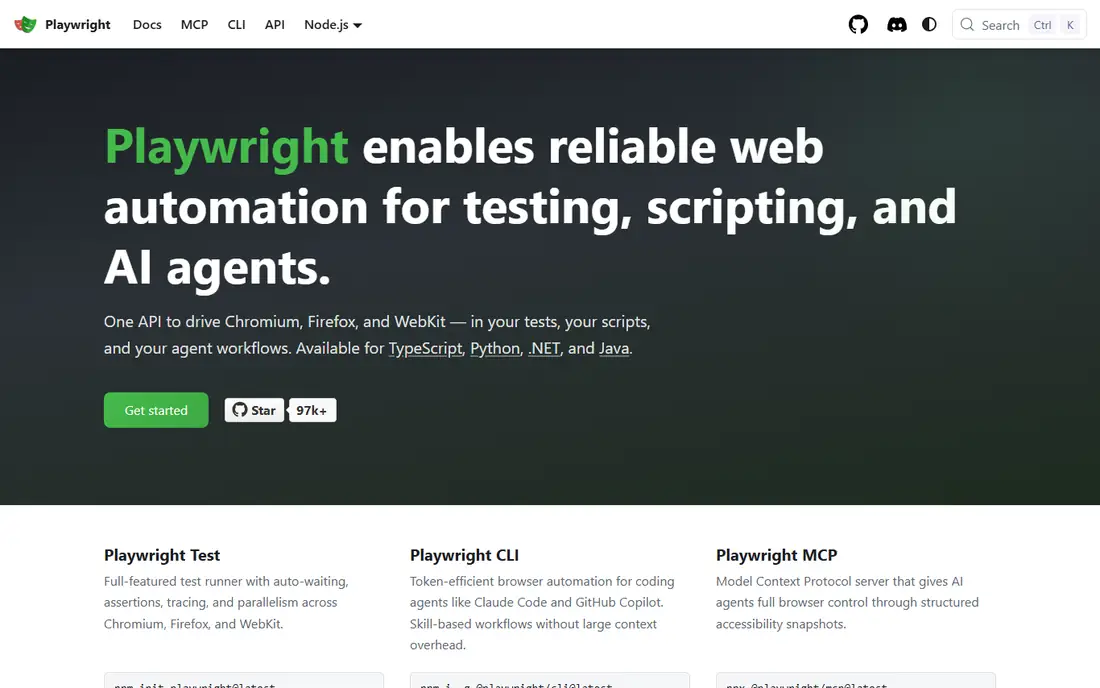
Playwright has become the default choice for new web test automation projects, with speed and reliability that older tools struggle to match. Auto-wait, the built-in runner, and the trace viewer get beginners productive faster than Selenium, and cross-browser coverage includes Chromium, Firefox, and WebKit, so Safari testing works without a separate tool.
It is code-first, so non-developer QA teams need programming skill, and the ecosystem is newer than Selenium. By October 2026 public data, Playwright npm downloads dwarf Cypress, which shows where new projects are heading. For a new web project with developers on the team, Playwright is the top pick.
What we like- Default for new web projects
- Auto-wait, built-in runner, trace viewer
- Cross-browser including Safari
Watch out for- Code-first, needs programming skill
- Newer ecosystem than Selenium
- Reporting needs setup

#2Selenium
Best for: Enterprise web standard4.5/5 on
G2 (27 reviews, checked Oct 2026)
Visit selenium.dev
Starting priceFree
Free planYes
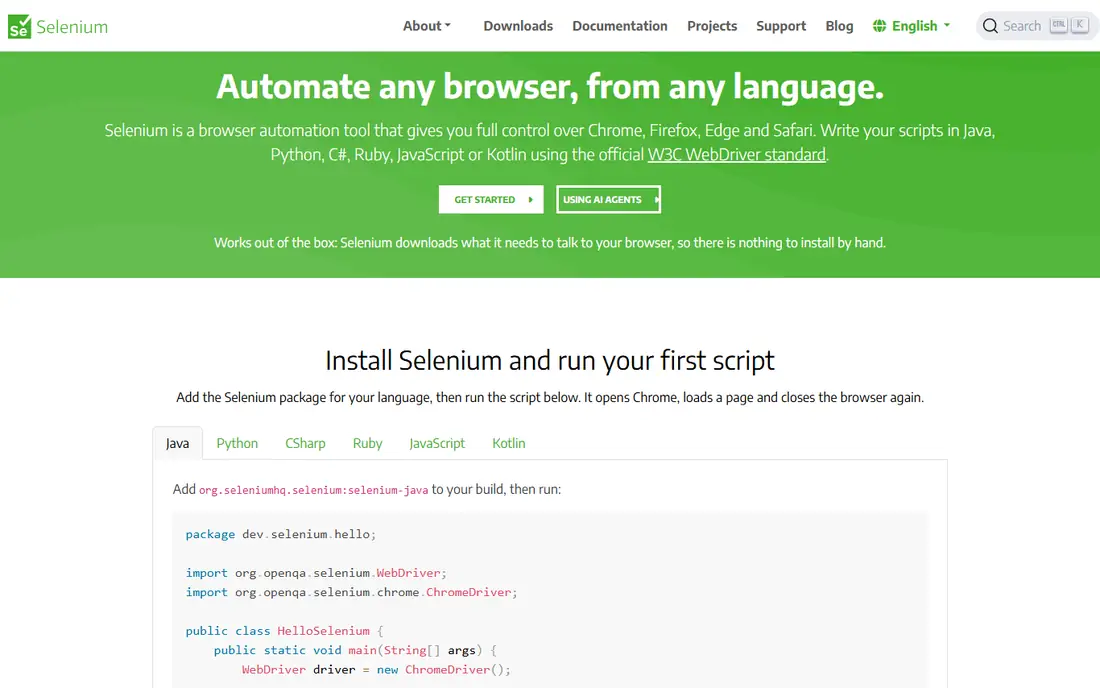
Selenium remains the enterprise standard with the largest ecosystem, especially where legacy browser support matters or where existing suites and Java-heavy teams already run Selenium. Language support covers Java, Python, C#, Ruby, and JavaScript, and the community and tooling depth is unmatched.
The cost is framework building: Selenium gives you a driver, not a test framework, so waits, reporting, and parallel runs need building and maintenance. For an enterprise with existing Selenium suites or legacy browser needs, Selenium stays the right choice.
What we like- Largest ecosystem and enterprise standard
- Many languages
- Legacy browser support
Watch out for- Needs framework building and maintenance
- Slower setup than Playwright
- Flaky tests without careful waits
#3Cypress
Best for: Frontend developer experience4.7/5 on
G2 (107 reviews, checked Oct 2026)
Visit cypress.io
Starting priceFree
Free planYes
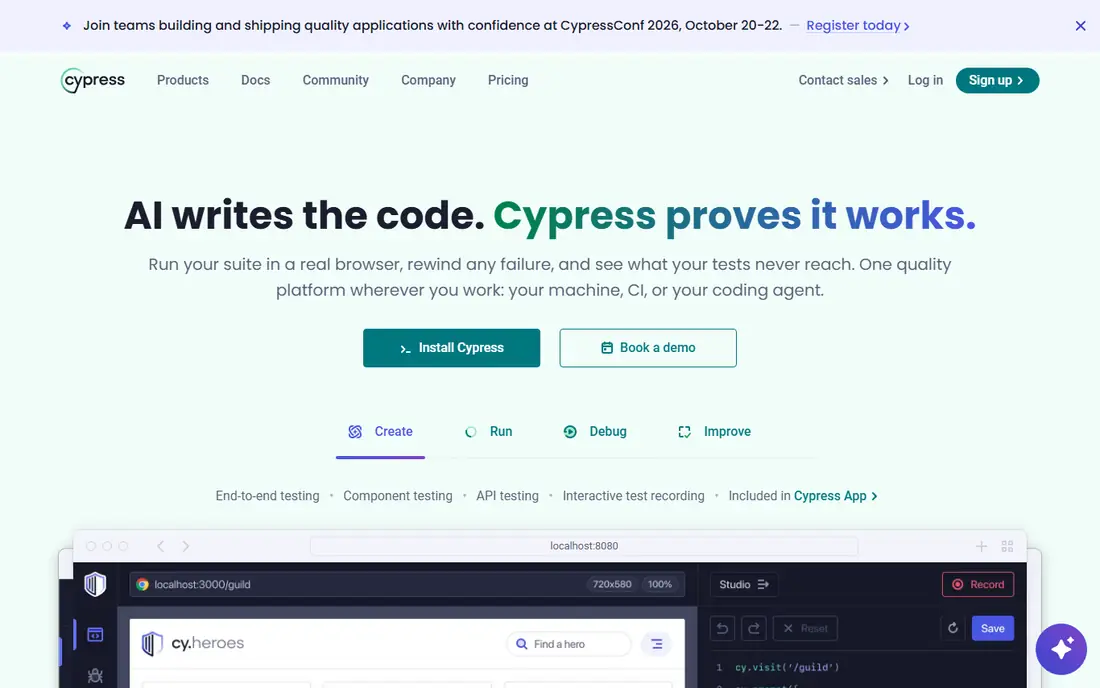
Cypress offers the best developer experience for frontend teams testing modern web apps, with fast feedback, time-travel debugging, and a runner that feels built for developers. The free core covers local testing, while Cypress Cloud adds parallelization and recording at about $67 a month for Team by October 2026 guides.
It is JavaScript and TypeScript only, and multi-tab flows and some Safari scenarios need workarounds. For a JavaScript frontend team that values developer experience above all, Cypress is the most enjoyable pick.
What we like- Best developer experience for frontend teams
- Fast feedback
- Free core, paid cloud
Watch out for- JavaScript and TypeScript only
- Cypress Cloud Team about $67 a month
- Multi-tab and Safari limits by guides

#4Katalon
Best for: Mixed-skill QA teams4.4/5 on
G2 (226 reviews, checked Oct 2026)
Visit katalon.com
Starting priceFree
Free planYes
Katalon suits mixed-skill QA teams that need an all-in-one platform for web, mobile, API, and desktop testing, with a low-code mode for non-developers beside full-code mode for engineers. The free tier covers starting teams, while Professional costs about $84 per seat a month by October 2026 guides.
Coded tests use Java and Groovy, which limits teams on other languages, and the platform feels heavier than Playwright for pure web work. For a QA team with mixed skills that needs one platform across layers, Katalon is the most complete pick.
What we like- All-in-one web, mobile, API, desktop
- Low-code mode beside full code
- Free tier plus paid plans
Watch out for- Professional about $84 per seat a month by guides
- Java and Groovy only for coded tests
- Heavier than Playwright

#5TestComplete
Best for: Codeless UI testing4.2/5 on
G2 (96 reviews, checked Oct 2026)
Visit smartbear.com
Starting priceSee website
Free planFree trial
TestComplete suits non-technical QA teams and regulated teams that need codeless GUI testing across desktop, web, and mobile, with script options in JavaScript, Python, and VBScript for teams that want code. Desktop coverage is the deciding factor: most web-first tools cannot automate Windows desktop apps at all.
It is paid only, with Base, Pro, and custom pricing on the vendor site, and it is Windows-focused. For a team testing desktop apps beside web, TestComplete earns its price. For web-only teams, Playwright or Cypress cost less.
What we like- Codeless GUI testing for non-technical teams
- Desktop, web, and mobile
- Script options in JavaScript and Python
Watch out for- Paid only, pricing on vendor site
- Windows-focused
- Heavier than code-first tools for web-only teams
Starting priceFree
Free planYes
Postman suits API teams that need exploration and automated API testing in one tool, with a free tier, GUI-mode test building, and Newman CLI for CI runs. Team pricing runs about $19 per user a month by October 2026 guides, with paid tiers for collaboration at scale.
It covers APIs only, not UI testing, and script tests need JavaScript. For an API-first team, Postman is the default pick, paired with Playwright or Cypress for UI coverage.
What we like- Free tier for API exploration
- Automated API tests via Newman CLI
- Team about $19 per user a month by guides
Watch out for- API only, no UI testing
- Paid tiers for collaboration at scale
- Script tests need JavaScript

#7Appium
Best for: Mobile automation4.4/5 on
G2 (63 reviews, checked Oct 2026)
Visit appium.io
Starting priceFree
Free planYes
Appium suits teams testing native, hybrid, and mobile web apps on iOS and Android, with free open-source licensing and language support in Java, Python, C#, and JavaScript. For native mobile testing, Appium is the standard recommendation beside Playwright for web.
Setup and device management take effort, and feedback is slower than web tools. For a team with real mobile apps to test, Appium is the essential pick, often paired with a device cloud like BrowserStack for scale.
What we like- Free open source
- Native, hybrid, and mobile web apps
- IOS and Android
Watch out for- Code-first, needs setup
- Slower feedback than web tools
- Device management needs a cloud or lab
Starting priceFree
Free planYes
Robot Framework suits non-developer QA teams that need keyword-driven acceptance testing readable by business stakeholders, with libraries for web, API, and database testing. The keyword syntax lets testers write tests without full programming, while Python keywords extend it where needed.
Technical setup is still needed, and complex flows run slower than code-first tools. For a team where test readability and business collaboration matter most, Robot Framework is a strong, free pick.
What we like- Free open source
- Keyword-driven, readable by non-developers
- Web, API, and database libraries
Watch out for- Python-based keywords need technical setup
- Slower than code-first tools for complex flows
- Reporting needs plugins
How we chose
We compared automation testing tools on testing layer, language support, codeless options, CI integration, cloud execution, and price, using vendor pages and October 2026 testing guides, and we favored tools with real production use over demo-only features. We favored tools with real production use and published pricing, and we left out single-purpose tools that cover only one narrow layer, except where noted, since this article covers general automation testing rather than one niche.
Start with the testing layer, then the team. Web UI teams should shortlist Playwright, Selenium, and Cypress. Mobile teams should add Appium. API teams should add Postman. Mixed-skill teams should look at Katalon or TestComplete, and teams needing readable acceptance tests should add Robot Framework. The biggest cost is often not the license but the people who keep tests running, so pick a tool your team can maintain with the skills it already has, not one that needs hiring to sustain.
Run a proof of concept before committing
Shortlist two tools, run a two-week proof of concept against your real application, and let your own numbers make the call. Measure test speed, flakiness, setup time, and maintenance effort, since vendor demos hide all four, and a tool that wins on your app beats one that wins on a benchmark. A tool that wins on your app beats a tool that wins on a benchmark, since your application quirks decide real maintenance cost.
Plan for maintenance, not just authoring
Tests break as applications change, and self-healing features help only so far. Budget time for test maintenance, flaky-test triage, and framework upgrades, and pick a tool with a community large enough to answer questions when tests fail at midnight before a release. AI tools can write and repair tests, but they work through a framework, so the framework choice still decides stability.
Cover the right layers, not just the UI
UI tests are the slowest and flakiest layer, so push coverage down where possible: API tests for business logic, component tests for interface pieces, and UI tests only for critical user journeys that real users complete every day. A pyramid with many API tests, fewer component tests, and a small set of UI tests runs faster and breaks less than a suite built entirely on browser clicks, which is why layer choice matters more than tool choice alone. Postman and similar API tools earn their place here, since they catch backend regressions before the UI suite ever runs.
Frequently asked questions
Which automation testing tool is best overall?
Playwright, for new web projects, with speed, reliability, and cross-browser coverage that older tools struggle to match. Selenium remains the enterprise standard for existing suites, and Cypress wins on developer experience for JavaScript teams that value fast feedback.
Is Selenium still worth learning?
Yes. Selenium remains the most common skill in existing enterprise suites and the standard where legacy browser support matters. Beginners get productive faster with Playwright, but knowing both covers more jobs and more codebases, and migration skills between the two are valuable in themselves.
Are there free automation testing tools?
Yes. Playwright, Selenium, Cypress core, Appium, Robot Framework, and Postman free tier all cost nothing to run. Paid costs appear in cloud services, collaboration tiers, and commercial platforms like Katalon and TestComplete, plus the engineering time to maintain any suite.
Should I choose a codeless tool?
Only if your team lacks developers and needs non-technical testers to author tests. Codeless tools like Katalon low-code mode and TestComplete suit mixed-skill teams, but code-first tools give more control and scale better for complex applications, where custom logic and integrations matter most.
Can AI replace test automation frameworks?
Not yet. AI agents write, repair, and run tests, but they do so through a framework such as Playwright or a platform such as Testsigma. The framework still decides which browsers you can reach and how stable the result is, so AI changes authoring speed, not the underlying test infrastructure.
Sources we checked (8)
- https://playwright.dev
- https://www.selenium.dev
- https://www.cypress.io
- https://katalon.com
- https://smartbear.com/product/testcomplete/overview/
- https://www.postman.com
- https://appium.io
- https://robotframework.org
Is your product missing or out of date?
We review this list regularly. Vendors can request a listing, send updated pricing or ask about featured placement.

Shihab Mia · Founder, Rankite
Shihab has 5+ years in B2B and SaaS SEO. He writes Rankite's software buying guides from pricing pages, documentation and public user reviews. More about Shihab.
 Playwright
 Postman
 Robot Framework