How we make this list: we compare pricing pages, product documentation and public user reviews. Rankite is independent; if a vendor ever pays for a featured spot, that listing is clearly labeled Partner.
Key takeaways
- HubSpot is the all-in-one platform play; ActiveCampaign is the automation specialist with new AI capabilities.
- Mailchimp, Brevo and GetResponse cover the accessible end, all with free plans or trials.
- Klaviyo and Drip are built for ecommerce and B2C, with deep purchase-data automation.
- Keap targets small businesses that want CRM plus automation in one system.
The best automated marketing software
Nobody has time to send every follow-up email manually, and nobody should. Automated marketing software watches what your contacts do, visiting, clicking, buying, going quiet, and responds with the right message at the right moment. The category ranges from simple email autoresponders to full customer platforms with AI agents. These eight cover the realistic shortlist for SMBs and mid-market teams.

#1
HubSpot
Best for: Teams that want marketing automation inside a full customer platform
Visit hubspot.com
Starting priceFree (free tools and CRM; paid hubs, see website for current pricing)
Free planYes
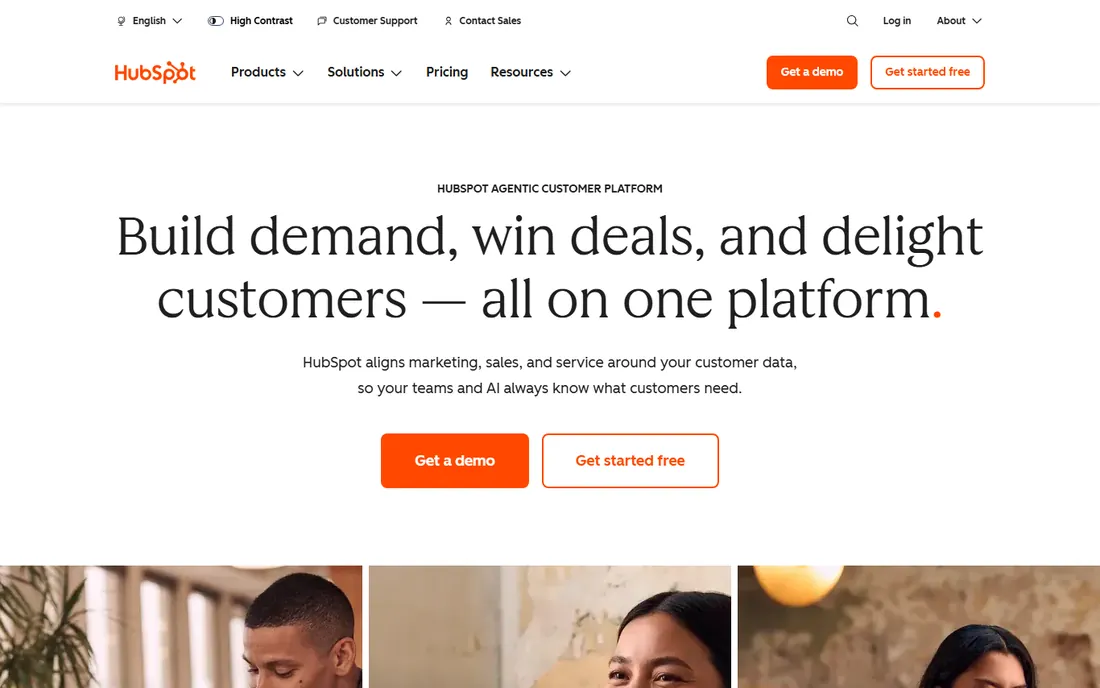
HubSpot's pitch is the unified customer platform: marketing, sales, service, content and data on one system, with a free Smart CRM at the center. Marketing Hub handles campaigns, lead nurturing, personalization and analytics, and the newer AI agents can resolve inquiries and flag interested accounts around the clock.
The free tier is genuinely useful for getting started, which is why so many small businesses begin here. The watch-out is cost at scale: HubSpot gets expensive as contact counts and hub tiers rise. For teams that want one platform for the whole customer journey and can grow into the pricing, it is the default enterprise-SMB choice.
What we like- Free CRM and marketing tools to start
- Marketing Hub connects with sales, service and content on one platform
- AI agents and strong analytics built in
Watch out for- Costs scale steeply as contacts and features grow
- The full platform is more than small teams need
- Paid tiers require careful plan math
Starting priceSee website
Free planNo
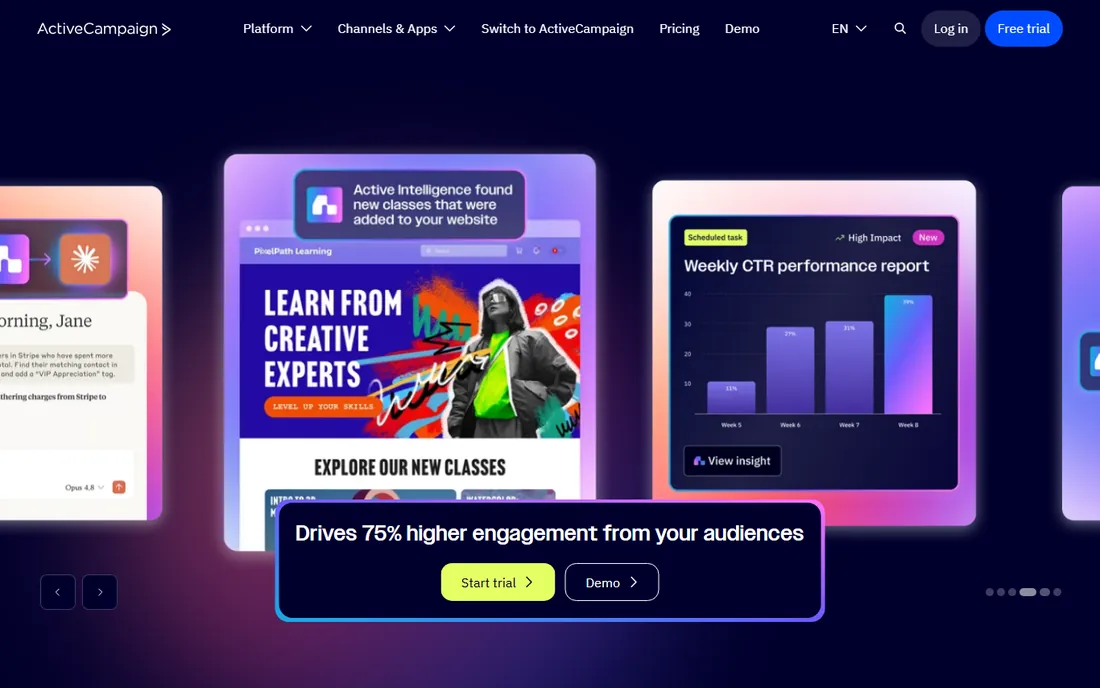
ActiveCampaign built its name on automation depth: multi-channel workflows that combine email, SMS and site messaging with detailed segmentation. The 2026 homepage leads with Active Intelligence, an AI layer that drafts campaigns, remembers context across workflows, tracks external signals like competitor moves, and runs scheduled tasks autonomously.
Pricing was not published on the homepage, so expect a quote or a visit to the pricing page. For marketers who have outgrown simple autoresponders and want automation they can shape precisely, ActiveCampaign remains the specialist's pick. Beginners should start with the trial and a simple welcome series.
What we like- Deep automation builder with a long reputation for flexibility
- Active Intelligence 3.0 adds AI that drafts campaigns and tracks external signals
- Works for any business type
Watch out for- Pricing is not published on the homepage
- The power brings a learning curve
- No permanent free tier
Starting priceFree (paid plans: Essentials, Standard, Premium; see website for current pricing)
Free planYes
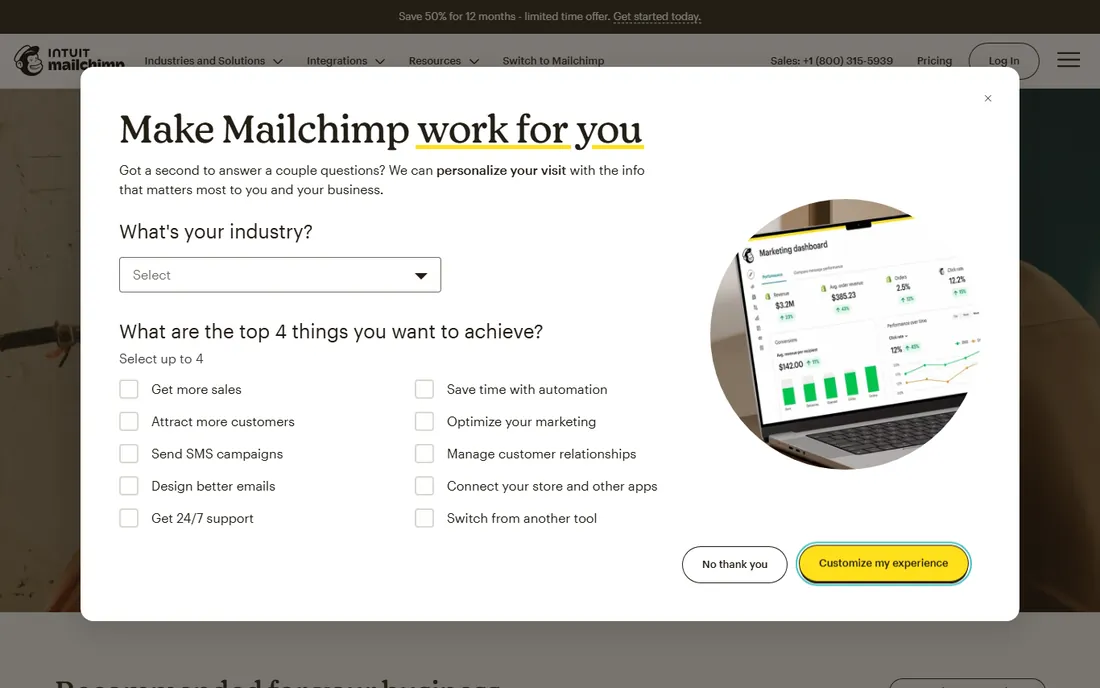
Mailchimp is the brand most small businesses know, and the free plan is why: start sending without a credit card, upgrade to Essentials, Standard or Premium as the list grows. The platform covers email and SMS, automations, AI-assisted content and analytics, positioned as marketing "minus the learning curve."
The pricing math deserves attention: Mailchimp gets pricey as contacts grow, which is the most common complaint. For small lists and straightforward needs, it is the easiest on-ramp in the category. Larger or more automation-hungry teams should compare ActiveCampaign or Brevo before committing.
What we like- Genuine free plan plus a 14-day Standard trial
- Intuitive builder with AI tools and analytics
- Email plus SMS in one platform
Watch out for- Costs rise quickly with list size
- Advanced automation trails ActiveCampaign and Klaviyo
- The Intuit-era interface changes divided some long-time users

#4
Brevo
Best for: Affordable multichannel marketing: email, SMS, WhatsApp and CRM
Visit brevo.com
Starting priceFree (paid plans, see website for current pricing)
Free planYes
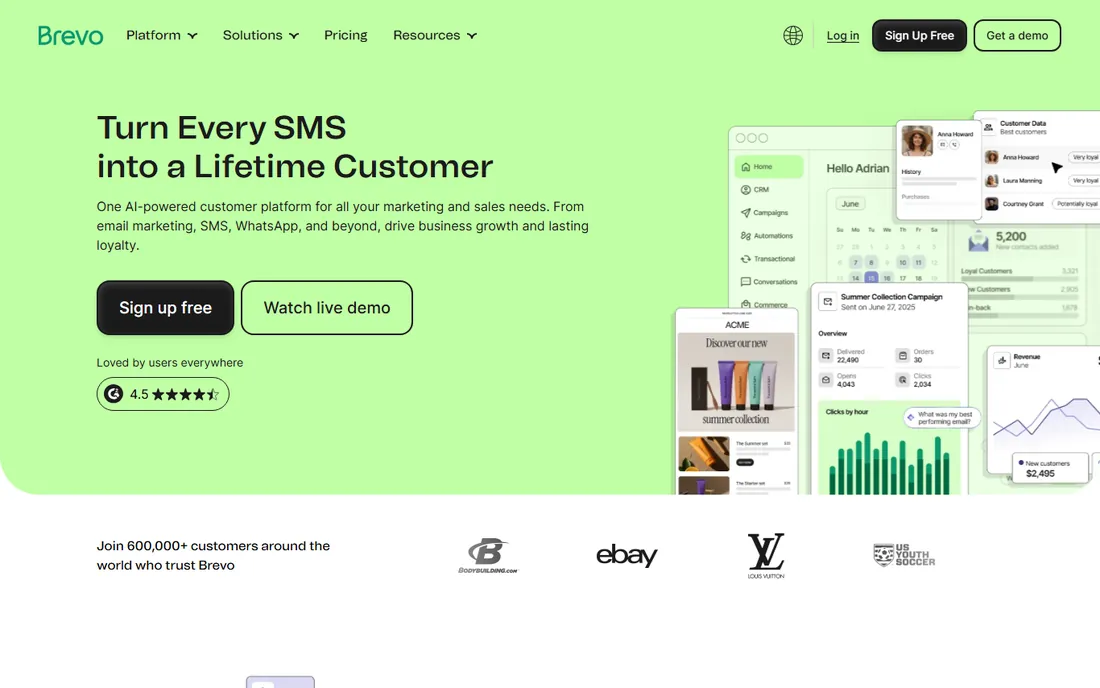
Brevo (formerly Sendinblue) is the value multichannel play: email, SMS, WhatsApp, automation, CRM and even loyalty tools in one AI-powered platform. The free plan lets small businesses start without budget approval, and the vendor's 600,000-customer claim indicates the platform handles real volume.
For businesses that need more than email, especially SMS and WhatsApp, without enterprise pricing, Brevo is a strong shortlist candidate. Compare the automation depth against ActiveCampaign during a trial, and confirm the channel pricing (SMS/WhatsApp credits) fits your volume before committing.
What we like- Free plan to start
- Email, SMS, WhatsApp, CRM and automation in one platform
- 600,000+ customers per the vendor suggests proven scale
Watch out for- Specific plan prices were not on the homepage
- The breadth means some depth trade-offs versus specialists
- Deliverability and support experiences vary by region

#5
Klaviyo
Best for: Ecommerce and B2C brands that want data-driven email and SMS
Visit klaviyo.com
Starting priceFree (paid plans scale by contacts and usage; see website for current pricing)
Free planYes
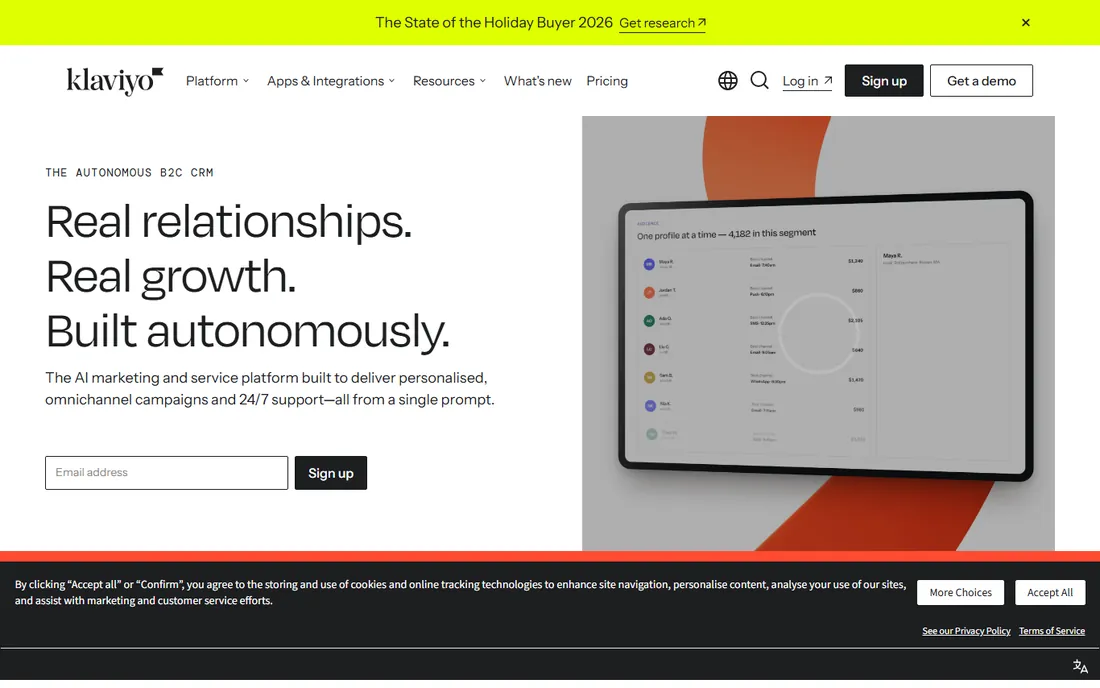
Klaviyo is the ecommerce marketer's CRM: it unifies customer data, email, SMS, push and WhatsApp, then automates around purchase behavior with flows for abandoned carts, post-purchase and win-back. The vendor confirms a free plan with core features, with paid plans scaling by contacts and usage. AI agents now draft campaigns and resolve service questions.
For Shopify stores and B2C brands, Klaviyo's purchase-data depth is the reason to choose it over generalists. The cost caution is real: as the list and SMS volume grow, so does the bill. Model pricing at your 12-month projected list size, not today's.
What we like- Free plan with core features confirmed on the vendor's site
- Deep Shopify and ecommerce integrations
- AI agents and predictive analytics built for revenue
Watch out for- Pricing scales with contacts and channel usage, so costs grow with success
- B2C/ecommerce focus means B2B teams get less
- SMS costs add up fast

#6
GetResponse
Best for: Email plus extras: landing pages, funnels, webinars and SMS
Visit getresponse.com
Starting priceSee website
Free planFree trial (14 days)
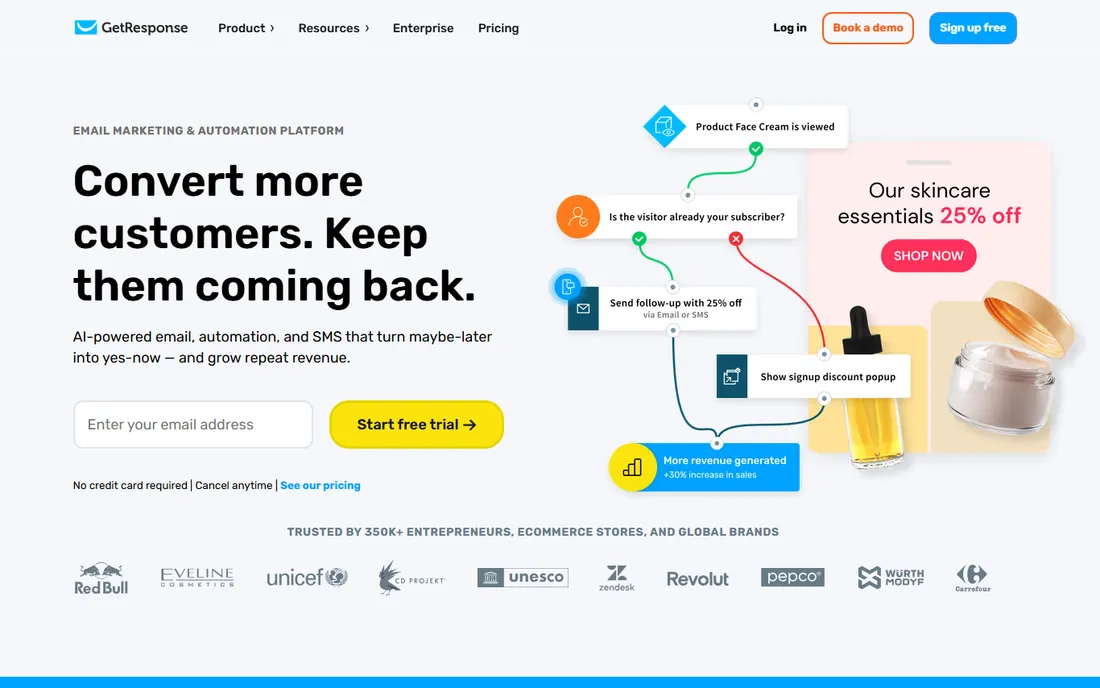
GetResponse bundles more than email: marketing automation, landing pages, conversion funnels, webinars, SMS, web push and AI tools for copy, send-time optimization and product recommendations. The 99% deliverability claim and 150+ integrations suggest a mature platform, and the free 14-day trial needs no credit card.
It suits small businesses that want one tool for email plus lead capture plus webinars, rather than stitching three tools together. Pure automation power users should compare ActiveCampaign; ecommerce-first teams should compare Klaviyo. For the all-rounder buyer, GetResponse's bundle is genuinely convenient.
What we like- Free 14-day trial with no credit card
- Landing pages, sales funnels and webinars built in
- AI tools for content, send-time and product recommendations
Watch out for- Pricing not published on the homepage
- The webinar feature is unusual in the category but adds complexity
- Automation depth trails the specialists

#7
Drip
Best for: Ecommerce email marketing with smart segmentation
Visit drip.com
Starting priceSee website
Free planFree trial (14 days)
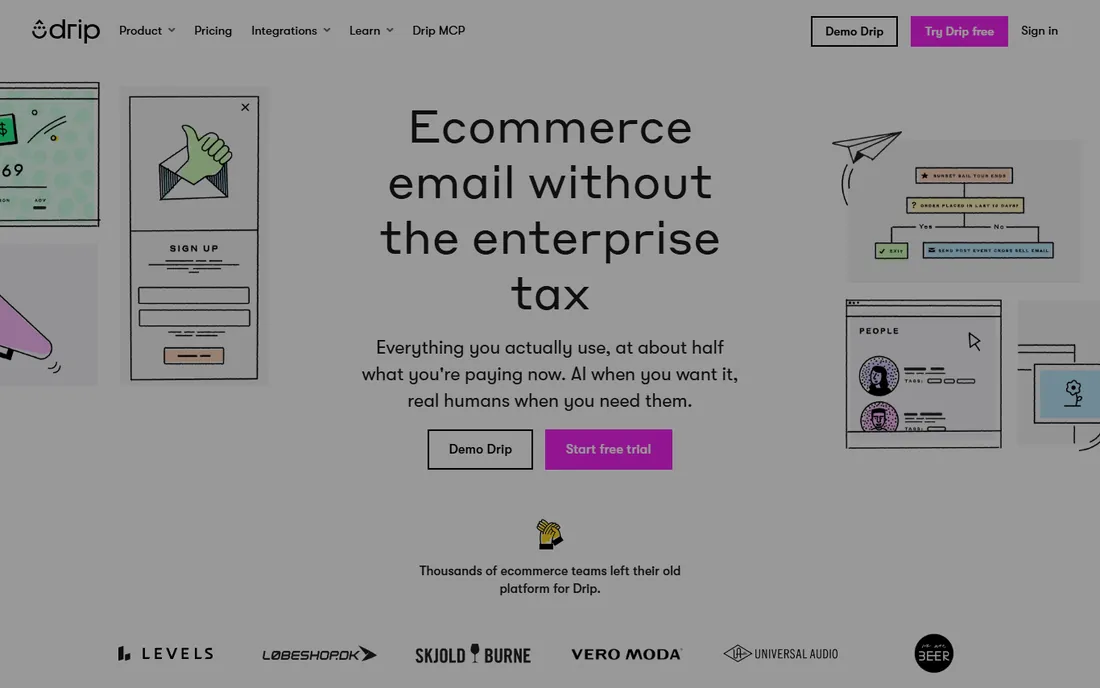
Drip positions itself as the ecommerce email platform for B2C businesses selling digital or physical goods: smart segmentation, prebuilt workflows, and automation that turns prospects into repeat buyers. The free 14-day trial gets stores running quickly, and the MCP connector lets you query your Drip data from Claude or ChatGPT.
The Klaviyo comparison is unavoidable: similar audience, similar features. Drip's pitch is power without enterprise complexity or cost. Ecommerce teams should trial both with their actual store data and compare the workflow builders, segmentation and pricing at their list size before choosing.
What we like- Built for ecommerce with 50+ integrations including Shopify and WooCommerce
- Smart segmentation with strong revenue claims
- Free 14-day trial and an MCP connector for AI assistants
Watch out for- Pricing not published on the homepage
- Ecommerce focus limits B2B fit
- The feature set overlaps Klaviyo heavily, so trial both

#8
Keap
Best for: Small businesses that want CRM and automation in one place
Visit keap.com
Starting priceSee website
Free planNo
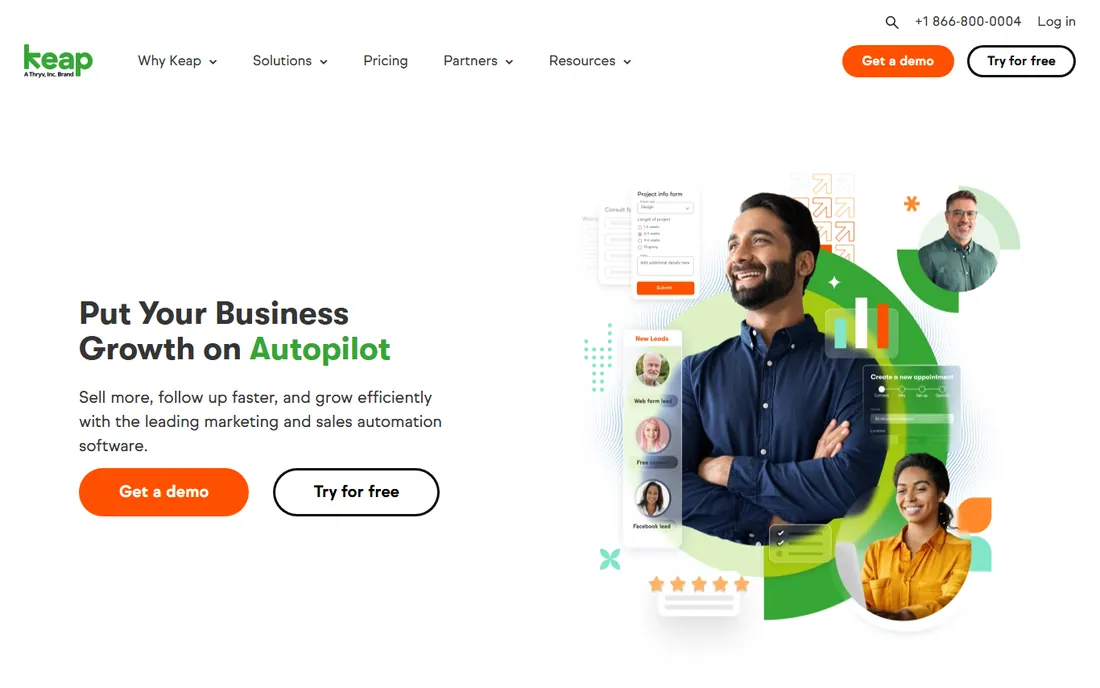
Keap (formerly Infusionsoft, now a Thryv brand) is the small-business automation veteran: CRM plus marketing, sales and service automation in one system, with a drag-and-drop builder and pre-built templates. The pitch is the fully automated customer experience: attract leads, nurture them, and keep them, without manual follow-up.
Pricing was not published on the homepage. Keap suits service businesses and small teams that want one system for contacts and automation rather than a separate CRM and email tool. Larger teams or pure ecommerce players will find HubSpot or Klaviyo a better fit.
What we like- Combines CRM with marketing and sales automation for small business
- Drag-and-drop automation builder
- 20+ years serving small businesses with 5,000+ integrations
Watch out for- Pricing not published on the homepage
- Small-business focus means less depth for mid-market teams
- The Infusionsoft legacy means some users remember a steeper learning curve
How we chose
We defined automated marketing software as platforms that automate marketing communications and workflows: email automation, multichannel campaigns, lead nurturing and segmentation. Pure CRMs without marketing automation and pure email-sending APIs did not qualify. For each candidate we opened the vendor's homepage, confirmed the product is current, and recorded pricing and free-tier terms only where the vendor publishes them.
Quick comparison
| Tool | Best for | Starting price | Free plan |
|---|
| HubSpot | Teams that want marketing automation inside a full customer platform | Free (free tools and CRM; paid hubs, see website for current pricing) | Yes |
 ActiveCampaign ActiveCampaign | Sophisticated email automation with AI that drafts ahead of you | See website | No |
 Mailchimp Mailchimp | Easy email and SMS marketing with a real free plan | Free (paid plans: Essentials, Standard, Premium; see website for current pricing) | Yes |
| Brevo | Affordable multichannel marketing: email, SMS, WhatsApp and CRM | Free (paid plans, see website for current pricing) | Yes |
| Klaviyo | Ecommerce and B2C brands that want data-driven email and SMS | Free (paid plans scale by contacts and usage; see website for current pricing) | Yes |
| GetResponse | Email plus extras: landing pages, funnels, webinars and SMS | See website | Free trial (14 days) |
| Drip | Ecommerce email marketing with smart segmentation | See website | Free trial (14 days) |
| Keap | Small businesses that want CRM and automation in one place | See website | No |
Is your product missing or out of date?
We review this list regularly. Vendors can request a listing, send updated pricing or ask about featured placement.
Automation depth versus ease: the real trade-off
The category splits on a single axis: how much control you get versus how fast you can start. ActiveCampaign and Klaviyo offer deep automation: branching workflows, detailed segmentation, behavioral triggers. That power takes learning. Mailchimp and Brevo offer guided simplicity: templates, simple builders, faster first campaigns. Neither end is better; they serve different teams.
The practical question is who runs it. A dedicated marketer with automation experience will be frustrated by a simple tool within months. A founder doing marketing part-time will abandon a complex tool within weeks. Match the platform's ceiling to the operator's skill, not to the feature list. You can always migrate up; you cannot recover the quarter lost to a tool nobody uses.
Start with your business type. Ecommerce and B2C: Klaviyo or Drip, trialed against each other with real store data. Small service businesses wanting CRM plus automation: Keap or HubSpot's free tier. Budget-conscious multichannel: Brevo. Email-first simplicity: Mailchimp. Automation depth: ActiveCampaign. Email plus landing pages and webinars in one: GetResponse.
Then evaluate the money honestly. Model pricing at your projected 12-month contact count and sending volume, including SMS, which is priced separately almost everywhere and adds up fast. Run the trial with a real campaign, not a test list: build the welcome series, connect the store, and send to a segment. The platform that gets a working automation live fastest, with your data, is usually the right one.
Frequently asked questions
What is the difference between email marketing and marketing automation?
Email marketing is sending campaigns to a list. Marketing automation is the system around it: triggers, segmentation, lead scoring, multichannel follow-up and CRM integration that respond to contact behavior automatically. Every tool on this list does both, but the automation depth varies enormously, from Mailchimp's guided flows to ActiveCampaign's branching workflows.
How much does marketing automation software cost?
Free plans exist (HubSpot, Mailchimp, Brevo, Klaviyo), and trials cover the rest. Paid plans typically start around $15-50 per month for small lists and scale with contacts and features; enterprise tiers run into the thousands. SMS is almost always billed separately by usage. Always model pricing at your projected list size, since contact-based pricing is where bills surprise people.
Do I need a CRM too, or is the marketing platform enough?
HubSpot and Keap include a real CRM. Klaviyo functions as a B2C CRM. The email-focused tools (Mailchimp, Brevo, GetResponse, Drip, ActiveCampaign) store contacts and handle marketing, but sales teams usually pair them with a dedicated CRM. If marketing and sales share one system, start with HubSpot or Keap; if marketing runs separately, any of the others plus your existing CRM works.
How long does it take to set up marketing automation?
A basic welcome series and abandoned-cart flow can go live in a day on any of these platforms. A full nurture program with segmentation, lead scoring and CRM integration takes two to six weeks. The bottleneck is rarely the software: it is having the content, the segments defined, and clean contact data. Migrate and clean the list before you build.
Will AI features actually help my marketing?
The useful ones save time on drafts, segmentation and send-time optimization; the hype ones promise autonomous growth. Klaviyo's and ActiveCampaign's AI drafting, Brevo's send-time optimization and HubSpot's agents are genuinely time-saving for small teams. Treat AI output as a first draft, review everything before sending, and measure whether the AI-assisted campaigns actually outperform your manual ones.
Sources we checked (8)
- https://hubspot.com/
- https://activecampaign.com/
- https://mailchimp.com/
- https://www.brevo.com
- https://www.klaviyo.com
- https://www.getresponse.com
- https://drip.com/
- https://keap.com
Is your product missing or out of date?
We review this list regularly. Vendors can request a listing, send updated pricing or ask about featured placement.

Shihab Mia · Founder, Rankite
Shihab has spent more than a decade helping SaaS and e-commerce brands grow through search. He writes Rankite's software buying guides from pricing pages, documentation and public user reviews. More about Shihab.