How we make this list: we compare pricing pages, product documentation and public user reviews. Rankite is independent; if a vendor ever pays for a featured spot, that listing is clearly labeled Partner.
Key takeaways
- Do not buy an influencer management platform yet. Run ten manual partnerships first with DMs, a spreadsheet and promo codes. If you cannot make the channel work by hand, software will not fix it. Platforms are for scale, not for proof.
- Once you scale, pricing splits hard: GRIN publishes self-serve tiers from $200/month month-to-month, Modash lists $199/month billed annually, and Shopify Collabs is free for Shopify merchants.
- The enterprise tier (CreatorIQ, Traackr, Aspire, Upfluence, Later) sells by quote with annual contracts, typically starting around $2,000/month.
- Discovery databases and creator marketplaces solve different problems: databases help you find creators, marketplaces let creators find you. Know which you need.
Quick comparison
| Tool | Best for | Starting price | Free plan |
|---|
 GRIN GRIN | DTC brands scaling creator programs | $200/month (Starter) | Yes (free tier) |
 Modash Modash | Creator discovery and vetting | $199/month (billed annually) | Free trial (14 days) |
 Shopify Collabs Shopify Collabs | Shopify merchants starting free | Free | Yes |
 Upfluence Upfluence | Finding influencers among your customers | See website | No |
 Aspire Aspire | Inbound creator marketplace | See website | No |
 CreatorIQ CreatorIQ | Enterprise global programs | See website | No |
 Traackr Traackr | Data-driven creator vetting | See website | No |
 Later Influence Later Influence | Ambassador and community programs | See website | No |
 impact.com impact.com | Affiliate and partnership scale | See website | No |
Is your product missing or out of date?
We review this list regularly. Vendors can request a listing, send updated pricing or ask about featured placement.
Influencer management platforms handle the full creator lifecycle: discovering influencers, vetting their audiences, outreach and contracting, product gifting, content approvals, payments, and measuring revenue per creator. The market splits between e-commerce-native platforms (GRIN, Upfluence, Aspire, Shopify Collabs), discovery-first tools (Modash, Traackr), and enterprise systems (CreatorIQ, Later, impact.com). Nine tools.
#1
GRIN
Best for: DTC brands scaling creator programs
Visit grin.co
Starting price$200/month (Starter)
Free planYes (free tier)
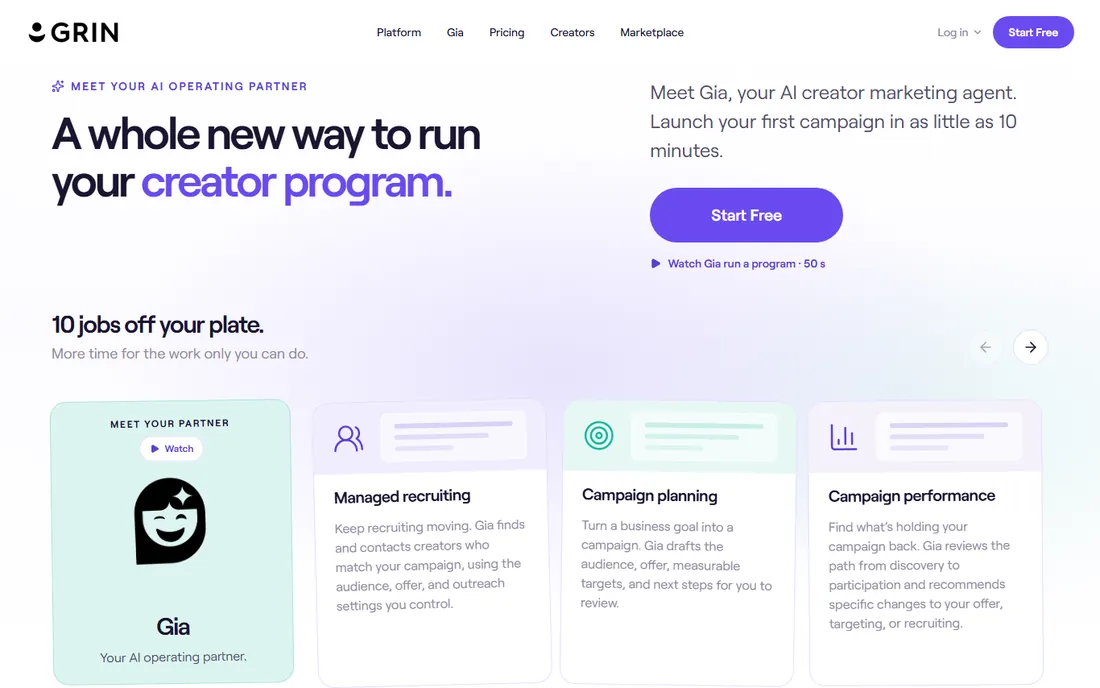
GRIN is the e-commerce standard for influencer programs, and in 2026 it did something rare in this category: it published self-serve pricing. Free at $0, Starter at $200/month, Growth at $500/month and Scale at $1,000/month, all month-to-month with no annual commitment. The platform covers discovery across 32M+ profiles, outreach, product seeding, affiliate codes, creator payments and sales reporting tied to Shopify order data.
The credit-based model means heavy months cost more, and the free tier's 50 monthly credits are a trial, not a program. But transparent pricing plus commerce-native execution (gifting automation, discount codes, revenue attribution) makes GRIN the default evaluation for DTC brands running 20+ creator partnerships. Annual-contract competitors now have to explain why they still hide their prices.
What we like- Published month-to-month pricing with no annual contract required
- Deep Shopify and WooCommerce integrations tying creators to order revenue
- Built-in seeding, payments and 1099 processing
Watch out for- The free tier is limited (50 monthly credits)
- Real program management needs the paid tiers
- Enterprise features still cost more
Starting price$199/month (billed annually)
Free planFree trial (14 days)
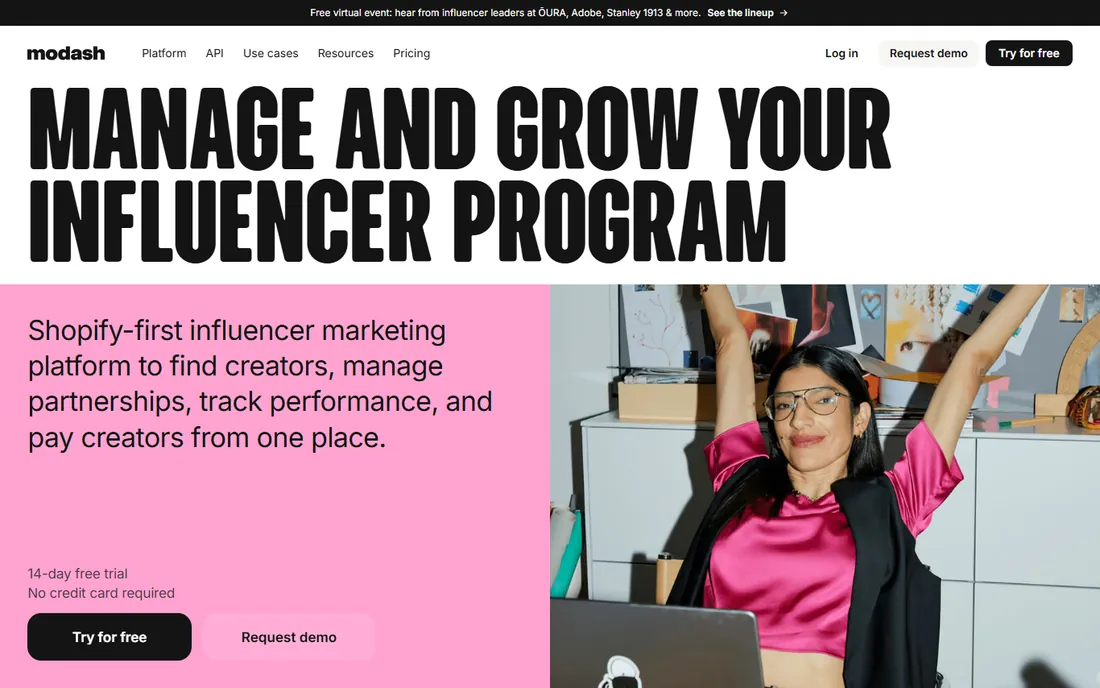
Modash is a discovery-first tool: the clearest example of self-serve influencer software. You sign up, search 250M+ creator profiles with detailed audience analytics, check authenticity scores and fake-follower rates, and export lists. Pricing is public at $199/month billed annually ($299 monthly), with a 14-day trial.
The limitation is scope: Modash finds and vets creators but does not manage the relationship. Outreach, gifting, contracts and payments happen elsewhere, which means pairing it with a CRM, a platform like GRIN, or disciplined spreadsheets. For brands whose problem is "find the right creators and avoid fakes," it is the best value in the category. For full lifecycle management, look at GRIN or Aspire.
What we like- A 250M+ creator database with strong fake-follower detection
- Transparent pricing at $199/month annual
- Fast, self-serve signup with no sales call
Watch out for- Campaign management features are basic
- Outreach happens outside the platform
- Limited e-commerce integrations
Starting priceFree
Free planYes
Shopify Collabs is the free on-ramp the category needed: any Shopify merchant can set up a creator application page, recruit affiliates, send gifted products and track sales through Shopify, all at no extra cost. For stores testing whether creator partnerships drive revenue, it removes every excuse.
The ceiling is real. Discovery is limited compared to Modash or GRIN, analytics are basic, and flat-fee campaign management is not its strength. It is an affiliate and gifting tool, not a full influencer platform. But as a starting point, or as the affiliate layer under a bigger program, free is a compelling price. Prove the channel here, then graduate.
What we like- Free for Shopify merchants with no platform fee
- Creators apply through an application page
- Affiliate and gifting workflows built into Shopify
Watch out for- Only useful inside the Shopify ecosystem
- Discovery and analytics are lighter than dedicated platforms
- Best for affiliates, less for flat-fee campaigns
Starting priceSee website
Free planNo
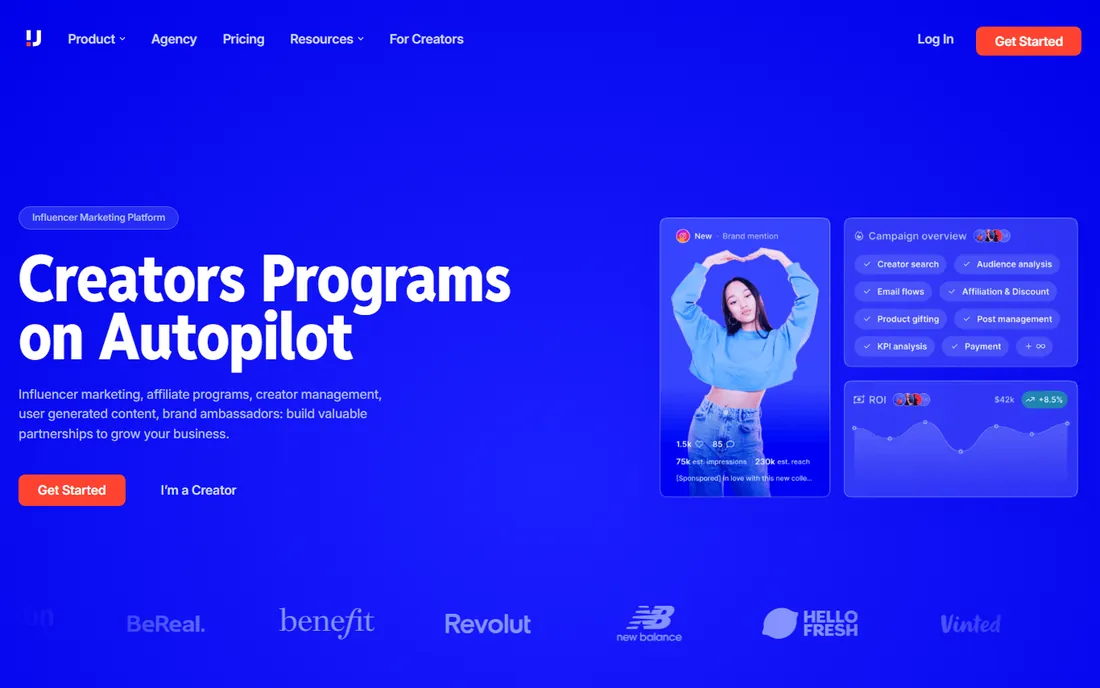
Upfluence's distinctive idea is that your best creators might already be customers. Its integrations with Shopify, WooCommerce and Klaviyo surface influential people inside your existing buyer and subscriber lists, and Live Capture spots creators browsing your site. The platform then handles the standard lifecycle: discovery across 12M+ profiles, outreach sequences, gifting, affiliate tracking and creator payments with tax support.
The buying experience is the category's worst habit: no public pricing, demo-gated sales, annual contracts. Reported entry points range from a few hundred to a few thousand per month depending on modules. For e-commerce brands whose customer base is the creator pool, the discovery angle justifies the sales call. Everyone else should compare GRIN's published pricing first.
What we like- Live Capture identifies influencers already visiting your site or buying your products
- Deep Shopify, Amazon and Klaviyo integrations
- Full campaign workflow with payments
Watch out for- No published pricing, everything through sales on annual contracts
- User reports put entry around $800-$3,500/month
- Modular pricing gets complex
Starting priceSee website
Free planNo
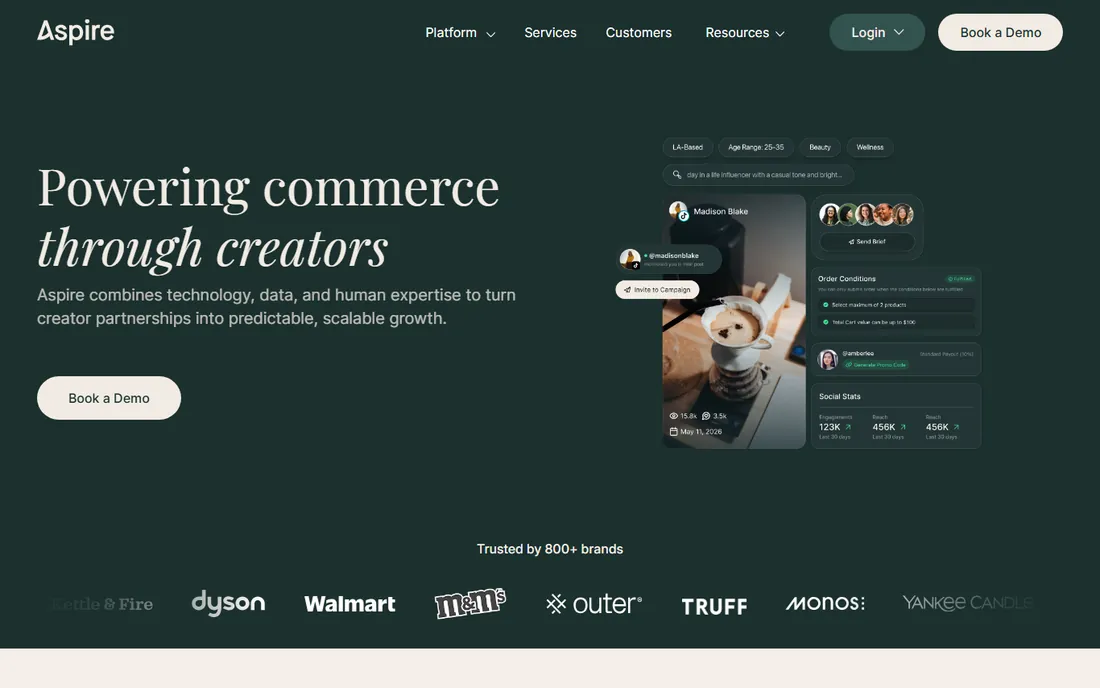
Aspire flips the discovery model: instead of only hunting creators, you post campaigns to its marketplace and creators apply. For brands with real visibility, inbound applications deliver better brand alignment and higher response rates than cold outreach, and the platform covers the full workflow from contracts to payments to affiliate tracking.
The catch is the price of admission: roughly $2,000/month minimum on annual contracts, per multiple 2026 analyses. The marketplace benefit also depends entirely on your brand's pull; unknown brands still hunt outbound. For established DTC brands building ambassador communities and always-on UGC engines, Aspire's model is differentiated. Smaller brands should start cheaper.
What we like- A 1M+ creator marketplace where influencers apply to your campaigns
- Strong UGC collection and content-rights workflows
- Good for ambassador programs
Watch out for- Entry around $2,000/month on annual contracts prices out small brands
- The marketplace only works if your brand attracts applicants
- CRM can feel rigid at scale
Starting priceSee website
Free planNo
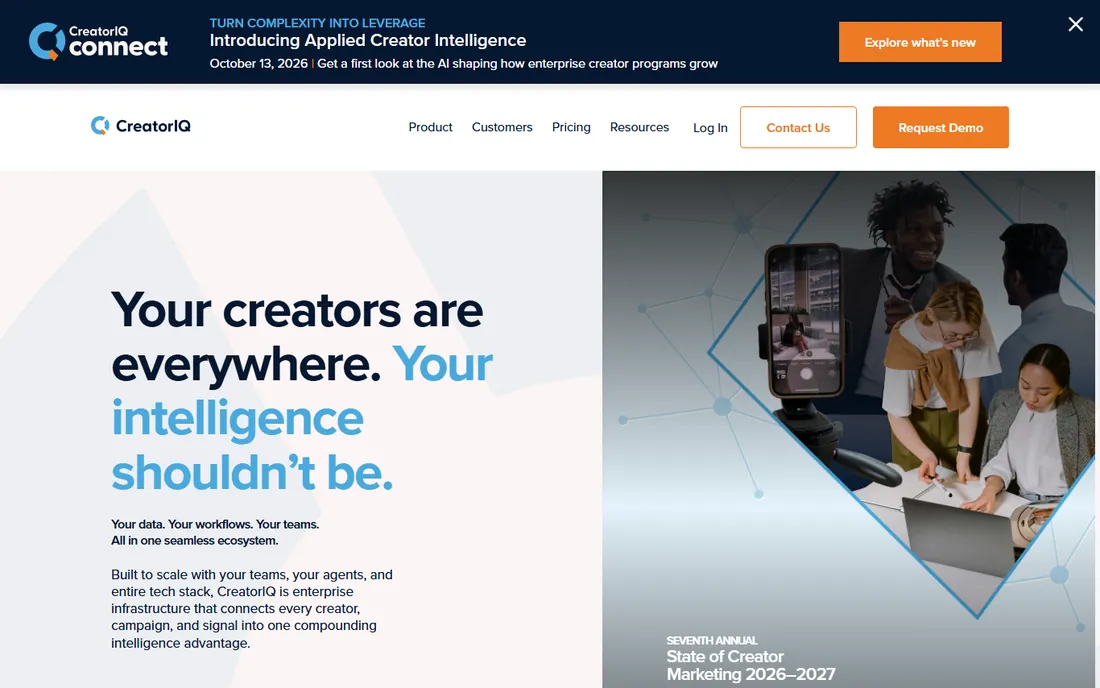
CreatorIQ is what large enterprises buy when influencer marketing becomes a global program: direct platform API integrations for reliable data, customizable dashboards, multi-market campaign management, payment processing with tax compliance, and the security reviews enterprise procurement demands. Big brands and their agencies standardize on it.
Everything about the commercial model is enterprise: custom quotes, annual commitments, implementation managers. There is no trial and no self-serve path. Industry analyses place entry in the low thousands per month at minimum. If you run influencer programs across regions with hundreds of creators, CreatorIQ is the shortlist. Under that scale, it is too much platform and too much contract.
What we like- The enterprise standard with direct API integrations to Meta, TikTok and YouTube
- Customizable reporting and global payment infrastructure
- Strong brand-safety tooling
Watch out for- Quote-only pricing with annual (often multi-year) contracts
- Overkill for programs under 50 creators
- Implementation takes weeks
Starting priceSee website
Free planNo
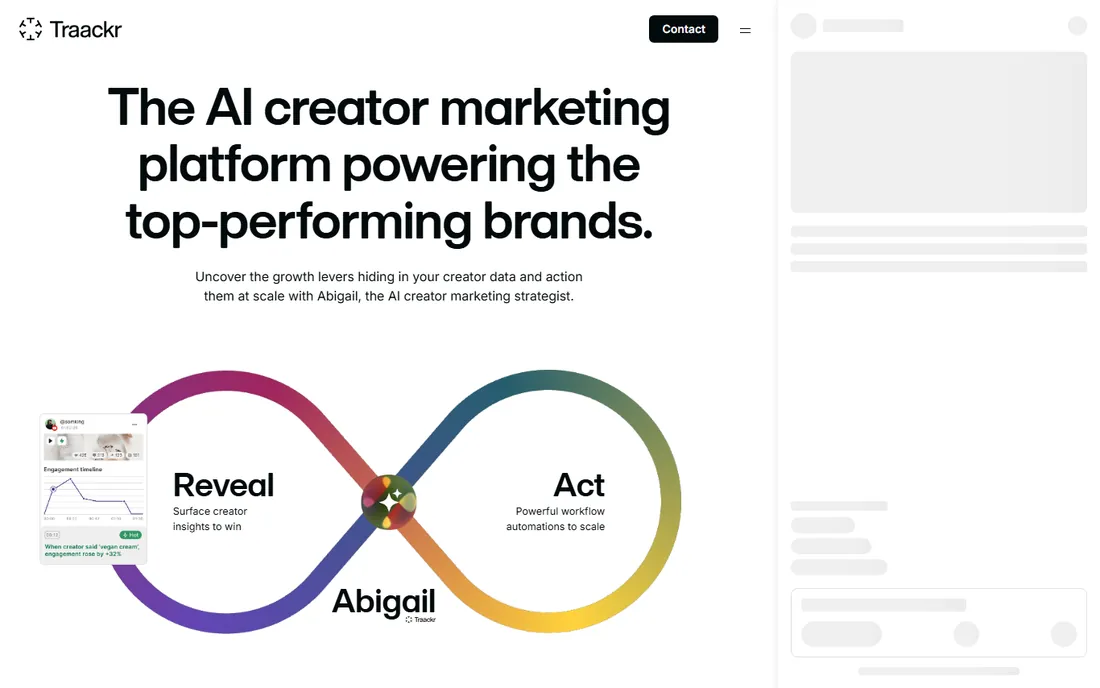
Traackr built its reputation on data: audience authenticity analysis, fake-follower detection, brand-safety scoring and competitive benchmarking that comms and compliance teams trust. Regulated industries and PR-driven organizations use it to vet creators rigorously before any partnership, and to benchmark share of voice against competitors.
It is less of an execution platform than GRIN or Aspire: outreach, gifting and payments are thinner. Pricing is quote-based with annual contracts. For teams where the question is "which creators are safe and genuinely influential" rather than "how do we manage 200 affiliates," Traackr's analytics lead. Pair it with an execution tool or accept the manual workflows.
What we like- Among the strongest influencer vetting and audience-quality analytics
- Good for regulated industries needing compliance controls
- Solid competitive benchmarking
Watch out for- Quote-based annual pricing
- Campaign execution features trail the e-commerce platforms
- The analytics depth needs dedicated users
#8
Later Influence
Best for: Ambassador and community programs
Visit later.com
Starting priceSee website
Free planNo
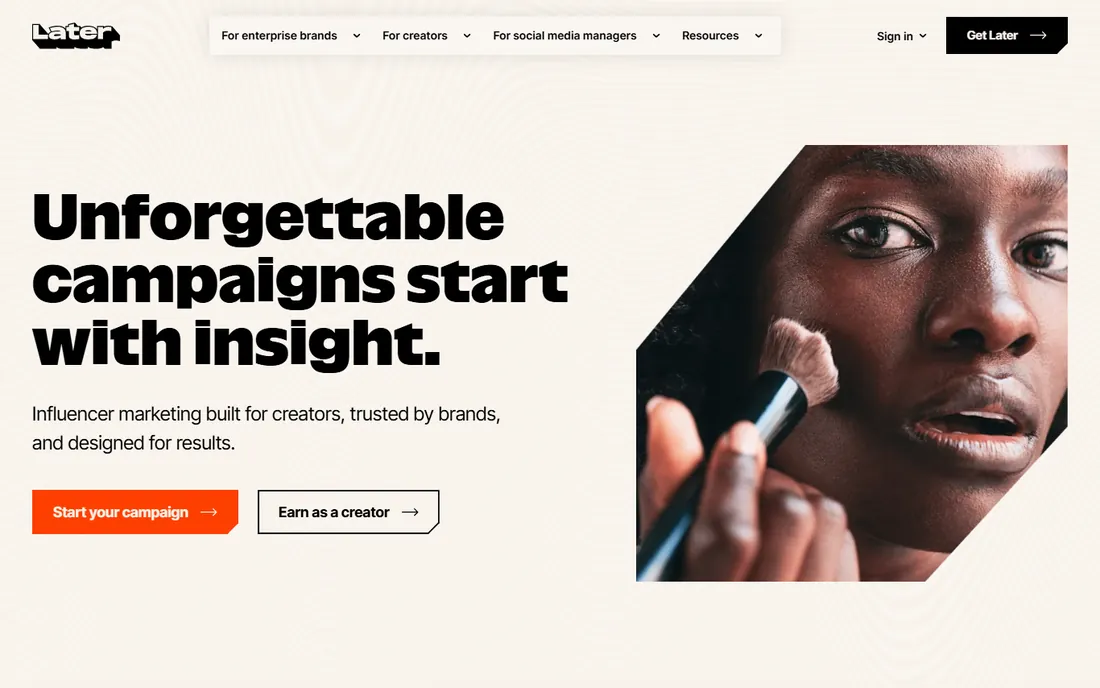
Later Influence (formerly Mavrck, now part of Later) targets the always-on end of the market: brands running ambassador communities of thousands, with referral programs, product feedback loops and content rights management for turning creator posts into paid ads. Enterprise retail and lifestyle brands use it as community infrastructure.
Pricing is custom and enterprise-leaning, and the platform assumes program scale that most SMBs do not have. For community-led brands where creators are an ongoing channel rather than a campaign tactic, it is purpose-built. For everyone else, the campaign-oriented platforms fit better.
What we like- Built for large ambassador communities and always-on programs
- Digital rights management for repurposing creator content
- Referral and feedback tooling
Watch out for- Custom enterprise pricing
- Geared toward big programs, not campaign-by-campaign buyers
- The Later acquisition reshaped packaging
Starting priceSee website
Free planNo
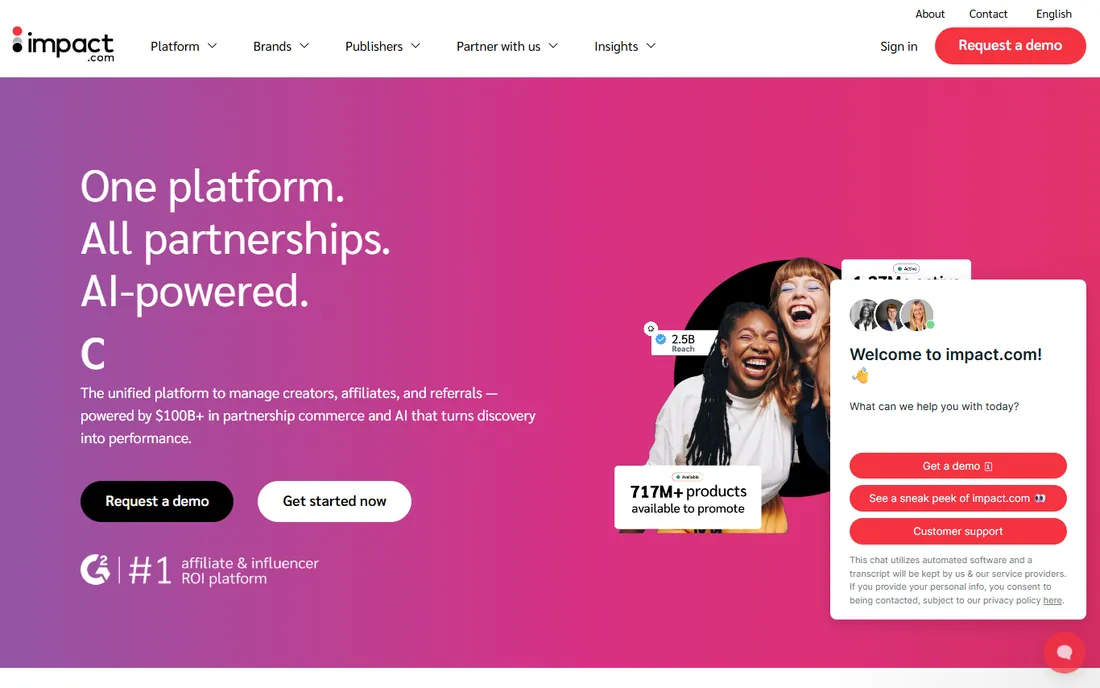
impact.com is the partnership platform that influencer programs graduate into when affiliate economics take over. It manages the full partnership lifecycle, discovery, contracting, tracking, payments, across affiliates, influencers, brand-to-brand deals and even traditional media partners, with the tracking and payout infrastructure to run it at scale.
It is not a pure influencer tool: creator-specific workflows like content approvals and gifting are less specialized than GRIN or Aspire. Pricing is quote-based. For brands where creators are one channel inside a larger partnerships strategy, impact.com unifies everything. For pure creator programs, the dedicated platforms stay sharper.
What we like- The leading partnership automation platform spanning affiliates, influencers and brand partnerships
- Dependable tracking and payout infrastructure
- Massive partner network
Watch out for- Quote-based pricing
- Broader than pure influencer management, so creator workflows are less specialized
- Implementation effort for full deployment
How we chose
We verified GRIN's published self-serve pricing and Modash's public pricing against 2026 pricing analyses, confirmed Shopify Collabs is free for merchants, and marked the rest "See website" because none publish prices. We weighted e-commerce integration depth, discovery quality, fake-follower detection, payment and tax handling, and contract flexibility. We read vendor documentation and public reviews on G2 and Capterra plus practitioner discussions on Reddit for the recurring themes: hidden pricing, annual-contract lock-in, attribution reliability and the manual-work reality behind "automated" outreach. We included free and self-serve options because most programs should start there.
How to choose without overbuying
Match the platform to your program stage, not your aspirations. Under 20 creators: Shopify Collabs (free), Modash for discovery ($199/month), and spreadsheets. You do not need a $2,000/month platform to manage fifteen relationships. At 20-100 creators with e-commerce attribution needs: GRIN's published tiers are the value benchmark. Past 100 creators, or multi-region, or compliance-heavy: the enterprise tier (CreatorIQ, Traackr, Later, Aspire) earns its keep.
Second, interrogate the contract. Annual commitments are the norm at the enterprise tier, and influencer programs change fast: creators churn, budgets shift, strategies pivot. Prefer month-to-month where it exists (GRIN's self-serve tiers), and never sign an annual contract before a paid pilot with real creators and real content.
Third, verify attribution before you trust it. Every platform claims revenue tracking; the quality ranges from promo-code counting to true incrementality. Ask exactly how a sale gets credited to a creator, what happens with multi-touch journeys, and whether you can export the raw data. If the answers are vague, the ROI reports will be too.
The marketplace vs database decision
Discovery comes in two flavors and they solve different problems. Databases (Modash, Traackr, GRIN's search) let you hunt: filter 250M profiles by niche, engagement, audience demographics and authenticity, then outreach outbound. You control targeting completely, but every relationship starts cold.
Marketplaces (Aspire's creator marketplace, Shopify Collabs' application page, #paid-style networks) let creators come to you: post a brief, receive applications, pick fits. Response rates and brand alignment run higher because creators opt in, but you only see creators who want to work with you, which skews toward smaller and mid-tier.
Most mature programs use both: databases for strategic targets and competitive conquests, marketplaces for volume and UGC. If you must pick one, pick the database when your brand is unknown (nobody applies to brands they have never heard of) and the marketplace when your brand has pull. Either way, vetting, fake followers, audience quality, engagement authenticity, is non-negotiable.
Frequently asked questions
How much do influencer marketing platforms cost?
Self-serve options publish prices: GRIN from $200/month, Modash $199/month billed annually, Shopify Collabs free for merchants. Enterprise platforms (CreatorIQ, Traackr, Aspire, Upfluence, Later) sell by quote on annual contracts, typically starting around $2,000/month. Creator payments are always separate from platform fees.
Should small businesses use influencer platforms?
Start without one. Run 10-20 manual partnerships with DMs, promo codes and a spreadsheet to prove the channel. When manual management breaks (usually around 20+ active creators), buy the cheapest platform that solves your actual bottleneck: discovery (Modash), affiliate management (Shopify Collabs), or full lifecycle (GRIN).
How do platforms detect fake followers?
They analyze engagement patterns, follower growth anomalies, audience authenticity signals and comment quality using platform API data. No detection is perfect, but dedicated tools (Modash, Traackr, HypeAuditor) are meaningfully better than eyeballing follower counts. Treat audience quality reports as a filter, not a verdict.
Do influencer platforms handle creator payments and taxes?
The full-lifecycle platforms do: GRIN, Upfluence, Aspire and CreatorIQ process creator payments and support tax documentation (W-9 collection, 1099 filing for US creators). Discovery-only tools do not. If you pay creators directly, confirm who handles compliance before you sign.
What is the difference between influencer marketing and affiliate marketing platforms?
They are converging. Influencer platforms manage creator relationships, content and flat-fee campaigns; affiliate platforms track performance-based payouts. Modern tools blend both: creators get flat fees plus affiliate commissions. impact.com approaches from the affiliate side, GRIN and Upfluence from the influencer side.
How do you measure influencer ROI?
Track promo-code redemptions and UTM-attributed revenue per creator as the baseline, add brand-lift signals (follower growth, engagement, content reuse value), and compare against the all-in cost: platform fees plus creator payments plus product costs. Be skeptical of platform-reported ROI that you cannot reconcile with your own analytics.
Sources we checked (20)
- https://www.storika.ai/guides/micro-influencer-program-costs-2026
- https://www.influencer-hero.com/blogs/top-10-campaygn-alternatives-for-effective-influencer-marketing-pricing-reviews
- https://ecommercefastlane.com/top-best-influencer-marketing-tools-ecommerce-dtc/
- https://toolradar.com/guides/best-influencer-marketing-platforms
- https://influencerfee.com/blog/influencer-marketing-platforms-comparison/
- https://hypefy.ai/blog/best-influencer-marketing-platform-for-us-brands
- https://medium.com/@creatoreconomybrief/the-best-tools-to-manage-influencer-marketing-campaigns-in-2026-9562a043a965
- https://stackinfluence.com/blog/influencer-marketing-platform-pricing
- http://fenced.ai/blogs/top-10-influencer-marketing-platforms-in-2026/
- https://www.scrumball.com/blog/top-15-influencer-marketing-platforms
- https://hypefy.ai/blog/best-influencer-marketing-platform-for-mid-size-brands
- https://www.grin.co
- https://www.modash.io
- https://www.shopify.com
- https://www.upfluence.com
- https://www.aspire.io
- https://www.creatoriq.com
- https://www.traackr.com
- https://www.later.com
- https://www.impact.com
Is your product missing or out of date?
We review this list regularly. Vendors can request a listing, send updated pricing or ask about featured placement.

Shihab Mia · Founder, Rankite
Shihab has spent more than a decade helping SaaS and e-commerce brands grow through search. He writes Rankite's software buying guides from pricing pages, documentation and public user reviews. More about Shihab.