How we make this list: we compare pricing pages, product documentation and public user reviews. Rankite is independent; if a vendor ever pays for a featured spot, that listing is clearly labeled Partner.
Key takeaways
- Independent shops that do mostly retail work: Web-Est (from vendor site, priced for independents) or ALLDATA Collision ($249/month) pair well with CCC ONE or Mitchell if you also need insurer-facing estimates.
- CCC ONE, Mitchell Cloud Estimating and Audatex are the three insurer-accepted estimating platforms; you usually pick the one your DRP or biggest carrier wants.
- ALLDATA Collision is the only one here that exists to make estimates OEM-compliant, with an estimator included and a $99/month add-on that flags required OEM procedures line by line.
- Tekmetric, Shop-Ware and AutoFluent are shop management systems with estimating built in; they make sense when you want one system for estimates, repair orders and payments, not just estimating.
- Every one of the big three is quote-based, so get the full per-estimate and per-user math in writing before you commit.
Quick comparison
| Tool | Best for | Starting price | Free plan |
|---|
 CCC ONE CCC ONE | Body shops that work with insurers and DRP networks | See website (custom quote) | No |
 Web-Est Web-Est | Independent shops that want estimating without insurer pricing pressure | See website | Free trial |
 Mitchell Cloud Estimating Mitchell Cloud Estimating | Shops that want estimating tied to diagnostics and repair data | See website (custom quote) | Promo (2 free months with 24-month contract) |
 Audatex Audatex | Shops and appraisers inside the Solera and insurer ecosystem | See website (custom quote) | No |
 ALLDATA Collision ALLDATA Collision | Shops that want every estimate backed by OEM repair procedures | $249/month (ALLDATA Collision) | No |
 Tekmetric Tekmetric | General repair shops that write estimates as part of full shop management | See website | No |
 Shop-Ware Shop-Ware | Shops that want cloud-based repair orders with strong customer experience | See website | Free trial (per reviewers) |
 AutoFluent AutoFluent | Independent shops that want one system for estimating, inventory and accounting | See website | Free trial (per reviewers) |
Is your product missing or out of date?
We review this list regularly. Vendors can request a listing, send updated pricing or ask about featured placement.
The best auto body estimating software
An estimator at an independent shop has two problems that never go away. The estimate has to be accurate enough that the shop gets paid fairly, and it has to arrive in a format the insurer or the customer accepts without a fight. The software you write it in decides both. Pick wrong and you spend your days reformatting estimates, looking up labor times by hand, and leaving money on the table that a better system would have caught.
These eight tools cover the real market: the three insurer-accepted estimating platforms (CCC ONE, Mitchell, Audatex), the independent-shop specialist (Web-Est), the OEM-information leader (ALLDATA Collision), and three full shop management systems that build estimates as part of a bigger workflow (Tekmetric, Shop-Ware, AutoFluent).
#1
CCC ONE
Best for: Body shops that work with insurers and DRP networks
Visit cccis.com
Starting priceSee website (custom quote)
Free planNo
CCC ONE is the default answer for most collision shops because it is the industry's largest connected platform: estimating, repair workflow, parts ordering, DRP management and insurer communication all live in one place. When your shop writes estimates that several insurers and a DRP need to approve, CCC ONE is usually the path of least resistance, and its AI-assisted estimating tools genuinely shorten the writing process.
The honest catch is cost and commitment. CCC publishes no pricing, and shops consistently report that it is the most expensive of the big three estimating platforms. You also buy into a platform built around insurer workflows: direct repair program rules, assignment routing and insurer guidelines are baked in. That is a plus for DRP shops and a nuisance for retail-only shops that answer to customers, not carriers.
What we like- Used by tens of thousands of shops and accepted by hundreds of insurers, so estimates rarely need reformatting
- AI-assisted estimating and mobile estimating speed up writing
- Connects estimating to repair workflow, parts ordering and DRP assignment routing
Watch out for- Pricing is quote-only and typically the priciest of the big three
- Deep insurer integration means the platform is shaped by insurer needs as much as shop needs
#2
Web-Est
Best for: Independent shops that want estimating without insurer pricing pressure
Visit web-est.com
Starting priceSee website
Free planFree trial
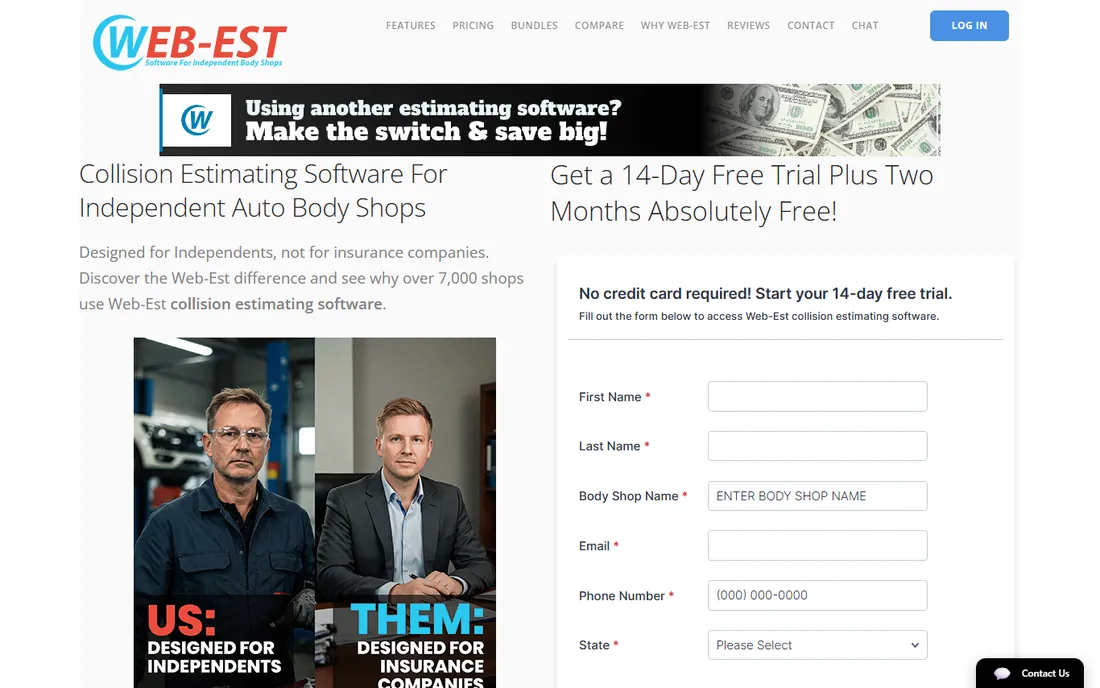
Web-Est was built for a specific customer: the independent body shop that writes estimates for retail customers and a few fleet accounts, not for a carrier network. The platform runs in the browser, includes unlimited imaging and point-and-click graphical estimating, and licenses its labor and parts data from Mitchell, which means the numbers behind the estimates come from the same database the big platforms use.
What owners like most is the price gap. Web-Est's own site positions it at roughly a third of what the big three charge, and reviewers consistently describe it as the value pick for small shops. The free trial makes it easy to test. The trade-off is scale: the integration list is shorter, and if a large insurer ever demands estimates written in their own preferred system, Web-Est is not it. For a shop that answers to customers, that rarely matters.
What we like- Built exclusively for independent shops, so pricing and features are aimed at them
- Licenses Mitchell's collision data for labor, paint times and parts prices
- Browser-based with no downloads, plus mobile-friendly Pro-Estimator included
Watch out for- No public pricing page, so you have to request a quote
- Smaller ecosystem than CCC or Mitchell, with fewer third-party integrations
#3
Mitchell Cloud Estimating
Best for: Shops that want estimating tied to diagnostics and repair data
Visit mitchell.com
Starting priceSee website (custom quote)
Free planPromo (2 free months with 24-month contract)
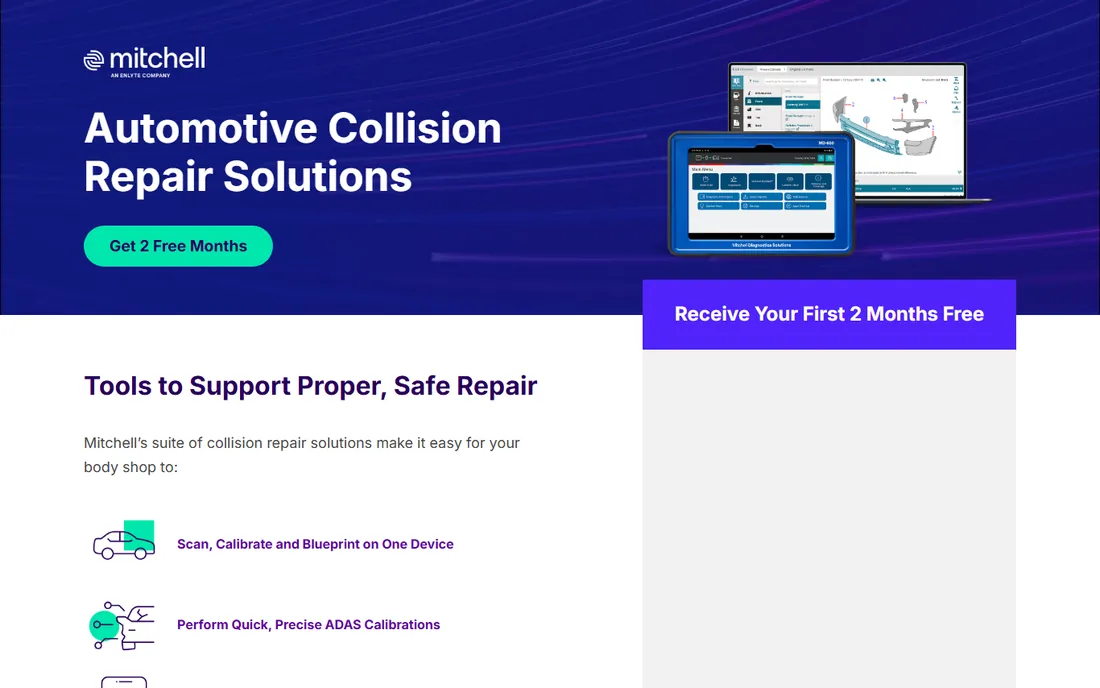
Mitchell sits in the middle of the big three: as widely accepted as CCC and Audatex, but built around a repair-information heritage that the other two do not match. Cloud Estimating runs from any internet-connected device, pulls in integrated repair procedures and diagnostic scans, and covers specialty vehicles like motorcycles, ATVs and heavy trucks. If your shop also buys repair data, diagnostics or management software from Mitchell, the estimating piece snaps into the same ecosystem.
The honest catch is the sales model. Pricing is quote-only, and the current offer of two free months comes with a 24-month contract attached, which is a real commitment for a shop switching systems. Mitchell estimating is strongest when paired with Mitchell diagnostics hardware and Mitchell TechAdvisor data; bought alone, some of the differentiation disappears. Get the monthly number for your shop size in writing before the demo ends.
What we like- Cloud-based estimating with VIN scanning, repair procedures and diagnostic scan integration
- Supports passenger cars, commercial vehicles, motorcycles and EVs
- Pairs with Mitchell's diagnostics hardware (MD-600) and repair management tools
Watch out for- Quote-only pricing with a current promo that requires a 24-month contract
- The full ecosystem works best when you buy multiple Mitchell products, not just estimating
#4
Audatex
Best for: Shops and appraisers inside the Solera and insurer ecosystem
Visit audatex.us
Starting priceSee website (custom quote)
Free planNo

Audatex is the third member of the insurer-accepted big three, owned by Solera. Its estimating platform leans on intelligent 3D vehicle graphics, exploded diagrams and color-coded parts, which estimators like because selecting the right part is visual instead of list-based. The database is among the most widely accepted in the industry, so estimates written in Audatex move through insurer review with minimal friction.
The catch is the buying experience. Audatex sells through Solera's claims organization, its web presence is scattered across several domains, and pricing is only available through a sales conversation. Independent shops sometimes find the onboarding process geared toward insurers and large multi-shop operators rather than single locations. If your volume flows through carriers that standardize on Solera tools, Audatex is worth the process. If not, the independent-oriented options cost less and onboard faster.
What we like- Intelligent 3D graphics with color-coded parts make damage selection visual and fast
- VIN integration and total-loss indicators baked into the estimating flow
- Longstanding contracts with major MSOs like the Boyd Group show enterprise trust
Watch out for- Sold primarily through Solera's claims ecosystem, so standalone pricing is opaque
- The US site and product pages are fragmented across audatex.us, audatexsolutions.com and Solera properties
#5
ALLDATA Collision
Best for: Shops that want every estimate backed by OEM repair procedures
Visit alldata.com
Starting price$249/month (ALLDATA Collision)
Free planNo
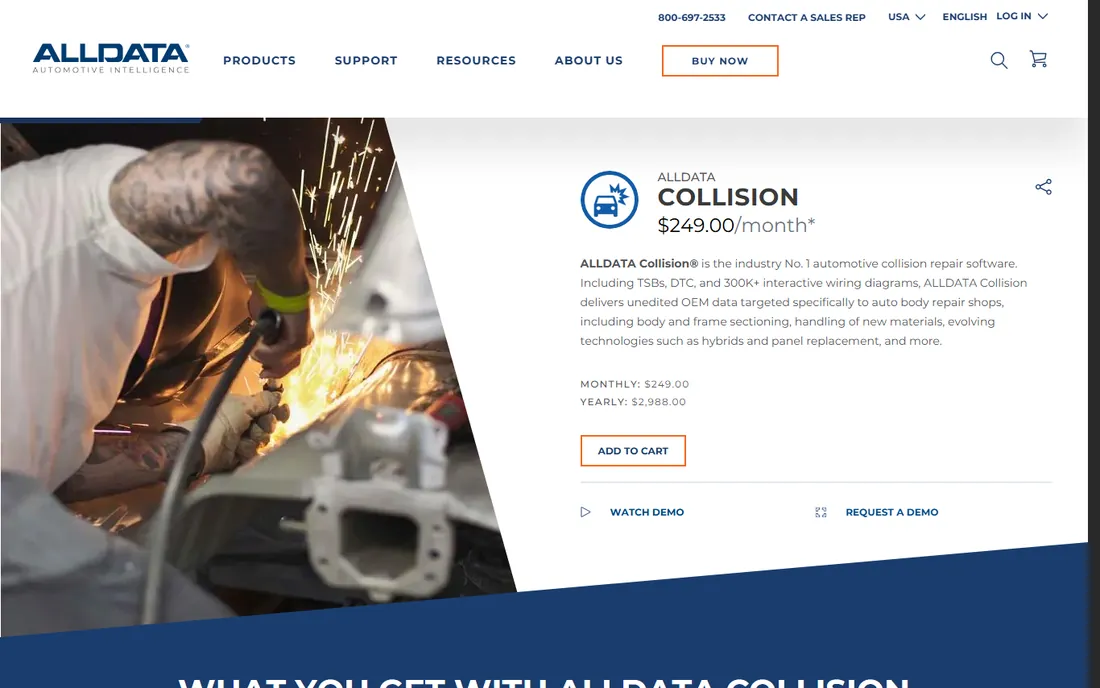
ALLDATA Collision is the only tool on this list that exists because of OEM repair information. The subscription includes an online Estimator that creates estimates with instant access to OEM collision repair data, and the Collision Advantage add-on checks your estimate line by line against OEM procedures so you never miss a required repair, which is liability protection as much as accuracy. Surveys of body shops consistently rank ALLDATA as the most-used source for OEM repair information.
That strength comes with a boundary. ALLDATA is not trying to be a DRP workflow platform: it does not route insurance assignments or manage production the way CCC ONE does. Shops that write estimates inside CCC or Mitchell and just need the OEM layer often subscribe to ALLDATA alongside their estimating platform, which pushes the monthly stack to $350 or more once the add-ons pile up. Buy it for the information; do not expect it to replace your estimating workflow.
What we like- Estimator included with the Collision subscription for compliant estimates with OEM data
- Collision Advantage ($99/month add-on) scans estimates line by line and flags OEM-required repairs
- Used by a large share of body shops for OEM research
Watch out for- It is repair information first, so the estimating module is simpler than the dedicated estimating platforms
- Add-ons stack up fast (Advantage, Repair Planner, Diagnostics)
#6
Tekmetric
Best for: General repair shops that write estimates as part of full shop management
Visit tekmetric.com
Starting priceSee website
Free planNo
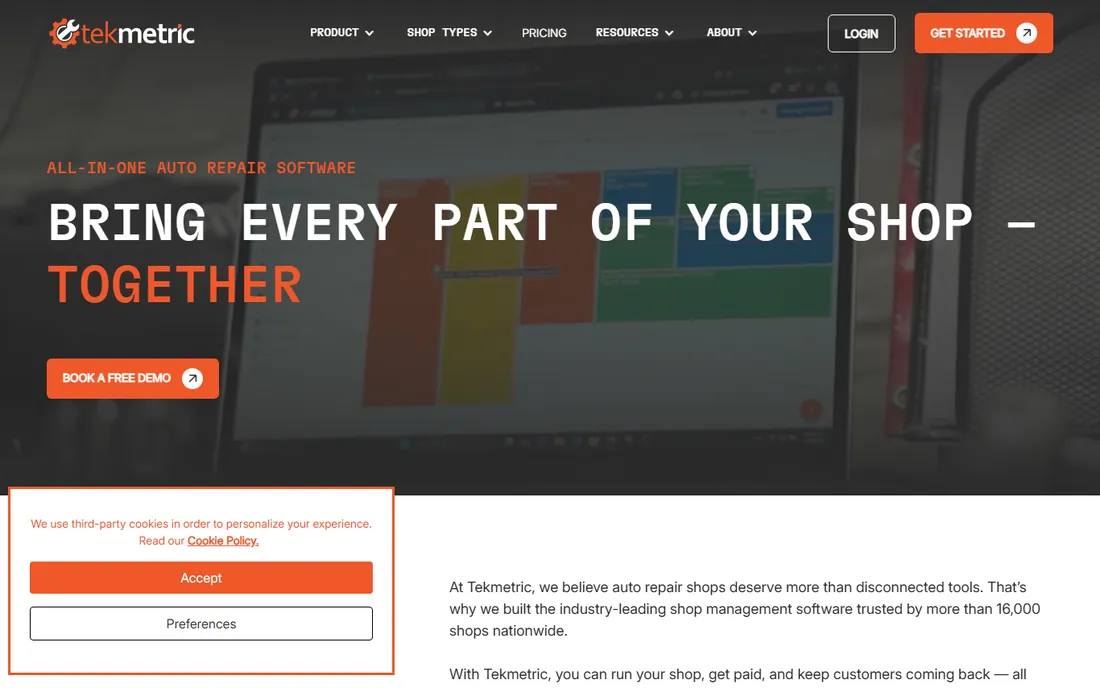
Tekmetric is the modern cloud shop management system that a lot of general repair shops now run, and its estimate building is a genuine strength: Smart Jobs pulls vehicle-specific labor times and parts into a full estimate quickly, then shares it with the customer by text or email for approval. Estimates flow straight into repair orders, payments and marketing follow-up, so nothing is retyped.
The honest limitation for this list is focus. Tekmetric is a general repair platform: it does not do insurer-facing collision estimating, DRP assignment routing or the kind of part-level graphics the collision estimating platforms provide. A body shop that needs estimates accepted by carriers should look elsewhere. A general repair shop or a body shop that does mostly retail collision work and wants one system for everything will find Tekmetric's workflow hard to beat.
What we like- Estimate building inside a complete shop management platform: digital inspections, parts ordering, payments and marketing
- Smart Jobs builds a full estimate in seconds from vehicle-specific labor times
- 70-plus integrations
Watch out for- Built for general repair, not collision, so it lacks insurer-facing estimating features like DRP routing
- Pricing is not published on the site
#7
Shop-Ware
Best for: Shops that want cloud-based repair orders with strong customer experience
Visit shop-ware.com
Starting priceSee website
Free planFree trial (per reviewers)

Shop-Ware takes the position that the estimate is the start of a customer conversation, not a document for an insurer. Its cloud platform builds estimates and repair orders with photos, videos and live chat built in, and its AI parts matrix adjusts parts pricing automatically to hit your gross-profit targets. Reviewers put its approval rates near 90 percent, which matters for retail shops where the customer approves the work.
For a collision shop, the gap is on the insurer side: Shop-Ware does not write carrier-format estimates, route DRP assignments or plug into insurer estimating networks. It also publishes no pricing, so you will talk to sales to learn the monthly cost (reviewers report starting around $99 per month). If your shop's customers approve their own estimates and you want the smoothest digital experience for them, Shop-Ware delivers. If carriers approve your estimates, you still need one of the big three.
What we like- Fully cloud-based repair orders with native digital inspections, live chat and real-time workflow
- AI parts matrix helps hit parts gross-profit targets automatically
- Strong payments and marketing features built in
Watch out for- Estimating is quote-based repair order estimating, not insurer-grade collision estimating
- No published pricing, so costs surface only through sales
Starting priceSee website
Free planFree trial (per reviewers)
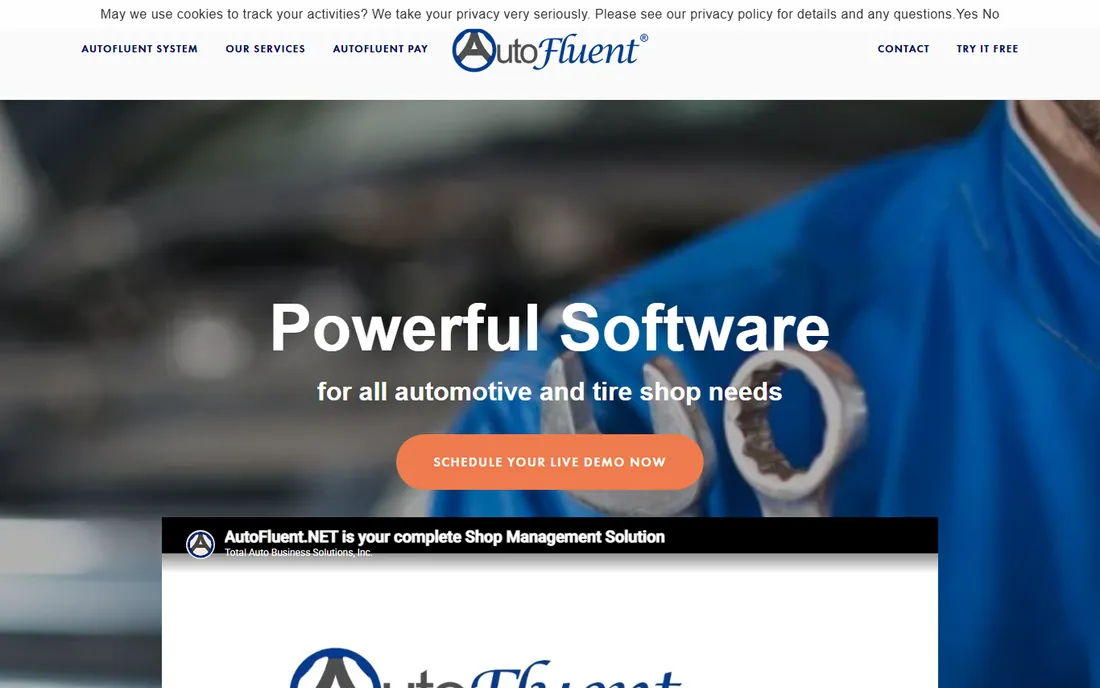
AutoFluent is the workhorse pick for independent auto service and tire shops. It covers estimating, work orders, inventory, mechanic hours, multi-location management and accounting integrations in one Windows-based system with cloud hosting included, and support and training come with the subscription at no extra charge. Tire shops get direct ordering from tire vendors, and warehouses and fleet work are covered too.
The honest trade-off is age. The interface reflects its Windows heritage and does not match the polish of Tekmetric or Shop-Ware, and like most tools in this space it publishes no pricing (reviewers report starting near $95 per month). Estimating here is repair-order estimating for service work, not insurer-format collision estimating. For a tire and service shop that wants one deep system without monthly add-on creep, it is a solid value. For a pure collision shop, the estimating platforms above fit better.
What we like- All-in-one estimating, inventory, POS, fleet and preventive maintenance with included cloud hosting
- Integrates with repair and labor guides, tire and parts vendors, QuickBooks and Sage 50
- Support and training included with subscription
Watch out for- Windows-centric interface that feels dated next to cloud-native tools
- Pricing not published on the site (reviewers report around $95/month)
How we chose
We started with the terms body shops actually search: auto body estimating software, collision estimating software and collision repair estimating. For each candidate we opened the vendor's own site, checked prices against public reviews on G2, Capterra and SourceForge plus practitioner discussion in body shop communities, and compared feature sets, insurer acceptance, OEM data depth and fit for independent shops. Where a vendor did not publish a price, we wrote "See website" rather than guessing. Every URL below is the vendor's own official page.
What to look for before you buy
Start with who approves your estimates. If insurers or a DRP network approve most of your work, your shortlist is CCC ONE, Mitchell Cloud Estimating and Audatex, because those are the formats carriers accept and the workflows their systems expect. If customers approve your estimates directly, the independent-oriented tools cost far less and onboard faster.
Second, separate estimating from everything else. The big three sell estimating plus workflow; Tekmetric, Shop-Ware and AutoFluent sell shop management that includes estimating; ALLDATA sells the information layer that makes any estimate defensible. Some shops run two systems on purpose: CCC or Mitchell for carrier work plus ALLDATA for OEM procedures. That is a legitimate and common stack, but budget for both.
Third, pin down the real price structure. Ask whether pricing is per user, per estimate, per location or flat monthly, and get the number for your shop size in writing. Ask about add-on modules, since several vendors here sell estimating at one price and the useful features at another. And ask what happens to your data and your contracts if you cancel: the multi-year promo offers from the big vendors are worth reading twice.
Check the data behind the estimates
An estimating platform is only as good as its parts and labor database. CCC, Mitchell and Audatex each maintain their own; Web-Est licenses Mitchell's. Ask how often parts prices and labor times update, whether the system flags OEM-required procedures automatically, and how the software handles newer vehicle types like EVs and ADAS-equipped cars. A cheap estimating tool with stale data costs more in missed labor hours than an expensive one with current data.
Plan the switch, not just the purchase
Moving estimating systems is a migration, not a download. Ask the vendor how your existing estimates, customer records and parts price books transfer over, how long training takes for your estimators, and whether the old system keeps running during the transition. Shops that run both systems for two weeks during the cutover report far fewer billing mistakes than shops that switch overnight.
What collision estimating software actually costs
For an independent shop, the realistic range is about $95 to $250 per month per location: Web-Est and AutoFluent at the low end, Tekmetric and Shop-Ware in the middle, ALLDATA Collision at $249 per month with add-ons pushing it higher. The big three (CCC ONE, Mitchell, Audatex) are custom-quoted and consistently cost more; shop owners should expect several hundred dollars per month per location, plus possible per-estimate or per-user fees.
Watch the contract terms. Mitchell's current promo offers two free months on a 24-month contract, which tells you the standard expectation is a long commitment. Several vendors charge separately for estimating, workflow and data modules, so the quote you compare is the all-in monthly number, not the headline price of the estimating module. And remember the hidden cost: an estimate written in a system your insurers do not accept has to be rewritten, and every rewrite is unpaid labor.
Frequently asked questions
What is the difference between collision estimating software and shop management software?
Collision estimating software (CCC ONE, Mitchell, Audatex, Web-Est) writes part-level estimates with labor times and parts pricing that insurers accept, often tied to DRP workflows. Shop management software (Tekmetric, Shop-Ware, AutoFluent) runs the whole shop: estimates, repair orders, inventory, payments and marketing. Collision shops that work with carriers usually need the first; general repair shops usually need the second.
Which estimating software do insurance companies prefer?
The three platforms insurers accept most widely are CCC ONE, Mitchell Cloud Estimating and Audatex. Many DRP agreements specify or strongly favor one of them. If a carrier represents a large share of your revenue, ask which estimating system their adjusters prefer before you buy anything.
Is Web-Est accepted by insurance companies?
Web-Est estimates are accepted by most major insurance companies, according to the company, and it licenses its collision data from Mitchell. Independent shops report writing carrier-accepted estimates with it. It is not a DRP workflow platform, though, so shops in formal DRP programs usually pair it with or replace it with CCC or Mitchell.
Do I need ALLDATA if I already have CCC or Mitchell?
Many shops carry both. CCC and Mitchell write the estimates your insurers accept; ALLDATA provides the OEM repair procedures, TSBs and wiring data that prove an estimate is complete and defensible. The Collision Advantage add-on checks estimates line by line against OEM requirements, which is liability protection the estimating platforms do not provide on their own.
Can I write estimates from my phone or tablet?
Most of these tools support mobile estimating. CCC ONE has a mobile app and tablet estimating, Mitchell Cloud Estimating runs on any internet-connected device, Web-Est includes the mobile-friendly Pro-Estimator, and ALLDATA offers a mobile add-on. If your estimators write estimates at the vehicle, test the mobile experience during the trial before committing.
How long does it take to switch estimating software?
Plan for two to four weeks: data migration, estimator training and a parallel-run period where the old system stays available. The biggest risk is billing continuity, not the software itself. Vendors that provide installation and training (CCC, Mitchell and AutoFluent all advertise it) generally get shops live faster than self-serve tools.
Sources we checked (9)
- https://www.cccis.com/ccc-one
- https://www.mitchell.com/collision-repair-software
- http://audatex.us/solutions/estimatics.html
- https://www.web-est.com
- https://www.web-est.com/pcompare.html
- https://www.alldata.com/us/en/collision
- https://www.tekmetric.com/
- https://shop-ware.com/
- https://autorepairsoftware.com/
Is your product missing or out of date?
We review this list regularly. Vendors can request a listing, send updated pricing or ask about featured placement.

Shihab Mia · Founder, Rankite
Shihab has spent more than a decade helping SaaS and e-commerce brands grow through search. He writes Rankite's software buying guides from pricing pages, documentation and public user reviews. More about Shihab.