How we make this list: we compare pricing pages, product documentation and public user reviews. Ratings come from G2, Capterra or Trustpilot, with the date we checked them.
Key takeaways
- HelloChinese is the best starting app for Mandarin: a structured, speaking first course built only for Chinese, free to start and Premium at 11.99 dollars a month.
- Pleco is the essential companion at any level: the standard Chinese dictionary app, free, with paid bundles from 29.99 dollars one time.
- Skritter owns character writing, with stroke order practice and spaced repetition from 14.99 dollars a month.
- Decide your script early: most apps teach simplified characters and pinyin for mainland Mandarin, while learners aiming at Taiwan or Hong Kong need traditional characters, which not every app supports well.
Quick comparison
| Tool | Best for | Starting price | Free plan |
|---|
 HelloChinese | Structured beginner course | Free | Yes |
 Duolingo | Daily habit building | Free | Yes |
 Pleco | Dictionary and lookup | Free | Yes |
 Skritter | Character writing practice | $14.99 per month | No |
 LingoDeer | Grammar explained clearly | Free | Yes |
 ChineseSkill | Game based beginner lessons | Free | Yes |
 Du Chinese | Graded reading practice | $14.99 per month | Yes |
 Anki | Vocabulary retention | Free | Yes |
Is your product missing or out of date?
We review this list regularly. Vendors can request a listing, send updated pricing or ask about featured placement.
The best apps for learning Chinese
Starting priceFree
Free planYes

What we like- HelloChinese is built only for Mandarin, and it shows: a speaking first path from pinyin and tones into characters, grammar, and short conversations, with speech recognition from the first lesson, native speaker videos, and character writing practice in logical order. The free tier covers the core opening lessons, and Premium at 11.99 dollars a month, or 69.99 a year, opens the full course, with a Premium Plus tier adding immersive stories. Its level range maps roughly to the early HSK levels, which suits the first year of study.
Watch out for- Content thins beyond the beginner to lower intermediate range, so committed learners graduate to reading and conversation tools within a year or so. Full access needs the subscription
- The free tier is a genuine start, not the course. Speech feedback, as everywhere, is approximate on tones.
#2Duolingo
Best for: Daily habit building4.5/5 on
G2 (145 reviews, checked Oct 2026)
Visit duolingo.com
Starting priceFree
Free planYes
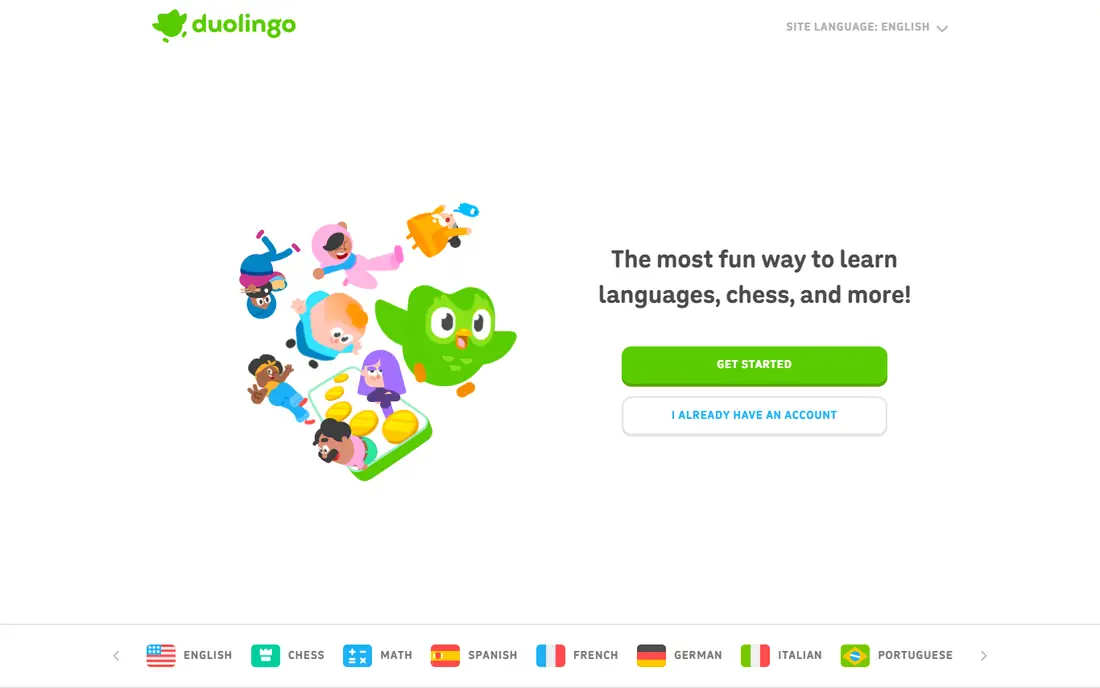
What we like- Duolingo's Chinese course is the easiest habit to keep: short game like lessons, streaks, and constant review, entirely free with ads or through Super at about 13 dollars a month or 84 dollars a year. For learners whose main enemy is inconsistency, five daily minutes here beat an abandoned textbook. It teaches simplified characters with pinyin support and works well as a warm up beside a deeper course app.
Watch out for- Its Chinese course is the shallowest here: limited depth, thin grammar explanation, and a ceiling around early HSK levels, so it cannot carry a serious learner alone. Sentence quality and tone drilling draw criticism from Mandarin specialists. Character writing practice is minimal compared with Skritter.
Starting priceFree
Free planYes
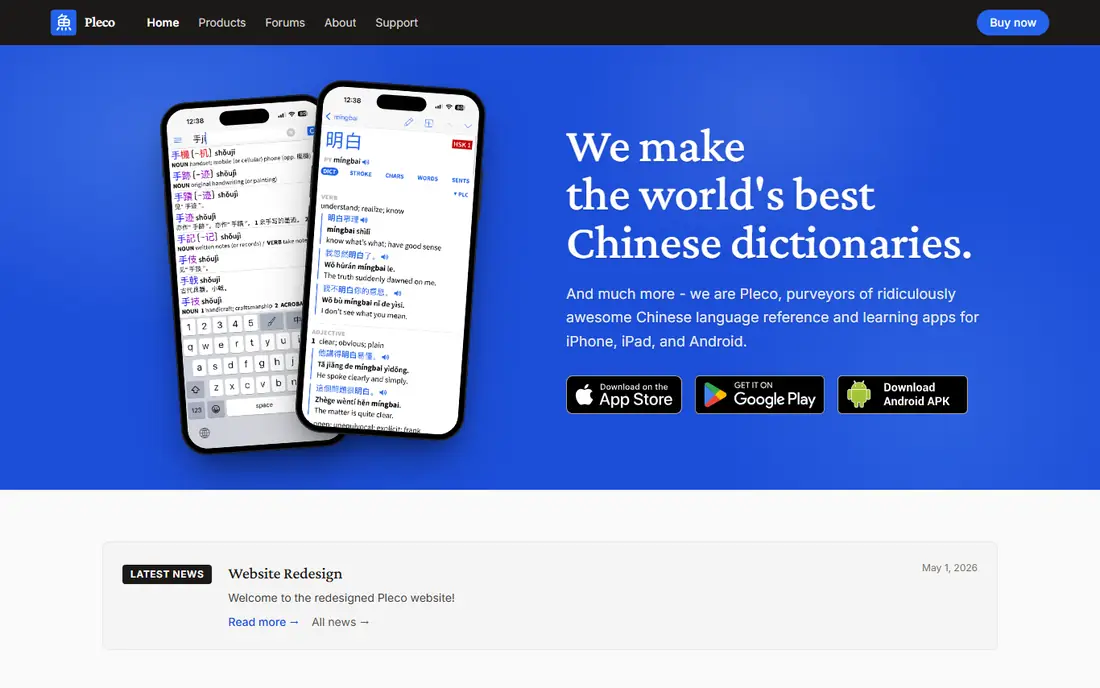
What we like- Pleco is the dictionary serious learners treat as infrastructure: fast offline lookup by character, pinyin, handwriting, or camera, with example sentences, stroke order, and audio, free in its core form. Paid bundles from about 29.99 dollars one time add specialist dictionaries, OCR, flashcards, and graded readers, and it is a purchase, not a subscription, which users love. It supports both simplified and traditional characters properly, a point several course apps cannot match.
Watch out for- Pleco is a reference tool, not a course: it will not sequence your learning or teach grammar. The add on catalogue is long enough that new buyers should start free and buy only the bundle pieces they actually need. Its interface assumes some knowledge, so day one beginners should pair it with HelloChinese rather than start here.
Starting price$14.99 per month
Free planNo
What we like- Skritter teaches you to write characters from memory: stroke order, component breakdowns, and spaced repetition that brings a character back just as you are about to forget it, for both simplified and traditional scripts. Decks align with major textbooks and HSK lists, so it slots into classroom study as well as self study. For learners whose goal includes handwriting, exams, or deep character knowledge, nothing else here does this job.
Watch out for- It is a subscription specialist at 14.99 dollars a month, lower on annual plans, on top of whatever course app you use. Writing by hand is a slower skill to build, and learners who only need to type pinyin may rationally skip it. It teaches characters and words, not conversation, so it is always a companion, never the whole stack.
Starting priceFree
Free planYes
What we like- LingoDeer was built for Asian languages specifically, and its Mandarin course pairs structured units with clear grammar notes inside every lesson, the piece Duolingo style apps skip. It covers characters, pinyin, and listening with a tidier, more classroom like feel, and a free tier lets you sample the approach. Learners who keep asking why a sentence works usually land here happily.
Watch out for- Its Mandarin depth still tops out around intermediate level, like most course apps. Pricing for full Premium access varies by platform and promotion, so confirm in the app
- The free plan label here reflects the genuine free starting tier. Speaking practice and feedback are lighter than HelloChinese's speech first design.
Starting priceFree
Free planYes
What we like- ChineseSkill is the friendliest free course app here: a game structured Mandarin course covering pinyin, characters, vocabulary, and sentence patterns, with much of its beginner content available without paying. It suits learners testing whether Chinese is for them before spending anything, and younger learners often prefer its pace and presentation. Offline lesson downloads help commuters.
Watch out for- Its ceiling is beginner level, and its polish and update pace trail HelloChinese. Monetisation and premium boundaries have shifted over the years, so check what the current version includes free. As a sole tool it leaves the same gaps as every course app: no dictionary depth, no writing discipline, no real conversation.
Starting price$14.99 per month
Free planYes
What we like- Du Chinese supplies the stage most learners miss: graded stories and articles written at HSK levels from beginner to advanced, with tap to translate, pinyin on demand, and full audio, so reading becomes practice instead of punishment. Some content is free, and full access runs from about 14.99 dollars a month. Twenty minutes a day here is how vocabulary from a course app turns into reading speed.
Watch out for- It teaches reading and listening only, with no speaking, writing, or grammar instruction. The subscription is another line item on top of a course app, which is the standard stack cost problem. Very new beginners need a few weeks of course work before even its easiest stories feel comfortable.
Starting priceFree
Free planYes
What we like- Anki is the memory engine underneath serious language study: spaced repetition flashcards with shared decks for HSK levels, textbook vocabulary, and sentence mining, free on desktop and Android and 24.99 dollars one time on iOS. Anything you meet in Pleco or Du Chinese can become a card in seconds, and the algorithm schedules reviews at the edge of forgetting. Learners who use it consistently retain vocabulary at rates course apps alone rarely match.
Watch out for- Anki is famously unlovely: setup, deck choices, and card design are your job, and badly made cards waste the method. It teaches recall, not usage, so it must sit beside input and conversation. The iOS price surprises people, though it funds the otherwise free project.
How we chose
We compared the Chinese learning apps that 2026 guides from italki, Class Central, WuKong Education, and Mandarin Mosaic rank most consistently, and checked pricing against their published surveys. We built the list as a working stack, course, dictionary, writing, reading, and memory, rather than eight rival course apps, because that is how the guides and experienced learners actually recommend studying. We required Mandarin specific design or proven Mandarin depth, which is why generalist apps with thin Chinese courses rank below specialists here.
How to choose the right app for learning Chinese
Beginners should start with one course app and Pleco, nothing more. Choose HelloChinese if you want speaking practice and structure from day one, LingoDeer if grammar explanations keep you going, ChineseSkill or Duolingo if free and game like matters most. Add Anki in week two with the course's own vocabulary list; ten new cards a day compounds into a working vocabulary within months. When the course starts feeling easy, that is the signal to add Du Chinese for reading and, if handwriting matters for your goals or exams, Skritter.
Set your script and your target before the apps set them for you. Mainland work, study, and HSK exams mean simplified characters and pinyin; Taiwan means traditional characters and, for reading signs and menus, comfort without pinyin support. State your level honestly when an app asks, and revisit the stack each quarter: course apps have ceilings by design, and the learners who progress are the ones who graduate to reading and real conversation on schedule. A tutor hour every week or two, even online, corrects the tone and usage habits no app feedback catches, and it is the cheapest insurance in the whole stack.
Frequently asked questions
Can I become fluent in Chinese with only apps?
Apps can carry you through beginner and intermediate levels, especially combined as a stack, but fluency needs real conversation and large amounts of reading and listening beyond any app's library. Treat apps as the foundation and structure, then graduate to graded readers, media, and regular speaking with native speakers or tutors.
Should I learn simplified or traditional characters?
Learn the script of the place and people you will actually use Chinese with: simplified for mainland China, Singapore, and HSK exams; traditional for Taiwan, Hong Kong, and many overseas communities. Pleco and Skritter handle both; course apps default to simplified, so traditional learners should check support before subscribing.
Do I need to learn pinyin?
Yes, at the start. Pinyin is the standard romanisation for Mandarin, used in dictionaries, input methods, and teaching materials, and it anchors your pronunciation while characters are new. Good apps wean you off pinyin gradually so you read characters directly rather than leaning on the romanisation forever.
How much do Chinese learning apps cost?
The stack can be free: ChineseSkill, Duolingo, Pleco's core, and Anki on desktop cost nothing. Paid pieces run about 12 dollars a month for HelloChinese Premium, 14.99 for Skritter or Du Chinese, and Pleco bundles from about 29.99 dollars one time. Most learners spend on one subscription at a time.
Are the apps' pronunciation scores reliable?
Only approximately. Speech recognition in learning apps is tuned to encourage learners and tolerate accent variation, so it passes tones a teacher would correct. Use the scores to build the habit of speaking aloud, and verify your pronunciation periodically with a tutor or native speaking partner.
Sources we checked (0)
Is your product missing or out of date?
We review this list regularly. Vendors can request a listing, send updated pricing or ask about featured placement.

Shihab Mia · Founder, Rankite
Shihab has 5+ years in B2B and SaaS SEO. He writes Rankite's software buying guides from pricing pages, documentation and public user reviews. More about Shihab.