How we make this list: we compare pricing pages, product documentation and public user reviews. Ratings come from G2, Capterra or Trustpilot, with the date we checked them.
Key takeaways
- Clue is the privacy and science pick: Berlin based, GDPR governed, with a clinical, gender neutral design and a free tier. Clue Plus is $39.99 a year.
- Flo is the biggest and most content rich tracker, free at the core, but read its history before trusting it: a 2021 FTC settlement over sharing health data. Its Anonymous Mode, which keeps data unlinked from your identity, should be switched on if you use it.
- Apple Health's built in Cycle Tracking is the strongest privacy default for iPhone owners: data stored on device and end to end encrypted, and it costs nothing.
- Drip is the open source answer: free, with data stored locally and no cloud account at all.
- Two health notes. No tracker predicts perfectly, and no period app is a contraceptive unless it is cleared as one, like Natural Cycles. And see a clinician for pain, very heavy bleeding, missed periods, or cycles that change suddenly; an app log is a helpful record to bring, not a diagnosis.
Quick comparison
| Tool | Best for | Starting price | Free plan |
|---|
 Clue | Science led tracking with strong privacy | Free | Yes |
 Flo | Content, community, and pregnancy mode | Free | Yes |
 Apple Health Cycle Tracking | On device privacy for iPhone owners | Free | Yes |
 Drip | Open source, local only tracking | Free | Yes |
 Natural Cycles | FDA cleared app based contraception | See website | No |
 Ovia | Fertility and pregnancy tracking | Free | Yes |
 Spot On | Planned Parenthood's teen friendly tracker | Free | Yes |
 Garmin Connect | Cycle tracking inside your watch data | Free | Yes |
Is your product missing or out of date?
We review this list regularly. Vendors can request a listing, send updated pricing or ask about featured placement.
The best apps to track your period
Starting priceFree
Free planYes
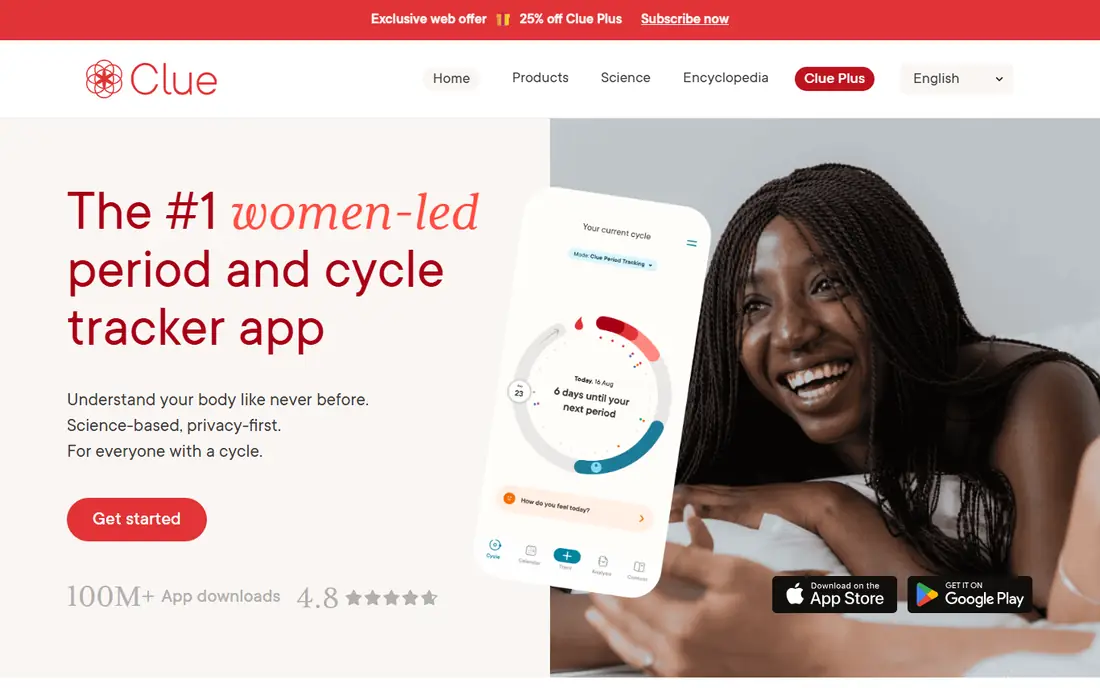
Clue is the tracker privacy guides reach for first. Its design is intentionally unadorned, its predictions are built with published science, and its business sits inside European privacy law, which is a structural protection rather than a promise in a policy page. Symptom and mood logging is detailed, and the app handles irregular cycles more gracefully than calendar only rivals because it learns from what you log.
The trade off is that the free tier is a doorway. The analysis most users eventually want lives in Clue Plus. Clue fits anyone who wants rigorous tracking from a company whose privacy posture is its identity, including people tracking through perimenopause or while trying to conceive.
What we like- Developed with researchers, with predictions that explain their reasoning
- Based in Berlin under GDPR, with EU data handling and a clear no sale stance
- A gender neutral, clinical design that treats you as an adult
- Modes for period tracking, trying to conceive, pregnancy, and perimenopause
Watch out for- Deeper analysis, pregnancy tracking, and wearable sync sit behind Clue Plus at $39.99 a year or $9.99 a month
- The free tier carries upgrade prompts
- Deliberately no lifestyle extras or community features
Starting priceFree
Free planYes
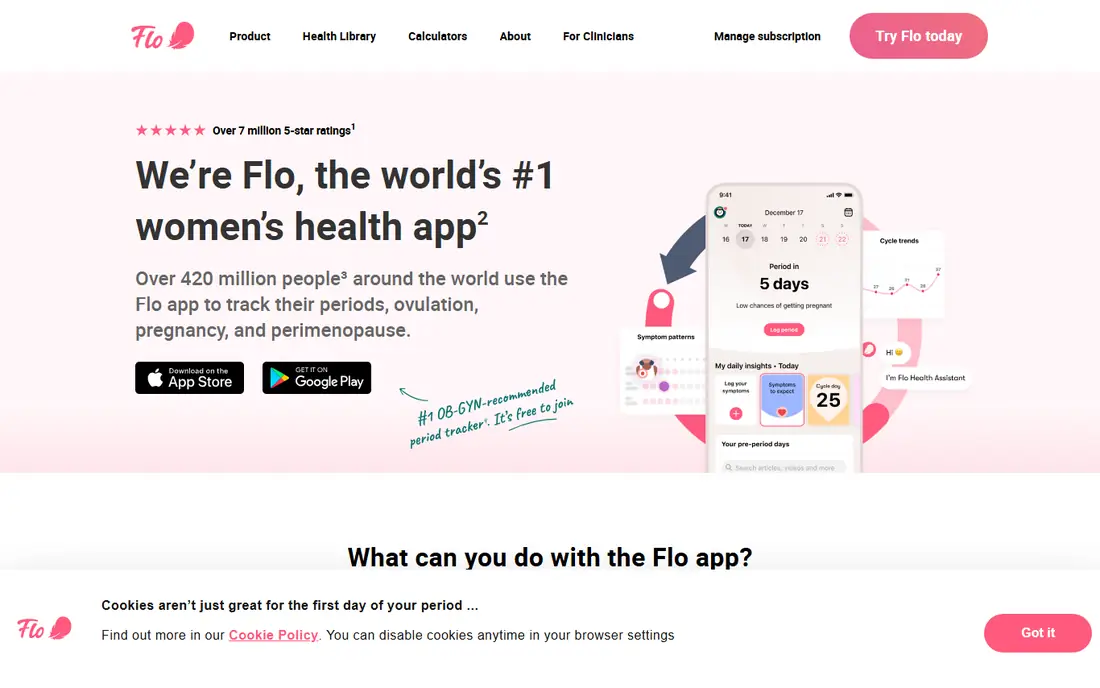
Flo is the feature giant: predictions, symptom tracking, content for every cycle question, community, and a smooth path into pregnancy tracking. Millions of users find it genuinely helpful, and its medical advisory board content is a real asset for people whose sex education failed them.
The trade off is trust, and it must be stated plainly. The FTC's 2021 action over data sharing is a documented part of this company's record. Flo has since added Anonymous Mode and undergone privacy audits, and a careful user enables that mode on day one. Flo fits people who value content and community most and will take the one privacy step the app offers.
What we like- The most downloaded tracker in the world, with more than 380 million downloads claimed
- A large library of expert reviewed health content and an AI assistant
- Anonymous community forums for questions people hesitate to ask aloud
- A pregnancy mode that follows through week by week
- An Anonymous Mode that tracks without tying data to your identity
Watch out for- A 2021 FTC settlement found Flo had shared health data with analytics firms despite promising otherwise, with a later class action
- Premium prices in current listings range from about $47.99 to $59.99 a year, with monthly pricing besides
- The free tier pushes Premium steadily
#3
Apple Health Cycle Tracking
Best for: On device privacy for iPhone owners
Visit apple.com
Starting priceFree
Free planYes
Apple's Cycle Tracking is the option many iPhone owners already own without knowing it. It logs periods, symptoms, and factors such as pregnancy and lactation, predicts the next cycle, and keeps the data inside Apple's health vault, encrypted in a way Apple itself cannot read when the right settings are on. There is nothing to sell you and nothing to advertise at you.
The trade off is depth. There are no articles, no community, and the analysis is modest. Apple Health Cycle Tracking fits iPhone users whose first requirement is that their most sensitive data stays on their own device under their own keys.
What we like- Built into every iPhone at no cost, with no separate account or subscription
- Cycle data stored on device, and end to end encrypted when synced with two factor iCloud
- Predictions for periods and fertile windows, with symptom and factor logging
- Apple Watch temperature sensing on supported models feeds cycle estimates
Watch out for- IPhone only, so Android users are excluded
- Predictions and insights are plainer than dedicated apps
- Health content and community do not exist here
#4Drip
Best for: Open source, local only tracking4.4/5 on
G2 (480 reviews, checked Oct 2026)
Visit dripapp.org
Starting priceFree
Free planYes
Drip is the answer for people who want the data to be physically incapable of leaving. There is no server to breach, subpoena, or sell, because there is no server: your cycle history lives in the app on your phone, under an open source codebase that does what it says in public. For the threat model that worries many tracker users, that architecture is the whole argument.
The trade off is everything a funded product buys: design finish, support, and breadth. Drip fits privacy maximalists and fertility awareness charters who are comfortable with a plainer tool that answers to nobody.
What we like- Open source, so its code can be inspected by anyone
- All data stored locally on your phone, with no cloud, no account, and no analytics
- Free, supported as a community project
- Tracks cycles and fertility signs for people who chart seriously
Watch out for- A smaller, volunteer driven project, so polish and update pace trail the commercial apps
- Fewer predictions and no content library
- Availability and installation are simplest on Android through open app stores
Starting priceSee website
Free planNo
Natural Cycles is a different product wearing similar clothes. It is not a period predictor; it is a regulated contraceptive that uses temperature to identify the fertile window, cleared by the FDA through a De Novo grant. People choose it to avoid hormones, and its effectiveness data is published like a medical device's, because it is one.
The trade off is rigour and risk. Missed measurements weaken it, irregular cycles fit it poorly, and its price sits far above the trackers because regulation and the included thermometer cost money. Natural Cycles fits committed users who want hormone free contraception and will follow its daily routine exactly. Anyone else should treat every app in this guide, this one included unless used as directed, as a tracker, never as birth control.
What we like- The only app here cleared by the FDA as a contraceptive, using basal temperature to mark fertile and non fertile days
- A daily red and green day system that is simple to follow
- Integrates with thermometers, rings, and watches for temperature
- Regulated as a medical device, with the accountability that brings
Watch out for- No free tier, and published prices conflict between sources, from monthly plans to about $149.99 a year with a thermometer band
- It demands daily temperature discipline and works best with regular sleep and cycles
- Like every contraceptive method, it has typical use failure rates that users must understand honestly
Starting priceFree
Free planYes
Ovia serves the trying to conceive chapter well: ovulation prediction, fertility scores explained in plain language, and a graduation path into its pregnancy tracker with kick counters and week by week guidance. Its partnerships with employers and insurers also mean some users get its premium coaching free through work.
The trade off is that partnership model itself. If your access comes through an employer programme, read what is reported back and in what form; reputable programmes share aggregates, but the question is yours to ask. Ovia fits people focused on conception and pregnancy who want guidance in warm language rather than a clinical chart.
What we like- Fertility prediction with a friendly, readable design
- A pregnancy app in the same family for when tracking turns to expecting
- Health coaching content, with some programmes offered through employers and health plans
- Free to use, supported by those partnerships
Watch out for- The free experience has historically carried advertising
- The employer programme angle means checking exactly what data your plan arrangement shares
- Cycle science and privacy posture are less distinctive than Clue's
Starting priceFree
Free planYes
Spot On is the tracker a health teacher would hand out. Planned Parenthood built it to teach while it tracks: what a cycle is, what is normal, when to see a clinician, with reminders for pills and other contraception layered in. Its data collection is deliberately minimal, which for a young user is exactly the right instinct.
The trade off is power. There is little analysis to grow into. Spot On fits teens, new trackers, and anyone who wants trustworthy education from a medical nonprofit in the same app as their calendar. Parents looking for a first tracker for a teenager will find the privacy and content choices here deliberately made.
What we like- Made by Planned Parenthood, with education built into the tracking
- Minimal data collection by design, from an organisation whose mission is the point
- Friendly for younger users and first time trackers
- Birth control reminders alongside cycle tracking
Watch out for- Feature depth is basic beside Clue or Flo
- Predictions are simple
- Its education first design suits beginners more than data driven charters
#8
Garmin Connect
Best for: Cycle tracking inside your watch data
Visit garmin.com
Starting priceFree
Free planYes
Garmin Connect is the pragmatic choice for the large group of women who already wear the watch. Tracking your cycle where your training and sleep already live shows real connections, the workout that felt impossible explained by the calendar, and removes one more app holding one more copy of sensitive data.
The trade off is specialisation: this is a sports platform with a cycle feature, and its predictions and content are thinner than dedicated trackers. Garmin Connect fits Garmin owners who want their cycle in context, and who prefer consolidating sensitive data in fewer places.
What we like- Menstrual tracking built into the app Garmin watch owners already use
- Cycle data sits beside sleep, training, and body battery, which reveals patterns a calendar cannot
- Predictions with symptom logging on the wrist
- No extra subscription for the tracking itself
Watch out for- Only makes sense with a Garmin watch, which is the real cost
- The health platform's focus is athletic performance, so cycle features are a section, not the centre
- Privacy follows Garmin's account policies rather than on device only storage
How we chose
We graded privacy as a primary feature, using each company's stated storage model, no sale commitments, account requirements, and documented record, including Flo's FTC settlement, because a guide that ignored it would fail its readers. Feature depth, prediction approach, and price were checked against October 2026 app store listings and comparison guides; where prices conflicted we wrote See website. We also required honesty about contraception: only Natural Cycles is cleared as one, and the guide says so wherever the topic arises. We did not claim hands on testing, and nothing here is medical advice.
How to protect your period data, whichever app you pick
Choose storage before features. The strongest positions in this guide are architectural: on device tracking in Apple Health and Drip cannot leak what it never uploads. If you choose a cloud app, prefer one with a written no sale policy, an anonymous or no account mode, and a jurisdiction whose privacy law you trust, and turn on every privacy setting on day one, not after a headline.
Then practise basic hygiene. Use a unique password and two factor authentication on the account, review the app's sharing settings after every major update, and delete the data, not just the app, if you stop using a tracker; most services have a data deletion route in settings or by request. Be thoughtful about what else you log: the more health detail a cloud record holds, the more it can reveal. And keep perspective in balance: millions use these apps safely, the goal is an informed choice, not fear.
Frequently asked questions
Are period tracker predictions accurate?
They are estimates that improve with regular cycles and consistent logging, and weaken with irregular cycles, stress, travel, illness, and the normal variation of real bodies. Apps that add temperature data, like Natural Cycles, estimate ovulation more concretely than calendar counting. Treat a predicted date as a window, plan for a range of days, and never use a prediction as your only contraception unless the app is cleared and used exactly as directed.
Can I use a period app as birth control?
Only one app in this guide: Natural Cycles, which is FDA cleared as a contraceptive device and must be used with daily temperature measurements as directed. Clue once had a separate cleared birth control feature; its standard tracker is not contraception, and neither are Flo, Ovia, or any calendar predictor. If avoiding pregnancy matters, use a proven method and let the app be a diary, not the defence.
Which period app is most private?
Drip and Apple Health Cycle Tracking, because their data stays on your device: Drip is open source with local storage and no account, and Apple's cycle data is encrypted so Apple cannot read it under the right settings. Among cloud trackers, Clue has the strongest posture, with GDPR governance and a no sale stance. Flo's Anonymous Mode is the step to enable if you choose Flo.
Do period apps sell your data?
Policies differ, which is why this guide names records. Flo's 2021 FTC settlement concerned sharing health data with analytics companies despite its promises; it has since changed practices and added Anonymous Mode. Clue states it does not sell personal data and operates under GDPR. The trackers that cannot sell your data are the local ones, because they never receive it. Read the privacy policy's data sharing section, in the app you choose, once a year.
When should I see a doctor instead of trusting the app?
For periods that are very painful, very heavy, longer than about a week, missing for months without explanation, or suddenly changing pattern; for bleeding between periods; and for any possibility of pregnancy with pain. Bring your app log to the appointment; months of recorded cycles are genuinely useful to a clinician. The app records, the clinician diagnoses, and confusing those two jobs is the one real danger in this category.
Sources we checked (0)
Is your product missing or out of date?
We review this list regularly. Vendors can request a listing, send updated pricing or ask about featured placement.

Shihab Mia · Founder, Rankite
Shihab has 5+ years in B2B and SaaS SEO. He writes Rankite's software buying guides from pricing pages, documentation and public user reviews. More about Shihab.