How we make this list: we compare pricing pages, product documentation and public user reviews. Ratings come from G2, Capterra or Trustpilot, with the date we checked them.
Key takeaways
- HelloChinese is the best all-round app for beginners, with structured lessons, tone training, and character writing built for Mandarin specifically.
- No single app covers everything. The strongest learners combine a course app, a dictionary like Pleco, a vocabulary tool like Anki, and speaking practice on italki.
- Tones matter from day one. Mandarin has four main tones plus a neutral tone, and an app with speech recognition that corrects your tones saves months of bad habits.
- Most learners outgrow beginner course apps within a few months, so plan your second stage early: graded reading, character writing, and real conversation.
- Prices vary by guide and region, so treat figures below as guide ranges and confirm the current price in the app store before subscribing.
Quick comparison
| Tool | Best for | Starting price | Free plan |
|---|
 HelloChinese | Structured beginner course | Free | Yes |
 Duolingo | Daily habit building | Free | Yes |
 Pleco | Dictionary and lookup | Free | Yes |
 Skritter | Character writing | See website | No |
 LingoDeer | Grammar-focused learning | Free | Yes |
 ChineseSkill | Game-based beginners | Free | Yes |
 Anki | Vocabulary retention | Free | Yes |
 italki | Live speaking practice | See website | No |
Is your product missing or out of date?
We review this list regularly. Vendors can request a listing, send updated pricing or ask about featured placement.
The best apps to learn Mandarin
Starting priceFree
Free planYes
HelloChinese is widely recommended as the best first app for Mandarin because it treats Chinese as its own subject, not as one more language in a generic template. Lessons cover pinyin, tones, characters, listening, and speaking from the start, with speech recognition that gives instant feedback on pronunciation and tone errors. Character writing practice teaches correct stroke order on screen.
The limits are scope and price. Most learners outgrow HelloChinese around intermediate level and need reading and conversation tools next, and premium pricing varies across guides, from around $9 to $13 per month depending on plan and region. For a beginner who wants a structured, gentle path into Mandarin, it is the best in class.
What we like- Purpose-built for Mandarin
- Tone training with speech recognition
- Character writing with stroke order
- HSK-aligned lessons
Watch out for- Premium needed for full courses
- Progress plateaus around intermediate level
- Premium pricing varies by guide and region
#2Duolingo
Best for: Daily habit building4.5/5 on
G2 (145 reviews, checked Oct 2026)
Visit duolingo.com
Starting priceFree
Free planYes
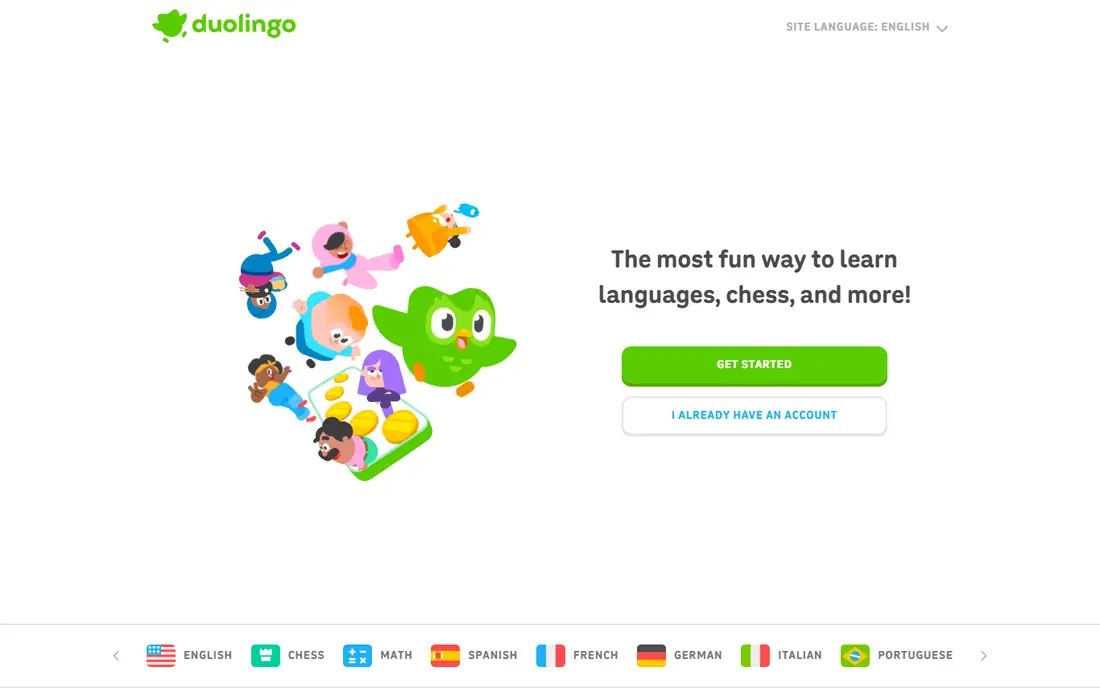
Duolingo is the best app for building a daily Mandarin habit, and the worst app to rely on alone. Its gamified micro-lessons and streaks get beginners to open the app every day, which is half the battle in language learning, and the free tier covers the basics with ads.
Depth is the problem. Grammar explanations are thin, tone training is weaker than HelloChinese, and character learning stays shallow. Use Duolingo to build the habit and learn basic words, then pair it with HelloChinese for structure and Pleco for lookup. On its own, Duolingo will not take you far in Mandarin.
What we like- Free with ads
- Gamified streaks build daily habits
- Good for first exposure to Mandarin
Watch out for- Shallow grammar explanations
- Weak tone and character depth
- Plus pricing varies by region
Starting priceFree
Free planYes
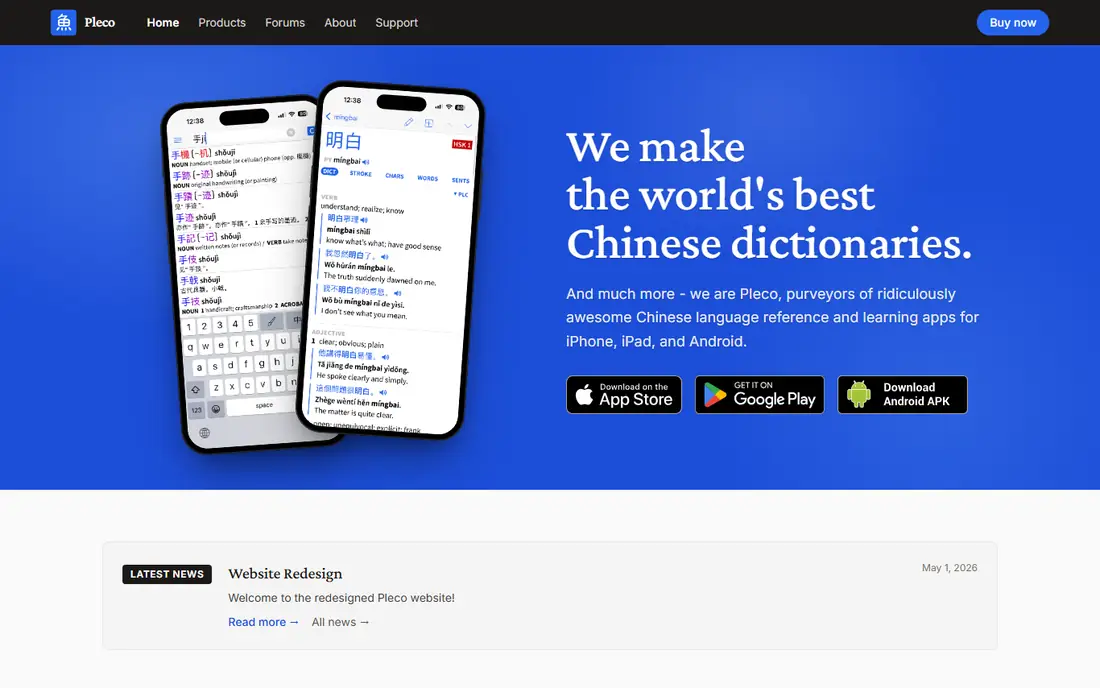
Pleco is the dictionary every serious Mandarin learner ends up using. The free app covers handwriting input, camera character recognition, stroke order animations, and audio, while paid bundles add flashcards, a document reader, and dictionaries. When you meet an unknown character in the wild, Pleco is how you identify it in seconds.
Pleco is not a curriculum, so it cannot replace a course app. Its value is as a companion: look up words from HelloChinese lessons, read signs with the camera, and build flashcards from what you actually encounter. Every learner on this list benefits from having Pleco installed from day one.
What we like- Best Chinese dictionary available
- Handwriting input and camera OCR
- Stroke order animations
- Audio for entries
Watch out for- Not a course
- Paid bundles for flashcards and reader features
- Interface rewards study, not casual browsing
Starting priceSee website
Free planNo
Skritter is unmatched for learning to write Chinese characters. It teaches stroke order with correction, tests recall through spaced repetition, and covers vocabulary alongside characters. For learners who want to read and write, not just speak, Skritter fills the gap that course apps leave.
It costs more than most apps here, with guides citing around $15 per month, and it offers only a trial free. It also focuses on writing, so speaking practice must come elsewhere. If your goal includes reading Chinese text or passing HSK written sections, Skritter is worth the price. If you only need spoken Mandarin, skip it.
What we like- Best character writing practice
- Stroke order correction
- Spaced repetition for characters and words
Watch out for- No free plan beyond a trial
- Pricing varies by guide, around $15 per month
- Focused on writing, not conversation
Starting priceFree
Free planYes
LingoDeer suits learners who want to understand why Mandarin works the way it does, not just memorize phrases. Its grammar explanations are clearer than Duolingo, its native audio is strong, and it supports both simplified and traditional characters, which matters for learners heading to Taiwan or Hong Kong.
It is less gamified than Duolingo or HelloChinese, so daily motivation depends more on your own discipline. Premium pricing varies across guides, from around $12 to $15 per month. For a learner who values grammar and structure over games, LingoDeer is a strong second course app.
What we like- Clear grammar explanations
- Native audio
- Supports simplified and traditional characters
Watch out for- Premium pricing varies by guide
- Smaller community than Duolingo
- Less gamified, so motivation must come from you
Starting priceFree
Free planYes
ChineseSkill offers guided, game-based lessons for beginners, with a step-by-step path through pinyin, tones, characters, and basic conversation. Its design suits learners who found Duolingo too shallow but want something lighter than a textbook-style course.
Advanced content is limited, and premium pricing varies by guide, so confirm in the app store. ChineseSkill works best as a first or second beginner app, paired with Pleco for lookup and conversation practice later. Learners who outgrow it usually move to HelloChinese depth or graded reading.
What we like- Step-by-step guided lessons
- Game-based design for beginners
- Supports simplified and traditional characters
Watch out for- Premium pricing varies by guide
- Limited advanced content
- Smaller update pace than larger apps
Starting priceFree
Free planYes
Anki is the gold standard for vocabulary retention, using spaced repetition to schedule reviews just before you forget a word. It is free on desktop and Android, with a one-time $24.99 iOS app, and shared decks cover HSK vocabulary at every level. Serious learners who stick with Anki retain far more words than those who rely on course apps alone.
The setup takes effort. Anki is a tool, not a course, so you must choose or build decks and learn its review system. That learning curve puts some beginners off, but the payoff is large: a daily Anki habit is the single most effective vocabulary method in language learning. Pair it with any course app on this list.
What we like- Best spaced repetition system for long-term memory
- Free on desktop and Android
- Huge shared deck library
Watch out for- Steep setup learning curve
- IOS app costs $24.99 one time
- Making good decks takes effort
#8italki
Best for: Live speaking practice3.8/5 on
G2 (19 reviews, checked Oct 2026)
Visit italki.com
Starting priceSee website
Free planNo
italki connects learners with native Mandarin tutors for one-on-one video lessons, with trial lessons and per-lesson pricing from around $4, and no subscription required. Speaking with a real person is the only way to build conversational fluency, correct tones in real time, and learn natural phrasing that apps cannot teach.
Costs add up if you take several lessons weekly, and tutor quality varies, so try trial lessons with two or three tutors before committing. italki is not a curriculum by itself, but as the speaking layer on top of HelloChinese, Pleco, and Anki, it completes the strongest Mandarin learning stack available.
What we like- One-on-one lessons with native tutors
- Lessons from around $4 each
- Flexible scheduling with no subscription
Watch out for- Costs add up with frequent lessons
- Tutor quality varies
- No structured curriculum without a tutor plan
How we chose
We compared apps on Mandarin-specific teaching, tone training, character writing, HSK alignment, speaking practice, pricing, and current status in 2026 guides and vendor pages. We included course apps, reference tools, and speaking platforms because no single app covers the whole job, and we left out generic language apps with thin Mandarin courses. Prices vary by guide and region, so we flagged conflicts rather than presenting one figure as certain.
How to pick an app to learn Mandarin
Start with HelloChinese for structure, add Pleco on day one for lookup, and build a daily habit you can keep. If you already use Duolingo for habit building, keep it as a warm-up, not as your main course. Add Anki when vocabulary starts slipping, Skritter when you want to write, and italki when you can hold a basic conversation and need real speaking practice.
Do not skip tones
Tones change word meanings in Mandarin, so a tone error is a vocabulary error, not an accent issue. Use an app with speech recognition, like HelloChinese, that corrects tones immediately, and practice tone pairs aloud daily. Learners who skip tone training early spend months unlearning bad habits later.
Plan your second stage now
Beginner apps plateau. Before you hit that wall, line up graded reading, character writing, and conversation practice so progress continues. A learner with HelloChinese plus Pleco, Anki, and a weekly italki tutor will pass the learner who finishes one app and wonders what comes next.
Frequently asked questions
What is the best app to learn Mandarin for a complete beginner?
HelloChinese is the best first app for most beginners, with structured lessons, tone training, and character writing built for Mandarin. Pair it with Pleco for dictionary lookup from day one.
Can I learn Mandarin with Duolingo alone?
No, not beyond basics. Duolingo builds a daily habit and teaches basic words, but its grammar, tone, and character depth are too shallow for real progress. Use it as a warm-up alongside HelloChinese or LingoDeer.
How long does it take to learn Mandarin with apps?
Basic conversation takes most learners six to twelve months of daily study, while reading and professional fluency take years. Apps speed up vocabulary and basics, but speaking practice with tutors and real reading matter more over time.
Should I learn simplified or traditional characters?
Simplified characters suit mainland China and Singapore, while traditional characters suit Taiwan, Hong Kong, and many overseas communities. HelloChinese, LingoDeer, and ChineseSkill support both, so choose based on where you plan to use Mandarin.
Is it worth paying for a Mandarin app?
Yes, once you know you will stick with it. Free tiers cover the first weeks, but premium courses, Skritter writing practice, and italki tutors pay off when study becomes a daily habit. Start free, then pay for the tool that removes your current bottleneck.
Do I need to learn characters to speak Mandarin?
You can speak without reading, and many learners start with pinyin and speaking only. Characters become essential for reading, texting, and advancing past intermediate level, so most learners add character study within the first few months.
Sources we checked (8)
- https://www.hellochinese.cc
- https://www.duolingo.com
- https://www.pleco.com
- https://www.skritter.com
- https://www.lingodeer.com
- https://www.chineseskill.com
- https://apps.ankiweb.net
- https://www.italki.com
Is your product missing or out of date?
We review this list regularly. Vendors can request a listing, send updated pricing or ask about featured placement.

Shihab Mia · Founder, Rankite
Shihab has 5+ years in B2B and SaaS SEO. He writes Rankite's software buying guides from pricing pages, documentation and public user reviews. More about Shihab.