How we make this list: we compare pricing pages, product documentation and public user reviews. Ratings come from G2, Capterra or Trustpilot, with the date we checked them.
Key takeaways
- The winning strategy for most apps in 2026 is hybrid: ads for free users, subscriptions for power users, and in-app purchases for extras.
- AdMob is the safest starting ad network, with 1 million plus apps and advertiser demand in more than 200 countries.
- AppLovin now leads mobile ad revenue share on iOS and Android, making its MAX mediation the highest-ceiling option for games.
- RevenueCat and Adapty remove subscription plumbing, with free tiers up to 2,500 and 5,000 dollars in monthly revenue respectively.
- Stripe and Paddle handle web payments, where you keep more of each sale than through app store billing.
Quick comparison
| Tool | Best for | Starting price | Free plan |
|---|
 Google AdMob | Starting ad monetization | Free to start | Yes |
 AppLovin MAX | High-scale game mediation | Free to start | Yes |
 Unity LevelPlay | Unity-built games | Free to start | Yes |
 Chartboost | Indie game ad revenue | Free to start | Yes |
 RevenueCat | Subscription infrastructure | Free to $2,500 MTR | Yes |
 Adapty | Paywall testing at scale | Free to $5,000 per month | Yes |
 Stripe | Web payments and billing | 2.9% + 30 cents per transaction | Yes |
 Paddle | Merchant of record sales | 5% + 50 cents per transaction | Yes |
Is your product missing or out of date?
We review this list regularly. Vendors can request a listing, send updated pricing or ask about featured placement.
Starting priceFree to start
Free planYes
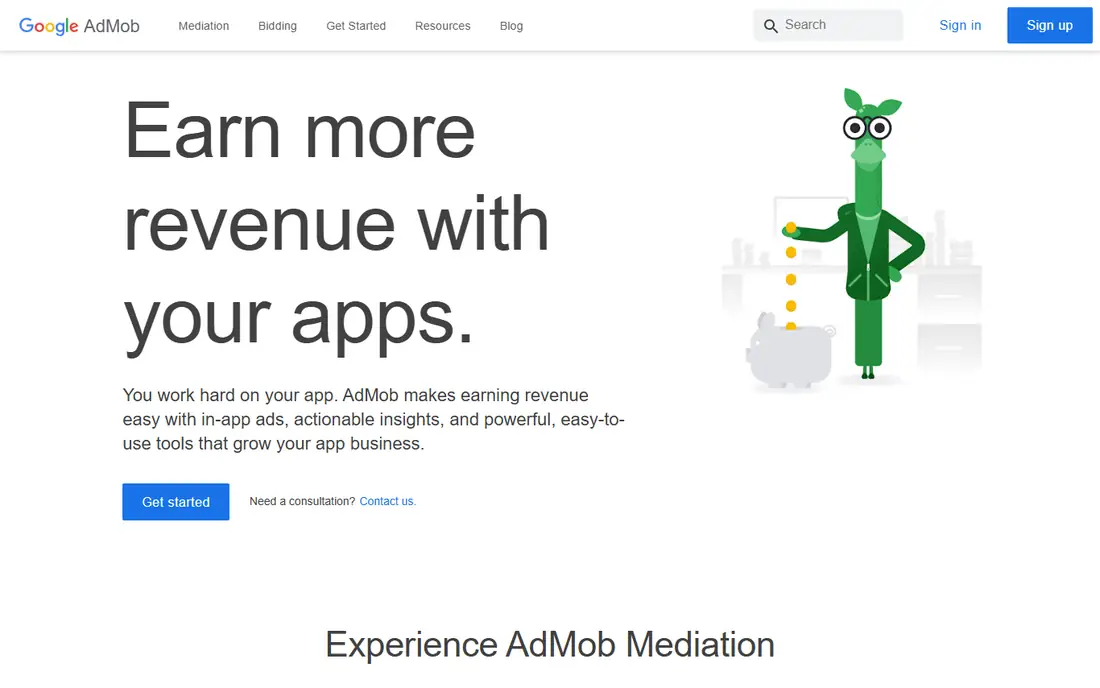
Google AdMob remains the default first network for new developers, and that has not changed in 2026. Its homepage cites 1 million plus apps using AdMob, 81 percent of the Android top 1000, and advertiser demand in more than 200 countries, with mediation groups, in-house campaigns, and direct deal support that scale as you grow.
AdMob's bidding lets every participating network compete for each impression in real time, so the highest-paying bid wins, and its formats cover banner, interstitial, native, rewarded, and video ads. Integration with Google Analytics for Firebase gives deeper insight into how users interact with your app and ads.
The risk is policy: AdMob bans are hard to appeal, so read the policies before launch and keep invalid traffic out. AdMob is the pick when you want reliable ad revenue from day one, especially for utility, tools, and news apps with modest traffic.
What we like- Largest global ad network
- High fill rates
- Banner, interstitial, native, rewarded, and video formats
- Mediation and bidding built in
Watch out for- Policy violations can trigger account bans
- Lower eCPM in some regions
- Limited manual control for advanced optimization
#2AppLovin MAX
Best for: High-scale game mediation4.2/5 on
G2 (21 reviews, checked Oct 2026)
Visit applovin.com
Starting priceFree to start
Free planYes

AppLovin runs its mediation product under the name MAX, and it is currently the platform most top-grossing mobile games route through. Independent 2025 data showed AppLovin MAX holding the largest share of top-downloaded and top-grossing games among mediation platforms, and 2026 Tenjin data put AppLovin at 53 percent of iOS ad revenue and first on Android at 29 percent.
The platform's Axon AI system automates targeting, bidding, and budget allocation, and its fullscreen ad formats run during natural pauses or in exchange for rewards, which suits games better than feed-based apps. AppLovin now also serves consumer brands beyond gaming, driving purchases, signups, and subscriptions.
The tradeoff is scale: MAX needs meaningful daily active users to optimize well, and switching to it mid-year can mean 2 to 4 weeks of degraded eCPM while its model relearns your app. AppLovin is the pick when your game already has traction and you want the highest ad revenue ceiling.
What we like- Largest mediation footprint among top games
- Machine-learning bid optimization
- Strong rewarded video demand
- 53 percent of iOS ad revenue in 2026 data
Watch out for- Needs meaningful daily users to shine
- Weaker for non-gaming apps
- Switching mid-year can depress eCPM for weeks
Starting priceFree to start
Free planYes
Unity LevelPlay is the mediation platform inside Unity's growth suite, alongside Unity Ads, ironSource Ads, Tapjoy Offerwall, and Aura. Its homepage notes that 85 percent of the top 100 games use Unity growth solutions, and LevelPlay lets those games run bidding across ad networks with one SDK.
The advantage is integration: if your game is already built in Unity, LevelPlay, Unity Ads, and the Tapjoy offerwall share tooling, analytics, and support, and Unity's monetization strategy tools help design an economy that feels like a natural extension of gameplay.
The limit is scope: LevelPlay's edge fades for non-Unity apps, and small games may find simpler networks easier. Unity LevelPlay is the pick when your game is Unity-built and you want mediation, ads, and offerwalls from one vendor.
What we like- Native fit for Unity-built games
- LevelPlay mediation plus Unity Ads demand
- Tapjoy offerwall
- 85 percent of top 100 games use Unity growth tools
Watch out for- Weaker outside Unity games
- Mediation complexity at small scale
- Unity's pricing history worries some indies
Starting priceFree to start
Free planYes
Chartboost is the indie-friendly ad platform, now part of LoopMe, with a homepage promise of monetization through trust and transparency. Its in-app bidding works across most major mediation partners, letting Chartboost bid in real time against your other demand sources, and its premier demand sources span 110 plus networks through one SDK.
Formats cover video, rewarded, interstitial, and banner, and transparent reporting shows ad requests, impressions, eCPM, fill rate, and auction data. LoopMe's marketplace AI now powers Chartboost, with direct SDK integrations in over 3,000 apps and 700 million active daily mobile users.
Chartboost will not match AdMob's fill rates or AppLovin's scale, but it adds a competitive bidder to your mediation stack and suits indie games that want direct brand demand. Chartboost is the pick as a second or third demand source that raises auction competition.
What we like- In-app bidding across major mediation partners
- 110 plus demand sources
- Video, rewarded, interstitial, and banner support
- Now powered by LoopMe AI
Watch out for- Smaller scale than AdMob or AppLovin
- Indie focus means thinner enterprise tooling
#5RevenueCat
Best for: Subscription infrastructure4.8/5 on
G2 (213 reviews, checked Oct 2026)
Visit revenuecat.com
Starting priceFree to $2,500 MTR
Free planYes
RevenueCat is the subscription backend most serious apps use, powering purchases, customer data, and growth on iOS, Android, and the web for more than 158,000 apps, with 18 billion dollars in revenue processed. Its homepage describes a subscription backend in a box: it streamlines purchase setup, automates receipt validation across StoreKit, Google Play, smart TV, and web, and handles platform changes so you do not have to.
Paywall tools let you build, target, and test paywalls that convert, with pre-built templates and a layer-driven editor, while analytics show what drives growth and predict campaign payback periods. Web-to-app campaigns bypass store fees and attribution restrictions for users you convert on the web.
Pricing is free to get started, with a 1 percent fee above 2,500 dollars in monthly tracked revenue in 2026 comparisons. RevenueCat is the pick when subscriptions are your main revenue and you want billing handled correctly across platforms.
What we like- Subscription backend in a box
- Cross-platform receipt validation
- Paywall templates and A/B testing
- 158,000 plus apps supported
Watch out for- 1 percent fee above the free tier
- Store fees still apply on top
- Analytics depth needs higher usage
Starting priceFree to $5,000 per month
Free planYes
Adapty calls itself RevenueOS for subscription apps, and its homepage makes the pricing pitch plainly: free until you earn 5,000 dollars a month, then 1 percent of revenue, with infrastructure, flows, paywalls, analytics, and user acquisition tools all included and no tiers.
The platform's strength is testing: its paywall and onboarding builder lets you design flows by hand, with AI, or through an agent, change what users see without app updates, and A/B test entire flows for revenue rather than just conversions. AI Growth Autopilot analyzes your app, competitors, and past results to recommend what to test next.
Adapty tracks 5 billion dollars in revenue across 30,000 plus apps, with 4 billion users served. It does not handle ads, so pair it with AdMob or AppLovin for a hybrid strategy. Adapty is the pick when paywall experimentation is your growth lever.
What we like- Free until you earn 5,000 dollars a month, then 1 percent
- Paywall and onboarding builders without app updates
- AI growth autopilot
- 30,000 plus apps
Watch out for- Subscription focus only, no ad mediation
- Smaller ecosystem than RevenueCat
#7Stripe
Best for: Web payments and billing4.2/5 on
G2 (462 reviews, checked Oct 2026)
Visit stripe.com
Starting price2.9% + 30 cents per transaction
Free planYes
Stripe is the web payments backbone for apps that sell on the web, whether through web signup, web-to-app funnels, or companion web products. Its homepage cites 135 plus currencies and payment methods, 1.9 trillion dollars in payments volume processed in 2025, and 200 million plus active subscriptions managed on Stripe Billing.
The monetization case is simple: web sales avoid Apple and Google's 15 to 30 percent store fees, leaving only Stripe's 2.9 percent plus 30 cents per transaction in the US, plus your own tax handling. Stripe Billing manages subscriptions, trials, proration, and failed payment recovery, and Stripe Connect handles creator payouts and marketplaces.
The catch is store policy: digital goods consumed in the app generally must use in-app purchase, so web billing fits web-first products, cross-platform subscriptions, and physical goods best. Stripe is the pick when your funnel starts on the web or your product spans web and mobile.
What we like- No monthly fee to start
- 135 plus currencies
- 200 million plus subscriptions managed
- Web-to-app billing that avoids store fees
Watch out for- Store rules limit what you can sell outside IAP
- You handle tax and compliance yourself
- Fees add up at volume
#8Paddle
Best for: Merchant of record sales4.5/5 on
G2 (240 reviews, checked Oct 2026)
Visit paddle.com
Starting price5% + 50 cents per transaction
Free planYes
Paddle is the merchant of record alternative to Stripe for digital product businesses. Its homepage emphasizes selling globally without complexity: as merchant of record, Paddle manages payments, tax, compliance, and billing across 300 plus markets, with 190 million transactions processed and 130 million dollars in sales taxes remitted last year.
The platform includes ProfitWell Metrics for real-time subscription, retention, and growth analytics, and Retain, which automatically recovers failed payments, reduces cancellations, and optimizes subscriptions. Paddle serves more than 10,000 customers.
Pricing is 5 percent plus 50 cents per transaction, higher than Stripe's rate, but it includes tax handling and compliance that Stripe leaves to you. Paddle is the pick when you sell digital products globally and want tax and compliance off your plate.
What we like- Merchant of record handles tax and compliance across 300 plus markets
- Retain recovers failed payments
- ProfitWell metrics included
Watch out for- Higher per-transaction fee than Stripe
- SaaS and digital focus, less suited to physical goods
How we chose
We compared app monetization tools with real app businesses using them, pricing from 2026 comparisons and vendor homepages we opened on 27 October 2026 to confirm they load and belong to the vendor. ironSource was replaced by Chartboost because ironSource's domain now routes to Unity Grow. Revenue figures and ad shares come from 2026 industry data and vary by app, category, and region. We did not claim hands-on testing.
What to check before you pick
Start from your app type. Games monetize with ads and in-app purchases through AdMob, AppLovin, LevelPlay, or Chartboost. Subscription apps need RevenueCat or Adapty. Web-first products need Stripe or Paddle. Most successful apps combine two or three of these.
Next, model the fees honestly. Store fees of 15 to 30 percent dwarf ad network revenue shares and payment fees, so web-to-app funnels and annual subscriptions that cut store fees can matter more than any single tool choice.
Finally, test one monetization change at a time. A paywall test, a rewarded ad placement, or a pricing change each need clean measurement, and stacking changes together makes it impossible to know what worked.
Frequently asked questions
What is the best app monetization strategy?
A hybrid: ads for free users, subscriptions for power users, and in-app purchases for extras. 2026 data shows 92 percent of top-grossing apps use a hybrid freemium model, and rewarded video formats report completion rates near 91 percent.
Should I start with ads or subscriptions?
Ads if you have high daily users and low willingness to pay, as in games and utilities. Subscriptions if you deliver ongoing value, as in fitness, productivity, and content apps. Most apps eventually run both.
How much do app stores take?
Apple and Google take 15 to 30 percent of in-app purchases and subscriptions, depending on program and tenure. Web sales through Stripe or Paddle avoid store fees but must follow store rules for digital goods consumed in the app.
What is mediation?
Mediation lets multiple ad networks bid for each impression in real time, so the highest-paying bid wins. AppLovin MAX, Unity LevelPlay, and AdMob mediation all do this, raising revenue over a single network.
Do I need RevenueCat or Adapty if I have few users?
No, but both are free at small scale, with RevenueCat free to 2,500 dollars in monthly revenue and Adapty free to 5,000 dollars a month. They save engineering time even for small apps, and switching later costs more.
Can I monetize without annoying users?
Yes, with rewarded ads users choose to watch, paywalls shown after value is proven, and subscriptions priced for the power users who want more. Ads that interrupt core flows and paywalls shown before any value are the two fastest ways to lose users.
Sources we checked (8)
- https://admob.google.com
- https://www.applovin.com
- https://unity.com
- https://www.chartboost.com
- https://www.revenuecat.com
- https://adapty.io
- https://stripe.com
- https://www.paddle.com
Is your product missing or out of date?
We review this list regularly. Vendors can request a listing, send updated pricing or ask about featured placement.

Shihab Mia · Founder, Rankite
Shihab has 5+ years in B2B and SaaS SEO. He writes Rankite's software buying guides from pricing pages, documentation and public user reviews. More about Shihab.