How we make this list: we compare pricing pages, product documentation and public user reviews. Ratings come from G2, Capterra or Trustpilot, with the date we checked them.

Key takeaways
- These tools are for legitimate research assistance only: discovery, extraction, summarising and citation checking, not for writing work you submit as your own.
- Elicit leads on structured literature extraction, Consensus on evidence-backed claim synthesis, and SciSpace on reading and understanding individual papers.
- ResearchRabbit and Semantic Scholar are free and cover discovery well, so a zero-cost stack of Semantic Scholar plus Elicit Basic handles most solo research.
- Every AI output needs verification: open the DOI, check the authors, methods and findings against the source, and follow your institution's rules on AI use.
Quick comparison
| Tool | Best for | Starting price | Free plan |
|---|
 Elicit | Systematic literature tables | $10 per month (billed annually) | Yes (5,000 one-time credits) |
 Consensus | Evidence-backed claim synthesis | $8.99 per month (billed annually) | Yes (unlimited basic search) |
 SciSpace | Reading and understanding papers | $12 per month (billed annually) | Yes (basic copilot chat) |
 Scholarcy | Structured paper summaries | $9.99 per month | Yes (10 free summaries per day) |
 ResearchRabbit | Citation network discovery | $0 | Yes (100% free) |
 Connected Papers | Related-paper graphs | $3 per month (billed annually) | Yes (5 free graphs per month) |
 Litmaps | Citation timelines and monitoring | $10 per month | Yes (1 map up to 20 articles) |
 Semantic Scholar | Free discovery and skimming | $0 | Yes |
Is your product missing or out of date?
We review this list regularly. Vendors can request a listing, send updated pricing or ask about featured placement.
Starting price$10 per month (billed annually)
Free planYes (5,000 one-time credits)
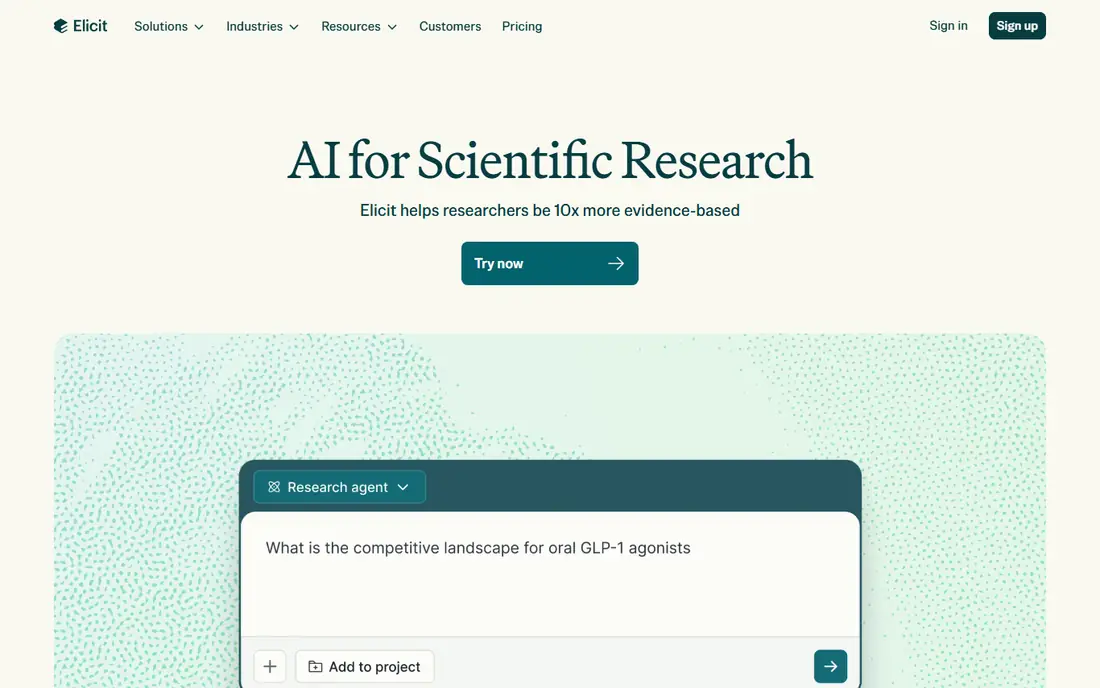
Elicit is the systematic review tool: it searches over 200 million papers via Semantic Scholar, extracts custom columns such as methods, outcomes and sample sizes into structured tables, and speeds the extraction phase of literature reviews dramatically. One comparison rates it 4.9 out of 5, the highest in its roundup, and notes that customizable table templates speed systematic review extraction.
Extraction is usable for methods and outcomes columns but needs verification for limitations, and the free tier's 5,000 one-time credits run out on large reviews. Elicit fits graduate students, faculty and systematic review teams that need structured extraction across many papers, with human oversight on all critical claims.
What we like- Custom column extraction across 50-plus papers
- Structured tables for systematic reviews
- Strong export
Watch out for- Free tier limited
- Extraction needs verification for limitations
- Plus cited at $11 per user per month in another guide
#2Consensus
Best for: Evidence-backed claim synthesis4.7/5 on
G2 (1,885 reviews, checked Oct 2026)
Visit consensus.app
Starting price$8.99 per month (billed annually)
Free planYes (unlimited basic search)
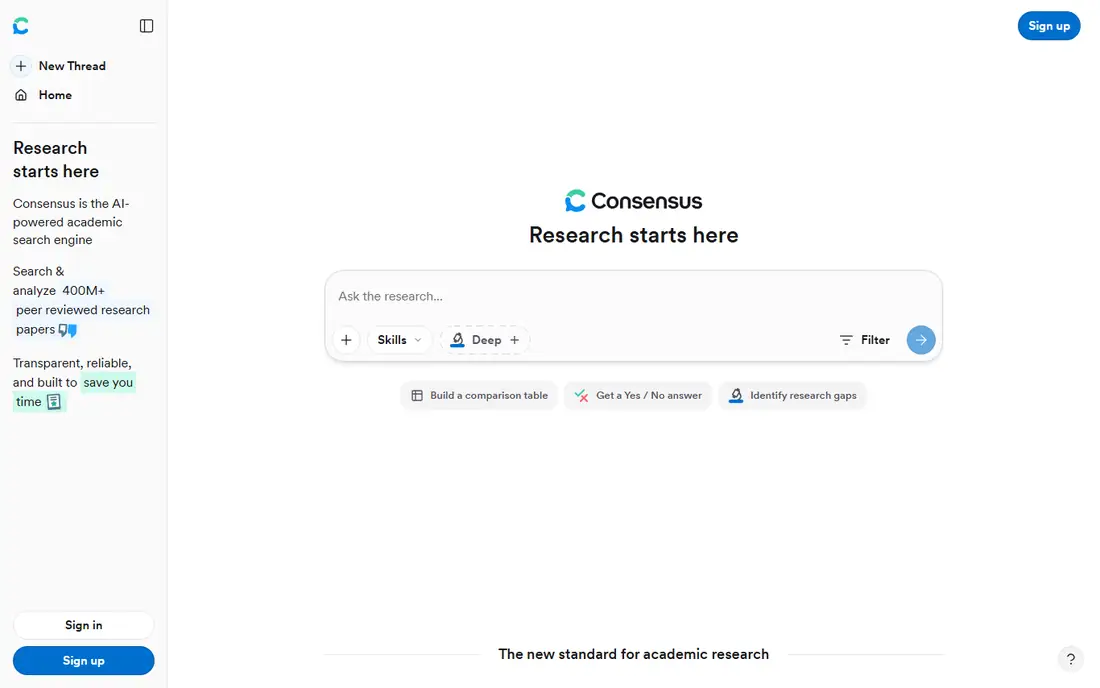
Consensus answers research questions with evidence-backed synthesis drawn from over 200 million papers, showing a Consensus Meter that reflects how far studies agree on a claim. It flags study quality and evidence strength, distinguishing randomised trials from observational work, and surfaces methodological limitations and biases in individual studies.
AI-generated conclusions are starting points, not final answers: verify every claim at the source before citing it. Consensus fits researchers and evidence-based medicine teams that need to know what the literature says about a specific claim, and how strong that evidence is.
What we like- Consensus Meter showing agreement across studies
- Evidence-backed claim synthesis
- Study quality flags
Watch out for- Synthesis needs source checking
- Paid features gated behind subscription
Starting price$12 per month (billed annually)
Free planYes (basic copilot chat)
SciSpace is the reading copilot: it explains papers interactively, chats about math formulas, builds review matrices and helps users understand dense academic text, drawing on a 280-million-plus paper index. For STEM researchers facing long, technical papers, that guided reading saves real time compared with skimming alone.
Higher tiers reach $160 per month in one comparison, so check which tier your needs require. SciSpace fits students and researchers who need to understand papers deeply, not just find them, and who will verify copilot explanations against the source text.
What we like- Interactive paper reading copilot
- Math formula chat
- Review matrices
- 280-million-plus paper index
Watch out for- Paid tiers reach $160 per month in one guide
- Writing features need academic-integrity care
Starting price$9.99 per month
Free planYes (10 free summaries per day)
Scholarcy turns individual papers into structured summary flashcards with key findings, methods and limitations, building a literature matrix across your reading list. The browser extension summarises papers as you browse, and 10 free summaries per day cover casual use.
It works from user uploads and open-access sources rather than a full discovery database, so it pairs with a discovery tool rather than replacing one. Scholarcy fits students and researchers who need quick, structured summaries of papers they already found, for revision and literature mapping.
What we like- Structured summary flashcards
- Literature matrix view
- Browser extension for quick summaries
Watch out for- PDF-focused, not a discovery database
- Summary quality varies by paper type
Starting price$0
Free planYes (100% free)
ResearchRabbit is completely free and builds interactive citation network graphs from seed papers, revealing co-authorship connections, related work and research gaps through visual exploration. Its recommendations surface papers you would miss with keyword search alone, and one comparison rates it 4.8 out of 5.
It covers discovery only, with no extraction, synthesis or writing features, so it pairs with Elicit or Consensus for later stages. ResearchRabbit fits budget-constrained researchers who want the best free discovery tool available, and teams mapping a field's structure.
What we like- Completely free
- Interactive citation network graphs
- Co-authorship discovery
- Recommendations
Watch out for- No extraction or synthesis features
- Discovery only
Starting price$3 per month (billed annually)
Free planYes (5 free graphs per month)
Connected Papers builds a similarity graph from a single seed paper, showing related work clustered by co-citation so researchers can orient themselves in a new field in minutes. At $3 per month on annual billing, it is the cheapest paid tool in this list, and 5 free graphs per month cover occasional use.
It offers one graph type, not the interactive network exploration of ResearchRabbit or the timelines of Litmaps. Connected Papers fits researchers entering a new topic who want a fast visual map of the key papers around one seed article.
What we like- Cheapest paid tool here
- Single-seed similarity graphs
- Quick field orientation
Watch out for- One graph type only
- Free tier limited to 5 graphs per month
Starting price$10 per month
Free planYes (1 map up to 20 articles)
Litmaps builds longitudinal citation timelines and monitors them in real time, revealing how a field developed and where research gaps sit through visual clusters. Sharing features suit collaborative teams tracking a fast-moving topic, and one comparison rates it 4.7 out of 5.
The free tier covers only one map of up to 20 articles, so serious use needs the $10 per month plan. Litmaps fits researchers tracking a field over time, and teams that need visual gap identification alongside regular monitoring.
What we like- Longitudinal citation timelines
- Real-time monitoring
- Visual gap identification
- Sharing features
Watch out for- Free tier limited to one map
- Newer tool with a smaller user base
Starting price$0
Free planYes
Semantic Scholar is the free discovery foundation: over 200 million papers, TLDR summaries for quick skimming, recommendations, and API access for building custom pipelines. It powers Elicit and Connected Papers behind the scenes, and its data quality and citation grounding make it the safest free starting point.
It offers no extraction tables, synthesis or writing features, so it anchors a stack rather than completing one. Semantic Scholar fits every researcher as a first stop, and budget-constrained solo researchers can pair it with Elicit Basic at zero total cost.
What we like- Completely free
- 200-million-plus papers
- TLDR summaries
- Recommendations
- API access
Watch out for- No extraction tables or synthesis
- Skimming only
How we chose
We graded tools on citation grounding accuracy, extraction flexibility, visual graph depth and export integration, following the dimensions used in a 2026 literature review comparison. Sources included an eight-tool literature review roundup, an Elicit review with September 2026 pricing, and a student-focused research tool guide. Where prices conflicted across guides, the article uses the most recent figure and notes the difference. We did not claim hands-on testing, and realistic expectations in 2026 still include human oversight on all critical claims.
What to check before you sign
Start with academic integrity, which outranks every feature. These tools assist discovery, extraction and understanding; they do not write your work. Cite sources properly, follow your institution's rules on AI use, and never submit AI output as your own work. Universities deploy detection tools, and unedited AI-generated text is both academic dishonesty and easily caught.
Next, verify every citation at the source. Open the DOI link on PubMed or Google Scholar and confirm that the authors, methodology and specific findings match your paper's claims, since AI tools can misattribute findings or invent references. Spot-check AI-generated summaries against 10 to 20 percent of papers manually, and document your workflow, search strategies and inclusion criteria, since AI transparency is increasingly required for publications.
Finally, build a stack rather than buying one tool. A practical pattern is Semantic Scholar for discovery, Elicit for structured extraction, Consensus for synthesis and ResearchRabbit for network mapping, with Scholarcy or SciSpace for reading. No single tool is best for everything, and combining tools beats relying on one. Set a verification routine for the stack: check extraction against the source paper for at least one in five papers, re-run important claims through a second tool, and keep a research log that records which tool produced each table or summary, so any error can be traced back to its source rather than hiding inside a polished-looking output.
Frequently asked questions
What is the best AI tool for academic research?
For literature reviews, Elicit. For evidence-based questions, Consensus. For reading papers, SciSpace. For free discovery, Semantic Scholar and ResearchRabbit. Most researchers combine two or three tools rather than relying on one.
Can I use AI tools to write my essay or thesis?
No, not as the author. AI tools can help you discover papers, extract data, summarise reading and check citations, but submitting AI-generated text as your own work is academic dishonesty. Write your own arguments and conclusions, and follow your institution's AI rules.
Are AI research citations reliable?
Not always. AI tools can misattribute findings, invent references or misread methods, so open every DOI and verify authors, methods and findings against the source before citing. Citation grounding accuracy varies by tool and paper type.
What is the cheapest way to do AI-assisted research?
Semantic Scholar plus ResearchRabbit for discovery, with Elicit Basic and Consensus free tiers for extraction and synthesis, covers most solo research at zero cost. Paid plans start at $3 per month for Connected Papers and $8.99 to $12 for Consensus, Elicit and SciSpace, while a full literature-review stack of Elicit plus Consensus plus SciSpace runs about $26 to $41 per month depending on tiers, which is still far less than the time cost of manual extraction across dozens of papers.
How do I document AI use in a paper?
Record which tools you used, your search strategies, inclusion and exclusion criteria, and how you verified outputs. Journals and institutions increasingly require AI transparency, and a documented workflow protects your work's credibility.
Do these tools replace reading papers?
No. AI summaries and extractions speed discovery and orientation, but critical claims need direct reading of the source paper, especially methods and limitations sections. Skim with AI, then read the key papers properly, in full, before citing them in your own work, every single time.
Sources we checked (5)
- https://www.aicentralresources.com/blog/8-best-ai-tools-for-literature-review-in-2026
- https://aitoolranked.com/blog/elicit-review-best-ai-literature-review-tools
- https://studytoolset.com/blog/best-ai-research-tools.html
- https://awesomeagents.ai/tools/best-ai-research-assistants-2026/
- https://aiagentsquare.com/blog/ai-academic-research-tools
Is your product missing or out of date?
We review this list regularly. Vendors can request a listing, send updated pricing or ask about featured placement.

Shihab Mia · Founder, Rankite
Shihab has 5+ years in B2B and SaaS SEO. He writes Rankite's software buying guides from pricing pages, documentation and public user reviews. More about Shihab.