How we make this list: we compare pricing pages, product documentation and public user reviews. Ratings come from G2, Capterra or Trustpilot, with the date we checked them.
Key takeaways
- Siemens and AVEVA suit large plants that need AI inside established automation and engineering workflows.
- PTC ThingWorx and Rockwell FactoryTalk suit manufacturers already running those vendors' control systems.
- Seeq and Braincube suit engineers who want to analyse process data and find production losses without a full platform rebuild.
- Tulip suits frontline operations, with apps that guide workers and capture shop-floor data.
- Industrial AI pricing is almost always quote-based, and success depends on data quality and integration with existing control systems.
Industrial engineering AI helps factories, plants and supply chains run better: predicting equipment failure, cutting scrap, optimising energy use and spotting quality drift before it becomes a batch of rejects. The platforms below differ in where they sit. Some live inside automation systems from Siemens or Rockwell. Others analyse historian data from any plant. A few put apps in workers' hands on the shop floor.
Pricing is enterprise and quote-based across this category, so the table marks prices as "See website". Budget for integration and data work alongside licences, since industrial AI fails most often on messy or missing data, not on algorithms.
Quick comparison
| Tool | Best for | Starting price | Free plan |
|---|
 Siemens Industrial AI | Large plant automation | See website | No |
 AVEVA | Process and plant intelligence | See website | No |
 PTC ThingWorx | Connected factory platform | See website | Free trial |
 Rockwell FactoryTalk | Rockwell control environments | See website | No |
 AspenTech | Process optimisation | See website | No |
 Braincube | Manufacturing data intelligence | See website | No |
 Seeq | Process data analytics | See website | Free trial |
 Tulip | Frontline operations apps | See website | Free trial |
Is your product missing or out of date?
We review this list regularly. Vendors can request a listing, send updated pricing or ask about featured placement.
Starting priceSee website
Free planNo
Siemens builds AI into its automation stack, from drives and controllers to plant software and digital twins. Industrial AI applications cover predictive maintenance, quality inspection with vision systems, energy optimisation and production planning. Because Siemens also makes the hardware, models can run close to machines with low latency, and domain knowledge from decades of plant work shapes the models.
The cost and commitment are enterprise-scale, and the strongest fit is a plant already running Siemens automation. For a large manufacturer standardising on Siemens, the integrated AI path is the most direct route to results.
What we like- AI embedded in automation, drives and plant software
- Deep domain models for manufacturing
- Global support network
Watch out for- Enterprise pricing and implementation
- Best value inside Siemens environments
Starting priceSee website
Free planNo

AVEVA combines process data, engineering information and operations software into a platform where AI can work across a plant's whole history. Its PI System heritage gives it deep historian data, and AI applications target asset performance, predictive maintenance and process optimisation in oil and gas, chemicals, power and food production. The engineering data model helps AI understand how a plant is actually built.
The portfolio is broad, which can confuse buyers, and implementation usually runs through specialist partners. For process industries with large historian estates, AVEVA gives AI a strong data foundation.
What we like- Strong process historian and engineering data
- AI for operations and asset performance
- Wide industry coverage
Watch out for- Complex product portfolio
- Implementation needs specialist partners
#3PTC ThingWorx
Best for: Connected factory platform3.9/5 on
G2 (33 reviews, checked Oct 2026)
Visit ptc.com
Starting priceSee website
Free planFree trial
ThingWorx is PTC's industrial IoT platform, connecting machines, sensors and business systems so AI can work on live production data. Analytics, machine learning and augmented reality tools sit on the same platform, letting engineers build dashboards, alerts and guided work instructions. Manufacturers use it for Overall Equipment Effectiveness, quality tracking and predictive maintenance.
Breadth means integration work. Connecting diverse machines and systems takes effort, and pricing comes by quote. For a manufacturer building a connected factory on one platform, ThingWorx is a proven choice.
What we like- Industrial IoT platform with analytics and AR
- Connects machines, sensors and systems
- Strong manufacturing apps
Watch out for- Platform breadth needs integration effort
- Pricing is quote-based
Starting priceSee website
Free planNo
FactoryTalk Analytics brings AI and analytics into Rockwell Automation environments, where many North American plants already run control systems. Applications cover predictive maintenance, quality prediction and production optimisation, using data from controllers and historians without a separate data project. The vendor's control expertise shapes models for real plant behaviour.
Plants outside Rockwell automation get less value, since integration is deepest there. Pricing is enterprise and quote-based. For a Rockwell plant that wants AI without ripping out controls, FactoryTalk is the natural path.
What we like- Analytics inside Rockwell automation
- Strong for discrete and process manufacturing
- Trusted control vendor
Watch out for- Best fit inside Rockwell systems
- Enterprise pricing
Starting priceSee website
Free planNo
AspenTech serves process industries with models built on chemical engineering knowledge. Its AI and optimisation tools cover planning, scheduling, advanced process control and asset performance in refining, chemicals, pharmaceuticals and mining. The models understand process physics, which helps them beat generic machine learning on complex plants.
The specialisation is also the limit. Discrete manufacturers making cars or electronics will find less fit, and pricing is enterprise. For a process plant that wants AI grounded in engineering models, AspenTech is the specialist leader.
What we like- Deep process models for chemicals, refining and pharma
- AI for planning, scheduling and asset optimisation
- Strong industry expertise
Watch out for- Specialised and expensive
- Less suited to discrete manufacturing
Starting priceSee website
Free planNo
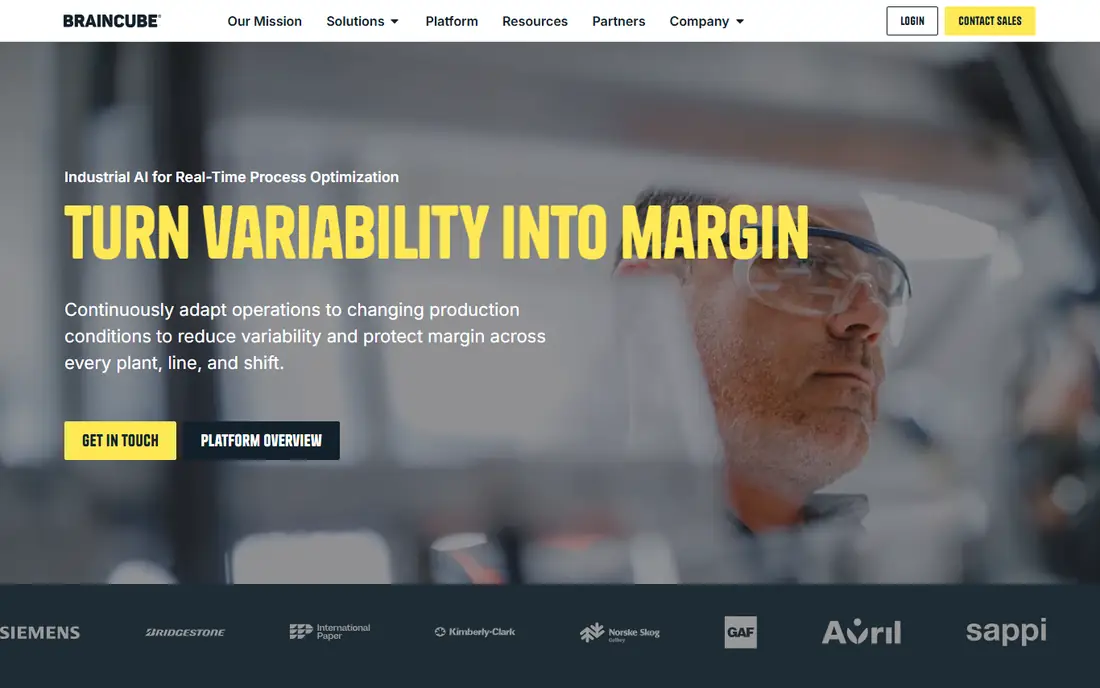
Braincube is a manufacturing intelligence platform that connects plant data and applies AI to quality, maintenance and productivity problems. Ready-made applications target common losses such as scrap, downtime and energy waste, and the platform is designed for fast deployment without a long data science project. Manufacturers in food, packaging, automotive and building materials use it to find improvements quickly.
The vendor is smaller than the automation giants, which matters for buyers who want a global support footprint. For a plant that wants AI results in weeks rather than a platform programme, Braincube's focused apps are appealing.
What we like- Purpose-built for manufacturing data
- Apps for quality, maintenance and productivity
- Fast time to value
Watch out for- Smaller vendor than Siemens or AVEVA
- Less known outside manufacturing circles
#7Seeq
Best for: Process data analytics4.6/5 on
G2 (150 reviews, checked Oct 2026)
Visit seeq.com
Starting priceSee website
Free planFree trial

Seeq lets process engineers analyse historian and sensor data without writing code. Time-series formulas, pattern search and machine learning tools help engineers find why a batch drifted, when a pump started degrading, or how a setpoint change affected yield. It connects to major historians and cloud data stores, so existing data becomes usable quickly.
Seeq is an analytics layer, not a control system, so acting on findings still needs plant systems or people. For engineers who want to interrogate process data themselves and build a case for change, Seeq is the fastest tool here.
What we like- Fast analysis of historian and sensor data
- No-code formula and machine learning tools
- Works with major historians
Watch out for- Analytics focus means less control integration
- Enterprise pricing for larger deployments
#8Tulip
Best for: Frontline operations apps4.5/5 on
G2 (37 reviews, checked Oct 2026)
Visit tulip.co
Starting priceSee website
Free planFree trial
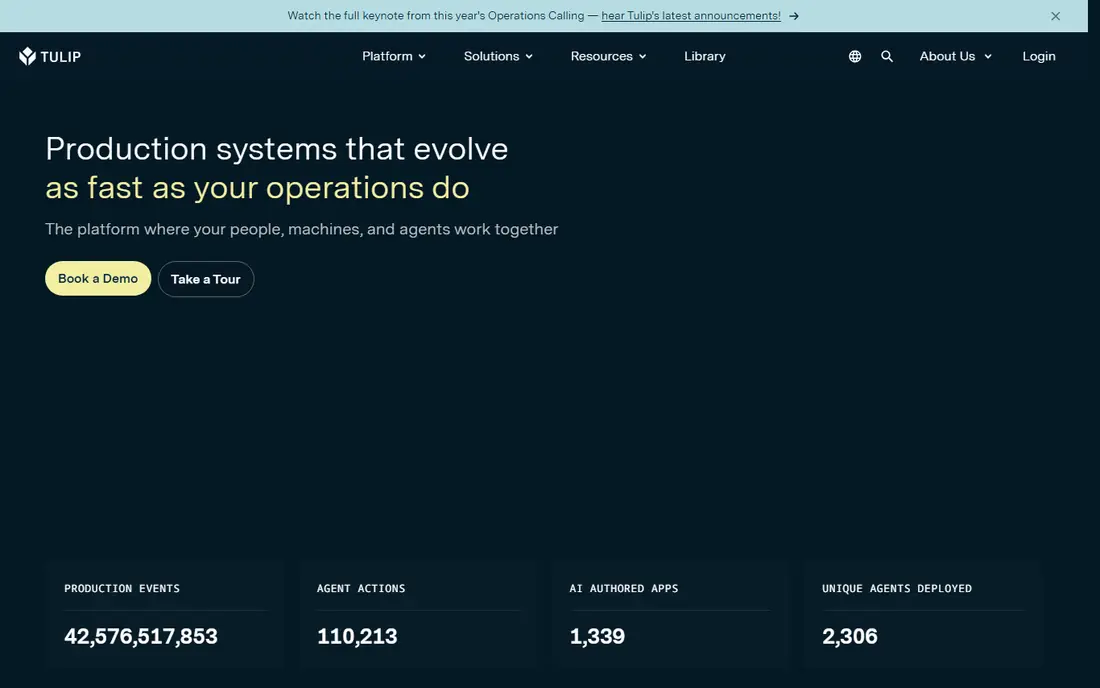
Tulip gives frontline teams no-code apps for assembly guidance, quality checks, machine monitoring and training. Workers use tablets at stations, and the data they generate feeds dashboards and AI models for productivity and quality analysis. The platform connects to machines, sensors and business systems, so shop-floor data joins the wider picture.
Deep process analytics is thinner than Seeq or AspenTech, since Tulip's strength is operations apps rather than process modelling. Pricing per station can add up across a large plant. For a manufacturer digitising frontline work and feeding AI with real operator data, Tulip is the most practical choice.
What we like- No-code apps for shop-floor workers
- Captures frontline data for AI
- Connects to machines and systems
Watch out for- Frontline focus means less deep process analytics
- Per-station pricing adds up
How we chose
We compared platforms on their published industrial capabilities, data integrations, deployment options and public case studies from manufacturers. We favoured platforms with proven plant deployments, historian and control system integrations, and AI applications aimed at real production problems. Prices were marked "See website" because industrial pricing is quote-based. We did not claim hands-on testing.
Making industrial AI work in a real plant
Data quality decides success. Before buying a platform, audit what data your plant actually records, how clean it is, and whether timestamps align across systems. A platform cannot fix missing sensors or inconsistent batch records, and many pilots stall at this step. Start with one production line and one clear problem, such as unplanned downtime on a bottleneck machine, and measure the result before scaling.
Also plan who owns the system. Industrial AI needs both process engineers who understand the plant and data people who understand models. Vendors that offer both platform and services shorten the path, but internal ownership matters for long-term results. A pilot with a named owner and a measured target beats a broad rollout without one.
Industrial AI projects pay back fastest when they start with one measurable problem. Pick a single line, machine or process with clear data, such as unplanned downtime on one press or scrap rate on one product, and run the AI pilot there for a full production cycle before expanding. Measure the baseline for at least a month first, since without a baseline nobody can prove the AI helped. Involve operators from day one, because they spot false alarms and bad recommendations faster than any dashboard, and their trust decides whether the system gets used after the pilot team leaves. Document data sources, sensor calibration and model limits during the pilot, so the second deployment reuses that work instead of starting over.
Frequently asked questions
What is industrial AI?
Industrial AI applies machine learning and analytics to manufacturing and process data to predict failures, improve quality, cut energy use and optimise production. It uses sensor, historian and operations data from plants, and its value comes from acting on predictions in real operations, not just from dashboards.
Do I need to replace my control systems to use industrial AI?
No. Most platforms in this guide connect to existing control systems and historians rather than replacing them. Siemens and Rockwell AI work deepest inside their own automation, while Seeq, Braincube and Tulip connect across vendors. Check integration with your specific systems before buying.
How much does an industrial AI platform cost?
Pricing is enterprise and quote-based, depending on plant size, data volume, users and services. Expect licence costs plus integration and support, with pilots often priced separately. Get a scoped quote for one production line before committing to a plant-wide rollout.
What data does industrial AI need?
It needs time-series data from sensors and historians, plus context such as batch records, maintenance logs and quality results. Clean timestamps and consistent units matter more than data volume. A data audit before purchase shows whether your plant is ready or needs instrumentation work first.
Can small factories use industrial AI?
Yes, though the entry point differs. Platforms like Braincube and Tulip offer faster deployments for mid-size plants, while Seeq's trial lets engineers test analytics on existing data. Start with one line and one problem, and scale only after measuring a result.
Is industrial AI the same as a digital twin?
Not quite. A digital twin is a virtual model of a plant or machine, while industrial AI is the analytics and prediction layer that can run on twin data or on raw sensor data. Many platforms combine both, using twins for simulation and AI for prediction and optimisation.
Sources we checked (8)
- https://www.siemens.com
- https://www.aveva.com
- https://www.ptc.com
- https://www.rockwellautomation.com
- https://www.aspentech.com
- https://www.braincube.com
- https://www.seeq.com
- https://tulip.co
Is your product missing or out of date?
We review this list regularly. Vendors can request a listing, send updated pricing or ask about featured placement.

Shihab Mia · Founder, Rankite
Shihab has 5+ years in B2B and SaaS SEO. He writes Rankite's software buying guides from pricing pages, documentation and public user reviews. More about Shihab.