How we make this list: we compare pricing pages, product documentation and public user reviews. Rankite is independent; if a vendor ever pays for a featured spot, that listing is clearly labeled Partner.
Key takeaways
- LangChain (open source, MIT) remains the default starting point for developers, with LangGraph for stateful multi-agent workflows and LangSmith for testing and observability.
- If your hardest problem is documents, start with LlamaIndex or Haystack: both are retrieval-first frameworks, and LlamaIndex adds a free LlamaParse tier for parsing messy files.
- CrewAI is the fastest route to role-based multi-agent systems, with a no-code builder plus a Python framework and enterprise governance.
- Flowise ($0 to $35 a month) and n8n (free self-hosted) let non-engineers build agent workflows visually, at the cost of less control than code.
- Temporal and Orkes (Conductor) solve the hardest problem, durability: long-running agent workflows that survive crashes, retries, and timeouts at scale.
Quick comparison
| Tool | Best for | Starting price | Free plan |
|---|
 LangChain LangChain | developers building LLM applications in Python or JavaScript | See website | Yes (open source) |
 LlamaIndex LlamaIndex | teams whose agents must reason over documents and private data | Free (open source) | Yes (open source; free LlamaParse tier) |
 CrewAI CrewAI | teams that want role-based AI agents collaborating as a crew | See website | Yes (open source) |
 Haystack Haystack | developers who want retrieval-strong, production-ready pipelines | See website | Yes (open source) |
 Flowise Flowise | teams that want to build LLM apps on a drag-and-drop canvas | $0/month | Yes (free plan) |
 Dust Dust | companies that want AI agents running on their internal tools and data | See website | See website |
 Orkes Orkes | enterprises running mission-critical AI agent workflows | See website | See website |
 Temporal Temporal | engineering teams building long-running, failure-proof workflows in code | See website | Yes (open source, MIT) |
 n8n n8n | teams that want AI agents inside broader workflow automation | See website | Yes (free self-hosted) |
Is your product missing or out of date?
We review this list regularly. Vendors can request a listing, send updated pricing or ask about featured placement.
The best AI orchestration software
#1
LangChain
Best for: developers building LLM applications in Python or JavaScript
Visit langchain.com
Starting priceSee website
Free planYes (open source)
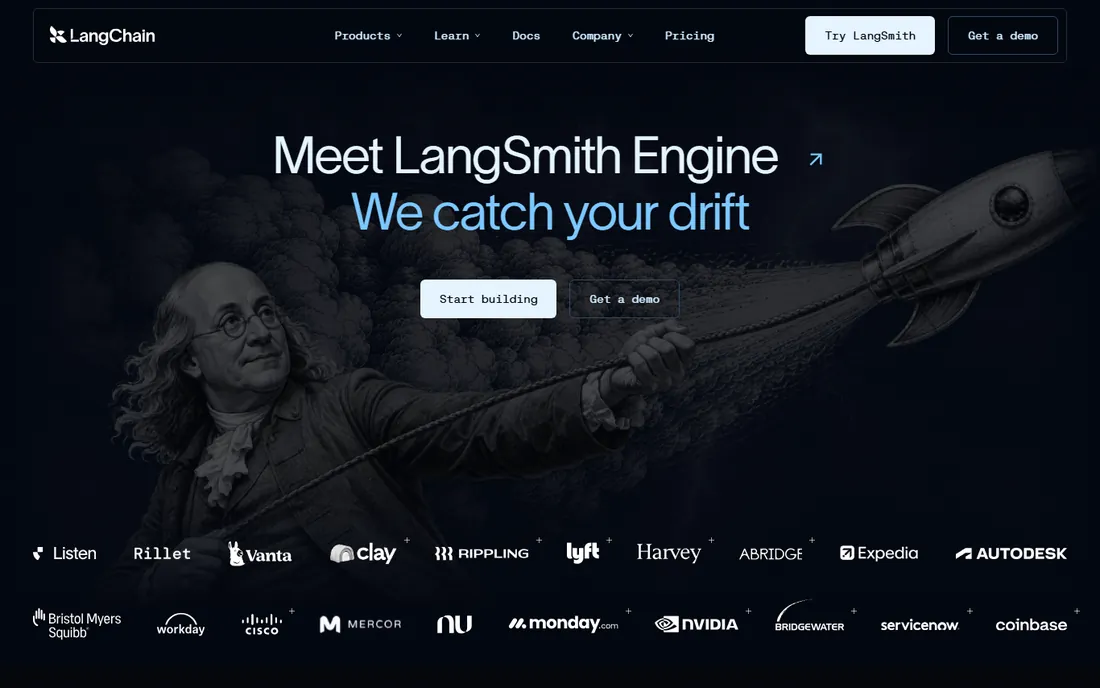
LangChain is the framework that defined the category: an open-source library for connecting language models to tools, memory, and data sources through composable chains and agents. The vendor's own site now frames it as an open agent platform spanning build, test, deploy, monitor, iterate, and govern, with 350 million-plus monthly open-source downloads and LangSmith customers including five of the Fortune 10.
The stack has three parts. LangChain is the high-level framework for fast prototyping. LangGraph is the orchestration engine for stateful, multi-agent workflows modeled as graphs, with checkpoints, human-in-the-loop, and durable execution. LangSmith is the agent engineering platform for observability, evaluation, and deployment. The ecosystem is the moat: hundreds of integrations mean you rarely build a connector from scratch. The cost is complexity and churn; LangChain's API has evolved aggressively, and serious production work tends to migrate downward into LangGraph.
What we like- Largest ecosystem and integration catalog in the space
- LangGraph gives fine control over stateful agent workflows
- LangSmith covers testing, tracing, and evals
Watch out for- API surface has changed a lot across versions
- Complex workflows push you into lower-level LangGraph code
- Production governance needs LangSmith or custom tooling
#2
LlamaIndex
Best for: teams whose agents must reason over documents and private data
Visit llamaindex.ai
Starting priceFree (open source)
Free planYes (open source; free LlamaParse tier)
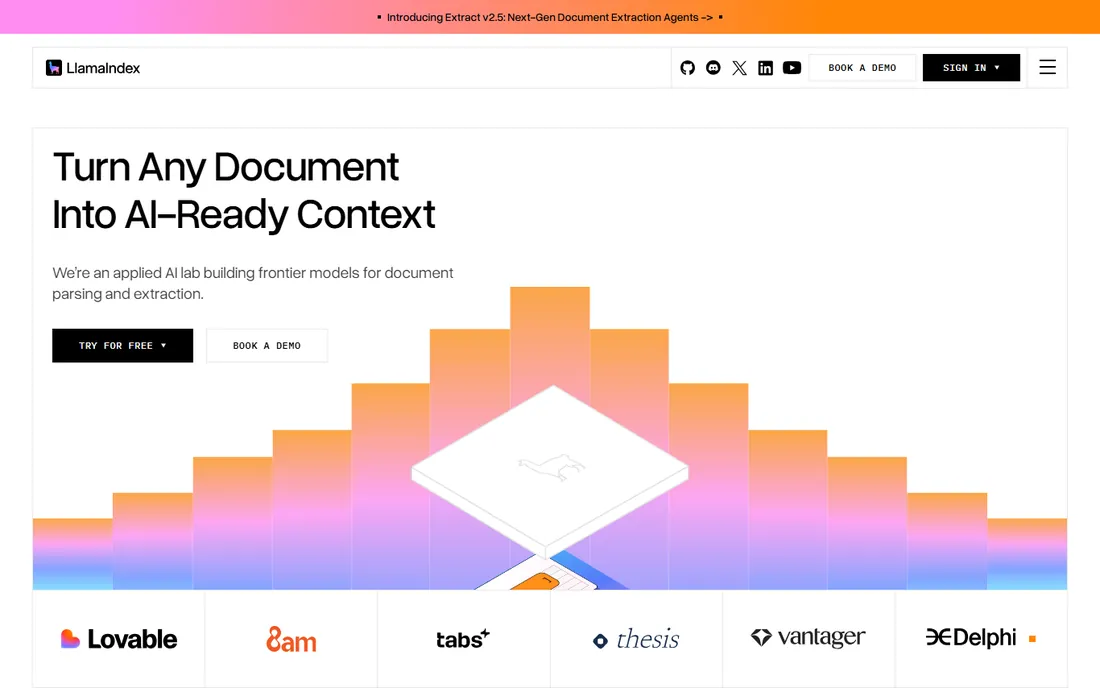
LlamaIndex is the data framework for the AI stack: an open-source library that ingests, indexes, and queries documents, databases, and APIs so LLMs can reason over your own data. With 300-plus data connectors, advanced indexing and re-ranking, and event-driven Workflows for multi-step orchestration, it is the strongest choice when the hard problem is retrieval quality rather than agent choreography.
The company has grown around LlamaParse, its agentic OCR product that converts messy PDFs, tables, charts, and handwriting into clean structured data. The free tier includes 10,000 credits a month (about 1,000 pages) with no credit card, and paid plans start at $50 a month. The vendor's own FAQ puts the LangChain comparison well: document-heavy teams tend to choose LlamaIndex, orchestration-heavy teams tend to choose LangChain, and many teams use both together.
What we like- Best-in-class data connectors, chunking, and retrieval for RAG
- Open-source framework under MIT
- LlamaParse free tier handles 1,000 pages a month
Watch out for- The company site now centers on LlamaParse document OCR, which can confuse framework users
- Retrieval tuning takes real effort
- Multi-agent orchestration is weaker than LangGraph
#3
CrewAI
Best for: teams that want role-based AI agents collaborating as a crew
Visit crewai.com
Starting priceSee website
Free planYes (open source)
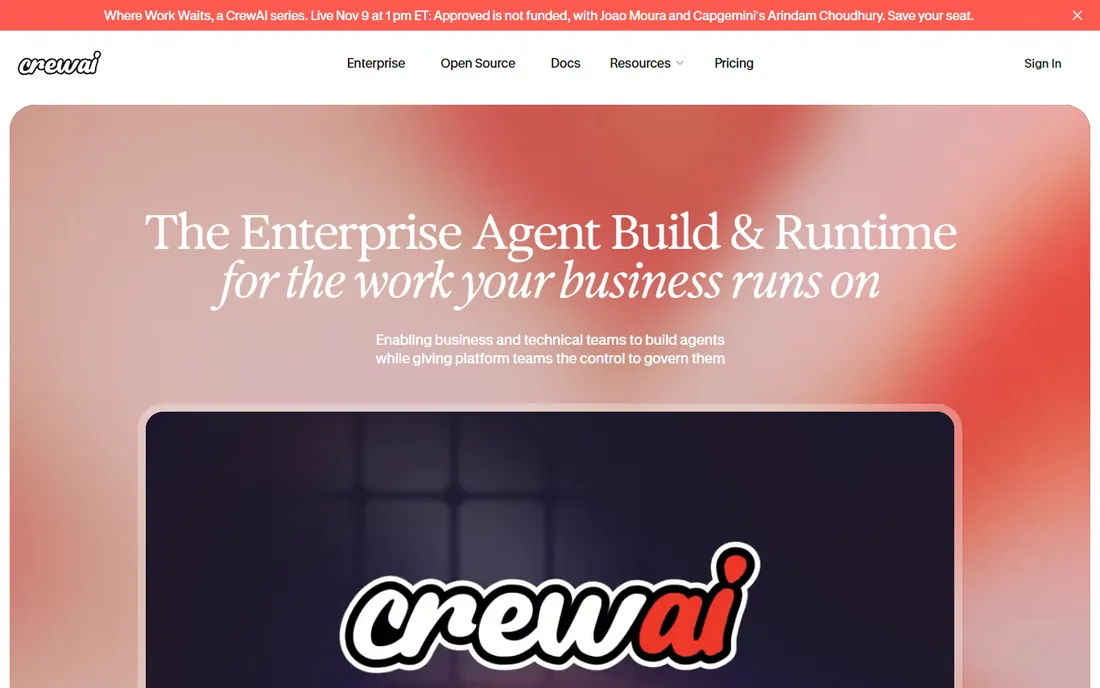
CrewAI is the open-source framework (MIT) for orchestrating role-playing AI agents that collaborate on complex tasks. You define agents by role, goal, and backstory, assign them tasks, and assemble them into crews that work sequentially, hierarchically (with a manager agent delegating), or in parallel. It supports any LLM backend and integrates with LangChain tools, MCP, and the A2A protocol.
The 2026 platform goes well beyond the framework: CrewAI Discovery mines patterns from billions of agent runs to rank automation opportunities in your tickets and workflows, the Studio builder offers no-code visual construction exportable to Python, and the Control Plane sits in the execution path with real-time tracing, RBAC, audit logs, PII redaction, and approval gates. The vendor claims usage by 65% of the Fortune 500. Watch the token math: every agent in a crew makes its own model calls, so costs scale with crew size.
What we like- Intuitive role, goal, and backstory model for agents
- No-code Studio builder plus a code-first API
- Control plane with RBAC, audit trails, and human-in-the-loop
Watch out for- Token spend multiplies with agent count
- Complex conditional logic still favors LangGraph
- Production observability is strongest on the Enterprise tier
Starting priceSee website
Free planYes (open source)
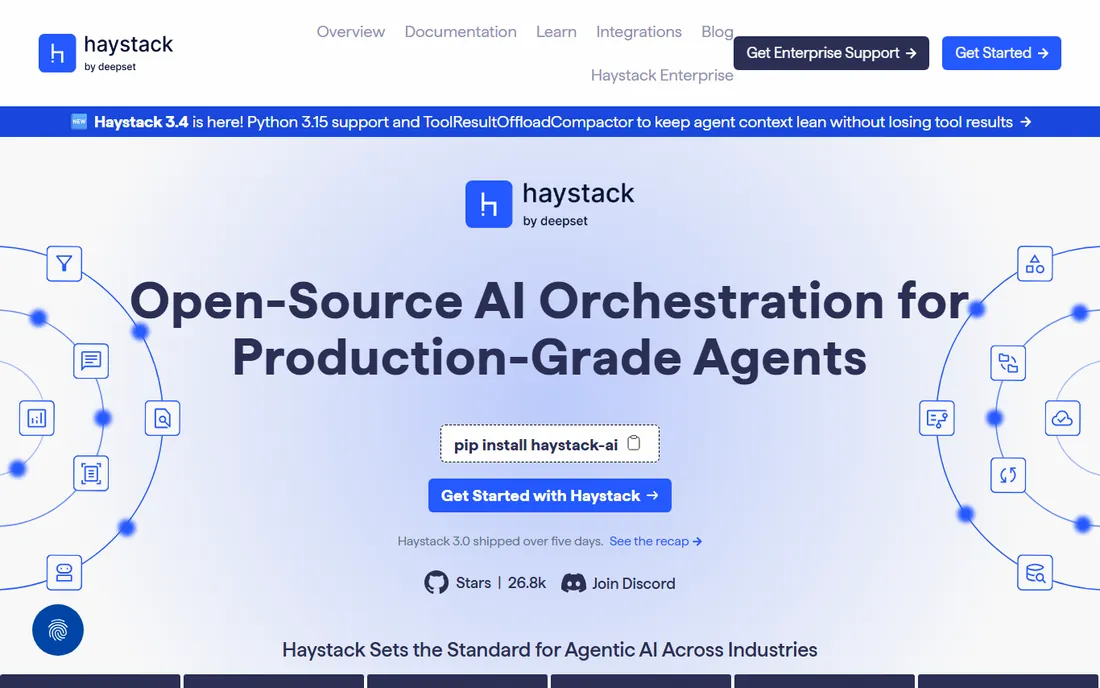
Haystack, from Berlin-based deepset, is an open-source Python framework for building production-ready LLM applications as modular pipelines. You assemble components, retrievers, generators, document stores, rankers, into pipelines for RAG, semantic search, agents, conversational AI, and content generation, with standardized interfaces that make swapping models straightforward.
Its heritage is retrieval: Haystack grew out of NLP and search, so hybrid retrieval, self-correction loops, and multimodal pipelines (image processing, audio transcription) are first-class rather than bolted on. Hayhooks turns any pipeline into a self-hosted REST API with one command. The trade-off is a steeper learning curve from the sheer number of interchangeable components, and deployment asks for real infrastructure skill. Teams that care about retrieval quality and European data-sovereignty options should shortlist it.
What we like- Modular pipeline design with 100+ components
- Strong retrieval heritage (hybrid search, self-correction loops)
- Standardized interfaces across models
Watch out for- Modularity can overwhelm beginners
- Deployment takes cloud and container know-how
- Smaller community than LangChain
#5
Flowise
Best for: teams that want to build LLM apps on a drag-and-drop canvas
Visit flowiseai.com
Starting price$0/month
Free planYes (free plan)
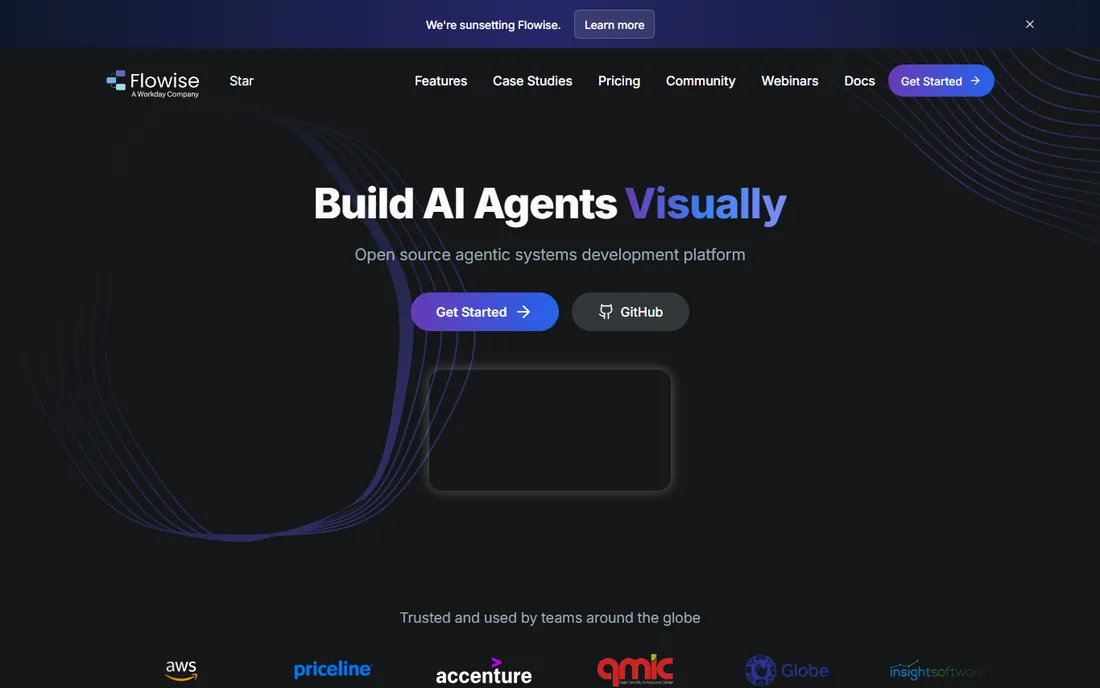
Flowise is an open-source, low-code platform for building LLM apps and AI agents visually. You drag nodes for models, vector stores, memory, tools, and APIs onto a canvas to assemble chatflows (single-agent chatbots with RAG) and agentflows (multi-agent systems), with human-in-the-loop steps, execution traces, and Prometheus/OpenTelemetry observability built in.
Every flow exposes a REST API plus TypeScript and Python SDKs and an embeddable chat widget, so prototypes ship as real product surfaces. Pricing is public and simple: Free at $0 a month (2 flows, 100 predictions), Starter at $35 a month (unlimited flows, 10,000 predictions), Pro at $65 a month. You can also self-host the Apache 2.0 codebase. It is the fastest way for a mixed team to ship a working RAG chatbot, but code-first teams will outgrow the canvas for complex logic.
What we like- Visual builder for chatflows and multi-agent agentflows
- 100+ LLMs, embeddings, and vector DBs
- API, SDKs, and embeddable chat widgets out of the box
Watch out for- Complex visual flows get fragile and hard to debug
- Less control than code-first frameworks
- Self-hosted security is your responsibility
#6
Dust
Best for: companies that want AI agents running on their internal tools and data
Visit dust.tt
Starting priceSee website
Free planSee website
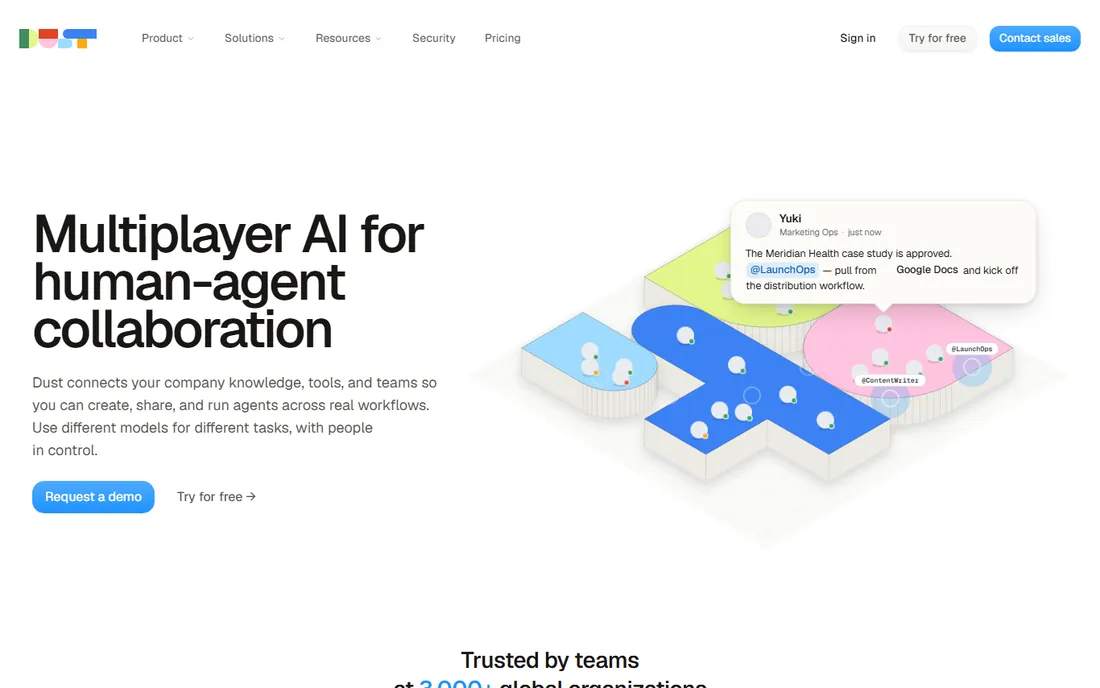
Dust is a Paris-based platform for building, deploying, and running AI agents that connect to a company's internal tools and data. The pitch is "multiplayer AI": people and agents share company knowledge, connected tools, conversations, and notifications in one system, so agents answer with the full picture and take action across departments. The vendor says it is trusted by 3,000-plus organizations.
Agents get context from 70-plus connectors and can use 20-plus models from OpenAI, Anthropic, Google, Mistral, and others. Governance is a headline feature: a dual-layer permission model separates what agents can access from who can use them, with SCIM-synced groups, admin-gated overrides, zero privilege escalation, and audit logs that track activity, adoption, usage, and costs. Dust suits operations, sales, and support teams that want agents on company data without building the plumbing themselves.
What we like- 70+ connectors to Slack, Notion, Google Drive, GitHub, Salesforce, and more
- 20+ frontier and open-source models
- AI-native governance with audit logs
Watch out for- Pricing is not public
- Per-user pricing can add up for large companies
- Less of a developer framework than a platform
#7
Orkes
Best for: enterprises running mission-critical AI agent workflows
Visit orkes.io
Starting priceSee website
Free planSee website
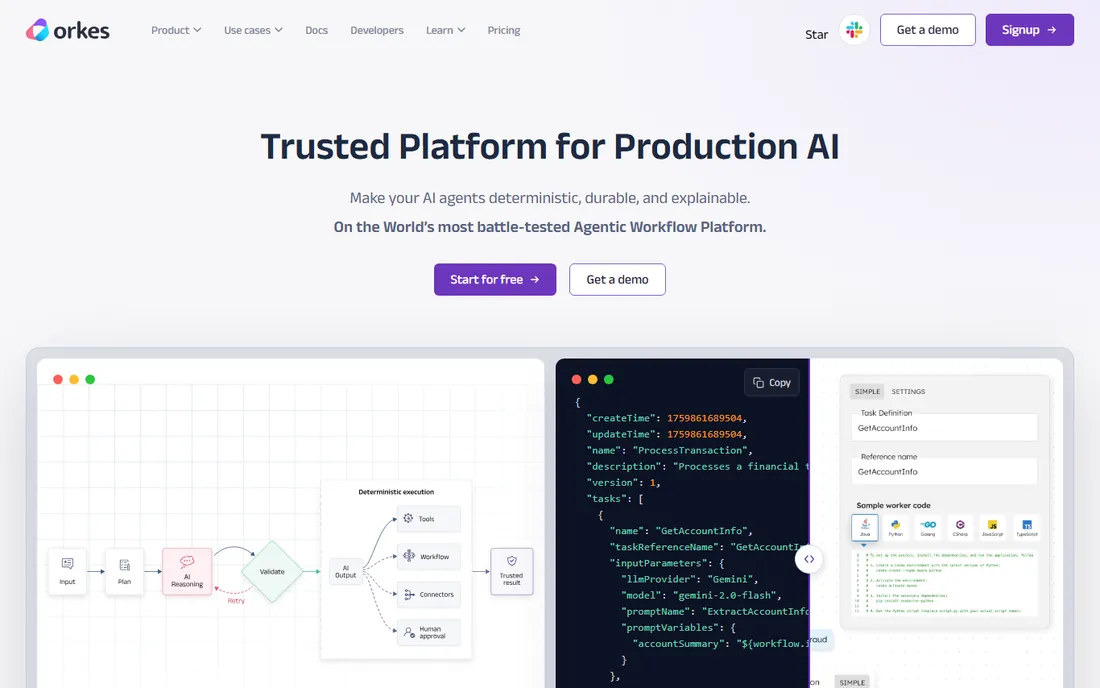
Orkes Conductor is the commercial platform behind Netflix's Conductor, the open-source orchestration engine the vendor says executes over a billion workflows a day for customers including Netflix, Tesla, LinkedIn, and American Express. The 2026 positioning is explicit: make AI agents deterministic, durable, and explainable by running them as durable workflows.
The platform is deliberately framework-agnostic. You can build agents with the Conductor SDK or bring existing agents from LangGraph, the OpenAI Agents SDK, Google ADK, or CrewAI, and Conductor adds durability, streaming execution, real-time monitoring, explainability, analytics, and guardrails that validate every input and output. Automatic state persistence gives up to 99.99% recovery on failures. This is infrastructure for teams whose agent failures cost real money: finance, logistics, and large-scale operations.
What we like- Battle-tested Conductor engine running 1B+ workflows daily
- Bring your own agents from LangGraph, OpenAI SDK, Google ADK, or CrewAI
- Full governance with RBAC, audit logs, and guardrails
Watch out for- Enterprise sales process
- Overkill for simple prototypes
- The power comes with configuration surface area
#8
Temporal
Best for: engineering teams building long-running, failure-proof workflows in code
Visit temporal.io
Starting priceSee website
Free planYes (open source, MIT)
Temporal is a durable execution platform: you write business logic as code in the languages you already use, and the platform guarantees it runs to completion despite failures. Workflows capture state at every step and resume exactly where they left off, no lost progress, no orphaned processes, no manual recovery. Activities (API calls, LLM calls, database writes) retry automatically.
For AI orchestration, that durability is the missing piece in most agent frameworks. An agent loop that runs for hours, calls tools, waits on humans, and retries failed steps maps naturally onto Temporal workflows, with signals for async events and queries for reading state. The project is 100% open source under the MIT license, self-hostable, with Temporal Cloud as the managed option. It is the engineer's choice: maximum control and reliability, with the expectation that you write real code.
What we like- Durable execution: workflows resume exactly where they left off after crashes
- SDKs in many languages
- Proven at massive scale with 9 years in production
Watch out for- Requires rethinking how you write code (deterministic workflows)
- Operational learning curve for self-hosting
- Agent-specific tooling is newer than the core engine
#9
n8n
Best for: teams that want AI agents inside broader workflow automation
Visit n8n.io
Starting priceSee website
Free planYes (free self-hosted)

n8n is the open-source workflow automation platform that has grown into a capable AI agent builder. On a visual canvas you drag, connect, and configure nodes, including dedicated AI agent nodes that implement ReAct-style reasoning, tool use, and chain-of-thought, while custom code nodes let you drop into JavaScript or Python whenever the visual abstractions run out.
The 400-plus integration nodes are the standout: wiring an agent to Slack, Google Sheets, PostgreSQL, Salesforce, or a custom API is field mapping, not auth boilerplate. That makes n8n strongest where the "agent" is one step in a larger operational process: an LLM node classifies incoming emails, conditional routing splits the flow, API nodes push results downstream. The self-hosted Community edition is free with full data residency control, and Cloud plans add managed hosting. With 207,000-plus GitHub stars, the community keeps it moving fast.
What we like- 400+ integration nodes with native AI agent nodes
- Visual canvas plus JavaScript/Python code nodes
- Self-hosted option for full data control
Watch out for- AI agent capabilities are simpler than dedicated agent frameworks
- Complex canvases get hard to maintain
- Cloud pricing is execution-based
Frequently asked questions
What is AI orchestration software?
Software that coordinates the moving parts of an AI application: model calls, tools, memory, retrieval, human approvals, retries, and state. Instead of one prompt in and one answer out, orchestration manages multi-step workflows where agents call tools, read data, and hand off to each other reliably.
Should I use a framework, a visual builder, or a workflow engine?
Use a framework (LangChain, LlamaIndex, Haystack, CrewAI) when engineers are building custom agents in code. Use a visual builder (Flowise, n8n, Dust) when speed matters and non-engineers need to participate. Use a workflow engine (Temporal, Orkes) when workflows must survive failures and run for hours or days at production scale. Many teams combine them.
What is the difference between LangChain and LangGraph?
LangChain is the high-level framework for building LLM applications quickly with chains and agents. LangGraph is the lower-level orchestration engine for stateful, multi-agent workflows modeled as graphs, with explicit control over branching, checkpoints, and human-in-the-loop. Most production agent systems end up using both.
Do I need durable execution for AI agents?
If your agents run for minutes and failures are cheap, probably not. If agents run for hours, coordinate across systems, wait on human approvals, or handle money and customer data, durability matters: without it, a crash mid-workflow means lost work and manual recovery. Temporal and Orkes exist for exactly this case.
Which tools are free and open source?
LangChain, LlamaIndex, CrewAI, Haystack, and Temporal are open source. Flowise has a free cloud plan and an open-source self-hosted codebase. n8n is free to self-host. LlamaIndex's LlamaParse adds a free tier of 10,000 credits a month. Dust and Orkes are commercial platforms with trials or demos.
How do I avoid runaway AI costs in orchestrated workflows?
Multi-agent systems multiply token spend because every agent makes its own model calls. Set per-workflow budgets, use cheaper models for routine steps, cache repeated retrieval, and monitor cost per run. CrewAI's control plane, LangSmith, and Dust's analytics all include cost accounting for this reason.
How we chose
We shortlisted tools that orchestrate AI work beyond a single model call: agent frameworks, multi-agent systems, visual agent builders, and durable workflow engines used for AI pipelines. For each candidate we read the vendor's own product pages and documentation, checked pricing pages where public, and read recent developer reviews and community signals (GitHub activity, G2, Capterra) for signs of real production use. We favored tools with active 2026 development, agent-specific features (not just chatbots), and honest public pricing over sales-gated platforms where possible. Prices are as published in October 2026.
What to check before you commit
Start with the failure mode, not the demo. The impressive demo shows the happy path; production shows timeouts, crashed workers, rate limits, and confused agents. Ask every vendor how a workflow recovers when a step fails, and test it yourself: kill a run mid-flight and see what happens.
Second, match the abstraction to your team. A visual builder your ops team can run beats a framework only two engineers understand, and vice versa: a code framework your engineers can debug beats a canvas that hides its logic. The best tool is the one your team can operate at 2 a.m.
Third, model the economics honestly. Per-user platforms (Dust), per-execution pricing (n8n Cloud), prediction-based tiers (Flowise), and self-hosted open source all produce different bills at the same volume. Multiply your expected runs by agents per run by tokens per agent, add the platform fee, and compare. Finally, check data residency and governance early: permissions, audit logs, and PII handling are easy to demo and hard to retrofit.
Sources we checked (14)
- https://www.langchain.com/
- https://www.llamaindex.ai/
- https://www.crewai.com
- https://haystack.deepset.ai
- https://flowiseai.com
- https://dust.tt/
- https://orkes.io/
- https://temporal.io/
- https://n8n.io
- https://en.wikipedia.org/wiki/LangChain
- https://en.wikipedia.org/wiki/CrewAI
- https://github.com/weijt606/ai-agent-map
- https://github.com/api-evangelist/orkes
- https://github.com/api-evangelist/temporal-io
Is your product missing or out of date?
We review this list regularly. Vendors can request a listing, send updated pricing or ask about featured placement.

Shihab Mia · Founder, Rankite
Shihab has spent more than a decade helping SaaS and e-commerce brands grow through search. He writes Rankite's software buying guides from pricing pages, documentation and public user reviews. More about Shihab.