How we make this list: we compare pricing pages, product documentation and public user reviews. Rankite is independent; if a vendor ever pays for a featured spot, that listing is clearly labeled Partner.
Key takeaways
- Scite's Smart Citations classify citations as supporting, mentioning or contrasting, the closest thing to true citation analysis.
- Elicit and Consensus answer research questions with sentence-level citations from peer-reviewed literature.
- Connected Papers, ResearchRabbit, Litmaps and Inciteful map citation networks visually so you can explore a field from one seed paper.
- SciSpace combines citation discovery with PDF chat, an AI writer and citation generation.
- Semantic Scholar, the free Allen Institute for AI database, powers several of these tools underneath.
Citation counts tell you a paper is popular. Citation analysis tells you whether the science holds up. The nine tools below use AI to classify, map and synthesize citations: showing which findings were supported or contradicted, building visual networks of related work, and generating cited answers to research questions.
Quick comparison
| Tool | Best for | Starting price | Free plan |
|---|
 Scite.ai Scite.ai | Smart citation classification | See website | No |
 Elicit Elicit | Systematic literature reviews | See website | Yes |
 Consensus Consensus | Evidence-based answers | See website | Yes |
 Connected Papers Connected Papers | Visual citation graphs | See website | Yes |
 ResearchRabbit ResearchRabbit | Iterative paper discovery | See website | Yes |
 Litmaps Litmaps | Literature review maps | See website | Yes |
 SciSpace SciSpace | All-in-one research AI | See website | Yes |
 Inciteful Inciteful | Free citation network search | See website | Yes |
 Semantic Scholar Semantic Scholar | Free AI-powered paper search | See website | Yes |
Is your product missing or out of date?
We review this list regularly. Vendors can request a listing, send updated pricing or ask about featured placement.
The best AI citation analysis software
Starting priceSee website
Free planNo
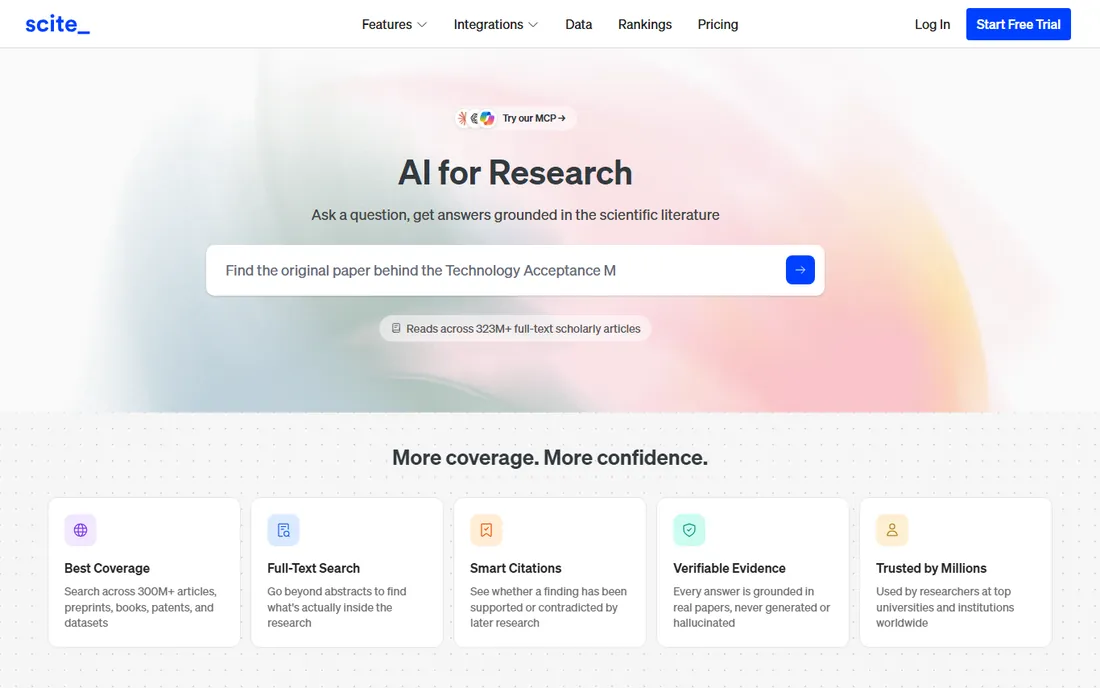
Scite is the purest citation analysis tool on this list. Its Smart Citations technology reads the full text of citing articles and classifies each citation as supporting, mentioning or contrasting the cited claim. That turns a citation count into an evidence signal: you can see at a glance whether a finding has held up.
The platform searches over 300 million articles, preprints, books, patents and datasets, with every AI answer grounded in real papers. It is a product of Research Solutions (NASDAQ: RSSS), which has added a Scite MCP server and a Claude connector for paid subscribers.
Use Scite when evaluating the evidence for a claim. Check one contested finding and read the contrasting citations before trusting the supporting ones.
What we like- Smart Citations classify support vs contrast
- 300M-plus articles indexed
- MCP and Claude connectors
Watch out for- Paid plans for full access
- Analysis limited by full-text availability
Starting priceSee website
Free planYes
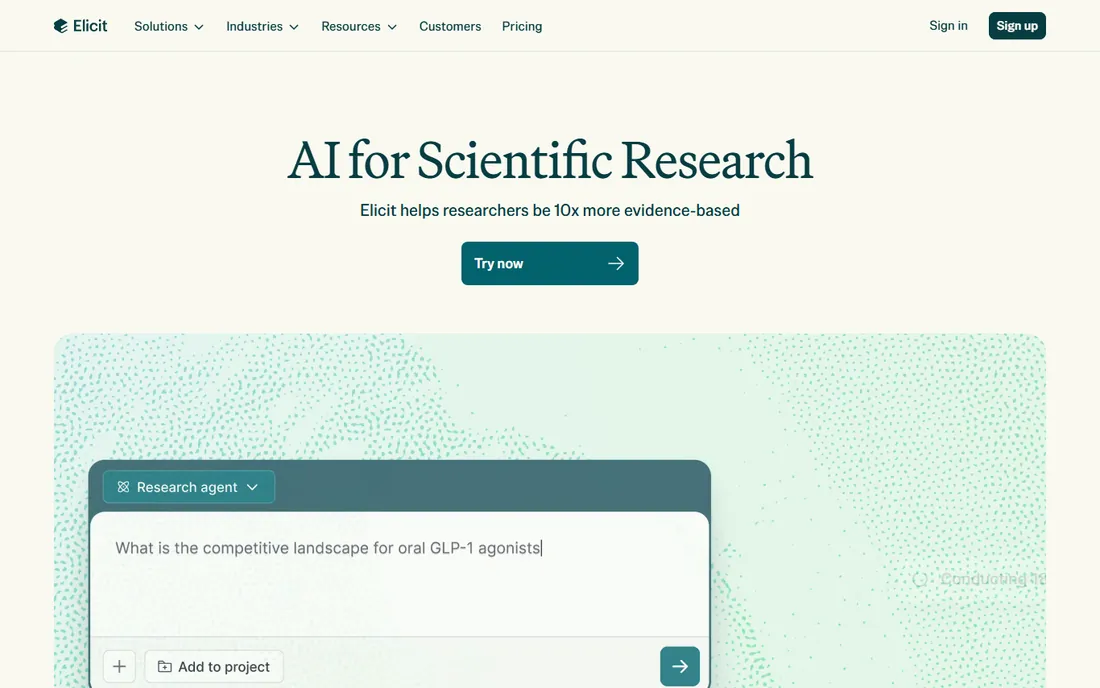
Elicit is the AI research assistant built for evidence-based work. Ask a research question and it searches over 138 million academic papers plus 545,000 clinical trials, then generates structured research reports with sentence-level citations. Data extraction tables let you compare interventions, outcomes and sample sizes across papers.
The free plan provides monthly credits, enough to run reports and try the systematic literature review workflow. Paid plans add Plus, Pro and Team tiers with higher usage. A research agent and MCP server extend it into agentic workflows.
Start free with one literature review question. Check the extracted quotes against the source papers to calibrate your trust.
What we like- Free plan with monthly credits
- Research reports with sentence-level citations
- Systematic review automation
Watch out for- Credit limits on free tier
- Strongest in well-indexed fields
Starting priceSee website
Free planYes
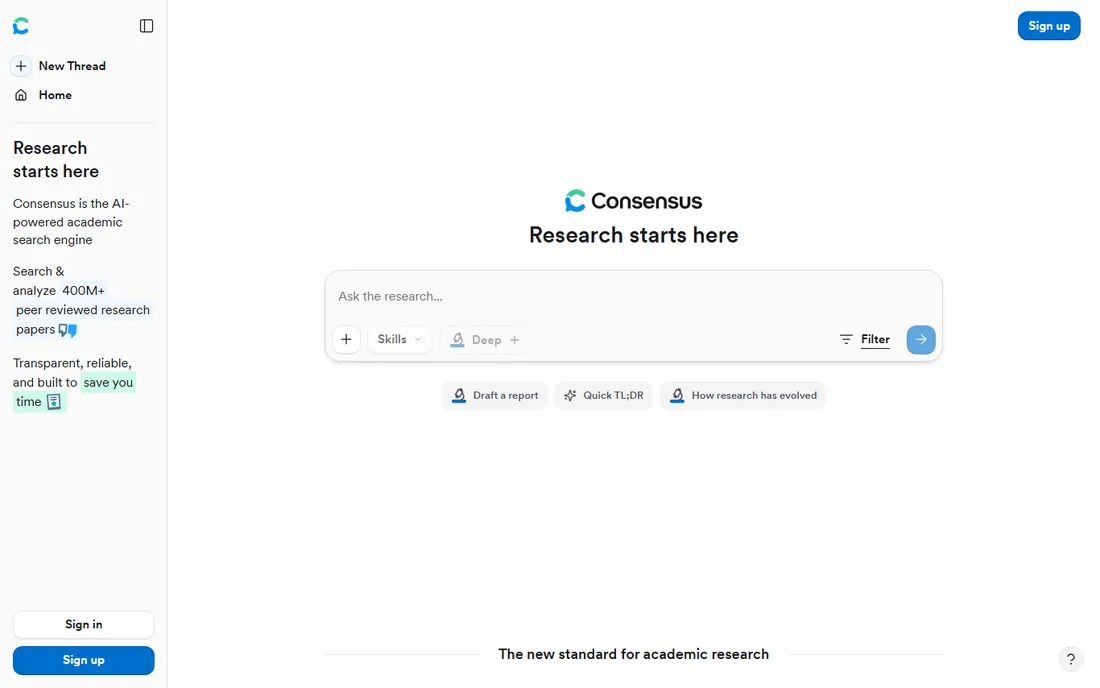
Consensus is an AI search engine over 220 million peer-reviewed papers that answers research questions with cited syntheses. Its Consensus Meter visualizes how much the literature agrees, and quality filters restrict results to RCTs, meta-analyses, human studies or top-quartile journals.
The platform evolved from search into a research agent with citation chaining and author tracing, plus an official MCP server connecting Claude, ChatGPT and Cursor to its evidence base. It is free to start, with paid tiers for heavier use.
Ask a yes-or-no research question and inspect the Consensus Meter. Always read the underlying papers before citing the answer yourself.
What we like- Free to start
- Consensus Meter shows agreement
- 220M-plus papers with licensed full text
Watch out for- Answers simplify complex debates
- Quality depends on study selection
Starting priceSee website
Free planYes
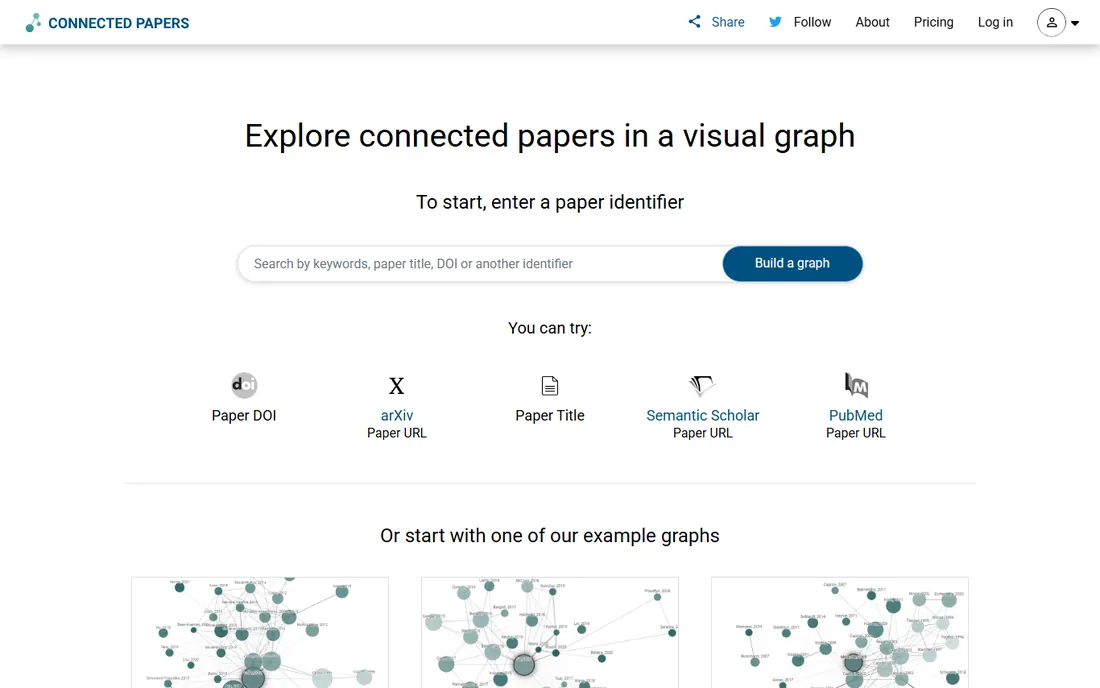
Connected Papers builds a visual graph of similar papers from one seed paper, using co-citation and bibliographic coupling over the Semantic Scholar database. Node size shows citation count, color shows publication year, and the Prior Works and Derivative Works views reveal ancestors and descendants of your seed.
The free plan allows five graphs per month without an account. Export citations as BIB files for your reference manager. It is the fastest way to get a visual overview of a new field.
Enter your most important seed paper and build a graph. The derivative works view often surfaces the state of the art you haven't read yet.
What we like- Free graphs without login
- Intuitive visual interface
- Prior and derivative work views
Watch out for- Five free graphs per month
- No login-free saving
Starting priceSee website
Free planYes
ResearchRabbit calls itself the Spotify for papers: build collections of academic work, follow authors, and get AI-curated recommendations that improve as you explore. It visualizes citation networks, supports Zotero imports, and emails personalized recommendations.
The platform is free and trusted by over a million researchers at institutions including Stanford, Harvard and Cornell, with access to over 310 million papers. A 2025 revamp added a cleaner iterative rabbit-hole flow.
Import your Zotero library to start from your existing collection. The recommendations get markedly better after you seed it with papers you already trust.
What we like- Completely free
- Spotify-style paper collections
- Learns from your selections
Watch out for- Requires registration
- Recommendations need seed input to shine
Starting priceSee website
Free planYes
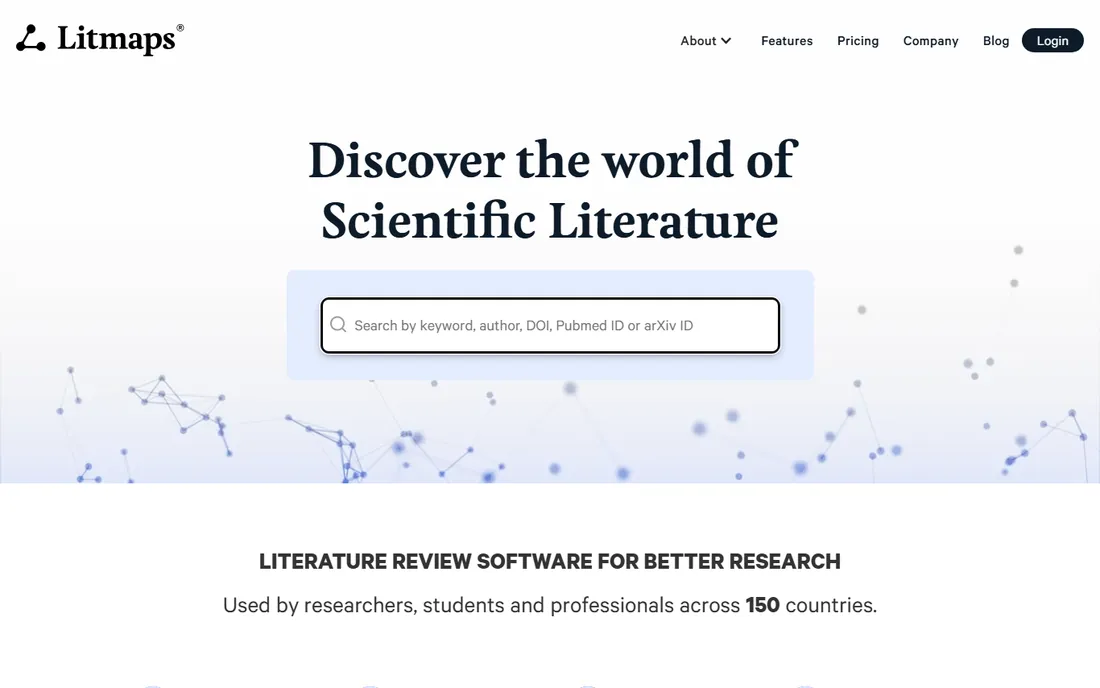
Litmaps combines interactive citation maps, modern search and email alerts on new research tied to your maps. Start with seed articles, switch between connection-based and similarity-based search algorithms, and monitor your field with ongoing alerts.
The platform is used by more than 350,000 researchers worldwide and has a strategic partnership with ResearchRabbit. Transparent algorithms and collaboration features are core to its positioning.
Build a seed map for your thesis topic and turn on monitoring. The alerts keep your literature review current without repeated manual searches.
What we like- Interactive citation maps
- New-paper alerts
- Used by 350,000-plus researchers
Watch out for- Advanced features need a subscription
- Maps need a desktop screen
Starting priceSee website
Free planYes
SciSpace, formerly Typeset, is the broadest research AI here: literature review, chat with PDF, AI writer, paraphraser, citation generator and 100,000-plus journal formatting templates, all connected to 280 million papers. It is trusted by over 9.6 million researchers.
The free plan includes all features with usage limits; paid Premium and Advanced plans add unlimited Deep Review and high-quality AI modes. An agent gallery and templates cover proposals, essays and thesis statements.
Try the free plan on one difficult paper with chat-with-PDF. Upgrade only when the usage caps start slowing your workflow.
What we like- Free plan available
- Chat with PDFs
- AI writer and citation generator
- 280M papers
Watch out for- Free plan limits chat and quality modes
- Formerly Typeset, branding still settling
Starting priceSee website
Free planYes
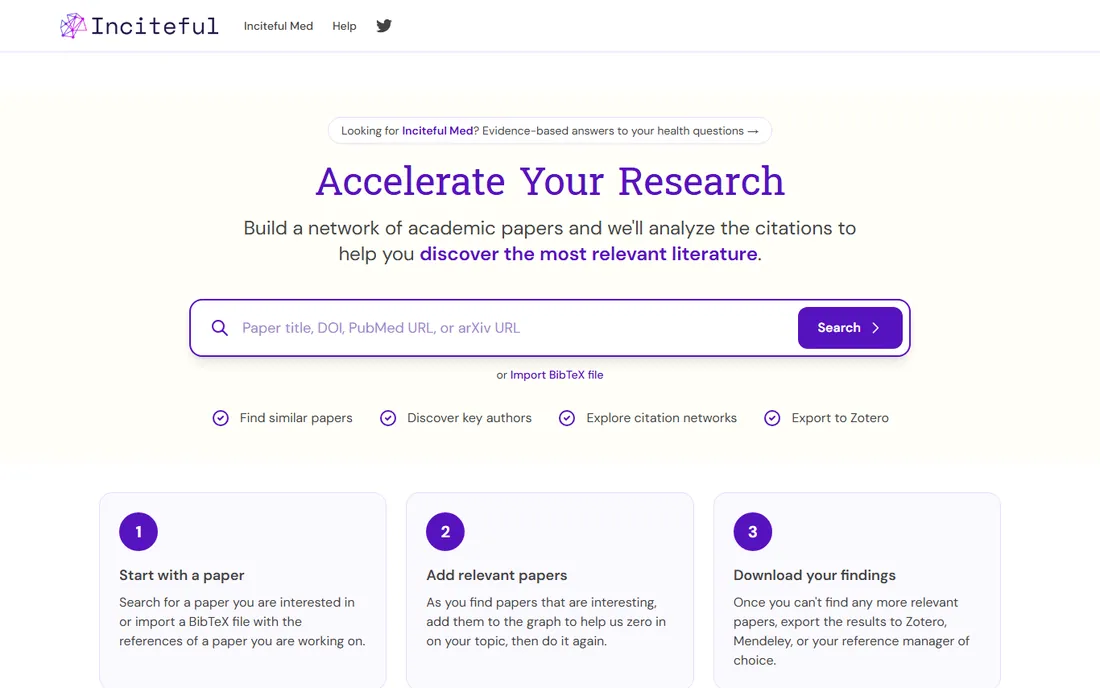
Inciteful takes a different approach: citations are the cornerstone of search. It builds a citation network around your papers and uses link-prediction algorithms, the same kind social networks use to suggest friends, to surface similar and recent literature. The database covers over 240 million papers and 2 billion citations, and the core tools are free forever.
Note the branding: the academic tool lives at inciteful.xyz, now presented as Inciteful Academic alongside Inciteful Med. Export findings to Zotero or Mendeley.
Use Inciteful when you want citation-driven discovery without paying. The link-prediction results often surface recent papers that keyword search misses.
What we like- 100 percent free
- 240M-plus papers and 2B-plus citations
- Link prediction algorithms
Watch out for- Interface is utilitarian
- No AI-generated prose answers
Starting priceSee website
Free planYes
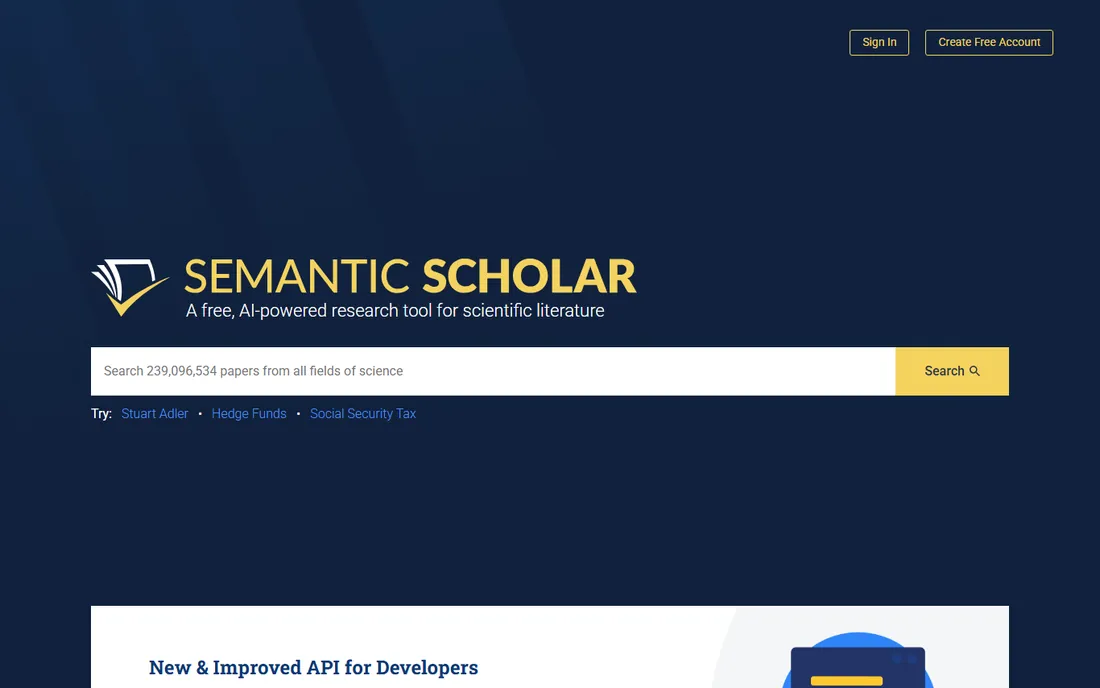
Semantic Scholar is the free AI-powered research tool from the Allen Institute for AI, searching nearly 239 million papers across all fields of science. It provides TLDR summaries, citation context and intent classification, influential citation counts, and a free API that powers tools like Connected Papers.
The Semantic Reader offers an augmented reading experience for select papers. Because it is nonprofit and free, it is the baseline every researcher should use before paying for anything.
Start every literature search here. Use the API if you need programmatic citation data for your own analysis.
What we like- Completely free
- 238M-plus papers
- Free API
- TLDR summaries and citation intent
Watch out for- No generative research reports
- Interface is a search engine, not a workspace
Getting reliable results from citation AI
AI citation tools speed up the search, but they work best with a disciplined routine. Start each project with two or three seed papers you already trust, because every recommendation engine downstream inherits the quality of its seeds. Read the contrasting citations in Scite before the supporting ones; a single strong refutation can matter more than ten mentions. When an AI answer synthesizes a claim, click through to the cited papers and confirm the sentence-level quotes actually support the point. For thesis-level work, pair one mapping tool with one evaluation tool: map the field with Connected Papers or Litmaps, then assess the evidence with Scite or Elicit. Set up monitoring alerts on your maps so your literature review stays current as new papers land.
Evaluating whether a claim holds up: Scite. Systematic reviews with data extraction: Elicit. Quick evidence-based answers: Consensus. Visual field mapping: Connected Papers, ResearchRabbit or Litmaps. Free citation network search: Inciteful. Free comprehensive search: Semantic Scholar. All-in-one AI research workspace: SciSpace.
Frequently asked questions
What is AI citation analysis software?
It is software that uses AI to analyze how papers cite each other: classifying citation sentiment, mapping citation networks, extracting cited claims, and synthesizing evidence across the literature. It goes beyond citation counts to show what citations mean.
Which tool shows whether a paper's findings were supported or contradicted?
Scite's Smart Citations classify each citation as supporting, mentioning or contrasting the cited work, based on full-text analysis of the citing article.
Are these tools free?
Several are free: Semantic Scholar, Inciteful and ResearchRabbit are completely free, while Connected Papers, Litmaps, Elicit, Consensus and SciSpace offer free tiers with limits. Scite is paid.
Can AI citation tools replace reading papers?
No. They accelerate discovery and synthesis, but you should always read the underlying papers before citing them, especially for claims central to your work.
What is the difference between Connected Papers and ResearchRabbit?
Both build visual citation graphs from seed papers. Connected Papers caps free use at five graphs per month, while ResearchRabbit is fully free and adds collections, author following and email recommendations that learn from your behavior.
Which tool is best for systematic literature reviews?
Elicit is purpose-built for systematic reviews with screening automation and data extraction tables. Scite helps evaluate the evidence quality of included studies.
How we chose
We selected active AI-powered citation analysis and literature discovery tools with current websites, covering citation classification, visual network mapping, evidence synthesis and free scholarly databases. We verified each vendor's homepage directly and compared citation methods, database coverage, free tiers and AI features from product pages and documentation.
Sources we checked (9)
- https://scite.ai/
- https://elicit.com/
- https://consensus.app/
- https://connectedpapers.com/
- https://www.researchrabbit.ai/
- https://www.litmaps.com/
- https://scispace.com/
- https://inciteful.xyz/
- https://www.semanticscholar.org/
Is your product missing or out of date?
We review this list regularly. Vendors can request a listing, send updated pricing or ask about featured placement.

Shihab Mia · Founder, Rankite
Shihab has spent more than a decade helping SaaS and e-commerce brands grow through search. He writes Rankite's software buying guides from pricing pages, documentation and public user reviews. More about Shihab.