How we make this list: we compare pricing pages, product documentation and public user reviews. Ratings come from G2, Capterra or Trustpilot, with the date we checked them.
Key takeaways
- BrowserStack and Sauce Labs are the fullest device-cloud replacements, with Appium support built in.
- Maestro and Detox are the free framework options for teams that keep their own devices or emulators.
- TestMu AI (formerly LambdaTest) is the value cloud pick, with a free plan and low entry pricing.
- HeadSpin suits teams that need real carrier networks and performance data from many countries.
Quick comparison
| Tool | Best for | Starting price | Free plan |
|---|
 BrowserStack | Broadest device cloud | See website | Free trial |
 Sauce Labs | Enterprise AI testing | See website | No |
 Kobiton | On-prem real devices | See website | Free trial |
 TestMu AI | Value device cloud | See website | Yes |
 Maestro | Simple YAML flows | Free | Yes |
 Detox | React Native testing | Free | Yes |
 AWS Device Farm | AWS-native testing | Free quota | Yes |
 HeadSpin | Carrier and performance testing | See website | Free trial |
Is your product missing or out of date?
We review this list regularly. Vendors can request a listing, send updated pricing or ask about featured placement.
The best Appium alternatives
Starting priceSee website
Free planFree trial
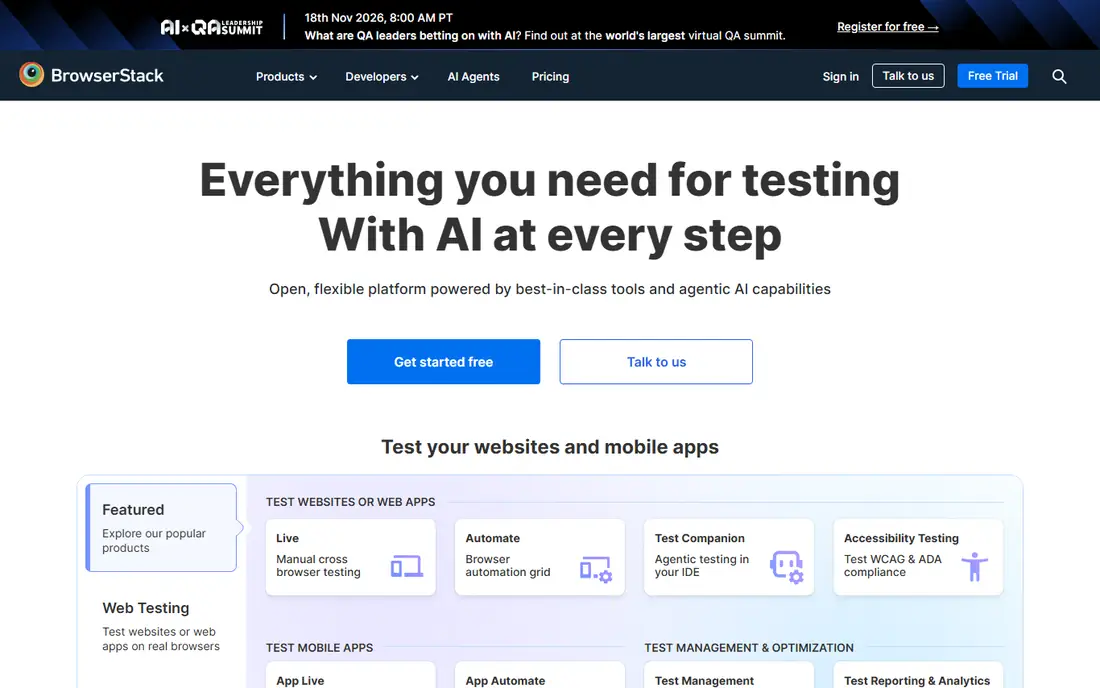
BrowserStack is the broadest device-cloud replacement for Appium teams. Its homepage presents an open test platform with AI agents at every step, covering cross-browser, real device, visual, and accessibility testing, with 150-plus integrations, 21 data centers across 13 locations, and 35,000-plus real devices. App Automate runs Appium, Espresso, XCUITest, and other frameworks on real devices, so existing Appium suites can move with little rewriting.
The trade-off is cost structure: published comparisons put App Automate from around $175 a month billed annually, and per-parallel pricing rises with team size. For teams that need the widest device coverage and already run Appium, BrowserStack is the most complete cloud option.
What we like- 35,000-plus real devices
- App Automate for Appium, Espresso, and XCUITest
- AI agents across testing
Watch out for- Pricing by parallel can grow fast
- App Automate entry pricing reported around $175 a month
#2Sauce Labs
Best for: Enterprise AI testing4.3/5 on
G2 (185 reviews, checked Oct 2026)
Visit saucelabs.com
Starting priceSee website
Free planNo
Sauce Labs is the enterprise pick, and the closest in spirit to Appium itself, since its founders created Selenium and Appium. Its homepage presents AURA, an agentic AI platform that writes, runs, analyzes, and heals tests, with claims of 90 percent fewer production incidents and 47 percent faster releases. It covers 10,000-plus real devices and 3,000-plus OS and browser combinations, supports every major framework including Appium, and reports 8.7 billion-plus test executions.
The trade-off is price: published comparisons put virtual devices from around $149 a month and real devices from around $199 a month, with enterprise plans higher. For large teams that want AI authoring plus a deep device cloud, Sauce Labs is the strongest enterprise alternative.
What we like- Built by the founders of Selenium and Appium
- 10,000-plus real devices
- AURA AI platform
Watch out for- Enterprise pricing
- Platform breadth needs setup
#3Kobiton
Best for: On-prem real devices4.3/5 on
G2 (39 reviews, checked Oct 2026)
Visit kobiton.com
Starting priceSee website
Free planFree trial
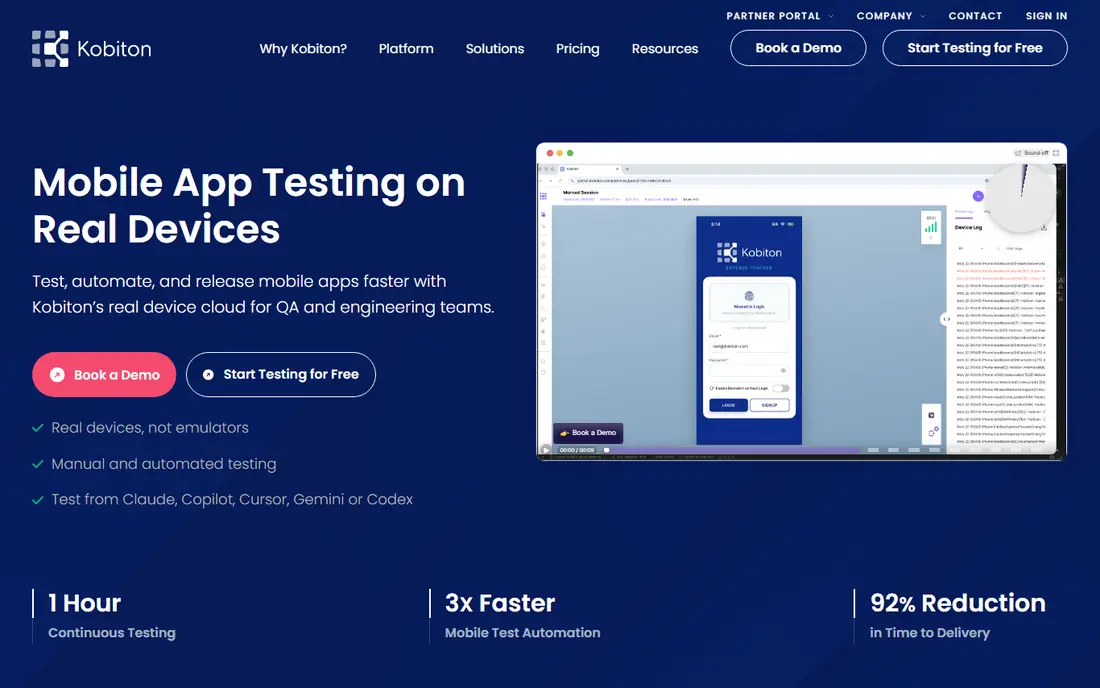
Kobiton is the on-prem pick for teams that want their own device lab. Its homepage presents a mobile device testing platform with device lab management, a mobile device cloud, session replay, and AI-augmented testing, including Appium script generation, self-healing execution, and no-code testing that its AI engine claims run three times faster. It serves financial services, retail, travel, and gaming teams, with customers including ING, Office Depot, Home Depot, and AT&T named on the page.
The trade-off is that dedicated devices sit on enterprise plans in published comparisons, with paid plans reported from around $83 a month. For teams that need real devices under their own control, Kobiton's lab management is unmatched here.
What we like- Real devices in cloud or on-prem
- Appium script generation
- Self-healing tests
- No-code option
Watch out for- Dedicated devices are enterprise-only with a five-device minimum in published comparisons
Starting priceSee website
Free planYes
TestMu AI, formerly LambdaTest, is the value cloud pick. Its homepage confirms the rebrand: on January 12, 2026, LambdaTest became TestMu AI, an agentic testing cloud with autonomous AI agents, a real device cloud with 50,000-plus devices, and 3,000-plus browser combinations, trusted by 3 million-plus users at companies including Microsoft, OpenAI, and Nvidia. Existing LambdaTest accounts, API keys, and integrations continue to work under the new brand.
The trade-off is naming confusion during the transition, since older guides still say LambdaTest. Published comparisons put live testing from around $39 a month and automation from around $199 a month, with a free plan. For teams that want a large device cloud at a lower price than BrowserStack or Sauce Labs, TestMu AI is the best value here.
What we like- 50,000-plus real devices
- HyperExecute fast runs
- Free plan with 100 lifetime automation minutes
Watch out for- Rebrand may confuse buyers
- Automation entry pricing higher than live testing
Starting priceFree
Free planYes
Maestro is the simplicity pick for teams that find Appium heavy. Its docs homepage presents it as the simplest and most effective framework for mobile and web UI automation using intuitive YAML flows, with Maestro Studio for visual test creation, a CLI for terminal runs, and Maestro Cloud for parallel CI runs. Published comparisons recommend it for teams shipping both iOS and Android from one suite, or for manual testers moving to automation.
The trade-off is power: YAML flows suit common journeys well but handle complex logic less cleanly than code. The framework itself is free locally, with cloud runs reported from around $250 per device a month. For small teams that want readable, low-maintenance tests, Maestro is the easiest Appium replacement to adopt.
What we like- Simplest mobile UI automation
- YAML flows readable by non-developers
- Studio, CLI, and Cloud
Watch out for- Less suited to complex logic than code frameworks
- Cloud pricing from around $250 per device a month
Starting priceFree
Free planYes
Detox is the React Native pick. Its homepage presents a gray-box end-to-end testing framework with cross-platform tests in JavaScript for iOS and Android, a modern async-await API for debuggable tests, automatic synchronization that monitors async operations to stop flakiness at its source, and CI support for Travis, CircleCI, and Jenkins. It is test-runner agnostic with Jest integration out of the box, and its async-await design lets developers set breakpoints inside asynchronous tests, which older callback-style frameworks made painful.
The trade-off is scope: Detox shines for React Native apps but is less general than Appium for native apps, and its docs note real-device support limits on iOS. For React Native teams, its synchronization alone makes it the best free Appium alternative.
What we like- Free and open source
- Automatic synchronization kills flakiness
- Jest integration
- Cross-platform JavaScript
Watch out for- React Native focus
- IOS real-device support noted as limited in its docs
Starting priceFree quota
Free planYes
AWS Device Farm is the AWS-native pick. Its homepage presents mobile and web testing on physical devices, with videos, logs, and performance data for every run, a built-in test suite that needs no scripting, and support for open source frameworks including Appium, Calabash, and Espresso. A private device lab option gives teams exclusive iOS and Android devices with persistent settings.
The trade-off is limits: published comparisons note a first 1,000 free device minutes, then $0.17 per device minute, with automated runs capped at 150 minutes, and no real carrier calls or SMS. For teams already on AWS with small test volumes, Device Farm's pay-as-you-go model is the cheapest cloud option here.
What we like- Real physical devices
- Appium, Espresso, and XCTest support
- Pay-as-you-go minutes
- Private device lab
Watch out for- No real carrier calls or SMS
- IOS app re-signing strips push and purchase entitlements in published comparisons
Starting priceSee website
Free planFree trial
HeadSpin is the carrier and performance pick. Its homepage presents a real device testing platform with SIM-enabled mobile devices, browsers, OTT devices, and Smart TVs across 50-plus global locations, plus waterfall session views, 130-plus built-in KPIs covering UI, network, device, and experience, AI-powered root cause analysis, and support for 60-plus automation frameworks. It claims 68 percent fewer QA hours for new releases and 90 percent fewer production issues in customer results.
The trade-off is focus: HeadSpin excels at real-world performance and carrier testing but is less of a general test-authoring tool than Maestro or Detox. Published comparisons put entry pricing around $39 a month with automation add-ons. For teams that need carrier networks in specific countries, HeadSpin is the only tool here that covers them deeply.
What we like- SIM-enabled real devices in 50-plus countries
- 130-plus performance KPIs
- 60-plus automation frameworks
Watch out for- Performance focus over general test authoring
- Pricing by quote in most comparisons
How we chose
We compared these tools on device coverage, framework support, Appium compatibility, real-world conditions, pricing, and ease of adoption. We opened each vendor's homepage to confirm the product exists today and matches its description, and we used published comparison guides where homepage pricing was not shown. We did not claim hands-on testing. Where a price could not be verified from the vendor, we wrote See website rather than guessing.
What to verify in a trial
Start with your flakiest existing test, not a demo app. Run it on your target devices through each candidate and compare pass rates, run time, and failure detail, since flakiness is the cost that kills mobile testing programs. Next, test the devices your users actually own, including older OS versions, since a cloud with thousands of devices still fails if it lacks your top ten models. Finally, check the real monthly cost at your parallel count and minute volume, since per-parallel and per-minute pricing diverge fast. Also confirm CI integration with your pipeline, since a tool that needs custom glue code for every run will slow releases even when its devices are excellent.
Frequently asked questions
What is Appium?
Appium is an open-source framework for automating native, hybrid, and mobile web apps on iOS and Android, using the WebDriver protocol. Teams often replace it when they want managed devices, simpler authoring, or less maintenance.
Can I keep my Appium tests with these tools?
Yes, with the device clouds: BrowserStack, Sauce Labs, Kobiton, TestMu AI, and AWS Device Farm all run Appium suites. Maestro and Detox require rewriting tests in their own style.
Which Appium alternative is free?
Maestro and Detox are free as frameworks, AWS Device Farm offers a free minute quota, and TestMu AI offers a free plan with limited automation minutes. Device clouds charge for devices and parallels.
Which is best for React Native?
Detox, for its synchronization and JavaScript tests, or Maestro for simple YAML flows. Both run on emulators, simulators, and real devices through clouds.
Do I need real devices or are emulators enough?
Emulators suit early development, but real devices catch memory, CPU, carrier, and manufacturer differences that emulators miss. Use real devices for release testing and emulators for fast feedback during development, and keep a small set of your users' most common devices as your release gate.
How do I compare device cloud pricing?
Count your parallels, monthly minutes, and device types, then ask each vendor for a quote at that exact usage. A low headline price can hide per-parallel or per-minute charges that dominate the real bill. Also ask about overage rates, since a release week with extra runs can push a monthly bill well above the quoted plan.
Sources we checked (8)
- https://www.browserstack.com
- https://saucelabs.com
- https://kobiton.com
- https://www.lambdatest.com
- https://maestro.mobile.dev
- https://wix.github.io/Detox
- https://aws.amazon.com/device-farm
- https://www.headspin.io
Is your product missing or out of date?
We review this list regularly. Vendors can request a listing, send updated pricing or ask about featured placement.

Shihab Mia · Founder, Rankite
Shihab has 5+ years in B2B and SaaS SEO. He writes Rankite's software buying guides from pricing pages, documentation and public user reviews. More about Shihab.