How we make this list: we compare pricing pages, product documentation and public user reviews. Ratings come from G2, Capterra or Trustpilot, with the date we checked them.
Key takeaways
- Mendix and OutSystems are the direct enterprise rivals, matching Appian on governed low code for complex, long lived applications.
- Microsoft Power Apps is the default inside Microsoft 365 estates, at 20 dollars per user per month for Premium, with licensing complexity as the catch.
- Pega and ServiceNow App Engine win when the platform is already the company's system for cases or IT workflows, because the apps inherit that data and those processes.
- Retool, Kissflow and Zoho Creator serve smaller, faster internal app needs at a fraction of enterprise platform cost.
Quick comparison
| Tool | Best for | Starting price | Free plan |
|---|
 Mendix | Enterprise low code, Siemens ecosystem | See website | Yes |
 OutSystems | High performance enterprise apps | See website | Yes |
 Microsoft Power Apps | Microsoft 365 estates | $20 per user per month | Yes |
 Pega | Case management and decisioning | See website | No |
 ServiceNow App Engine | Apps on the ServiceNow platform | See website | No |
 Retool | Internal tools for engineering teams | See website | Yes |
 Kissflow | Business user process apps | See website | No |
 Zoho Creator | Budget low code for SMBs | $8 per user per month | Yes |
Is your product missing or out of date?
We review this list regularly. Vendors can request a listing, send updated pricing or ask about featured placement.
The best Appian alternatives
#1Mendix
Best for: Enterprise low code, Siemens ecosystem4.4/5 on
G2 (417 reviews, checked Oct 2026)
Visit mendix.com
Starting priceSee website
Free planYes
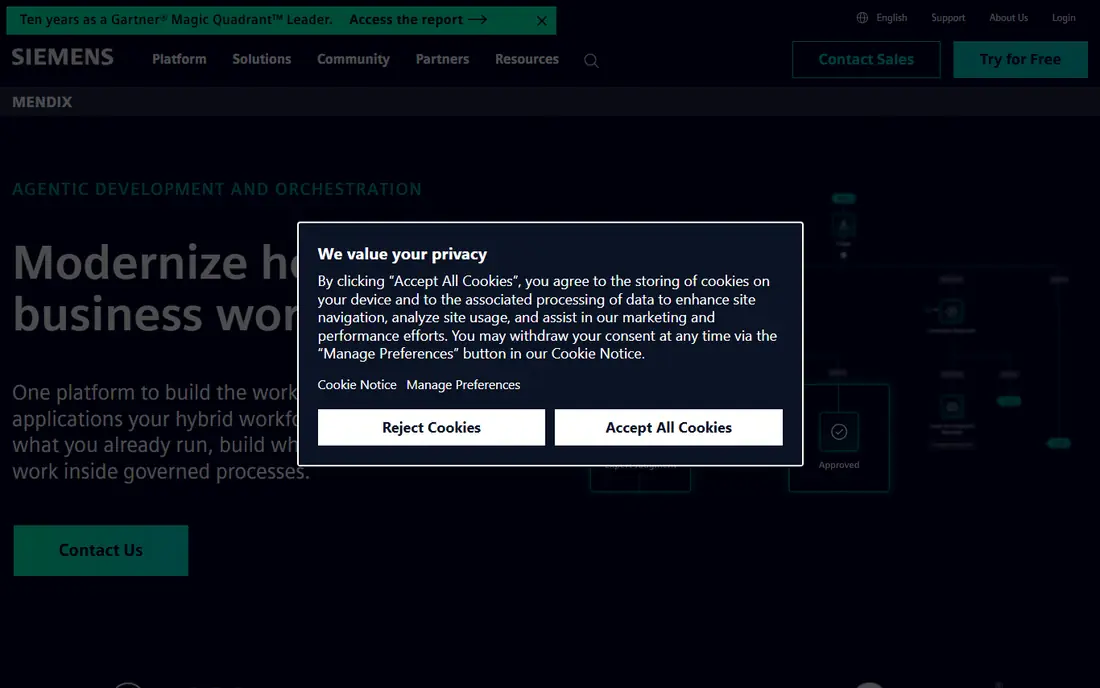
Mendix is the cleanest like for like answer. A company leaving Appian over price, roadmap or the Siemens ecosystem will find the same shape of platform: governed, IT led, built for applications that must survive a decade.
Run the total cost model early. Per app pricing rewards consolidation, so an estate of many small apps costs more than the same functions in a few larger ones.
What we like- Mendix, owned by Siemens, is Appian's most direct competitor: a governed low code platform for building serious business applications, with visual modelling, built in DevOps, cloud deployment options including private cloud, and collaboration between business and IT through separate studio views for different skill levels. Its industrial and manufacturing base, through Siemens, gives it strength in operational technology adjacent apps. A free tier allows building and small scale deployment, and the platform supports the application lifecycle controls large IT departments demand.
Watch out for- Commercial pricing is per application and negotiated rather than listed, and costs climb with apps and users in ways that need careful modelling. The visual modelling approach suits data and workflow apps better than unusual interfaces. Outside Siemens and industrial circles, brand awareness trails Appian. Developer hiring pools for Mendix specialists are thinner than for Microsoft or Java skills.
#2OutSystems
Best for: High performance enterprise apps4.5/5 on
G2 (1,810 reviews, checked Oct 2026)
Visit outsystems.com
Starting priceSee website
Free planYes
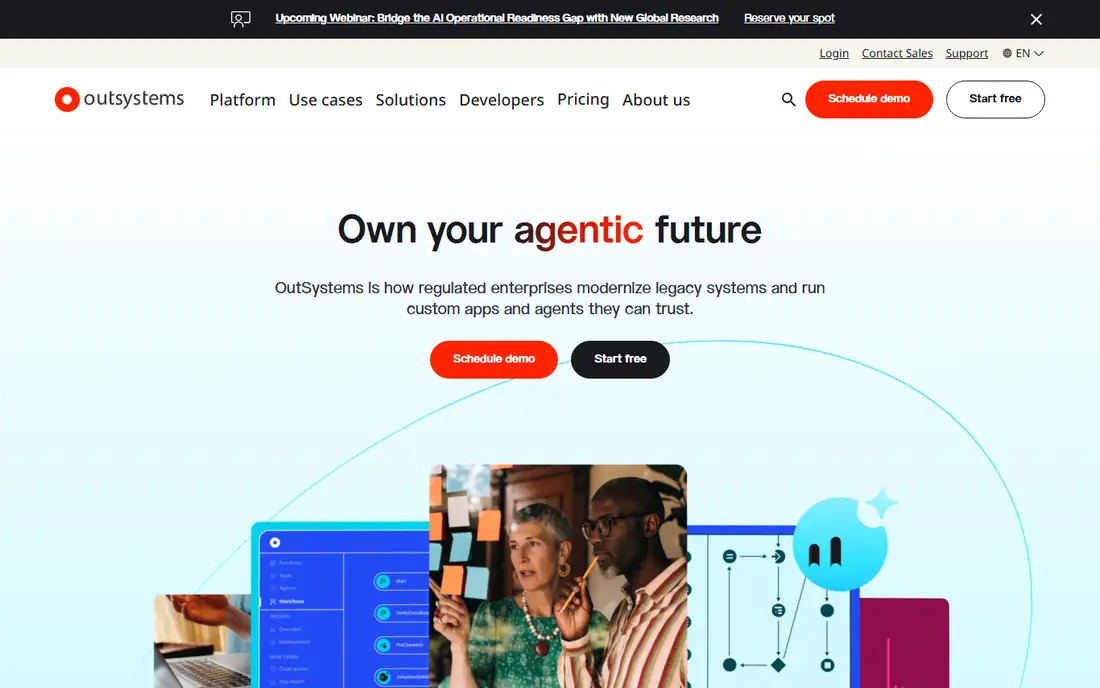
OutSystems fits organisations whose low code apps are front line products: customer portals, field service systems, core process replacements. It is the pick when an Appian evaluation failed on performance, mobile depth or full stack ambition.
For departmental workflow apps, it is heavier and dearer than the job requires. Buy it for the systems the business runs on.
What we like- OutSystems builds enterprise applications with a strong claim on performance and full stack coverage: visual development that generates real code architecture, strong mobile app support, built in lifecycle management, and AI assisted development through its Mentor tooling. It has a long record with large consumer facing and core business systems, not only internal tools. A free personal environment lets developers learn the platform properly before a company buys. Deployment options include its cloud and customer clouds.
Watch out for- Pricing is quote led and positioned at the premium end, with platform fees that rule out small use cases. The generated architecture still needs OutSystems skills to run well, so a company is buying into a specialist talent pool. Contracts and module structures need care, as the priced unit is not the simple per user figure buyers may expect. Community size is smaller than the Microsoft ecosystem's.
#3Microsoft Power Apps
Best for: Microsoft 365 estates4.3/5 on
G2 (569 reviews, checked Oct 2026)
Visit microsoft.com
Starting price$20 per user per month
Free planYes
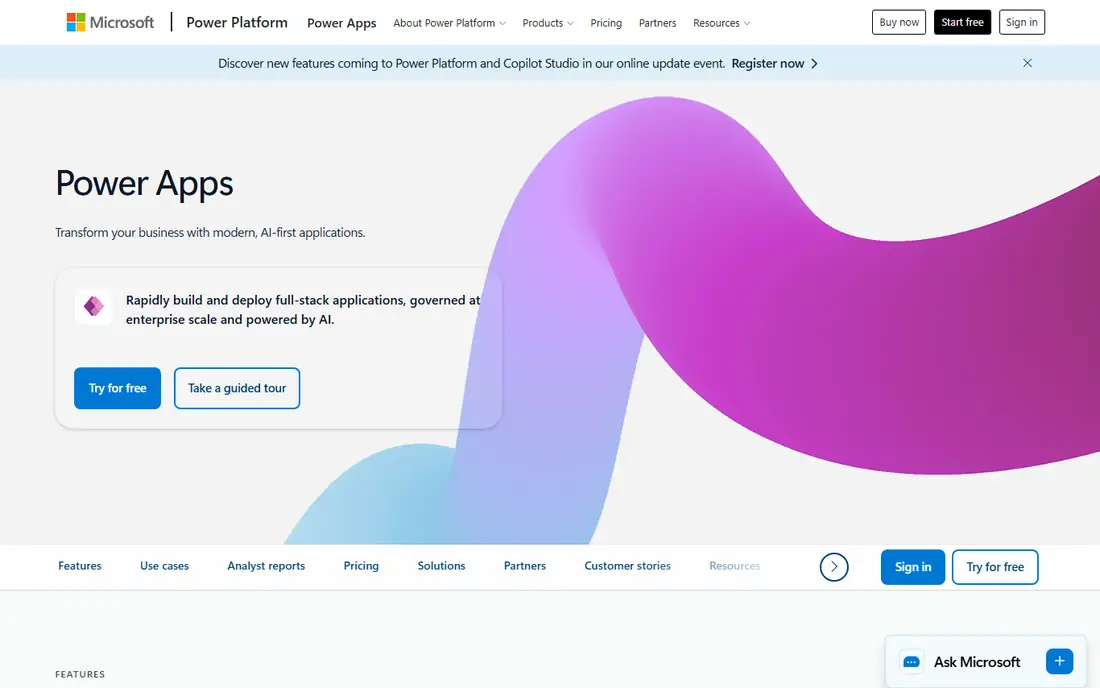
Power Apps is the right Appian alternative when the honest requirement is many modest internal apps inside a Microsoft company, delivered by a mix of IT and trained business users.
Price the licence model with your real user counts before the first success story spreads, because per user Premium across a whole workforce is a serious line item, and retrofitting governance costs more than setting it on day one.
What we like- Power Apps wins by position: inside a Microsoft 365 company, identity, data in SharePoint and Dataverse, Teams delivery and admin governance are already there, and staff can build canvas apps with skills close to Excel formulas. Premium licensing is 20 dollars per user per month billed yearly, with per app and pay as you go options, and thousands of connectors reach beyond Microsoft data. Copilot assistance helps beginners start. A developer plan is free for building and testing, and seeded rights inside some Microsoft 365 plans cover standard connector apps.
Watch out for- Licensing is the famous catch: who needs Premium, which connectors are premium, and how guests and external users count can turn a cheap start into a large bill, and it takes expertise to model. Apps built quickly by everyone can sprawl into an ungoverned estate without a platform team. Complex, pixel perfect or very high scale applications reach its limits sooner than Mendix or OutSystems. Outside a Microsoft estate, its central advantage disappears.
#4Pega
Best for: Case management and decisioning4.2/5 on
G2 (278 reviews, checked Oct 2026)
Visit pega.com
Starting priceSee website
Free planNo
Choose Pega when the work is the company's hardest operational core, measured in millions of cases and regulatory exposure, and when decisioning inside the process is a requirement rather than a feature.
If your Appian shortlist exists because of ordinary workflow digitisation, Pega will likely overshoot the budget and the timeline. It competes at the top of this market, deliberately.
What we like- Pega is the heavyweight for case driven work in regulated industries: insurance claims, bank onboarding, service cases, with a model driven platform whose centre is the case lifecycle and the decisions inside it. Its decisioning engine, used for next best action in customer service and marketing, is a capability Appian does not match directly. Large banks, insurers and government bodies run core processes on it. AI agents and workflow automation are being built into the same platform story.
Watch out for- Pega is a major commitment: premium pricing, long implementations and a specialist partner ecosystem, with a learning curve that makes Appian feel light. It is rarely the economical answer for a handful of departmental apps. Projects carry enterprise programme risk, and success depends heavily on the quality of the implementation team. Buyers should reference check similar scale deployments, not demos.
Starting priceSee website
Free planNo
App Engine is the answer to a specific question: we run ServiceNow, so why is this workflow in another tool? Consolidating onto the existing platform usually wins on data, identity and support contracts.
Everyone else should read this entry as conditional. It is a platform extension, not a platform candidate.
What we like- For the many enterprises where ServiceNow already runs IT service, HR cases and operations, App Engine lets teams build workflow apps on the same data model, identity and automation fabric, with Flow Designer and Integration Hub beside them. Apps inherit ServiceNow's workflow discipline and reporting, and employees meet them in the same portal they already use. Creator workflows extend building to trained business users under IT guardrails. That installed base gravity is its entire case, and it is a strong one.
Watch out for- It makes little sense as a standalone purchase: pricing rides on ServiceNow platform agreements and is firmly enterprise. Apps live inside ServiceNow's shape, so public facing or unusual experience requirements fit badly. Licensing across ServiceNow modules is a specialist subject, and costs grow with the platform footprint. Companies without ServiceNow gain nothing here that Mendix or Power Apps do not offer more directly.
#6Retool
Best for: Internal tools for engineering teams4.6/5 on
G2 (359 reviews, checked Oct 2026)
Visit retool.com
Starting priceSee website
Free planYes
Retool replaces the Appian use case that was never really process management: the internal tool backlog. If most of your Appian apps are CRUD screens over a database with some buttons, Retool does them faster and cheaper.
If your apps are audited, multi week, multi party processes, stay with the platforms above. Knowing which backlog you have is the whole decision.
What we like- Retool builds internal tools at developer speed: drag together tables, forms and charts connected directly to your databases and APIs, with real code allowed wherever the visual builder ends. Admin panels, support consoles and operations dashboards that take weeks in a normal stack take days. A free plan covers small teams, and paid tiers price per builder and end user at levels far below enterprise platforms, with self hosting available for companies that must keep data inside their network. Engineers actually like it, which matters for adoption.
Watch out for- Retool is for internal tools, not customer facing products or heavy case management
- Long running business processes with human tasks over weeks are Appian's home ground, not Retool's. Per user pricing across both builders and end users needs counting at scale. Complex logic can tangle inside components if teams skip discipline. Its workflow and AI add ons broaden it, but the centre of gravity stays the internal console.
#7Kissflow
Best for: Business user process apps4.3/5 on
G2 (590 reviews, checked Oct 2026)
Visit kissflow.com
Starting priceSee website
Free planNo
Kissflow fits the department that found Appian too much platform: a backlog of approval and tracking processes, no developers to spare, and a need for something running this quarter.
It is a business user tool with a ceiling, and it is honest about that ceiling. Buy it for the backlog it clears, not as a ten year platform bet.
What we like- Kissflow aims low code at business teams rather than IT: process apps, approvals, onboarding and procurement flows built by the people who run them, with forms, workflow rules and reporting in a deliberately simple studio. It has widened from workflow into a broader low code platform while keeping that business user posture. Pricing is platform based and aimed below enterprise rivals, with published tiers that have historically started at levels a department can approve, though current figures should be confirmed on the site.
Watch out for- Depth for complex, integration heavy enterprise applications trails Mendix and OutSystems. Governance and lifecycle tooling suit mid size estates rather than regulated giants. The brand carries less weight in enterprise procurement. Pricing pages have changed structure over time, and some features sit behind higher editions, so the demo must match your exact use cases.
#8Zoho Creator
Best for: Budget low code for SMBs4.3/5 on
Capterra (170 reviews, checked Oct 2026)
Visit zoho.com
Starting price$8 per user per month
Free planYes
Zoho Creator is what a small company should price before it signs anything else on this list. For internal apps, field data collection and customer portals at SMB scale, it delivers most of the outcome for a small fraction of the cost.
Outgrowing it is a good problem, and by then the company will know exactly which enterprise features it actually needs.
What we like- Zoho Creator is the budget end of serious low code: build database backed apps with forms, workflows, reports and customer portals, deployed to web and mobile, from 8 dollars per user per month billed annually, with a free plan to start. Its Deluge scripting language gives an escape hatch when visual building is not enough, and it ties into the wider Zoho suite for companies already using Zoho CRM or books. AI features are bundled rather than metered as a separate credit pool. For small and mid size businesses, the value is difficult to argue with.
Watch out for- Enterprise depth is not the offer: very complex applications, strict governance needs and large scale consumer apps belong on the platforms above. Some advanced work requires learning Deluge, which is a real if gentle programming step. Third party integration breadth trails Power Apps. Support responsiveness on technical issues is a recurring theme in user reviews, improving at higher tiers.
How we chose
We picked platforms a company can adopt in October 2026 as an Appian replacement across the real decision shapes: direct enterprise rivals, estate plays inside Microsoft or ServiceNow, an internal tools specialist, and business user and budget low code. Every platform is actively sold and publishes at least entry pricing or a free tier, except the quote led enterprise vendors, which are labelled see website. No platform was hands on tested; judgements rest on vendor documentation, pricing pages and current comparison reporting, including Microsoft's published per user figures and Zoho's published entry price.
How to pick an Appian alternative
Diagnose why Appian is being replaced, because each cause points at a different tool. Price points at Retool, Kissflow or Zoho Creator for ordinary apps, or a hard Mendix or OutSystems negotiation. Estate fit points at Power Apps or ServiceNow. Process depth at scale points at Pega.
Then count users honestly. Per user platforms punish broad rollouts; per app and platform fee models punish sprawl. Model your real app count and real user count for year two, not the pilot, and make vendors quote against that model in writing.
Finally, run one real process through the finalist, including its ugliest integration and its audit requirements. Low code demos all look easy. The migration of one true workflow tells you the implementation cost, the skill needs and the ceiling, which are the facts the contract will be priced on.
Frequently asked questions
What is the closest alternative to Appian?
Mendix, with OutSystems close behind. Both are governed enterprise low code platforms for complex, long lived applications, with lifecycle management and deployment options comparable to Appian's. The choice between them usually comes down to ecosystem: Siemens and industrial strength for Mendix, full stack and mobile depth for OutSystems.
Is Power Apps a real Appian replacement?
For internal apps inside a Microsoft company, yes, and it is the most common Appian displacement in practice. For complex, long running, audited business processes with heavy case work, Appian, Mendix, OutSystems and Pega remain stronger. The licence model is the trap: model Premium seats across your real user base before committing.
Why is enterprise low code pricing never listed?
Because it is negotiated against app counts, user counts, deployment model and term, and vendors prefer a sales process to a price list. Treat any precise figure from a third party as an estimate. The budget tools here, Zoho Creator at 8 dollars per user per month and Power Apps at 20, are the exceptions that show what the floor of the market looks like.
Can business users really build production apps?
Within guardrails, yes, on Kissflow, Zoho Creator, Power Apps and ServiceNow's creator tools, for forms, approvals and tracking apps of modest complexity. Production still needs IT owned identity, data and lifecycle rules. The failures in this pattern are governance failures, not tool failures, and every platform here provides the controls if a team sets them.
What should we migrate first when leaving Appian?
The app with the clearest boundaries and the least integration debt, not the flagship process. A clean first migration proves the new platform's identity, data and deployment patterns and trains the team. Migrate the flagship last, with the lessons priced in, and run both platforms in parallel until the audit trail is continuous.
Sources we checked (0)
Is your product missing or out of date?
We review this list regularly. Vendors can request a listing, send updated pricing or ask about featured placement.

Shihab Mia · Founder, Rankite
Shihab has 5+ years in B2B and SaaS SEO. He writes Rankite's software buying guides from pricing pages, documentation and public user reviews. More about Shihab.