How we make this list: we compare pricing pages, product documentation and public user reviews. Ratings come from G2, Capterra or Trustpilot, with the date we checked them.
Key takeaways
- Ansible core is free and open source, while the Red Hat Automation Platform adds control, support, and governance at enterprise pricing.
- Puppet, Chef, and SaltStack lead for agent-based configuration management, while Terraform and Pulumi lead for infrastructure as code.
- Agentless versus agent-based is the first decision: Ansible needs no agents, while Puppet and Chef install agents on every node.
- Chef starts at $59 per node per month billed annually, while Rudder and CFEngine offer free open-source editions.
Quick comparison
| Tool | Best for | Starting price | Free plan |
|---|
 Puppet | Hybrid infrastructure at scale | See website | Yes |
 Chef | Policy-driven workflows | $59 per node per month | Yes |
 SaltStack | Massive high-speed fleets | See website | Yes |
 Rudder | Compliance plus automation | $0 | Yes |
 CFEngine | Huge fleets on light agents | $0 | Yes |
 Terraform | Infrastructure as code | $0 | Yes |
 Pulumi | Multi-language infrastructure code | $40 per month | Yes |
 Jenkins | CI/CD-driven automation | $0 | Yes |
Is your product missing or out of date?
We review this list regularly. Vendors can request a listing, send updated pricing or ask about featured placement.
The best ansible alternatives
#1Puppet
Best for: Hybrid infrastructure at scale4.2/5 on
G2 (43 reviews, checked Oct 2026)
Visit puppet.com
Starting priceSee website
Free planYes
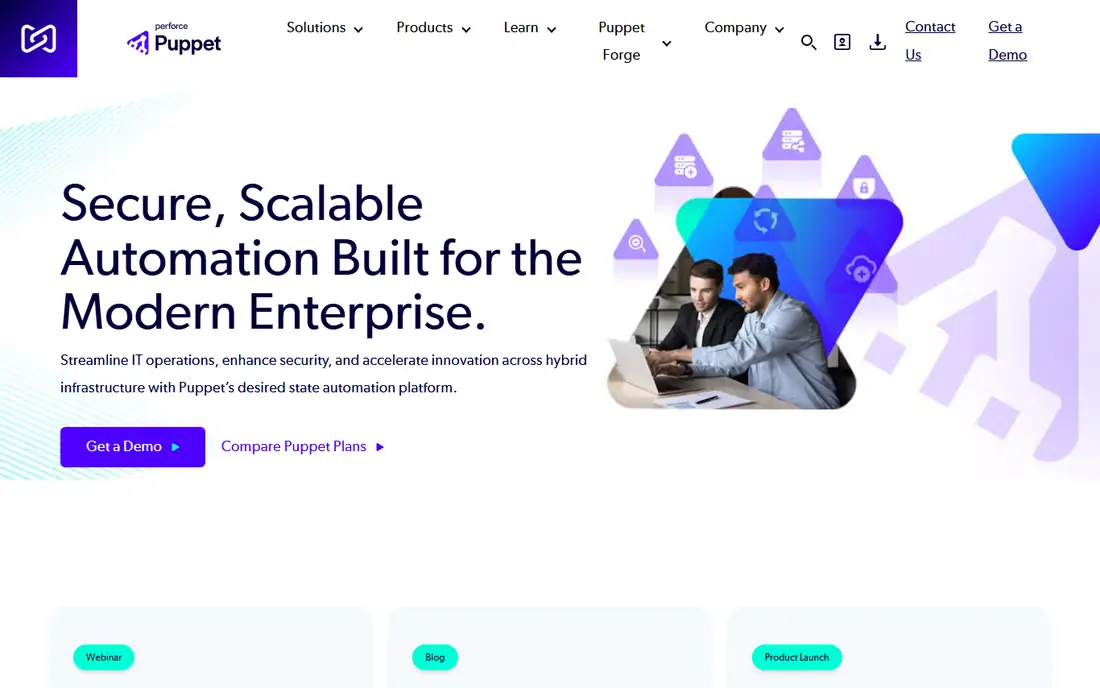
Puppet is the classic Ansible rival for configuration management. Its model-based approach defines the desired state of each node, and agents enforce that state continuously, correcting drift automatically. Real-time reporting shows compliance across hybrid infrastructure, and intelligent orchestration handles complex rollouts. Open-source Puppet is free, while Puppet Enterprise pricing is available on request.
The agent requirement adds deployment work compared with Ansible agentless model, and Puppet language takes learning. For enterprises managing hybrid infrastructure with strict desired-state control, Puppet remains a top pick.
What we like- Model-based control with desired-state enforcement
- Real-time reporting
- Strong hybrid cloud support
Watch out for- Enterprise pricing on request
- Agent-based, so every node needs an agent
- Learning curve for its language
#2Chef
Best for: Policy-driven workflows4.3/5 on
G2 (136 reviews, checked Oct 2026)
Visit chef.io
Starting price$59 per node per month
Free planYes
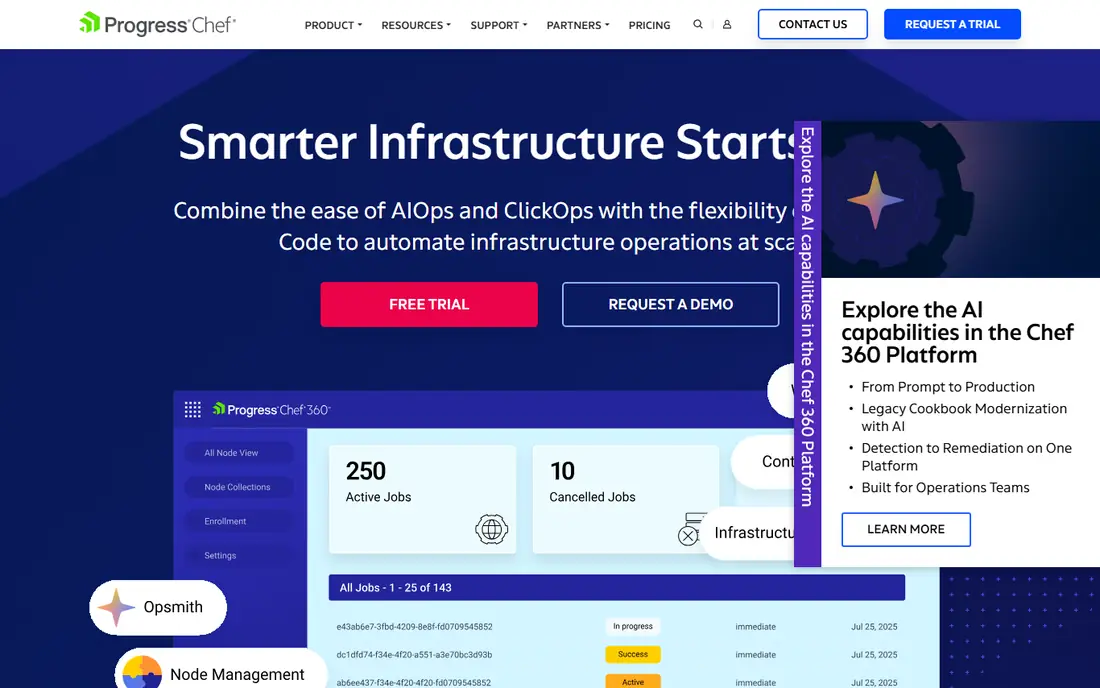
Chef automates infrastructure through policy-driven workflows written as recipes and cookbooks. Multi-cloud management covers on-prem and cloud nodes alike, and the high-availability design suits large fleets. Pricing starts at $59 per node per month billed annually, with a free trial and open-source editions available.
Per-node pricing grows expensive for large fleets, and Ruby skills help for serious cookbook work. For teams that want policy-as-code automation with strong workflow control, Chef is a proven choice.
What we like- Policy-driven workflow automation
- Multi-cloud management
- High availability design
Watch out for- $59 per node per month billed annually adds up at scale
- Ruby-based recipes need developer skills
- Agent-based
Starting priceSee website
Free planYes
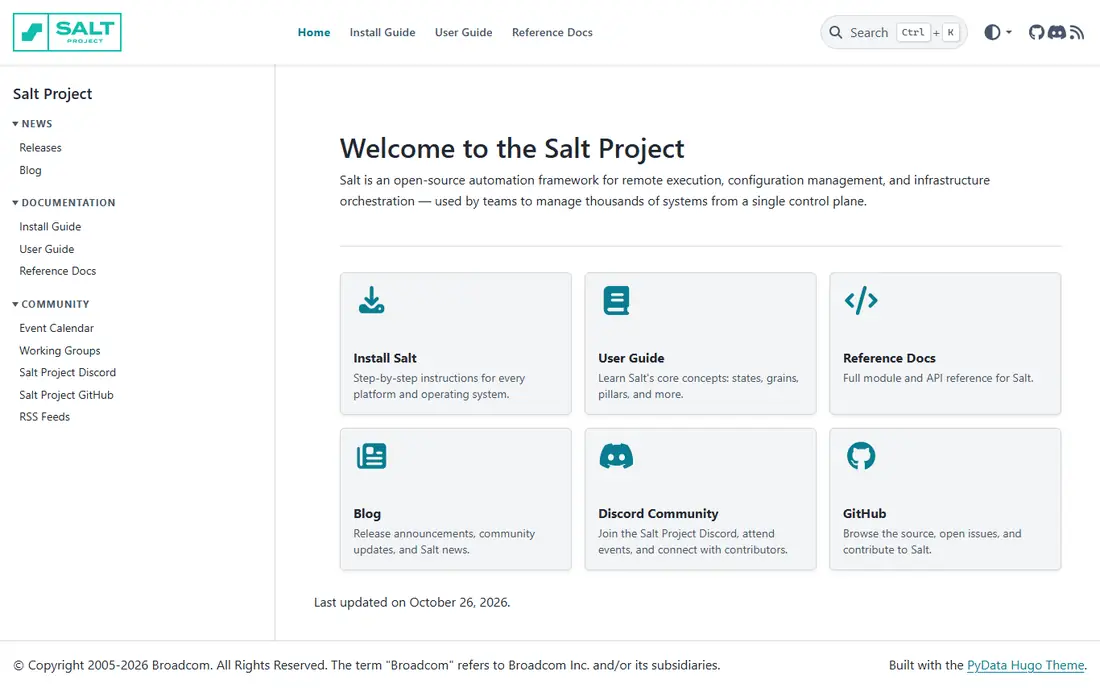
SaltStack, now part of Broadcom, handles fleets of 10,000-plus nodes with fast parallel execution and a strong API. Prebuilt modules cover common automation tasks, and the event-driven design suits real-time orchestration. Open-source Salt is free, while enterprise editions are priced on request.
Configuration complexity grows at scale, and the Broadcom ownership adds roadmap questions for some teams. For massive fleets where execution speed matters, SaltStack is the strongest agent-based pick.
What we like- Handles 10,000-plus nodes
- Very fast execution
- Strong API and prebuilt modules
Watch out for- Enterprise pricing on request
- Configuration complexity at scale
- Now part of Broadcom
#4Rudder
Best for: Compliance plus automation4.3/5 on
G2 (18 reviews, checked Oct 2026)
Visit rudder.io
Starting price$0
Free planYes
Rudder combines configuration management with continuous auditing, which makes it the pick for compliance-heavy teams. Its web-driven interface supports role-based workflows for beginners, experts, and managers, and its enforcement engine corrects drift automatically. Inventory management and auditing come built in, and the open-source edition is free.
The community is smaller than Puppet or Chef, and enterprise features sit behind paid tiers. For teams that need automation plus compliance reporting without enterprise pricing, Rudder offers strong value.
What we like- Free and open source
- Web-driven configuration
- Compliance reporting and drift correction
Watch out for- Smaller community than Puppet or Chef
- Agent-based nodes
- Enterprise features gated
Starting price$0
Free planYes
CFEngine is the veteran of this group, with a secure open-source base and agents light enough to scale to 50,000 servers. Execution runs in about a second per policy run, which suits fleets where agent overhead matters. The open-source edition is free, with enterprise support available separately.
The interface and policy language feel older than modern tools, and the ecosystem is smaller. For huge fleets on constrained hardware, CFEngine remains a dependable, lightweight choice.
What we like- Free and open source
- 1-second execution time
- Scales to 50,000 servers
Watch out for- Older interface and language
- Smaller ecosystem
- Enterprise support costs extra
#6Terraform
Best for: Infrastructure as code4.6/5 on
G2 (120 reviews, checked Oct 2026)
Visit terraform.io
Starting price$0
Free planYes
Terraform approaches automation from provisioning rather than configuration enforcement. Its declarative language defines cloud infrastructure across providers, and the ecosystem covers nearly every cloud service. The open-source edition is free, with Terraform Cloud adding collaboration and governance on paid tiers.
Terraform provisions infrastructure but does not continuously enforce node configuration the way Puppet or Chef do, so many teams pair it with Ansible or Chef. For cloud infrastructure as code, Terraform is the standard pick.
What we like- Free and open source
- Huge provider ecosystem
- Declarative infrastructure across clouds
Watch out for- Provisioning-focused, not ongoing configuration enforcement
- State management needs care
- Learning curve
#7Pulumi
Best for: Multi-language infrastructure code4.8/5 on
G2 (25 reviews, checked Oct 2026)
Visit pulumi.com
Starting price$40 per month
Free planYes
Pulumi lets engineers write infrastructure code in general-purpose languages like Python, TypeScript, Go, and C#, which suits teams that prefer real programming languages over domain-specific ones. Plans start at $40 per month with a free plan available, and multi-cloud support covers the major providers.
The ecosystem is smaller than Terraform, and state backend planning matters for team use. For developer-led teams that want infrastructure in a language they already know, Pulumi is the best Terraform rival.
What we like- Write infrastructure in Python, TypeScript, Go, or C#
- Free plan available
- Multi-cloud support
Watch out for- Smaller ecosystem than Terraform
- $40 per month entry for teams
- State backend needs planning
#8Jenkins
Best for: CI/CD-driven automation4.4/5 on
G2 (570 reviews, checked Oct 2026)
Visit jenkins.io
Starting price$0
Free planYes
Jenkins is the CI/CD workhorse that many teams use alongside or instead of Ansible for automation. Its plugin ecosystem covers deployment, testing, and orchestration, and pipelines-as-code keep automation versioned. Jenkins is free and open source, with no per-node pricing.
Jenkins is not a configuration management tool, so it lacks desired-state enforcement, and self-hosting adds maintenance. For teams whose automation lives in delivery pipelines, Jenkins is the free, flexible pick.
What we like- Free and open source
- Huge plugin ecosystem
- Drives automation from pipelines
Watch out for- Not a configuration management tool
- Needs plugins for most tasks
- Maintenance burden on self-hosting
How we chose
We compared agent models, pricing, scale, compliance features, and ecosystem size for each tool, then checked them against recent configuration-management comparisons and G2 reviewer data. Tools made the list only if they automate infrastructure or configuration today with a published free tier or entry price. Where enterprise pricing sits behind a quote, we used See website rather than printing a contested figure. We also weighed community health for open-source tools, since a free tool with a shrinking community costs more in the long run than a paid tool with active maintenance. Puppet, Terraform, and Jenkins score well here, while smaller projects need a closer look at recent release activity before adoption.
Choose by agent model first, then by job
The first decision is agentless versus agent-based. Ansible runs agentless over SSH, which means no agent rollout and no agent maintenance, but less continuous enforcement. Puppet, Chef, SaltStack, Rudder, and CFEngine install agents that enforce desired state continuously and correct drift, at the cost of agent deployment and upgrades. Teams with strict compliance needs usually pick agent-based tools, while teams that value simplicity pick agentless.
The second decision is provisioning versus configuration. Terraform and Pulumi provision cloud infrastructure, while Puppet, Chef, and SaltStack manage the configuration of machines once they exist. Most mature teams use both: Terraform provisions, and Ansible or Puppet configures. Budget for both layers rather than expecting one tool to cover everything. Migration deserves its own plan too. Moving from Ansible playbooks to another tool is not a simple conversion, since each system has its own language and model. Start by inventorying your most-used playbooks, migrate the highest-value automation first, and run both tools in parallel during the transition so a failed migration never blocks a deployment. Teams that rush a full cutover usually discover edge cases in production, while teams that migrate incrementally keep shipping throughout. Finally, handle secrets carefully in any automation tool. Playbooks and manifests that embed passwords or API keys leak credentials into version control, so use a secrets manager or the tool native vault from day one. Audit who can read and change automation code, since automation credentials often carry broad access across your infrastructure. Also plan for agent lifecycle if you pick an agent-based tool. Agents need updates, certificate rotation, and monitoring for nodes that stop checking in, and those tasks fall on your team every month. Budget that maintenance time honestly before choosing, since an agent fleet that nobody maintains drifts into the same inconsistency the tool was bought to prevent.
Frequently asked questions
Is Ansible itself free?
Yes, Ansible core is free and open source. The Red Hat Ansible Automation Platform adds a control plane, governance, support, and advanced workflows at enterprise pricing, with older published figures from $5,000 per year for basic tiers. Small teams can run Ansible core free, while enterprises pay for the platform. Teams that outgrow core usually hit governance limits first: role-based access, audit trails, and scheduled job management are the features that push organizations toward the paid platform rather than raw automation power.
Which Ansible alternative is best for compliance?
Rudder leads for compliance plus automation, with continuous auditing and drift correction built in and a free open-source edition. Puppet also offers strong compliance reporting with real-time enforcement. Choose Rudder for budget compliance work and Puppet for enterprise-scale compliance. Both tools generate audit trails that show which nodes match policy and which drifted, which matters for regulated industries where auditors ask for proof, not promises.
Do I need agents for configuration management?
Not with Ansible, which runs agentless over SSH. Puppet, Chef, SaltStack, Rudder, and CFEngine all use agents, which enable continuous enforcement and drift correction but add deployment work. Pick agentless for simplicity and agent-based for strict desired-state control. Agent-based tools also report node health continuously, so silent failures surface faster than with scheduled agentless runs. Test agent updates on a small node group first, always, before wider rollout.
Can Terraform replace Ansible?
Only partly. Terraform provisions cloud infrastructure, while Ansible configures machines and applications after provisioning. Most teams use Terraform plus Ansible or Puppet together, with Terraform handling infrastructure and the configuration tool handling ongoing state. The combination also keeps responsibilities clear: infrastructure changes go through Terraform reviews, while configuration changes go through the configuration tool, so a bad change in one layer never silently breaks the other.
Which Ansible alternative is cheapest at scale?
CFEngine and Rudder offer free open-source editions that scale to tens of thousands of servers with light agents. Jenkins is also free for pipeline-driven automation. For paid tools, per-node pricing like Chef at $59 per node per month grows expensive fast, so model your node count before choosing. Multiply the per-node price by your full fleet, including staging and development nodes, since vendors count every managed node, not just production servers.
Sources we checked (8)
- https://www.puppet.com
- https://www.chef.io
- https://www.saltproject.io
- https://www.rudder.io
- https://www.cfengine.com
- https://www.terraform.io
- https://www.pulumi.com
- https://www.jenkins.io
Is your product missing or out of date?
We review this list regularly. Vendors can request a listing, send updated pricing or ask about featured placement.

Shihab Mia · Founder, Rankite
Shihab has 5+ years in B2B and SaaS SEO. He writes Rankite's software buying guides from pricing pages, documentation and public user reviews. More about Shihab.