How we make this list: we compare pricing pages, product documentation and public user reviews. Ratings come from G2, Capterra or Trustpilot, with the date we checked them.
Key takeaways
- The closest drop-in replacements for Claude are OpenAI and Google Gemini, both with broad model ranges and mature developer tooling.
- Open-weight options from Mistral, Together AI, and Fireworks cut vendor lock-in and often cost less per token for high-volume work.
- Groq stands out for raw inference speed, which matters for real-time agents and voice apps.
- Cohere fits enterprise search and retrieval work better than general chat, while DeepSeek fits teams optimizing hard for cost.
- All eight charge by usage, so compare per-token pricing on each vendor's pricing page before committing, since rates change often.
Quick comparison
| Tool | Best for | Starting price | Free plan |
|---|
 OpenAI API | Broadest model range | See website | No |
 Google Gemini API | Long context and multimodal work | See website | Yes |
 Mistral AI | Open-weight models you control | See website | See website |
 Cohere | Enterprise search and retrieval | See website | See website |
 Together AI | Running open models at scale | See website | See website |
 Fireworks AI | Fast open-model inference | See website | See website |
 Groq | Fastest inference for agents | See website | Yes |
 DeepSeek API | Lowest-cost reasoning models | See website | See website |
Is your product missing or out of date?
We review this list regularly. Vendors can request a listing, send updated pricing or ask about featured placement.
The best Anthropic API alternatives
Starting priceSee website
Free planNo
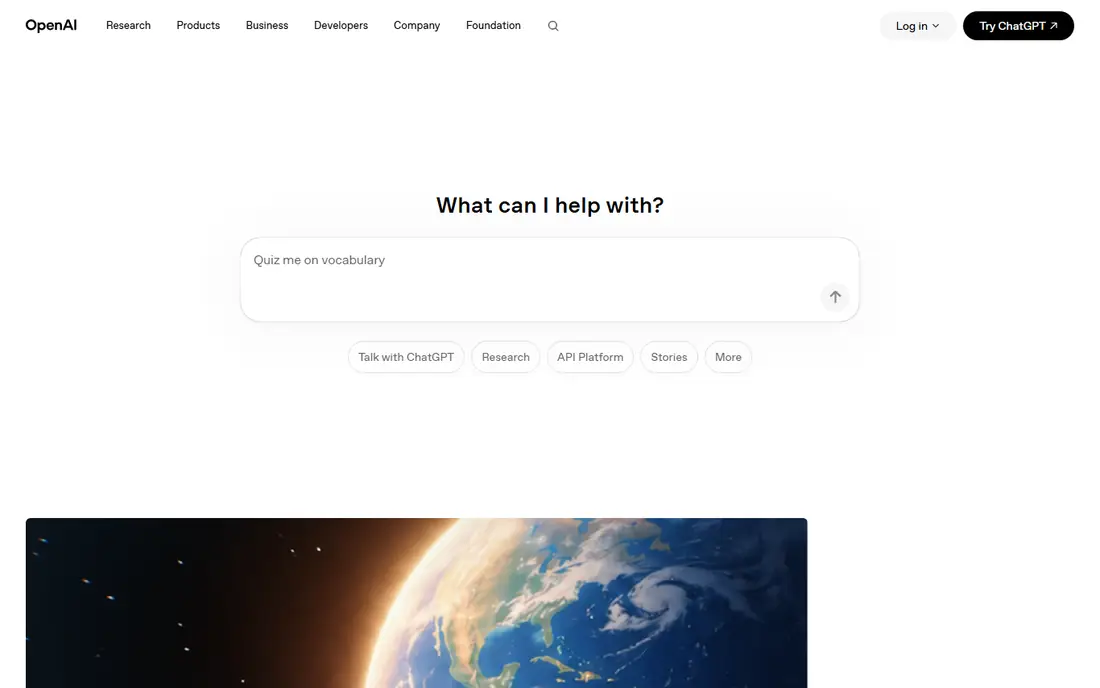
OpenAI is the default alternative most teams evaluate first, and for good reason. Its API covers chat, reasoning, image, audio, and embedding models, and its documentation and SDK support are the benchmark other vendors copy. The homepage now highlights GPT-6.1 Terra, announced October 26, 2026, alongside the GPT-6 family, so model names move fast and your code should pin model versions rather than tracking marketing names.
The honest catch is cost and control. Flagship models are priced for performance, not thrift, and heavy workloads can surprise a budget. OpenAI also gives you no open weights to self-host, so if independence from a single vendor matters, pair it with an open-weight provider rather than betting everything on one API.
What we like- Frontier models plus strong tooling and documentation
- Huge community and third-party integrations
- Structured outputs and function calling built in
Watch out for- Prices sit at the higher end for flagship models
- API console page renders as an app, so plan details live behind sign-in
Starting priceSee website
Free planYes
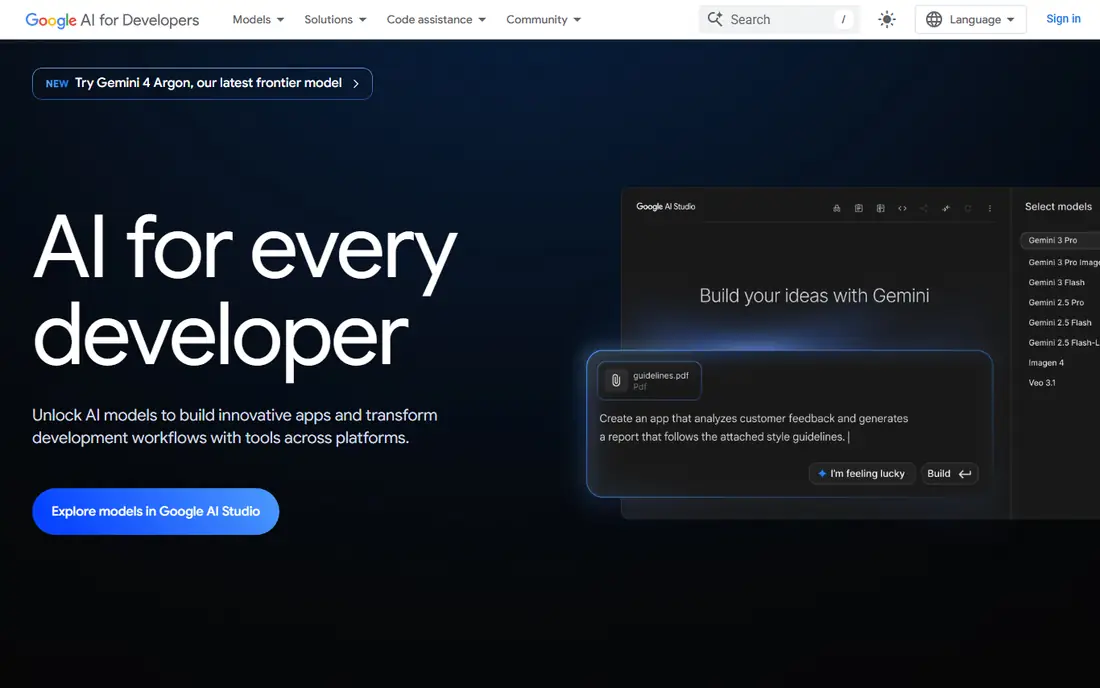
Google's developer site frames its offer plainly: integrate Google AI models with an API key, and build with Gemini, Imagen, and Veo from Google DeepMind. That breadth is the appeal. One key reaches text, image, and video models, and the long context windows Gemini is known for suit document analysis and large codebases.
The free tier in AI Studio makes prototyping cheap, which is a real advantage over APIs that charge from the first token. Watch the naming, though. Gemini model generations turn over quickly, and the homepage already points to newer releases, so test your prompts against the exact model you plan to ship.
What we like- API key access through Google AI Studio with a free tier
- Gemini, Imagen, and Veo models from one platform
- Gemma open models for self-hosting
Watch out for- Model naming changes often, which complicates long-term code
- Enterprise features push you toward Google Cloud, adding setup complexity
Starting priceSee website
Free planSee website
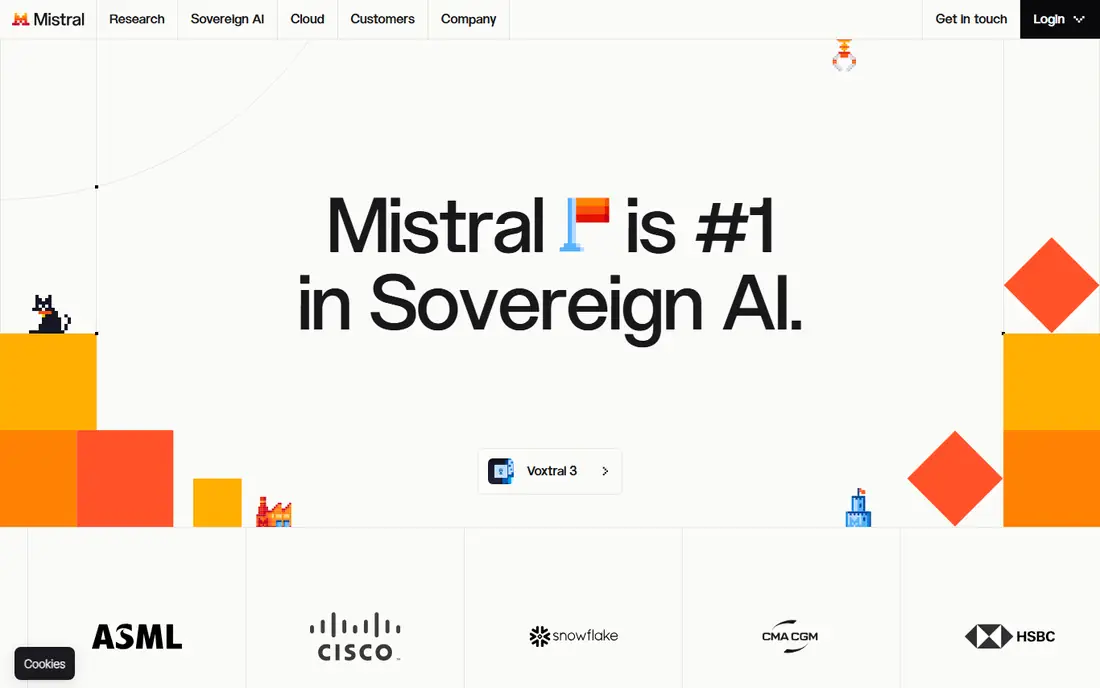
Mistral pitches itself around a single idea: it makes the models, and you keep them. Its homepage stresses open-weight frontier models, customization around your own data, and deployment on-prem, in your VPC, or on Mistral infrastructure. For regulated teams and European companies, that control over where inference runs is a genuine differentiator.
The trade-off is ecosystem depth. You will find fewer plug-and-play integrations than with the biggest providers, and some agent tooling needs more assembly. If your team can manage its own deployment or accepts Mistral's hosted API, the payoff is independence and predictable data handling.
What we like- Frontier open-weight models you can run on-prem or in your own cloud
- European hosting options for data control
- Specialist models for coding and research
Watch out for- Smaller ecosystem than OpenAI or Google
- Fewer ready-made integrations and agent frameworks
#4Cohere
Best for: Enterprise search and retrieval4.2/5 on
G2 (27 reviews, checked Oct 2026)
Visit cohere.com
Starting priceSee website
Free planSee website
Cohere has shifted its homepage toward its North platform, described as a complete agentic enterprise AI platform you control and deploy on your terms. Underneath that sits the capability that made Cohere known: retrieval, reranking, and embeddings tuned for enterprise documents. If your Claude workload is mostly retrieval-augmented generation over internal knowledge, Cohere may beat a general chat API on accuracy and cost.
The catch is visibility. Cohere's chat models get less public discussion than its retrieval stack, so benchmark them on your own documents before assuming parity. Larger deployments also tend to involve sales conversations rather than pure self-serve signup, which slows evaluation for small teams.
What we like- Strong retrieval and embedding models for search over company documents
- Private deployment options
- Enterprise security and compliance focus
Watch out for- Chat models are less famous than Claude or GPT, so fewer public benchmarks
- Pricing is sales-led for larger deployments
Starting priceSee website
Free planSee website
Together AI calls itself the AI native cloud, and its homepage backs that with a long model list spanning chat, image, video, and code, including recent open releases. Its pitch is the fastest way to run open-source models on demand, with serverless inference, batch processing up to 30 billion tokens per model, and dedicated deployments for steady workloads.
That catalog is both the strength and the work. With dozens of models, quality and price vary widely, and the burden of picking and testing falls on you. For teams that already know which open model they want, Together AI is a fast, flexible host. For teams that want one recommended model, a frontier provider is simpler.
What we like- Huge catalog of open models across text, image, video, and code
- Serverless inference with no infrastructure to manage
- Batch and dedicated options for scale
Watch out for- Model quality varies across the catalog, so testing is mandatory
- Support depth is thinner than the hyperscale providers
Starting priceSee website
Free planSee website
Fireworks describes itself as the specialized intelligence platform: one place to run, ensemble, and train open models. Its homepage claims up to 4x the throughput of providers wrapping standard serving stacks, up to 99.6 percent cache hits, and cached input at half price or less. Those numbers, if they hold for your workload, translate directly into lower bills.
The limit is the open-model ceiling. On the hardest reasoning and coding tasks, frontier closed models still lead, and no serving optimization closes that gap. Fireworks fits best when your workload is well served by open models and your priority is speed and cost per finished task rather than maximum capability.
What we like- Optimized inference with high cache-hit rates that cut cost
- Model ensembling and fine-tuning on one platform
- Global deployment across 30+ regions
Watch out for- Open-model ceiling, so it cannot match frontier closed models on the hardest tasks
- Pricing depends on caching behavior, which varies by workload
Starting priceSee website
Free planYes
Groq's homepage is blunt: inference is the bottleneck, and Groq was built to remove it. Its custom LPU hardware, now joined by LPX alongside NVIDIA GPUs, delivers the low-latency responses that make agents and voice apps feel instant. For interactive use cases, that speed is not a luxury. It changes what the product can do.
The catalog is the constraint. Groq hosts a curated set of models rather than the whole open ecosystem, so check that your preferred model is available before designing around it. The free tier makes that check cheap, but production workloads should confirm rate limits and capacity for peak traffic.
What we like- Purpose-built inference hardware for very low latency
- Free tier for experimentation
- Strong fit for real-time agents and voice
Watch out for- Model catalog is narrower than Together AI or Fireworks
- Capacity and rate limits can bite at sudden scale
Starting priceSee website
Free planSee website
DeepSeek's homepage leads with its app and its API platform, and notes that its V4.1 Flash model was updated with stronger project development ability and lower cost, plus new API support for web search and fetching. For teams optimizing cost, DeepSeek's reasoning models have repeatedly undercut frontier pricing while staying competitive on benchmarks.
Two cautions deserve plain stating. First, the homepage itself is largely in Chinese, which slows evaluation for English-speaking teams, though API docs are available in English. Second, regulated teams should settle data residency and compliance questions before routing sensitive data through the API, since those answers matter more than the price gap.
What we like- Very low per-token pricing for strong reasoning models
- API platform with web search and fetch support
- Open-weight models available
Watch out for- Homepage is largely in Chinese, which complicates evaluation
- Data residency questions matter for regulated teams
- Support is thinner than US providers
How we chose
We compared API providers on vendor homepages and documentation, focusing on model range, pricing model, deployment control, and fit for workloads teams commonly run on Claude, such as chat, coding, retrieval, and agents. We favored providers with live homepages and current model offerings, and we left out resellers and wrappers that add no model of their own. Prices are listed as See website throughout because API rates change often and vary by model, and a stale number here would mislead more than help.
What to check before you switch
Start by benchmarking on your own prompts. Public leaderboards rarely match your workload, so run your hardest coding, retrieval, and long-document tasks against two or three finalists and compare accuracy, latency, and cost per task. A model that wins a benchmark can still lose on your data.
Next, check the practical details. Confirm rate limits for your peak traffic, data retention and residency policies, and whether the provider supports the features your code relies on, such as structured outputs, tool calling, and streaming. Also pin model versions in your code, since providers retire and rename models without much notice.
Finally, design for more than one provider. An abstraction layer or a simple provider switch in your code turns a future price hike or outage from an emergency into a configuration change. The API market moves fast, and the cheapest capable provider today may not hold that title next quarter.
Frequently asked questions
What is the closest alternative to the Anthropic API?
OpenAI and Google Gemini are the closest in capability and tooling, with broad model ranges, strong documentation, and mature SDKs. Teams that want open weights instead should look at Mistral, Together AI, or Fireworks, accepting a capability gap on the hardest tasks.
Which Anthropic API alternative is cheapest?
DeepSeek usually leads on per-token price for reasoning models, with open-model hosts such as Together AI and Fireworks close behind for high-volume work. Always check the vendor pricing page for your exact model, since rates change and caching behavior affects real bills.
Can I use open models instead of Claude?
Yes, for many workloads. Mistral, Together AI, and Fireworks host open models you can call by API or self-host, which removes vendor lock-in. For the hardest reasoning, coding, and agentic tasks, frontier closed models still lead, so test on your own prompts before switching.
Which alternative is fastest for real-time agents?
Groq, by design. Its custom inference hardware targets very low latency, which suits voice apps and interactive agents. Fireworks is also strong on speed for open models, especially when caching works well for your traffic pattern.
Do these APIs offer free tiers?
Google AI Studio and Groq both offer free tiers for experimentation, while most others are pay-as-you-go from the start. Free tiers usually carry rate limits, so treat them as evaluation tools rather than production plans.
How hard is it to migrate from Claude to another API?
The code change is usually small, since most providers use OpenAI-compatible request formats, but prompts often need retuning. System prompts written for Claude may behave differently on other models, so budget time for prompt testing and quality checks rather than assuming a clean swap.
Sources we checked (8)
- https://openai.com
- https://ai.google.dev
- https://mistral.ai
- https://cohere.com
- https://www.together.ai
- https://fireworks.ai
- https://groq.com
- https://www.deepseek.com
Is your product missing or out of date?
We review this list regularly. Vendors can request a listing, send updated pricing or ask about featured placement.

Shihab Mia · Founder, Rankite
Shihab has 5+ years in B2B and SaaS SEO. He writes Rankite's software buying guides from pricing pages, documentation and public user reviews. More about Shihab.