How we make this list: we compare pricing pages, product documentation and public user reviews. Ratings come from G2, Capterra or Trustpilot, with the date we checked them.
Key takeaways
- React is the default alternative for hiring and ecosystem, Vue for approachable structure, and Svelte for compile time simplicity with small bundles.
- Qwik is the closest relative in spirit, chasing instant loads through resumability rather than fine grained reactivity alone.
- Preact serves React compatible projects that need to be tiny, Angular serves enterprises that want everything decided, and Lit builds web components that outlive frameworks.
- Every option here is free and open source, so the real costs are learning curve, hiring and how long the choice must live.
Quick comparison
| Tool | Best for | Starting price | Free plan |
|---|
 React | Ecosystem, hiring and long lived products | Free | Yes |
 Vue | Approachable apps with structured growth | Free | Yes |
 Svelte | Small bundles and simple component code | Free | Yes |
 Qwik | Instant loading content sites at scale | Free | Yes |
 Preact | React style apps with a tiny runtime | Free | Yes |
 Angular | Enterprise applications with strict structure | Free | Yes |
 Lit | Design systems as standard web components | Free | Yes |
Is your product missing or out of date?
We review this list regularly. Vendors can request a listing, send updated pricing or ask about featured placement.
The best SolidJS alternatives
#1
React
Best for: Ecosystem, hiring and long lived products
Visit react.dev
Starting priceFree
Free planYes
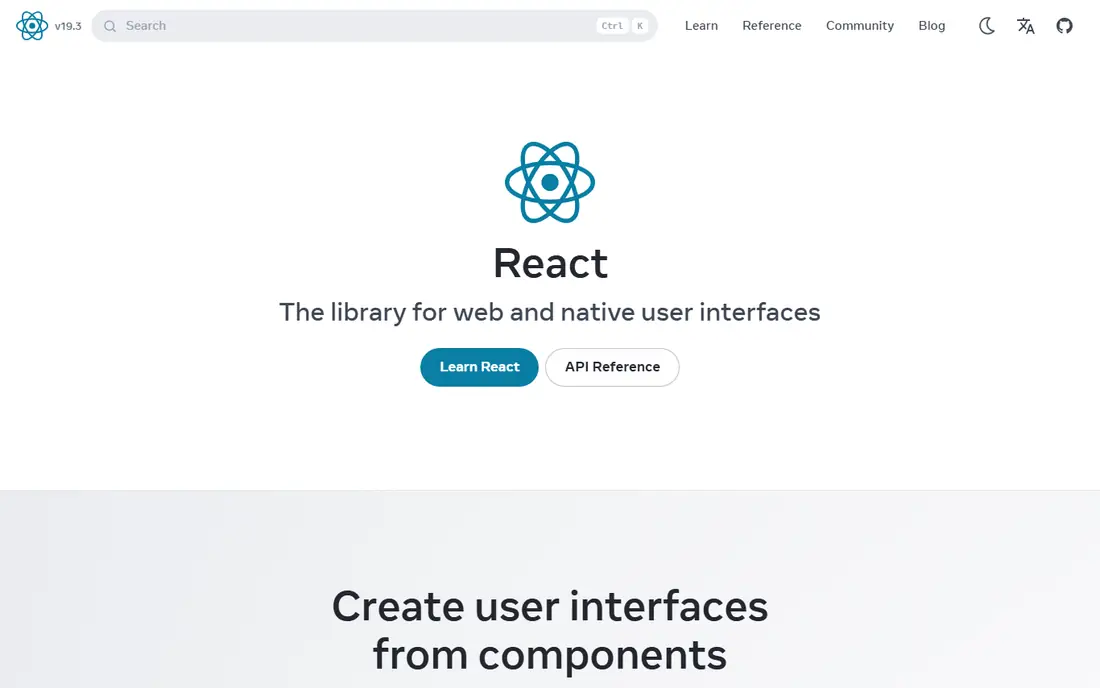
What we like- React is the gravity well of frontend development: the largest component ecosystem, the most tutorials, UI libraries, integrations and experienced hires, and meta frameworks such as Next.js that carry it into full stack applications. A Solid developer's component and JSX habits transfer directly, since Solid borrowed React's surface syntax, and the difference is the model underneath: React re renders components and diffs a virtual DOM rather than updating nodes surgically. For a product that must be maintained for a decade by people not yet hired, that labour market is the argument, and it usually wins.
Watch out for- Performance takes engineering: careless React apps re render far more than needed, and the fine grained precision Solid gives by default must be recreated with memoisation and discipline. The ecosystem's size is also churn: state managers, routers and data libraries rise and fall, and choices multiply. React's own direction, server components included, adds concepts every year, so the simple library story is historical. Bundle sizes start larger than Solid or Svelte and shrink only with effort.
Starting priceFree
Free planYes
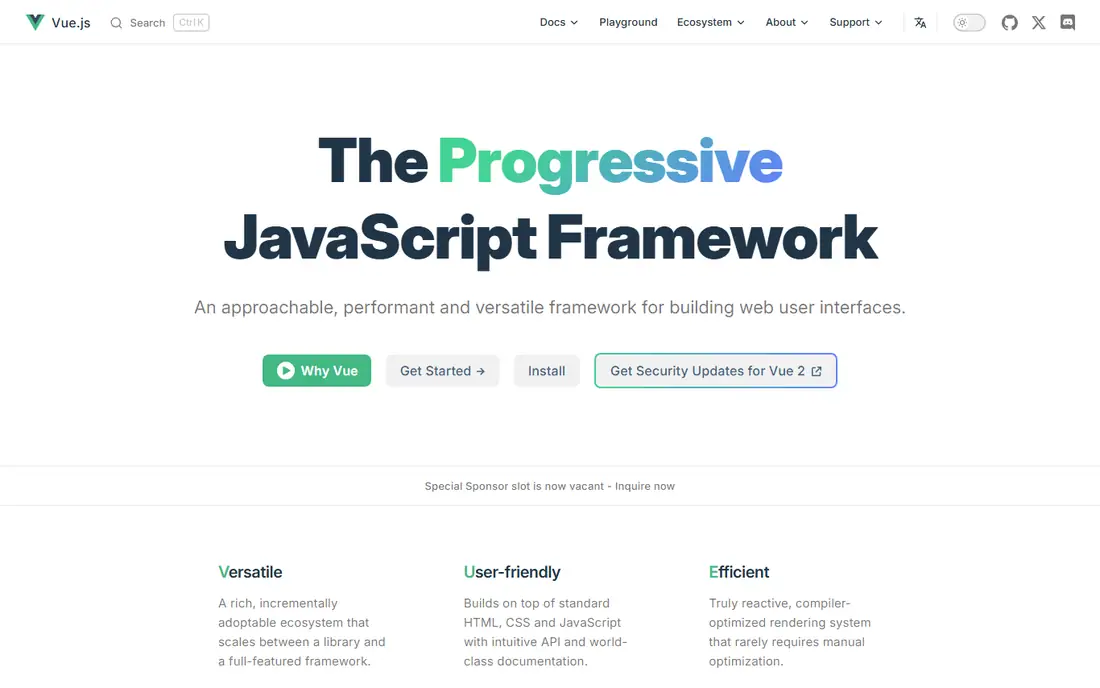
What we like- Vue is the friendliest step from Solid for developers who liked its readability: single file components with template, script and style together, a reactivity system built on reactive proxies that feels close to signals, and documentation widely praised as the clearest in the field. Nuxt provides the full stack meta framework. Vue scales from a widget on an existing page to a full application without changing tools, and its community occupies a healthy middle ground, smaller than React's, large enough that libraries and answers exist for almost anything.
Watch out for- The hiring pool is smaller than React's in the US market, though strong in Europe and Asia. Vue's two authoring styles, Options and Composition APIs, split tutorials and codebases, which confuses newcomers reading older material. TypeScript support is good now but was historically a step behind. Enterprise adoption at the largest scale trails React and Angular, so conservative organisations sometimes resist it for reasons of precedent rather than capability.
Starting priceFree
Free planYes
What we like- Svelte moves the work to compile time: components compile into lean JavaScript with no framework runtime of consequence, producing some of the smallest bundles and simplest code in this list. Its runes system in Svelte 5 brought signal style reactivity that Solid developers will recognise, with component code that reads close to plain JavaScript and HTML. SvelteKit is a mature full stack framework. For content sites, embedded widgets and performance sensitive interfaces built by small teams, Svelte offers the shortest distance between idea and fast page.
Watch out for- The ecosystem and job market are the smallest of the big four here, which matters to teams hiring and developers career planning. Large component libraries are fewer, so more gets built in house. The compile step means behaviour occasionally surprises developers used to runtime frameworks, and debugging crosses the boundary between written and generated code. Enterprise references exist but are thinner, and tooling for very large applications is proven at fewer scales than React's or Angular's.
#4
Qwik
Best for: Instant loading content sites at scale
Visit qwik.dev
Starting priceFree
Free planYes
What we like- Qwik attacks the problem Solid developers also care about, time to interactive, from the loading side: resumability serialises the application state in the HTML so the browser resumes rather than re executes the framework, and JavaScript loads in tiny pieces on interaction. The result is near instant interactivity even for large pages, aimed at ecommerce and content sites where load time is revenue. Its component model and JSX feel familiar, and Qwik City supplies routing and full stack features. For public facing pages at real scale, it is the most interesting performance story after Solid itself.
Watch out for- Resumability is a genuinely different mental model, and its rules about what can be serialised trip up experienced developers for weeks. The community and library ecosystem are the youngest in this list, so integrations may need building. Developer experience details, debugging, hot reloading edge cases, are rougher than the mature frameworks. Hiring Qwik experience is nearly impossible
- You hire JavaScript developers and train them, which suits some teams and rules it out for others.
Starting priceFree
Free planYes
What we like- Preact answers one specific Solid style concern inside the React world: size. It offers React's component model and, through a compatibility layer, most of its ecosystem, in a runtime of a few kilobytes, plus its own signals library that brings fine grained updates to Preact and React applications. Widgets, embeds and performance critical surfaces use it where a full React runtime is hard to justify. Migration from React is often a build setting rather than a rewrite, and the project is mature, stable and deliberately unhurried.
Watch out for- Compatibility is most, not all: libraries that reach into React internals can break, and you will find the edges at the worst time. Preact is a library, not an application framework, so routing, data and structure are your assembly, or a framework on top. The community is small and quiet beside React's, and hiring markets treat it as a React dialect. If size is not a binding constraint, plain React usually wins on ecosystem alone.
Starting priceFree
Free planYes
What we like- Angular is the complete, opinionated platform: routing, forms, HTTP, testing, internationalisation and a command line that generates consistent structure, all maintained by Google with long term support rhythms enterprises plan around. Recent Angular versions adopted signals for fine grained reactivity, a direct response to the model Solid helped popularise, alongside standalone components that simplified its once heavy module system. For large teams building internal applications over many years, Angular's value is that decisions are made once, centrally, and enforced by the framework.
Watch out for- It is the heaviest learning curve here by a distance: TypeScript, dependency injection, decorators and framework conventions all arrive together. Bundle sizes and ceremony are overkill for small sites. The developer experience suits organisations more than individuals, and community energy in the startup world sits with React and Svelte. Choosing Angular is an organisational commitment that outlives most projects' original teams.
#7
Lit
Best for: Design systems as standard web components
Visit lit.dev
Starting priceFree
Free planYes
What we like- Lit builds standard web components, custom elements that run in any framework or none, which makes it the answer when components must outlive framework choices: design systems shared across React, Vue and plain HTML properties, embedded widgets and multi brand platforms. It is small, fast, maintained by Google, and its reactive properties cover much of what components need without a virtual DOM. A Solid developer's appreciation for direct DOM efficiency fits Lit's design. It is also a genuine exit from framework churn: a Lit component from years ago still drops into today's stack.
Watch out for- Lit is a component library, not an application framework: routing, state architecture and data fetching are yours to assemble, which is the point and also the work. The application building ecosystem is intentionally thin. Teams wanting a full stack story should look at the frameworks above instead. Hiring Lit specialists is niche, though any web component knowledge transfers, and debugging across shadow DOM boundaries has its own learning curve.
How we chose
We compared frameworks and libraries a SolidJS developer would realistically adopt for production work in 2026, weighting the factors that drive the switch: ecosystem size and hiring, the reactivity and rendering model, full stack options and longevity. All seven are free and open source with active maintenance, so starting price is free across the board and the comparison turns on engineering trade offs instead. We excluded frameworks tied to a single vendor's platform and very new projects without production track records, and we treated meta frameworks as part of each ecosystem's case rather than separate entries.
How to choose the right SolidJS alternative
Be honest about which Solid property you are giving up and which problem you are solving. If the problem is hiring or ecosystem, choose React and accept memoisation discipline as the price, with Preact as the escape valve for size critical surfaces. If the problem is team onboarding, Vue gets new developers productive fastest with a model close to signals. If the problem is bundle weight on content sites, Svelte and Qwik attack it directly, Svelte by compiling away, Qwik by not loading.
Prototype the painful parts, not the hello world. Build your application's worst screen, the dense table, the live updating chart, the form with forty conditional fields, in the two finalists over a weekend each, and measure both the bundle and how the code felt at hour six. Framework choices are reversed rarely and regretted at leisure, and the difference between these seven is mostly how they behave on your worst screen, not their landing pages. Finally, check the job market you hire from and the integrations you cannot replace, since those two facts outlast every benchmark.
Frequently asked questions
Why do developers leave SolidJS if it is so fast?
Usually for ecosystem reasons rather than performance: a needed component library or integration exists for React only, a team cannot hire Solid experience, or a full stack framework's features matter more than runtime efficiency. Some also find the fine grained model, where code runs once and updates flow through signals, harder to reason about than React's re render model once applications grow. Speed is rarely the complaint; it is the thing they regret giving up.
Which alternative feels most like SolidJS?
In code feel, Vue with the Composition API and Svelte 5 with runes both use signal style reactivity that Solid developers recognise immediately. Qwik shares the performance obsession but through resumability, a different idea that takes longer to internalise. React shares the JSX surface while behaving least like Solid underneath, which makes it simultaneously the easiest syntax switch and the deepest model switch in this list.
Is React still the safest career choice?
Yes, by market size: more roles list React than every other option here combined in most markets, and its skills transfer partially to Preact and conceptually to everything else. Vue is a strong second in many regions. The specialist options carry a different trade: Svelte, Qwik and Lit expertise is scarcer, which cuts both ways, fewer applicants for the roles that exist and fewer roles overall. Framework depth in JavaScript fundamentals outlasts any single library.
Can these frameworks match Solid's performance?
For most real applications, close enough that users cannot tell: the bottlenecks in production apps are usually data fetching, images and third party scripts rather than framework update mechanics. Svelte and Qwik match or beat Solid on some loading measures, and Preact with signals narrows update costs inside React's model. Where Solid still leads is sustained, high frequency DOM updates in framework controlled code, a profile that matters to data dense dashboards and games more than to typical product interfaces.
Should a new project pick a framework or web components with Lit?
Pick a framework for a product application: routing, data and structure arrive solved. Pick Lit when the deliverable is components consumed by many applications or by other teams' frameworks, such as a corporate design system, or widgets embedded in properties you do not control. The two combine well: several design systems ship Lit components consumed happily by React and Vue applications, which is the standards based web working as intended.
Sources we checked (0)
Is your product missing or out of date?
We review this list regularly. Vendors can request a listing, send updated pricing or ask about featured placement.

Shihab Mia · Founder, Rankite
Shihab has 5+ years in B2B and SaaS SEO. He writes Rankite's software buying guides from pricing pages, documentation and public user reviews. More about Shihab.