How we make this list: we compare pricing pages, product documentation and public user reviews. Ratings come from G2, Capterra or Trustpilot, with the date we checked them.
Key takeaways
- Zig is the closest low-level alternative, with explicit allocators, comptime metaprogramming, and C interop without a borrow checker.
- Go is the best alternative for network services, with fast compilation, built-in concurrency, and a huge ecosystem.
- C++ remains the most capable alternative for existing codebases, with C++20 and C++23 safety features narrowing the gap.
- Nim pairs Python-like readability with native speed, compiling to C, C++, or JavaScript.
- Odin, D, V, and Crystal each trade some of Rust safety for simplicity, speed of development, or a friendlier syntax.
Quick comparison
| Tool | Best for | Starting price | Free plan |
|---|
 Zig | Low-level systems work | Free | Yes |
 Go | Network services | Free | Yes |
 C++ | Existing codebases | Free | Yes |
 Nim | Readable native code | Free | Yes |
 Odin | Games and data-oriented design | Free | Yes |
 D | C-like systems with convenience | Free | Yes |
 V | Simple maintainable software | Free | Yes |
 Crystal | Ruby-like native code | Free | Yes |
Is your product missing or out of date?
We review this list regularly. Vendors can request a listing, send updated pricing or ask about featured placement.
The best alternatives to Rust
Starting priceFree
Free planYes
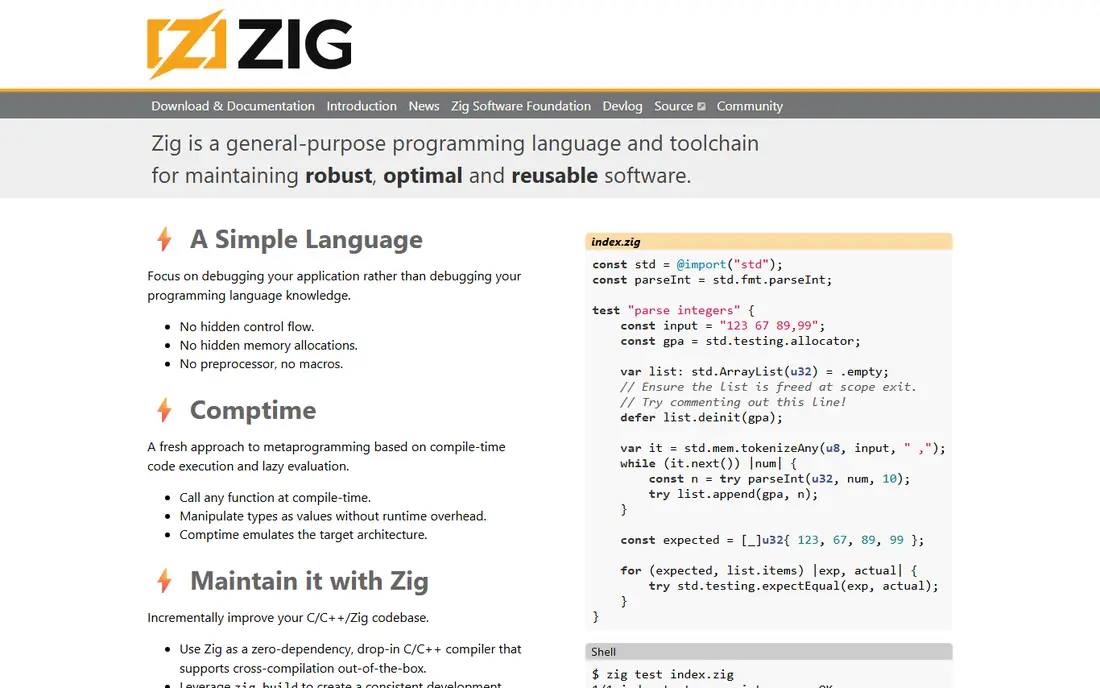
Zig is the alternative most Rust developers reach for first. Its homepage describes a general-purpose programming language and toolchain for maintaining reliable, optimal, and reusable software, with no hidden control flow, no hidden memory allocations, no preprocessor, and no macros. Allocators are explicit, so every allocation is visible in the code, and comptime lets any function run at compile time, manipulating types as values without runtime overhead.
Zig also works as a zero-dependency, drop-in C and C++ compiler with cross-compilation out of the box, which makes it practical for incrementally improving an existing C codebase. The Zig Software Foundation, a non-profit founded in 2020, sustains development through donations. The trade-off is safety: Zig gives control rather than guarantees, so the programmer owns memory correctness. Pick Zig when you want C-level control with modern tooling and no borrow checker fights.
What we like- No hidden control flow or allocations
- Comptime executes code at compile time
- Drop-in C and C++ compiler with cross-compilation
Watch out for- No borrow checker, so memory safety is manual
- Ecosystem is smaller than Rust or Go
Starting priceFree
Free planYes
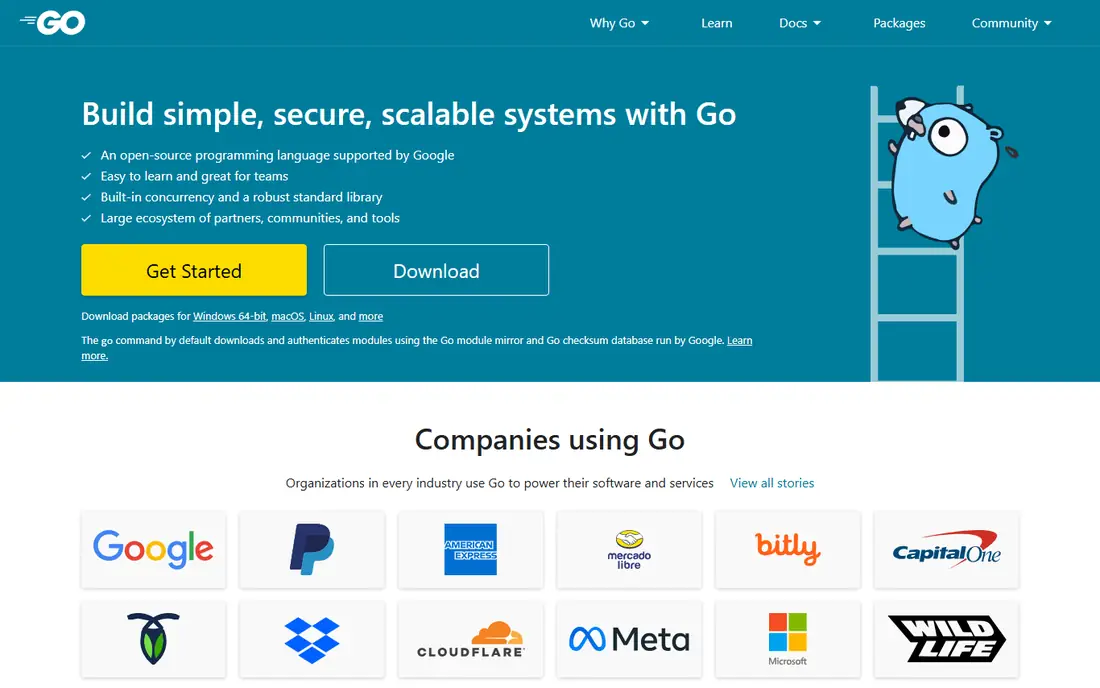
Go is the best alternative when the project is a network service rather than a systems component. Its homepage promises building simple, secure, scalable systems with Go, an open-source language supported by Google that is easy to learn, great for teams, and packed with built-in concurrency and a strong standard library. Teams report that new members write production Go within a month, and services compile into single static binaries that deploy easily into containers and Kubernetes.
Go shares Zig simplicity and explicit error handling, returning errors as values rather than throwing exceptions, but it includes a garbage collector and targets backend services rather than bare metal. That makes Go wrong for kernels and drivers, and right for APIs, CLIs, DevOps tools, and cloud services. Pick Go when team speed, fast builds, and service reliability matter more than manual memory control.
What we like- Very fast compilation
- Built-in concurrency with goroutines
- Single static binaries and strong cloud tooling
Watch out for- Garbage collector, so not a bare-metal systems language
- Error handling is verbose by design
Starting priceFree
Free planYes
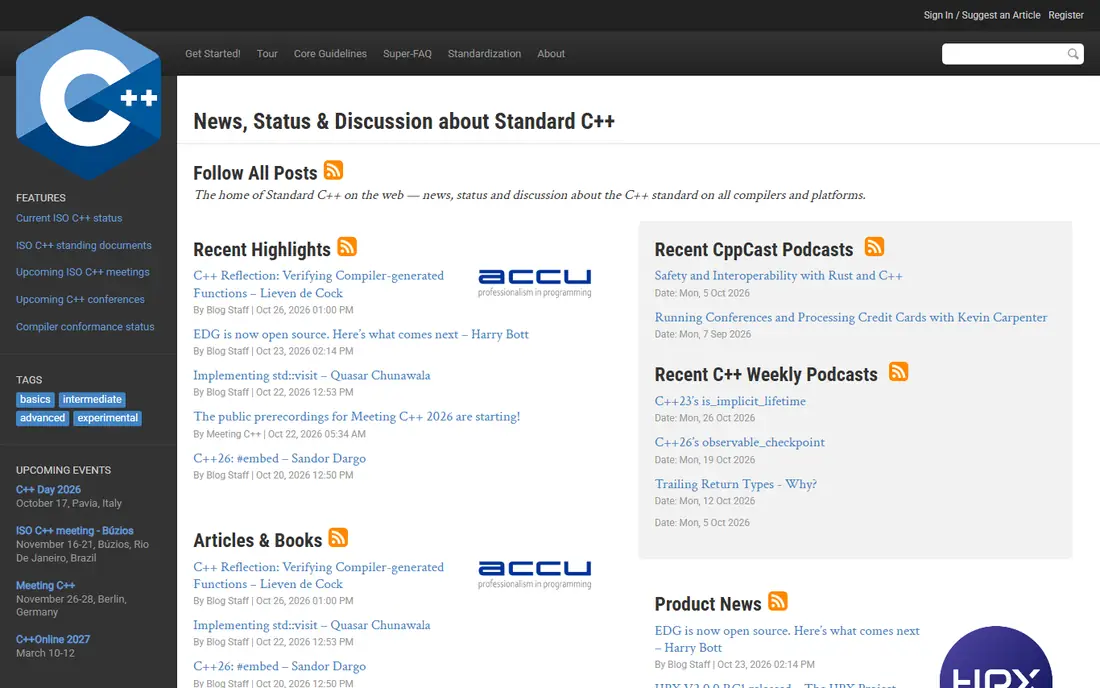
C++ is the incumbent alternative, and for existing codebases it is often the only realistic one. Its homepage is the home of Standard C++ on the web, tracking news, status, and discussion across compilers and platforms, with C++26 features such as reflection, contracts, and safety hardening arriving in current compilers. C++20 and C++23 added features that improve safety, including contracts and better lifetime analysis, narrowing the gap with Rust without changing the programming model.
The difference is philosophical: Rust enforces safety through the borrow checker, while C++ offers safety features the programmer chooses to exercise. That freedom is also the risk, since unsafe code compiles without complaint. Pick C++ when the codebase, libraries, or hardware targets already exist in C++, or when game engines and high-performance computing libraries make anything else impractical.
What we like- Largest systems ecosystem
- C++20 and C++23 add safety features
- Unmatched library and hardware support
Watch out for- Safety is opt-in, not enforced
- Large language with long compile times and complex tooling
Starting priceFree
Free planYes
Nim pairs readability with performance. Its homepage calls it an efficient, expressive, elegant language, statically typed and compiled, combining concepts from Python, Ada, and Modula. Nim generates small native dependency-free executables, supports Windows, Linux, BSD, and macOS, and manages memory deterministically with destructors and move semantics inspired by C++ and Rust. It compiles to C, C++, or JavaScript, so one language covers backend and frontend needs.
The macro system allows direct manipulation of the abstract syntax tree, and compile-time evaluation of user functions gives metaprogramming power without runtime cost. Nim is used in production by blockchain infrastructure such as the Nimbus Ethereum client, plus web services and SaaS companies, though adoption is specialized rather than mainstream. Pick Nim when you want Python-like code that runs at native speed.
What we like- Python-like syntax with native speed
- Compiles to C, C++, or JavaScript
- Deterministic memory management with destructors
Watch out for- Smaller ecosystem and hiring pool
- Adoption is concentrated in startups and blockchain infrastructure
Starting priceFree
Free planYes
Odin is the C alternative for game developers and data-oriented programmers. Its homepage calls it the data-oriented language for people who ship, with software and games shipping on Steam built with Odin. The language offers distinct typing for high performance, modern systems, and data-oriented programming, with built-in support for structure-of-arrays data types, array programming, SIMD operations, and custom allocators.
The core library includes official bindings for OpenGL, Vulkan, Direct3D 11 and 12, Metal, and WebGL, plus SDL2, GLFW, raylib, and miniaudio in the vendor library, so game development starts with batteries included. Odin principles stress simplicity, readability, and the joy of programming, with clear code preferred over clever code. Pick Odin when the project is a game or a performance-critical data pipeline and you want C-level control with a modern language.
What we like- Data-oriented design with SOA types and array programming
- Custom allocators and low-level control
- Batteries-included graphics bindings
Watch out for- Smaller community than Zig or Go
- Manual memory management with no borrow checker
Starting priceFree
Free planYes
D is the pragmatic systems language for developers who like C++ syntax but want modern convenience. Its homepage describes a general-purpose language with static typing, systems-level access, and C-like syntax, promising code that is fast to write, fast to read, and fast to run. Type inference reduces boilerplate, built-in arrays, slices, and ranges simplify daily programming, and the @safe, @trusted, and @system attributes let the programmer choose safety-efficiency trade-offs per function.
D supports garbage collection by default, scoped resource management through RAII, and manual memory management with custom allocators and inline assembly when needed. The -betterC subset drops the runtime for embedded and systems work. The ecosystem is smaller than C++ or Go, but the language scales from scripts to large projects with unit testing and fast compilation. Pick D when you want C++ familiarity with less friction.
What we like- C-like syntax with static typing
- Fast compilation
- Garbage collection plus manual control and @safe attributes
Watch out for- Smaller ecosystem than C++ or Go
- Garbage collector by default, with -betterC as a separate mode
Starting priceFree
Free planYes
V is the simplest language on this list. Its homepage describes V 0.5 as simple, fast, safe, and compiled, for developing maintainable software, with the claim that you can learn the entire language over a weekend and that in most cases there is only one way to do something. Safety features include bounds checking, no undefined values, no variable shadowing, immutable variables by default, and mandatory error checks through option and result types.
V compiles to human-readable C, giving C-level performance and platform support, with a single binary output and no dependencies. The built-in web framework Veb, ORM, formatter, profiler, and package manager reduce external dependencies. Memory management defaults to a minimal tracing garbage collector, with autofree and manual modes available, though autofree is still experimental. Pick V when simplicity and maintainability matter most and the project can grow with a maturing language.
What we like- Entire language learnable in a weekend
- Compiles to native binaries as fast as C
- Built-in web framework, ORM, and formatter
Watch out for- Version 0.5, so still maturing
- Autofree memory management is experimental and not production ready
Starting priceFree
Free planYes
Crystal is the pick for developers who love Ruby syntax but need native speed. Its homepage describes a general-purpose, object-oriented language with syntax inspired by Ruby, compiled with static type checking and an advanced type inference algorithm. Code feels dynamic: types are inferred, the compiler catches errors early, and null pointer exceptions are avoided at runtime through flow typing that tracks variable types at each point.
Concurrency uses fibers, green threads that communicate through channels without shared memory or locks, following the communicating sequential processes model. C bindings call native libraries without runtime overhead, and the Shards dependency manager fetches libraries from their repositories. The ecosystem is smaller than Ruby or Go, but Crystal suits web services, CLIs, and tools where Ruby readability and native performance both matter. Pick Crystal when Ruby syntax is the draw and compilation to native code is the requirement.
What we like- Ruby-inspired syntax with static type checking
- Advanced type inference
- Fibers and channels for concurrency
Watch out for- Smaller ecosystem than Ruby or Go
- Windows support has lagged Unix platforms
How we chose
We compared languages that cover Rust ground: systems programming, native performance, and memory safety, plus the higher-level options Rust developers consider when safety guarantees matter less than speed of development. Each language homepage was opened to confirm the project exists and the domain belongs to that language. All eight languages are free and open source. Python and JavaScript were excluded because they run on virtual machines and do not match Rust native performance, while Hare was excluded because it is newer and less established than the languages listed. The list mixes manual-memory languages with garbage-collected ones so both systems and service use cases find a fit.
What to check before you pick
Start with the domain, because it decides the shortlist. Systems, embedded, and game work belongs with Zig, C++, Odin, or D. Network services and CLIs belong with Go, Crystal, or V. Readable native code with metaprogramming belongs with Nim. Trying to force one language to cover every domain is how projects stall.
Next, weigh safety against control honestly. Only Rust enforces memory safety through the borrow checker; every alternative here trades some of that guarantee for simplicity, speed, or familiarity. If the project is safety-critical infrastructure, that trade needs explicit justification, and C++ safety features or D @safe attributes should be part of the plan. Finally, test the ecosystem: check that the libraries, hiring pool, and tooling for your specific project exist before committing, since a language with a small ecosystem can cost more in missing libraries than it saves in syntax.
Frequently asked questions
What is the closest alternative to Rust?
Zig is the closest low-level alternative, with explicit allocators, comptime metaprogramming, and C interop, but without the borrow checker. C++ is the closest alternative for existing codebases, with C++20 and C++23 safety features. Neither enforces memory safety the way Rust does, so the programmer owns correctness in both.
Is Go a good alternative to Rust?
Go is a good alternative for network services, APIs, and CLIs, where fast compilation, built-in concurrency, and team productivity matter most. Go is not a good alternative for bare-metal systems work, since it uses a garbage collector and lacks manual memory control. Choose Go for services, Zig or C++ for systems.
Which Rust alternative is easiest to learn?
V claims the entire language can be learned over a weekend, and Go is widely reported as easy for teams to adopt within a month. Nim and Crystal are also easy for Python and Ruby developers respectively. Zig and C++ have steeper learning curves, though Zig is simpler than C++ once manual memory management is understood.
Which Rust alternative is fastest?
Zig, C++, Odin, and D all compile to native code with manual memory control, so performance depends on the specific program rather than the language. V claims C-level performance through its C backend. Go is fast for services but garbage collection pauses can affect latency-sensitive systems work. Benchmark your own workload rather than trusting general claims.
Can I use these languages for game development?
Yes. Odin is built for games, with graphics bindings and data-oriented design, and games ship on Steam with it. C++ remains the dominant game language through engines such as Unreal. Zig suits engine and tooling work, while V and Crystal suit smaller games and tools. Rust itself is also used for games, so the choice depends on engine and team experience.
Sources we checked (8)
- https://ziglang.org
- https://go.dev
- https://isocpp.org
- https://nim-lang.org
- https://odin-lang.org
- https://dlang.org
- https://vlang.io
- https://crystal-lang.org
Is your product missing or out of date?
We review this list regularly. Vendors can request a listing, send updated pricing or ask about featured placement.

Shihab Mia · Founder, Rankite
Shihab has 5+ years in B2B and SaaS SEO. He writes Rankite's software buying guides from pricing pages, documentation and public user reviews. More about Shihab.