How we make this list: we compare pricing pages, product documentation and public user reviews. Ratings come from G2, Capterra or Trustpilot, with the date we checked them.
Key takeaways
- Zoho Inventory is hard to beat on price, with a free plan and per-organization pricing, so alternatives win on depth, not on sticker cost.
- QuickBooks Commerce suits teams that already run QuickBooks accounting, since inventory and books share one system.
- Cin7 and Fishbowl suit larger sellers and manufacturers that need warehouse workflows, production, and EDI.
- Odoo Inventory suits businesses that want a full ERP suite and are willing to configure it, with a free single-app option.
- Watch order, user, and location caps closely, since most inventory tools price on all three at once.
Quick comparison
| Tool | Best for | Starting price | Free plan |
|---|
 QuickBooks Commerce | QuickBooks accounting users | $50 per month | No |
 Cin7 | Scaling multichannel sellers | $349 per month | No |
 Veeqo | Shipping-focused sellers | $156 per month | No |
 Ordoro | Shipping and dropshipping | See website | No |
 Odoo Inventory | Full ERP on a budget | Free | Yes |
 inFlow Inventory | B2B wholesalers | $129 per month | No |
 Katana | Manufacturers | Free | Yes |
 Fishbowl | QuickBooks manufacturers | $229 per month | No |
Is your product missing or out of date?
We review this list regularly. Vendors can request a listing, send updated pricing or ask about featured placement.
The best Zoho Inventory alternatives
Starting price$50 per month
Free planNo
QuickBooks Commerce, formerly TradeGecko, is the natural alternative for businesses that already run QuickBooks Online. Inventory syncs across sales channels in real time, orders flow into fulfillment, and the accounting side needs no third-party sync tool, since stock, sales, and books live in one Intuit system. A private B2B portal lets wholesale customers order at their own prices, which covers the wholesale use case that Zoho handles through price lists and a customer portal. Plans start at $50 per month for Essentials, with Plus at $80 and Advanced at $150 per month.
The main limit is that the integration advantage only applies to QuickBooks users. Teams on Xero or another accounting system gain little from QuickBooks Commerce over a standalone tool, and there is no free plan to test it on a small scale. For QuickBooks shops, though, the combined system removes a whole category of sync errors and reconciliation work, and that alone justifies the higher price over Zoho for many growing sellers.
What we like- Direct QuickBooks Online integration
- Centralized multi-channel inventory
- B2B wholesale portal
Watch out for- No free plan
- Accounting tie-in only helps QuickBooks users
- Advanced plan from $150 per month
Starting price$349 per month
Free planNo
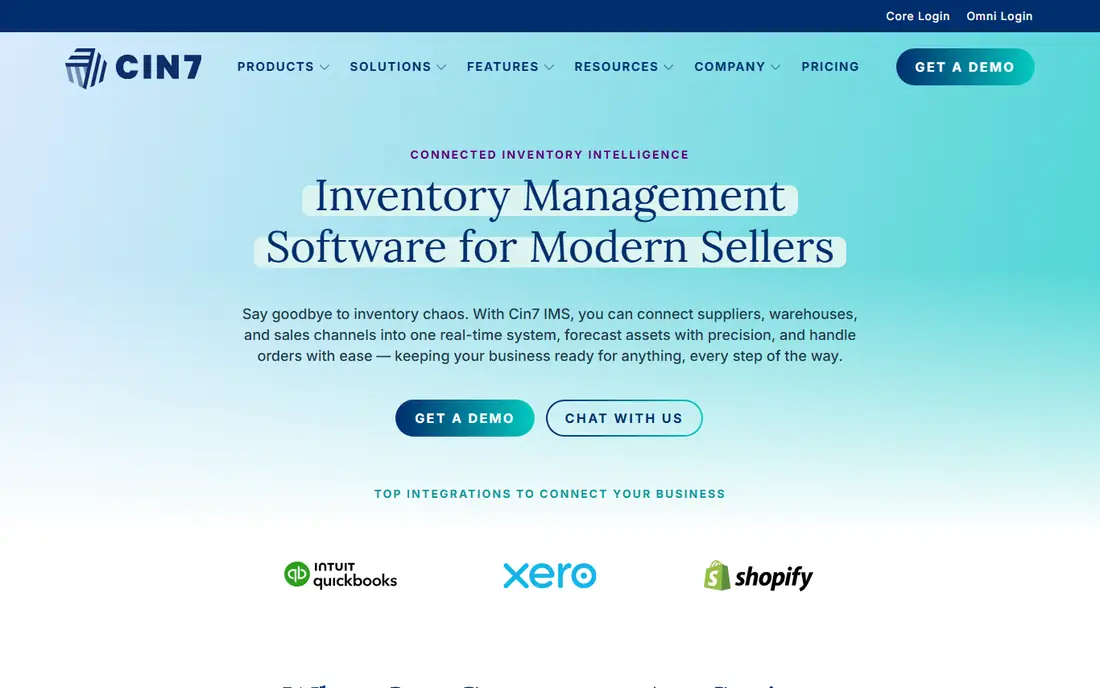
Cin7 Core is built for multichannel brands that have outgrown basic inventory tools. It connects Amazon, eBay, Shopify, WooCommerce, and other channels with real-time stock sync, adds warehouse management with picking and packing workflows, and offers a B2B portal add-on for wholesale customers. With more than 700 integrations, it covers point of sale, shipping, accounting, and marketplace connections that smaller tools handle only through add-ons. Core pricing starts at $349 per month, with Omni plans custom priced for larger operations.
The price and setup effort are the barriers. Cin7 costs more than ten times Zoho Standard at entry level, and implementation for a multi-warehouse business takes weeks rather than days. Some older guides still list Cin7 from $299 per month, so treat the $349 figure from the current vendor page as the one to verify at purchase. For brands selling across many channels with wholesale and retail mixed together, Cin7 depth pays for itself in fewer stockouts and less manual reconciliation. For a small seller on one or two channels, it is more tool than needed.
What we like- 700 plus integrations
- Warehouse management
- B2B portal add-on
- Strong for omnichannel brands
Watch out for- High entry price
- Implementation takes time
- Overkill for small single-channel sellers
#3Veeqo
Best for: Shipping-focused sellers4.5/5 on
G2 (47 reviews, checked Oct 2026)
Visit veeqo.com
Starting price$156 per month
Free planNo
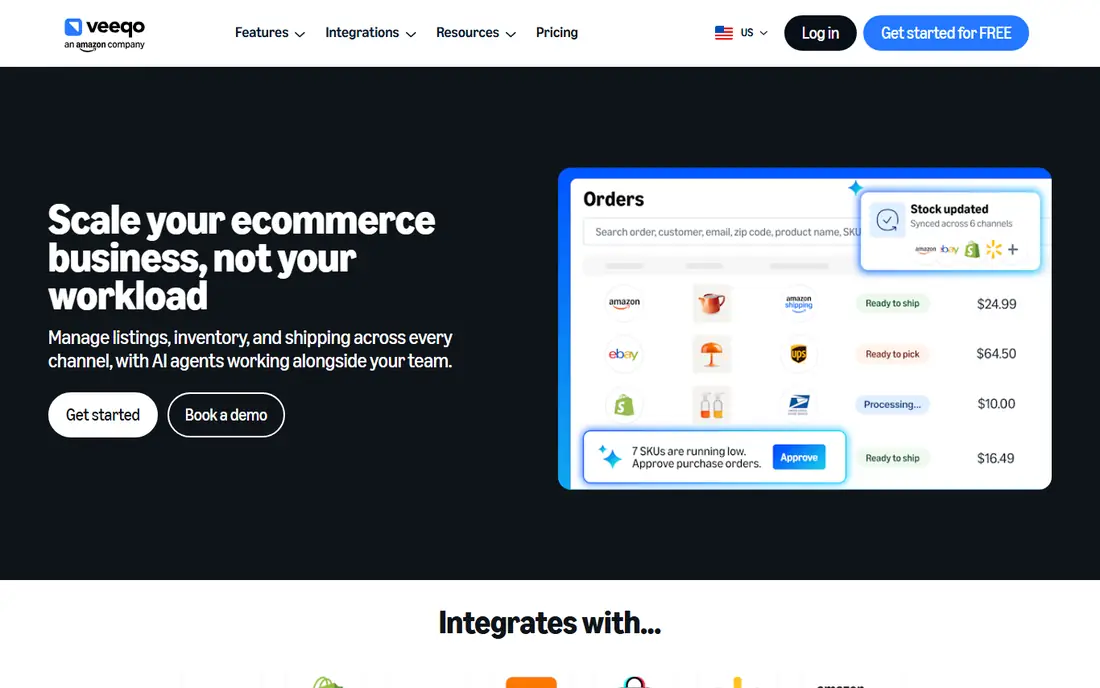
Veeqo combines inventory sync, order management, and shipping in one platform, which suits sellers whose main pain is fulfillment rather than stock counting. Orders from multiple channels land in one queue, stock updates everywhere when an order ships, and built-in shipping tools offer discounted rates and label printing without a separate shipping app. Pricing starts at $156 per month, which sits between Zoho and Cin7, and reflects the shipping features bundled in.
The trade-off is depth outside shipping. Veeqo does not match Cin7 on warehouse workflows or Fishbowl on manufacturing, so sellers who make their own products should look elsewhere. For pure resellers and ecommerce brands that ship many parcels a day, though, the combined inventory and shipping workflow saves more time than a cheaper inventory-only tool, and the shipping discounts can offset part of the subscription cost.
What we like- Inventory sync plus shipping in one place
- Discounted shipping rates
- Order management across channels
Watch out for- Higher price than Zoho
- Shipping focus means less manufacturing depth
- No free plan
#4Ordoro
Best for: Shipping and dropshipping4.8/5 on
G2 (14 reviews, checked Oct 2026)
Visit ordoro.com
Starting priceSee website
Free planNo
Ordoro targets small and mid-sized ecommerce sellers that need inventory management and shipping in one place, with dropshipping support for sellers who never hold stock themselves. Shipping discounts, batch label printing, and supplier management cover the daily workflow of a shipping-heavy store, while inventory tracking keeps channel stock in sync. Guides conflict on Ordoro pricing, with some listing entry plans from $59 per month and others listing inventory plans near $349 per month, so check the current vendor pricing page before budgeting, which is why this article lists the price as See website.
That pricing uncertainty is the main drawback, along with the lack of a free plan and a smaller integration ecosystem than Cin7. For sellers whose workflow centers on shipping and dropshipping, Ordoro covers the job well, and the shipping discounts matter more than the subscription line. For sellers who need manufacturing or deep warehouse features, Cin7 or Fishbowl fits better.
What we like- Shipping discounts
- Dropshipping support
- Inventory and shipping together
Watch out for- Pricing guides conflict
- No free plan
- Smaller ecosystem than Cin7
#5Odoo Inventory
Best for: Full ERP on a budget4.4/5 on
G2 (65 reviews, checked Oct 2026)
Visit odoo.com
Starting priceFree
Free planYes
Odoo Inventory is part of the Odoo ERP suite, and its pricing model is unusual: the first app is free for unlimited users, while paid plans start at $24.90 per user per month billed annually in the first year. Inventory features include double-entry stock tracking, which records every movement in and out, barcode scanning, and multi-warehouse support, and the same system can add accounting, CRM, manufacturing, and ecommerce as the business grows. That modular path suits businesses that want an ERP eventually but cannot justify one today.
The cost is configuration time. Odoo is powerful because it is flexible, but that flexibility means setup takes longer than a focused inventory tool, and implementation for a multi-module business can cost more than the first year of licenses. For a single-app inventory user, the free tier is genuinely useful and hard to match. For teams that want a tool that works well out of the box with minimal setup, Zoho or QuickBooks Commerce will feel faster, even though Odoo scales further in the long run.
What we like- Free single-app option
- Double-entry inventory tracking
- Barcode support
- Full ERP suite available
Watch out for- Configuration takes effort
- Per-user pricing on paid plans
- Implementation can exceed license cost
Starting price$129 per month
Free planNo
inFlow Inventory is built for small and mid-sized B2B wholesalers, with private customer portals that show each buyer only their own products and prices. That per-customer pricing control is the feature wholesalers actually need, and inFlow pairs it with purchase orders, stock tracking, and integrations with Shopify, Amazon, and QuickBooks. Pricing starts at $129 per month, or $99 per month billed annually on some plans, with a 14-day free trial to test the system on real orders.
The limits are the lack of a free plan and less multichannel depth than Cin7, so pure retail brands with many channels may prefer a different tool. For wholesalers, though, inFlow structure fits the business: customer-specific pricing, B2B portals, and order workflows designed for trade buyers rather than retail shoppers. If your customers are other businesses, inFlow is a better fit than a retail-first tool, even at a higher price than Zoho.
What we like- Private B2B portals with per-customer prices
- Strong for wholesalers
- 14-day free trial
Watch out for- No free plan
- Monthly price higher than Zoho
- Less multichannel depth than Cin7
Starting priceFree
Free planYes
Katana is a cloud inventory tool built for product businesses that manufacture or assemble their own goods. It covers raw materials, bills of materials, production planning, and finished stock in one flow, so a maker can see what can be built from current materials without a spreadsheet. The free plan covers up to 30 SKUs, which lets a small maker test the system on a real product line, and paid plans are custom priced for larger catalogs. Integrations with Shopify, WooCommerce, Amazon, QuickBooks, and Xero keep sales and accounting connected.
Katana is not a multichannel-first tool, so brands that only resell goods will find its manufacturing features unused and its channel depth thinner than Cin7 or Veeqo. For makers, though, the production view is the point: Zoho and most inventory tools track finished stock well but handle raw materials and production poorly, and Katana closes that gap. If you build what you sell, Katana is the strongest alternative on this list, and the free tier makes it easy to test.
What we like- Free plan for up to 30 SKUs
- Manufacturing and production planning
- Shopify and QuickBooks integrations
Watch out for- Paid plans custom priced
- Not a core multichannel tool
- Manufacturing focus adds complexity for resellers
#8Fishbowl
Best for: QuickBooks manufacturers4.0/5 on
G2 (274 reviews, checked Oct 2026)
Visit fishbowl.net
Starting price$229 per month
Free planNo
Fishbowl is an inventory and manufacturing platform designed to sit alongside QuickBooks, and it is the pick for manufacturers and distributors that need advanced production management plus EDI connections to big-box retailers. It handles bills of materials, work orders, and multi-location stock, and its QuickBooks integration keeps accounting in sync without manual entry. Pricing starts at $229 per month billed annually for the Essentials plan, with higher tiers for EDI and advanced pricing rules.
The drawbacks are price and setup effort: Fishbowl costs far more than Zoho, and a manufacturing implementation takes real planning. There is no free plan, only a demo, so evaluation takes more effort than a self-serve trial. For manufacturers already running QuickBooks who need production depth and EDI, Fishbowl is the established choice, and its QuickBooks tie-in removes the accounting friction that standalone tools create. For pure resellers, it is more tool than needed.
What we like- Manufacturing and production management
- EDI for big-box retail
- Deep QuickBooks integration
Watch out for- No free plan
- Higher price
- Setup effort for manufacturers
How we chose
We compared tools that replace Zoho Inventory for small and mid-sized sellers, weighting multi-channel sync, warehouse and manufacturing depth, shipping features, and accounting integration alongside price. We favored tools with a free plan or trial, since inventory software is hard to judge without real orders, and we flagged price conflicts where guides disagree rather than picking one figure silently. Prices come from vendor pricing pages and current guides, and where guides conflict we list the vendor figure or mark the price as See website. We did not test any tool hands-on, and we did not list Zoho Inventory itself, since it is the product being replaced.
Buying guide
Start from how you sell. If you sell on many channels and ship high volumes, shortlist Cin7 and Veeqo first, and compare warehouse depth against shipping features. If you make your own products, shortlist Katana and Fishbowl, and check whether your accounting system is QuickBooks, since Fishbowl fits QuickBooks shops best. If you already run QuickBooks Online, QuickBooks Commerce removes sync work that other tools add. If you want a full ERP path on a budget, Odoo free single-app plan is worth testing, but budget for setup time.
Before you commit, test with real data and check four limits: monthly order caps, user counts, warehouse counts, and SKU counts, since most tools cap at least one of these and growing past a cap forces an upgrade. Run a full order cycle, from purchase order to shipment to invoice, on the trial, and confirm that stock updates reach every channel you sell on. Migration from Zoho is straightforward for products and stock levels, but order history and custom fields often need manual mapping, so export your data early and check it before canceling the old plan.
Frequently asked questions
Is there a free Zoho Inventory alternative?
Yes. Odoo offers a free single-app plan for unlimited users, and Katana offers a free plan for up to 30 SKUs. Both cover real inventory work, though Odoo needs configuration time and Katana suits makers best, so free does not mean identical to Zoho free plan.
Which alternative is best for QuickBooks users?
QuickBooks Commerce is the closest fit, since inventory and accounting share one Intuit system with no sync tool in between. Fishbowl is the better pick for QuickBooks users who also manufacture, since it adds production depth that QuickBooks Commerce does not offer.
Do these tools handle multiple warehouses?
Most do, but warehouse counts are often capped by plan, so check the limit before you buy. Cin7 and Fishbowl handle multi-warehouse workflows well, while cheaper tools may limit you to one or two locations on entry plans.
Can I migrate from Zoho Inventory without losing data?
Products, stock levels, and customer records usually export cleanly, but order history, custom fields, and automation rules often need manual mapping. Export your data before canceling, and run a trial import on the new tool to catch mapping problems early.
What does inventory software cost per month?
Entry prices run from free to about $350 per month. Representative figures are Zoho from $29 per month, QuickBooks Commerce from $50, inFlow from $129, Veeqo from $156, Fishbowl from $229, and Cin7 Core from $349, with Odoo free for one app and Katana free for small catalogs.
Should a manufacturer pick Katana or Fishbowl?
Pick Katana if you are a small maker who wants production planning with a free starting tier and simple setup. Pick Fishbowl if you run QuickBooks, need EDI for big-box retail, or need deeper manufacturing and distribution features at scale.
Sources we checked (0)
Is your product missing or out of date?
We review this list regularly. Vendors can request a listing, send updated pricing or ask about featured placement.

Shihab Mia · Founder, Rankite
Shihab has 5+ years in B2B and SaaS SEO. He writes Rankite's software buying guides from pricing pages, documentation and public user reviews. More about Shihab.