How we make this list: we compare pricing pages, product documentation and public user reviews. Ratings come from G2, Capterra or Trustpilot, with the date we checked them.
Pick Zoho Books if you want a free plan to start on and cheap paid tiers that scale to a full suite, especially if you already use other Zoho apps. Pick QuickBooks Online if you run a US business and need full double-entry accounting, inventory, payroll and US sales tax handling, and you work with a US accountant. Zoho Books is the better value for a small business that wants to pay little or nothing. QuickBooks is the fuller system for a US business that needs payroll and tax depth.
Key takeaways
- Zoho Books Free costs nothing for businesses under 50,000 dollars in annual revenue, and paid tiers run from 20 to 275 dollars per month.
- QuickBooks Online costs 38 dollars per month for Simple Start, 85 for Essentials, 140 for Plus and 340 for Advanced, after an August 2026 price rise.
- QuickBooks handles inventory, payroll and US tax reporting. Zoho Books handles accounting, inventory and projects from Professional upward.
How do Zoho Books and QuickBooks compare on price
Zoho Books has the cheapest paid tiers in this comparison. The free plan costs nothing for businesses under 50,000 dollars in annual revenue and allows 1,000 invoices per year. Standard costs 20 dollars per month, or 15 dollars when billed annually. Professional costs 50 dollars per month, or 40 dollars annually. Premium costs 70 dollars per month, or 60 dollars annually. Elite costs 150 dollars per month, or 120 dollars annually. Ultimate costs 275 dollars per month, or 240 dollars annually. A 14-day free trial of Premium is available. These figures are confirmed by the vendor pricing page and by NerdWallet, and they were re-checked on 20 November 2026.
QuickBooks Online raised prices on 1 August 2026. The current US list prices are Solopreneur at 20 dollars per month, Simple Start at 38 dollars, Essentials at 85 dollars, Plus at 140 dollars and Advanced at 340 dollars. Intuit lists 70 percent off for three months until 29 November 2026, so Simple Start shows at 11.40 dollars, Essentials at 25.50 dollars, Plus at 42 dollars and Advanced at 102 dollars during that introductory period. Budget on the list price, because the discount ends after three months. Older reads of 75 dollars for Essentials, 115 dollars for Plus and 275 dollars for Advanced are from before the August rise and should not be used.
For full accounting, QuickBooks Simple Start at 38 dollars costs 18 dollars more than Zoho Standard. At the top, Zoho Ultimate at 275 dollars costs 65 dollars less than QuickBooks Advanced at 340 dollars.
Zoho Books Free is a genuine free ledger. It costs nothing for businesses under 50,000 dollars in annual revenue and allows 1,000 invoices per year, with one user plus an accountant. It covers invoicing, expenses, bank reconciliation and basic reporting, which is enough for a one-person business to run on. The limits are real: one user, 1,000 invoices a year and no bank feeds, so a business that grows past 50,000 dollars in revenue or needs automatic bank import has to move to Standard at 20 dollars per month.
QuickBooks has no free plan. Solopreneur at 20 dollars per month is the cheapest way in, and it covers income and expense tracking rather than full accounting. Simple Start at 38 dollars is the entry point for full double-entry accounting, with invoicing, expenses, sales tax and 1099 tracking. A 30-day trial is available on the paid plans. The difference is clear: Zoho lets you run a business for free until you pass 50,000 dollars in revenue, while QuickBooks asks for 20 or 38 dollars a month from the start.
Both tools let you send invoices, but the limits differ. Zoho Books Free allows 1,000 invoices per year, which is about 83 a month, and Standard raises that to 5,000 a year. Professional allows 10,000 a year, Premium 25,000 and Elite and Ultimate 100,000. QuickBooks lets you send unlimited invoices on every plan, with payment links, recurring invoices, late payment reminders and progress invoicing on Plus and Advanced. For a business that sends more than 83 invoices a month, Zoho Free is not enough, and Standard at 20 dollars is the right tier.
QuickBooks has the deeper invoicing workflow for a US business, with custom templates, sales tax handling and 1099 tracking for US contractors. Zoho Books has a clean invoicing workflow with estimates, recurring invoices and payment reminders, and it fits well with Zoho CRM and Zoho Inventory if you use the rest of the suite. For a US business that sends many invoices with tax and recurring billing, QuickBooks is the stronger tool.
When should you move from Zoho Books to QuickBooks
Move to QuickBooks when your business needs something Zoho cannot do well. The clearest triggers are US payroll for more than a couple of people, US sales tax handling across many states, or an accountant who works in QuickBooks daily and charges extra to work anywhere else. QuickBooks Payroll is built in, while Zoho Books has no native US payroll and needs a separate provider. QuickBooks Plus at 140 dollars per month adds inventory, project profitability and budgeting, and Advanced at 340 dollars adds batch workflows, custom permissions and revenue recognition.
A business that uses Zoho CRM, Zoho Inventory or Zoho People gets more value from Zoho Books than from QuickBooks, because the data flows between the apps without extra integrations.
Check your revenue, because Zoho Free ends at 50,000 dollars in annual revenue and you need Standard at 20 dollars after that. Check how many invoices you send each month, because Zoho Free caps at 1,000 a year and QuickBooks has no cap. Check whether you need US payroll, because only QuickBooks has it built in. Check whether you already use Zoho apps, because the suite integration is Zoho Books' biggest advantage. Check the renewal price after any introductory discount, because QuickBooks lists 70 percent off for three months and the discount ends.
Quick comparison
| Tool | Best for | Starting price | Free plan |
|---|
 Zoho Books | Small businesses that want a free plan with room to grow into a full suite | 0 dollars for Free; Standard 20 dollars per month, 15 dollars when billed annually | Free for businesses with under 50,000 dollars in annual revenue, up to 1,000 invoices per year |
 QuickBooks Online | US small businesses that want full accounting, inventory and payroll in one place | 38 dollars per month for Simple Start; Essentials 85 dollars, Plus 140 dollars, Advanced 340 dollars; Solopreneur 20 dollars | No free plan; 30-day trial on paid plans; 70 percent off for three months until 29 November 2026 |
 Xero | Growing teams that want unlimited users and clean multi-currency accounting | 27 dollars per month for Early; Growing 59 dollars, Established 97 dollars | No free plan; introductory discount for new US customers for the first three to six months |
 FreshBooks | Freelancers and service businesses that live on invoicing and time tracking | 23 dollars per month for Lite; Plus 43 dollars, Premium 70 dollars | No free plan; 30-day trial |
 Wave | Sole proprietors and freelancers who want a genuinely free ledger | 0 dollars for Starter; Pro is 19 dollars per month or 190 dollars per year | Starter is free with unlimited invoices, estimates, bills and bookkeeping records |
 Sage Accounting | Small businesses that want flat pricing and unlimited users on the top tier | 20 dollars per month for Accounting Start, for one user | No free plan; 30-day trial |
 Kashoo | First-time owners who want the simplest possible bookkeeping | 30 dollars per month, flat, with unlimited users | No free plan; 14-day trial |
 ZipBooks | Service businesses that want a free tier focused on invoicing | 0 dollars for Starter; Smarter 15 dollars per month, Sophisticated 35 dollars per month | Starter is free with unlimited invoices and estimates, one bank account and basic reports |
Is your product missing or out of date?
We review this list regularly. Vendors can request a listing, send updated pricing or ask about featured placement.
#1Zoho Books
Best for: Small businesses that want a free plan with room to grow into a full suite4.4/5 on
G2 (329 reviews, checked Oct 2026)
Visit zoho.com
Starting price0 dollars for Free; Standard 20 dollars per month, 15 dollars when billed annually
Free planFree for businesses with under 50,000 dollars in annual revenue, up to 1,000 invoices per year
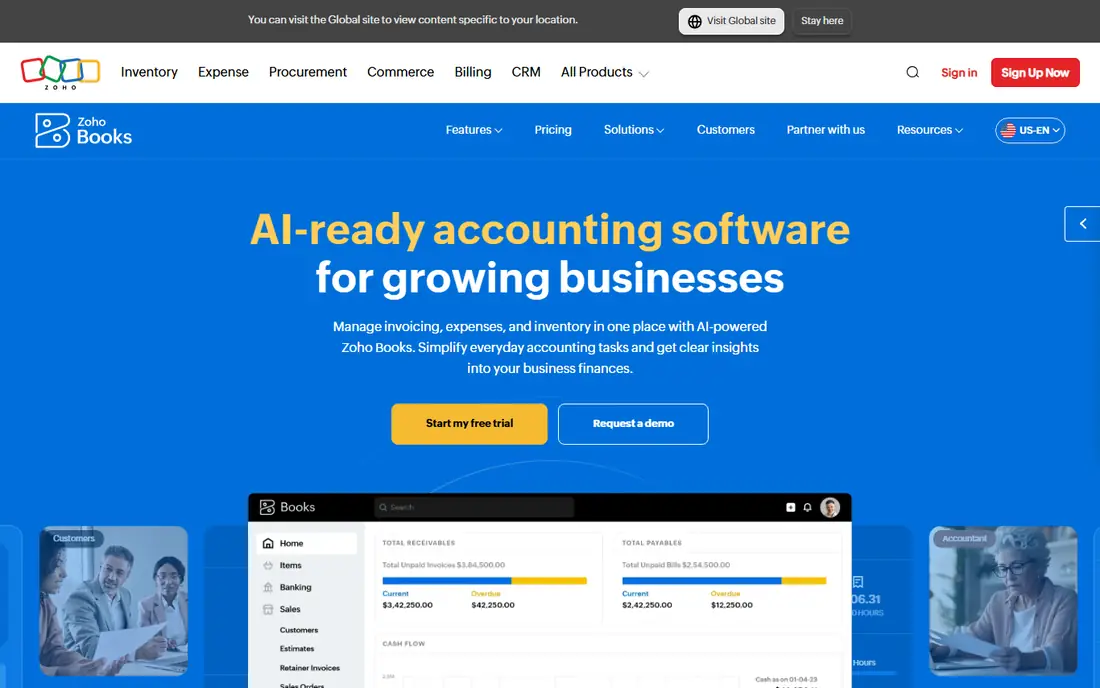
Zoho Books is the best value paid option in this comparison. The free plan costs nothing for businesses under 50,000 dollars in annual revenue and allows 1,000 invoices per year. Standard costs 20 dollars per month, or 15 dollars when billed annually, and adds three users, 5,000 invoices per year, automatic bank feeds and sales tax tracking. Professional costs 50 dollars per month, or 40 dollars annually, and adds five users, 10,000 invoices, multi-currency, inventory and project tracking. Premium costs 70 dollars per month, or 60 dollars annually, Elite 150 dollars, or 120 dollars annually, and Ultimate 275 dollars, or 240 dollars annually.
What we like- Useful free plan
- Cheap paid tiers
- Strong fit with the rest of the Zoho suite
- 14-day free trial of Premium
Watch out for- Free plan is limited to one user plus an accountant
- Invoicing caps rise only with paid tiers
- Support is better on paid plans
#2QuickBooks Online
Best for: US small businesses that want full accounting, inventory and payroll in one place4.0/5 on
G2 (3,871 reviews, checked Oct 2026)
Visit quickbooks.intuit.com
Starting price38 dollars per month for Simple Start; Essentials 85 dollars, Plus 140 dollars, Advanced 340 dollars; Solopreneur 20 dollars
Free planNo free plan; 30-day trial on paid plans; 70 percent off for three months until 29 November 2026
QuickBooks Online is the default accounting choice for US small businesses. Almost every US accountant knows it, most banks connect to it, and most industry tools integrate with it. Simple Start costs 38 dollars per month for one user, Essentials 85 dollars for three users, Plus 140 dollars for five users and Advanced 340 dollars for 25 users, with Solopreneur at 20 dollars for one-person businesses. Plus adds inventory, project profitability and budgeting, while Advanced adds batch workflows, custom permissions and revenue recognition. The weaknesses are price and user limits: a five-person team pays for Plus even if it only needs invoicing, and the August 2026 rise pushed Plus from 115 to 140 dollars.
What we like- Largest US accountant network
- Strong inventory and project tools on Plus
- Built-in payroll
- Deep sales tax and 1099 handling
Watch out for- Most expensive option in this comparison at the top tiers
- Per-user limits force upgrades as the team grows
- Prices rose in August 2026
#3Xero
Best for: Growing teams that want unlimited users and clean multi-currency accounting4.4/5 on
G2 (1,832 reviews, checked Oct 2026)
Visit xero.com
Starting price27 dollars per month for Early; Growing 59 dollars, Established 97 dollars
Free planNo free plan; introductory discount for new US customers for the first three to six months
Xero is the best choice for a business where several people touch the books. Early costs 27 dollars per month and includes quotes, 20 invoices and five bills a month, bank reconciliation, document capture, reports, sales tax and a 30-day cash flow forecast. Growing at 59 dollars removes the invoice cap and adds automated bill entry, dashboards, budgets and a 60-day forecast. Established at 97 dollars adds multi-currency, project time and costs, expense and mileage claims, KPI analysis and a 180-day forecast. None of the plans charge per user, which is a real saving for a team of five or more.
What we like- Unlimited users on every plan
- No per-user fees
- Strong multi-currency and project tools on Established
- Clean interface
Watch out for- Early caps invoices at 20 per month and bills at five
- No native payroll in the US, it is powered by Gusto
- Prices rose in October 2026
#4FreshBooks
Best for: Freelancers and service businesses that live on invoicing and time tracking4.5/5 on
G2 (981 reviews, checked Oct 2026)
Visit freshbooks.com
Starting price23 dollars per month for Lite; Plus 43 dollars, Premium 70 dollars
Free planNo free plan; 30-day trial
FreshBooks is built for people who send invoices for their time. Lite costs 23 dollars per month and includes unlimited invoices, estimates, time tracking, expenses, recurring invoices and automatic bank import. Plus at 43 dollars and Premium at 70 dollars add more clients, team members and automation, while Select is custom priced for larger teams. The vendor pricing FAQ confirms these figures from 5 March 2026, with annual billing at 248.40 dollars for Lite, 464.40 dollars for Plus and 756 dollars for Premium. Older reads of 21, 38 and 65 dollars are from before the March rise and should not be used.
What we like- Best invoicing experience in this list
- Strong time tracking and expense capture
- Simple interface that clients understand
Watch out for- Weaker double-entry accounting than QuickBooks or Xero
- No free plan
- Prices rose in March 2026
#5Wave
Best for: Sole proprietors and freelancers who want a genuinely free ledger4.3/5 on
G2 (328 reviews, checked Oct 2026)
Visit waveapps.com
Starting price0 dollars for Starter; Pro is 19 dollars per month or 190 dollars per year
Free planStarter is free with unlimited invoices, estimates, bills and bookkeeping records
Wave is the only tool in this list with a free plan that has no cap on invoices. Starter costs nothing and includes unlimited estimates, invoices, bills and bookkeeping records, with online payments at 2.9 percent plus 60 cents per transaction. Pro costs 19 dollars per month or 190 dollars per year and adds automatic bank import, auto-merge and categorisation, late payment reminders, branding removal, admin, editor and viewer roles, integrations and live human support. An introductory rate of 9.50 dollars per month for the first three months applies to new monthly Pro subscribers. Payroll costs 40 dollars per month plus 6 dollars per person, and bookkeeping help starts at 149 dollars per month.
What we like- Free plan with no invoice cap
- Simple to set up
- Payroll available in all 50 states
- Pro adds bank import and extra user roles
Watch out for- Automatic bank import and receipt scanning moved behind Pro
- No phone support on the free plan
- Limited reporting depth
#6Sage Accounting
Best for: Small businesses that want flat pricing and unlimited users on the top tier4.2/5 on
G2 (76 reviews, checked Oct 2026)
Visit sage.com
Starting price20 dollars per month for Accounting Start, for one user
Free planNo free plan; 30-day trial
Sage Accounting is the cloud accounting product from Sage, aimed at small businesses that want simple, flat pricing. Accounting Start costs 20 dollars per month for one user with unlimited sales invoices. Standard costs 40 dollars per month with two users included and extra users at 4 dollars per month. Plus costs 50 dollars per month with unlimited users. There is no free plan, but a 30-day trial is available. These figures come from a November 2026 read of the vendor pricing page, and GetApp lists the same 20 dollar starting price. Older or directory reads of 10 dollars for Start and 25 dollars for the standard plan conflict with the current page and should not be used.
What we like- Flat monthly pricing
- Plus includes unlimited users
- Unlimited sales invoices on every plan
- Strong UK and Commonwealth support
Watch out for- No free plan
- Fewer US-specific payroll and tax features than QuickBooks
- Conflicting reads of 24, 53 and 80 dollars and of 5, 10 and 12 dollars exist
#7Kashoo
Best for: First-time owners who want the simplest possible bookkeeping4.6/5 on
G2 (55 reviews, checked Oct 2026)
Visit kashoo.com
Starting price30 dollars per month, flat, with unlimited users
Free planNo free plan; 14-day trial
Kashoo is built for owners with no bookkeeping background. It has one paid plan at 30 dollars per month, flat, with unlimited users, and it covers invoicing, online payments, income and expense tracking, sales tax tracking, advanced reporting and multi-currency. A 14-day trial is available. The flat price is the appeal: there are no tiers to compare and no per-user fees to calculate.
What we like- One flat plan with unlimited users
- Very simple interface
- AI-powered auto-categorisation
- Multi-currency included
Watch out for- No free plan
- Fewer integrations than QuickBooks or Xero
- Limited reporting depth
- One roundup lists 27 dollars, which conflicts with the 30 dollar vendor figure
#8ZipBooks
Best for: Service businesses that want a free tier focused on invoicing4.7/5 on
G2 (86 reviews, checked Oct 2026)
Visit zipbooks.com
Starting price0 dollars for Starter; Smarter 15 dollars per month, Sophisticated 35 dollars per month
Free planStarter is free with unlimited invoices and estimates, one bank account and basic reports
ZipBooks is a free-first accounting tool for service businesses. Starter costs nothing and includes unlimited invoices and estimates, unlimited customers and vendors, basic reports and one bank connection. Smarter costs 15 dollars per month and adds time tracking, recurring invoices, saved documents and deeper reports. Sophisticated costs 35 dollars per month and adds advanced reporting and multiple users. The interface is clean and modern, and the free tier is generous enough for a freelancer to run a real business on it.
What we like- Free plan with unlimited invoices
- Clean modern interface
- Time tracking on paid plans
- Cheap upgrade path
Watch out for- Limited accounting depth
- Fewer integrations than QuickBooks or Xero
- Reporting is basic on the free plan
Frequently asked questions
Is Zoho Books really free
Yes, with a limit. Zoho Books Free costs nothing for businesses under 50,000 dollars in annual revenue and allows 1,000 invoices per year, with one user plus an accountant. If your revenue passes 50,000 dollars or you need automatic bank feeds, Standard at 20 dollars per month, or 15 dollars when billed annually, is the next step.
Does QuickBooks have a free plan
No. QuickBooks Online has no free plan. The cheapest way in is Solopreneur at 20 dollars per month for income and expense tracking, or Simple Start at 38 dollars per month for full double-entry accounting. A 30-day trial is available on the paid plans, and Intuit lists 70 percent off for three months until 29 November 2026.
Which tool is better for a business already using Zoho apps
Zoho Books is the better pick. It shares data with Zoho CRM, Zoho Inventory, Zoho People and the rest of the suite without extra integrations, so customer, inventory and project data flow between the apps.
Which tool is better for US payroll
QuickBooks is the better pick. QuickBooks Payroll is built into QuickBooks Online, with tax filing and 1099 handling for US contractors. Zoho Books has no native US payroll and needs a separate provider, which adds cost and a second login. For a US business with staff, that gap alone can justify the higher QuickBooks price.
Can I move from Zoho Books to QuickBooks later
Yes. Both tools export customers, invoices and transaction history, and migration services can move the data. The harder part is rebuilding any custom invoice templates and retraining your team, so pick the tool you expect to keep for at least two years rather than planning to switch. If you expect to hire US staff or need 1099 tracking within a year, start on QuickBooks now instead of moving later.
Sources we checked (8)
- https://www.zoho.com/us/books/pricing/
- https://quickbooks.intuit.com/pricing/
- https://www.xero.com/us/pricing/
- https://www.freshbooks.com/2026-faq-price-change
- https://www.waveapps.com/pricing/
- https://www.sage.com/en-us/products/sage-accounting/
- https://www.kashoo.com/pricing/
- https://www.zipbooks.com/pricing/
Is your product missing or out of date?
We review this list regularly. Vendors can request a listing, send updated pricing or ask about featured placement.

Shihab Mia · Founder, Rankite
Shihab has 5+ years in B2B and SaaS SEO. He writes Rankite's software buying guides from pricing pages, documentation and public user reviews. More about Shihab.