How we make this list: we compare pricing pages, product documentation and public user reviews. Ratings come from G2, Capterra or Trustpilot, with the date we checked them.
Key takeaways
- Cvent suits enterprise event programs that need venue sourcing, registration, and a large integration set in one platform.
- Bizzabo suits corporate marketing events that want a polished attendee experience plus CRM sync and SmartBadge check-in.
- Swapcard suits B2B trade shows that need AI matchmaking and lead capture for exhibitors.
- Eventbrite suits simple public events under 500 attendees, with free listing for free events and a built-in marketplace.
- Most event platforms price by quote, so budget planning needs a sales call and a clear attendee count, not just a pricing page.
Quick comparison
| Tool | Best for | Starting price | Free plan |
|---|
 Cvent | Enterprise event programs | See website | No |
 Bizzabo | Corporate marketing events | $17,999 per year | No |
 Swapcard | B2B trade shows | $610 per event | No |
 Eventbrite | Simple public events | Free | Yes |
 RingCentral Events | Virtual-first conferences | $99 per month | Free trial |
 vFairs | Virtual and hybrid expos | See website | Free trial |
 Sched | Budget-friendly schedules and apps | $50 per month | No |
 Guidebook | Campus and association apps | $99 per month | No |
Is your product missing or out of date?
We review this list regularly. Vendors can request a listing, send updated pricing or ask about featured placement.
The best Whova alternatives
#1Cvent
Best for: Enterprise event programs4.3/5 on
G2 (2,414 reviews, checked Oct 2026)
Visit cvent.com
Starting priceSee website
Free planNo
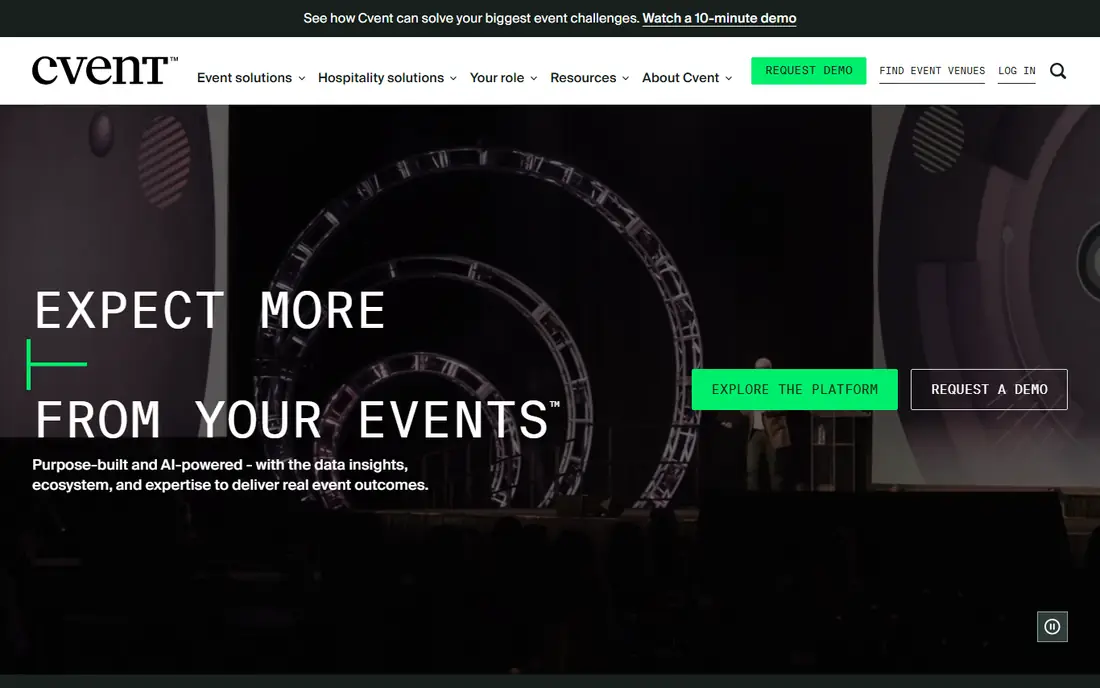
Cvent suits enterprise event programs that run many conferences, trade shows, and meetings a year. Its venue sourcing marketplace, registration workflows, attendee app, and analytics cover the full event lifecycle, with over 200 integrations for CRM, marketing automation, and finance. For a team managing a portfolio of events, that breadth beats a single-event app.
The trade is price and complexity. Pricing is quote-only, with a median reported around $19,550 per year in one guide, and its enterprise depth is overkill for a single small conference. Cvent fits best for enterprises and associations with recurring, large-scale event programs.
What we like- Venue sourcing marketplace
- 200 or more integrations
- Registration, app, and analytics in one suite
Watch out for- Quote-only pricing, median reported around $19,550 per year
- Enterprise complexity for small events
- Long evaluation cycle
#2Bizzabo
Best for: Corporate marketing events4.3/5 on
G2 (448 reviews, checked Oct 2026)
Visit bizzabo.com
Starting price$17,999 per year
Free planNo
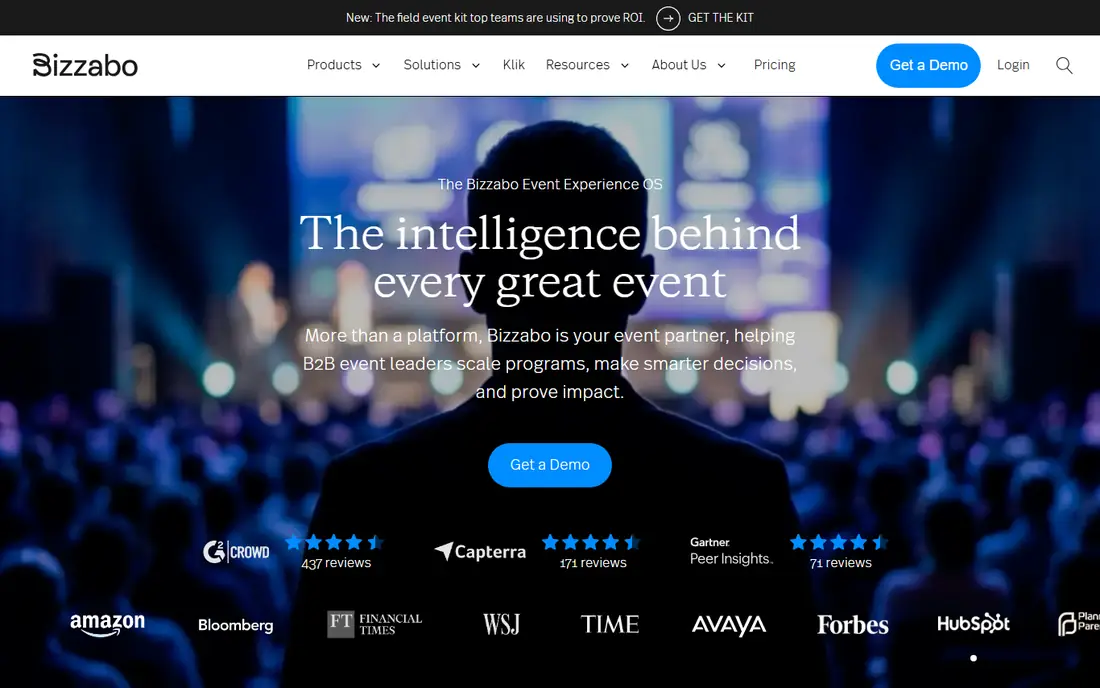
Bizzabo suits corporate marketing events where the attendee experience and the marketing pipeline matter equally. Its polished event app, registration, and website tools present a professional brand, while SmartBadge check-in and lead capture give exhibitors measurable results, and HubSpot sync ties attendance to marketing campaigns. For a B2B marketing team, that closed loop justifies the price.
The limits are cost and model. Bizzabo starts around $17,999 per year with a 3-user minimum in one guide, and it is built for annual programs rather than a single small event. Bizzabo fits best for corporate marketing teams running recurring B2B events.
What we like- Polished attendee experience
- SmartBadge for check-in and lead capture
- HubSpot sync for marketing teams
Watch out for- Annual subscription from about $17,999 per year with a 3-user minimum
- No published per-event option in most guides
- Enterprise focus
Starting price$610 per event
Free planNo
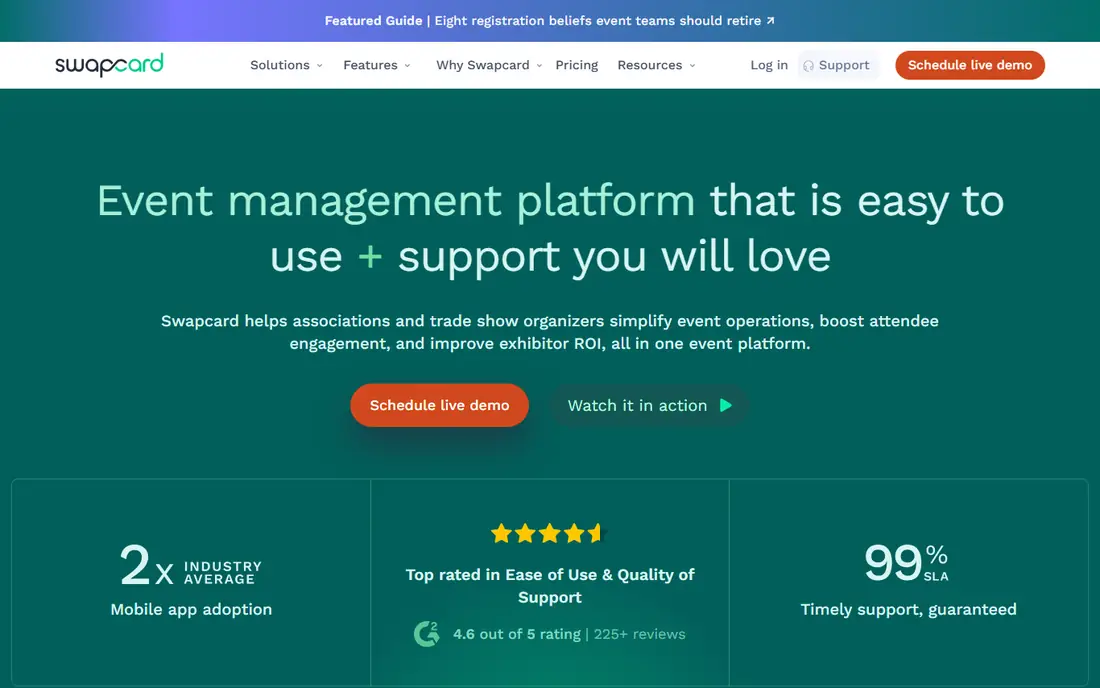
Swapcard suits B2B trade shows and networking-focused conferences where exhibitor value is the point. Its AI matchmaking suggests relevant meetings, its lead capture tools help exhibitors follow up, and its per-event tiers from $610 give a lower entry than annual enterprise platforms. For a trade show organizer, that exhibitor focus is the deciding factor.
The trade is scope and tiering. Per-event pricing varies by tier, its trade-show focus means a simple academic conference may pay for features it does not need, and some advanced features sit on higher tiers. Swapcard fits best for trade shows and B2B conferences where networking and lead capture drive revenue.
What we like- AI matchmaking and lead capture
- Strong for exhibitor-led events
- Per-event tiers plus custom plans
Watch out for- Per-event pricing varies by tier
- Trade-show focus means simpler conferences may overpay
- Some features need higher tiers
Starting priceFree
Free planYes
Eventbrite suits simple public events under 500 attendees where discovery and ticketing matter more than a deep conference app. Listing a free event is free, paid events carry per-ticket fees, and its marketplace helps attendees find events without the organizer buying ads. Ticketing, check-in, and basic analytics cover the core job for a concert, workshop, or community gathering.
The limits are depth. Its attendee app is thinner than Whova's for multi-track conferences, and complex registration logic suits Swoogo better. Eventbrite fits best for public events that need discovery and simple ticketing, not a full conference platform.
What we like- Free listing for free events
- Built-in marketplace for discovery
- Simple ticketing and check-in
Watch out for- Paid-event fees apply
- Limited attendee app depth compared with Whova
- Less suited to complex multi-track conferences
#5RingCentral Events
Best for: Virtual-first conferences4.5/5 on
G2 (933 reviews, checked Oct 2026)
Visit ringcentral.com
Starting price$99 per month
Free planFree trial
RingCentral Events, formerly Hopin, suits virtual-first conferences and global webinars. Its platform handles breakout rooms, expo networking, and large audiences scaling to 100,000 attendees, with a 30-day free trial and paid tiers from $99 per month in some guides. For a team running virtual or hybrid events at scale, its virtual tooling is stronger than a purely in-person app.
The trade is in-person depth. Its virtual focus means onsite check-in, badge printing, and venue features are thinner than Cvent's or Bizzabo's. RingCentral Events fits best for virtual-first conferences and webinars where reach matters more than onsite logistics.
What we like- Virtual-first platform scaling to 100,000 attendees
- Breakout rooms and expo networking
- 30-day free trial
Watch out for- Virtual focus means in-person features are thinner
- Paid tiers from $99 per month in some guides
- Formerly Hopin, so older guides use that name
#6vFairs
Best for: Virtual and hybrid expos4.7/5 on
G2 (1,786 reviews, checked Oct 2026)
Visit vfairs.com
Starting priceSee website
Free planFree trial
vFairs suits virtual trade shows, expos, and career fairs where the booth experience matters. Its immersive 3D exhibitor booths, chat, and webinar tools recreate a trade show floor online, and some guides report free use for up to 500 attendees before custom pricing. For a virtual expo organizer, that booth depth beats a generic webinar platform.
The limits are pricing and effort. Larger events are quote-based, its virtual focus means in-person features are thinner, and 3D booths need exhibitor effort to look polished. vFairs fits best for virtual and hybrid expos where exhibitor presentation drives attendance.
What we like- Immersive 3D exhibitor booths
- Virtual trade shows and career fairs
- Free for up to 500 attendees in some guides
Watch out for- Quote-based pricing for larger events
- Virtual focus
- 3D booths need exhibitor effort to look good
#7Sched
Best for: Budget-friendly schedules and apps4.4/5 on
G2 (25 reviews, checked Oct 2026)
Visit sched.com
Starting price$50 per month
Free planNo
Sched suits budget-conscious organizers who need a solid schedule and attendee app without enterprise pricing. Its entry from about $50 per month covers schedules, speaker profiles, and a mobile app, with per-event or monthly billing that suits a single conference. For a small association, university department, or community conference, Sched covers the core job at a fraction of Whova's quote-based price.
The trade is depth. Sched has fewer enterprise features than Cvent or Bizzabo, its networking is simpler than Swapcard's AI matchmaking, and exhibitor tooling is limited. Sched fits best for small conferences and workshops where a clean schedule and app matter most.
What we like- Low entry price from about $50 per month
- Simple schedules and attendee apps
- Per-event or monthly billing
Watch out for- Fewer enterprise features than Cvent or Bizzabo
- Networking is simpler than Swapcard
- Limited exhibitor tooling
Starting price$99 per month
Free planNo
Guidebook suits universities, associations, and high-volume organizers that need a reliable native app. Its strong offline app works where venue Wi-Fi fails, which matters for campus events and large conferences, and some plans cover unlimited events, which suits an organization running many small gatherings. Starting around $99 per month in some guides, it is affordable for recurring use.
The limits are networking and registration. Its networking is basic compared with Swapcard, and registration depth trails Cvent and Swoogo. Guidebook fits best for campus and association events where a dependable offline app matters more than AI matchmaking.
What we like- Strong native offline app
- Good for universities and associations
- Unlimited events on some plans
Watch out for- Quote-based for larger plans in some guides
- Networking is basic
- Limited registration depth
How we chose
We compared these tools on event type fit, attendee app quality, networking, exhibitor tooling, and pricing transparency, since Whova buyers usually leave over price, a missing feature, or a better fit for their event type. Pricing figures come from vendor pages and current comparison guides checked in October 2026, and any figure we could not confirm is marked as See website. We did not claim hands-on testing. Instead we weighed public documentation, pricing pages, and user reviews, plus the practical difference between a per-event price and an annual subscription.
What to check before you pick
Start with event type. A trade show needs Swapcard's matchmaking, a virtual expo needs vFairs' booths, a corporate marketing event needs Bizzabo's pipeline, and a simple public event needs Eventbrite's marketplace. Next, count attendees and events: per-event pricing suits a single conference, while annual subscriptions suit recurring programs. Finally, test the attendee app on a real phone, since demo videos hide offline behavior and check-in speed.
Pricing transparency and total cost
Only four of nine platforms in one 2026 guide publish pricing openly, while the rest require a sales conversation before basic budget math is possible. That adds weeks to evaluation for no benefit to the buyer. When comparing quotes, include attendee app fees, exhibitor lead capture, badge printing, and support, since those add-ons can double a headline price.
Onsite reliability
An event app that fails on event day is worse than no app. Test offline behavior, check-in speed, and badge printing with real devices before the event, and confirm support hours cover your event timezone. Sched and Guidebook's native offline apps are a real advantage in venues with weak Wi-Fi.
Frequently asked questions
What is Whova used for?
Whova is an event app and management platform for academic conferences, associations, and community events, with community boards, attendee networking, agendas, and exhibitor features. Guides report pricing from about $2,000 per event, quote-based, with no free plan.
Which Whova alternative is cheapest?
Sched from about $50 per month and Guidebook from about $99 per month are cheapest for small conferences, while Eventbrite is free for free events. Swapcard from $610 per event suits a single trade show without an annual commitment.
Is Eventbrite good for conferences?
Eventbrite suits simple public events and single-track gatherings, but its attendee app is thinner than Whova's for multi-track conferences. For a complex conference, Sched, Guidebook, or Cvent give deeper agenda and networking features.
Which platform is best for trade shows?
Swapcard leads for B2B trade shows with AI matchmaking and lead capture, while vFairs leads for virtual trade shows with immersive 3D booths. Cvent suits enterprise trade shows that also need venue sourcing.
Do I need an annual subscription or per-event pricing?
Per-event pricing suits a single conference, while annual subscriptions suit recurring programs. Bizzabo and Cvent use annual models, Swapcard and Sched offer per-event options, and Guidebook covers unlimited events on some plans.
What should I test before event day?
Test the attendee app on real phones, including offline behavior, check-in speed, and badge printing, and confirm support hours cover your event timezone. Run a full rehearsal with a small group before opening registration to attendees.
Sources we checked (8)
- https://www.cvent.com
- https://www.bizzabo.com
- https://www.swapcard.com
- https://www.eventbrite.com
- https://www.ringcentral.com/us/en/events/
- https://www.vfairs.com
- https://sched.com
- https://guidebook.com
Is your product missing or out of date?
We review this list regularly. Vendors can request a listing, send updated pricing or ask about featured placement.

Shihab Mia · Founder, Rankite
Shihab has 5+ years in B2B and SaaS SEO. He writes Rankite's software buying guides from pricing pages, documentation and public user reviews. More about Shihab.