How we make this list: we compare pricing pages, product documentation and public user reviews. Ratings come from G2, Capterra or Trustpilot, with the date we checked them.
Key takeaways
- Rutter still exists in 2026, with production pricing quoted on request and a free 30-day Starter plan for proof of concept work.
- Merge is the best general alternative, with a free tier for three linked accounts and Launch at 650 dollars per month for up to ten accounts.
- Apideck and Unified.to publish clear starting prices, at 599 dollars and 750 dollars per month, which makes budgeting easier.
- Codat, Railz, and Paragon do not publish a starting price, so request a quote early and compare the unit that drives the bill.
- Nango is the lowest cost entry point for developer-led teams, with a free tier for ten connections and pricing from 50 dollars per month.
- Paragon and Cyclr are embedded integration platforms rather than pure unified APIs, so they suit customer-facing workflows.
What does Rutter API do and why do teams look for an alternative?
Rutter provides one unified API that lets a software product read and write data across commerce, accounting, payments, and ads platforms through a single data model. Its commerce API covers platforms such as Shopify, Amazon, WooCommerce, BigCommerce, eBay, and Etsy, along with orders, inventory, and customer data. A team that builds with Rutter connects once and uses the same endpoints for each platform, rather than building a separate integration for every store or marketplace.
You should compare unified APIs on platform coverage first, because a vendor that lacks your customers main storefront cannot help you no matter how good its documentation is. List the five commerce platforms your customers use most, then check each vendor against that list, including read and write support, order and inventory objects, and webhook support.
Which Rutter alternative is best for commerce-heavy products?
The best Rutter alternative for commerce-heavy products depends on whether commerce is your only need or one part of a wider financial data plan. Merge is a strong general choice because it covers commerce alongside accounting, HR, CRM, and ticketing, with mature sync and support for large teams. Apideck is a strong choice when accounting sits next to commerce, because its accounting API is deep and its pricing is published, although its commerce catalog is smaller.
How much does a Rutter alternative cost in 2026?
A Rutter alternative costs from 50 dollars per month at the low end to several thousand dollars per month at the enterprise end, and several leading vendors do not publish a price at all. Prices checked 12 Nov 2026 show Nango as the cheapest entry point, with pay-as-you-go pricing from 50 dollars per month and a free tier for ten connections.
When should you choose an embedded iPaaS instead of a unified API?
You should choose an embedded iPaaS instead of a unified API when your customers need to build and manage their own integrations inside your product. A unified API gives your engineers one data model and one set of endpoints, and your team writes the integration logic in code. An embedded iPaaS gives your customers a visual workflow builder, a connect portal, and prebuilt actions, so they can link apps, map fields, and set up automations without waiting for your engineers.
What should you check before you switch from Rutter?
You should check platform coverage, data parity, migration effort, and contract terms before you switch from Rutter. Start by listing every platform your customers have connected through Rutter, then confirm that the new vendor supports each one with the same read and write operations. Next, compare the data fields, because a field that Rutter returns may be missing, named differently, or only available through a raw payload on the new vendor.
Quick comparison
| Tool | Best for | Starting price | Free plan |
|---|
 Merge | Teams that need one unified API across commerce, accounting, HR, ATS, CRM, and ticketing | 650 dollars per month for Launch, after the first 3 linked accounts free, with 65 dollars per month for each additional linked account, checked 12 Nov 2026 | Yes, first 3 production linked accounts free |
 Apideck | Accounting-led products that also need commerce and CRM data with published pricing | 599 dollars per month for Launch, covering 25 active consumers in one category, checked 12 Nov 2026 | No free plan, 30-day free trial with no credit card required |
 Codat | Banks, lenders, and fintech products that need standardised accounting, banking, and commerce data | Quote only, no public price on the vendor pricing page, checked 12 Nov 2026 | No permanent free plan, trial available on request with up to 50 companies described in vendor documentation |
 Nango | Developer-led teams that want to build and own their integrations with managed auth and sync | 50 dollars per month pay-as-you-go, with a 50 dollar monthly minimum returned as credits, checked 12 Nov 2026 | Yes, free for 10 connections |
 Unified.to | Teams that want usage-based pricing, unlimited connections, and live pass-through data | 750 dollars per month for Grow, including 750,000 API calls, checked 12 Nov 2026 | No free plan for production, 30-day free trial on Grow and Pro with no credit card required |
 Railz | Financial institutions, lenders, and fintech teams that need accounting and banking data with analytics | Quote only, no public price on the vendor site, checked 12 Nov 2026 | No permanent free plan listed, trial available on request through FIS |
 Paragon | SaaS teams that want embedded integrations with a white-label connect portal and workflow builder | Quote only, Pro and Enterprise plans both show Talk to sales on the vendor pricing page, checked 12 Nov 2026 | No free plan, 14-day free trial reported by third-party comparisons |
 Cyclr | SaaS teams that want a white-label embedded iPaaS with multi-tenant control and private cloud options | 1,595 dollars per month for Pay As You Go, checked 12 Nov 2026 | No free plan, free trial available |
Is your product missing or out of date?
We review this list regularly. Vendors can request a listing, send updated pricing or ask about featured placement.
The top Rutter API alternatives
#1
Merge
Best for: Teams that need one unified API across commerce, accounting, HR, ATS, CRM, and ticketing
Visit merge.dev
Starting price650 dollars per month for Launch, after the first 3 linked accounts free, with 65 dollars per month for each additional linked account, checked 12 Nov 2026
Free planYes, first 3 production linked accounts free
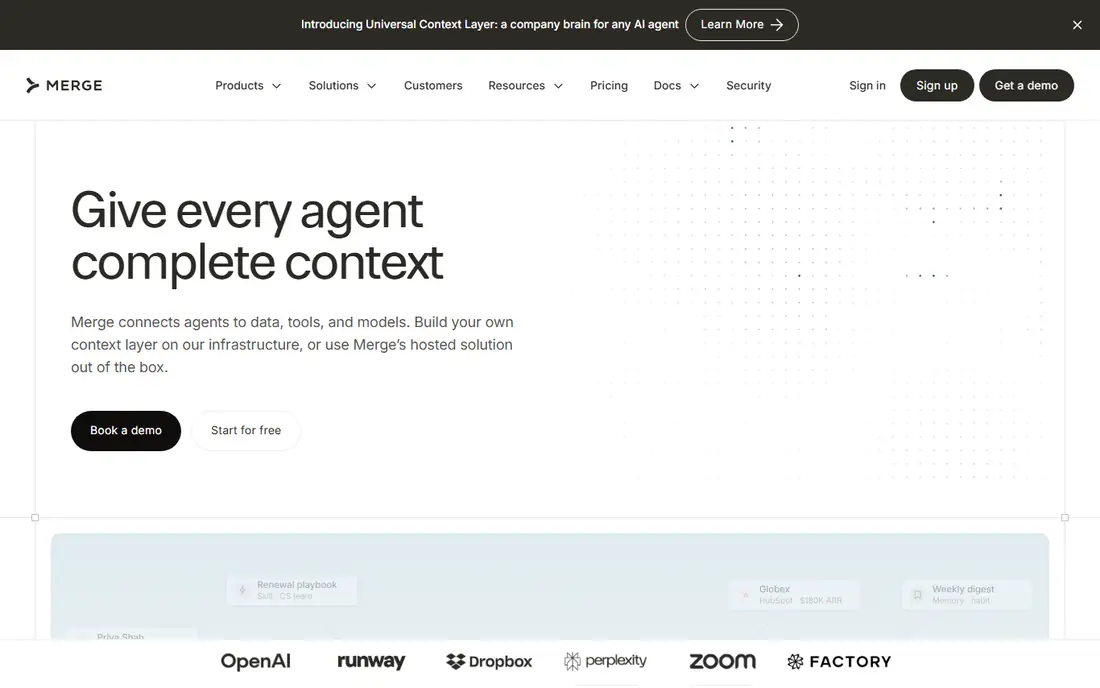
Merge is the most direct general replacement for Rutter, because it covers the same ground and adds HRIS, ATS, CRM, and ticketing. Its unified API normalises data from more than 250 third-party tools into one schema, so your engineers learn one model and reuse it across every integration. Professional and Enterprise plans add custom field mapping, field-level scopes, custom sync frequencies, and sandboxes.
What we like- Broadest category coverage in this guide, mature sync and observability tooling, strong documentation and SDKs, SOC 2 Type II, ISO 27001, HIPAA, and GDPR compliance, and a growing agent handler for AI products
Watch out for- Per-linked-account pricing rises fast as customer numbers grow, and each category is licensed separately, so a team that needs several categories pays more than the headline Launch price suggests
#2
Apideck
Best for: Accounting-led products that also need commerce and CRM data with published pricing
Visit apideck.com
Starting price599 dollars per month for Launch, covering 25 active consumers in one category, checked 12 Nov 2026
Free planNo free plan, 30-day free trial with no credit card required
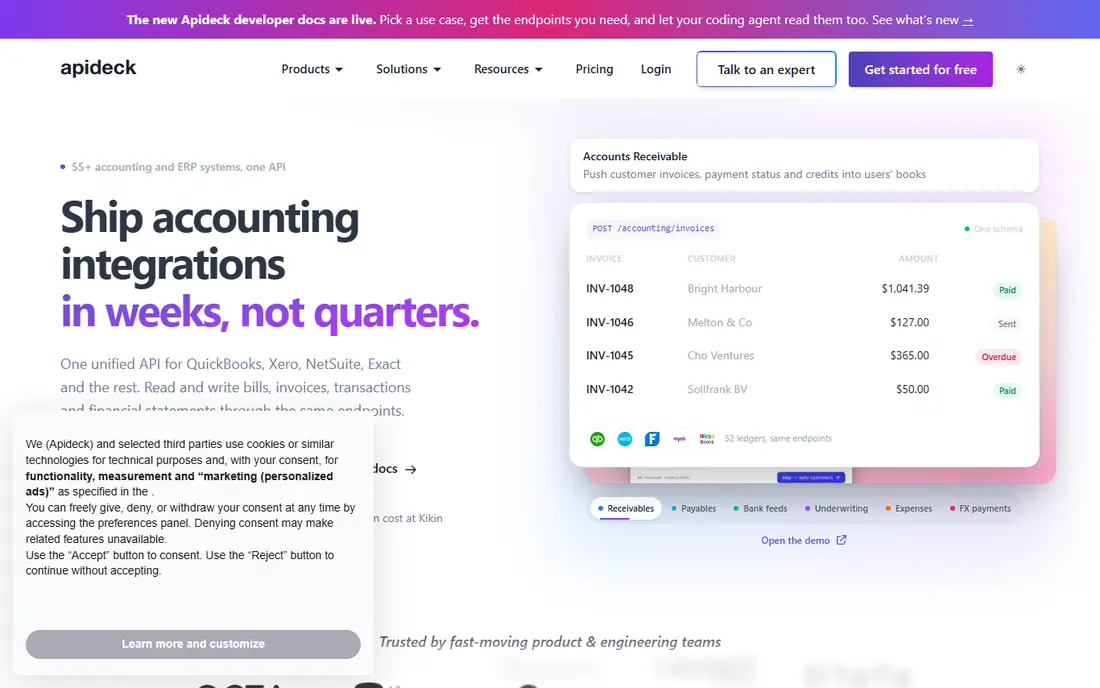
Apideck normalises providers into one schema across accounting, ERP, HRIS, CRM, ecommerce, ATS, issue tracking, and file storage, with roughly 200 connectors in total. It supports QuickBooks, Xero, NetSuite, Exact, and many other ledgers alongside commerce platforms. The real-time pass-through design means each request goes live to the source system, which suits teams that do not want a vendor to hold a copy of their customers records.
What we like- Clear published pricing with no sales call needed to start, deep accounting and ERP coverage across more than 55 systems, real-time pass-through calls with no stored copy of customer data, and custom field mapping on higher plans
Watch out for- Launch covers only one unified API category, so a team that needs accounting and commerce together must move to Scale at 1,299 dollars per month, and there is no permanent free tier for long proof of concept work
#3
Codat
Best for: Banks, lenders, and fintech products that need standardised accounting, banking, and commerce data
Visit codat.io
Starting priceQuote only, no public price on the vendor pricing page, checked 12 Nov 2026
Free planNo permanent free plan, trial available on request with up to 50 companies described in vendor documentation
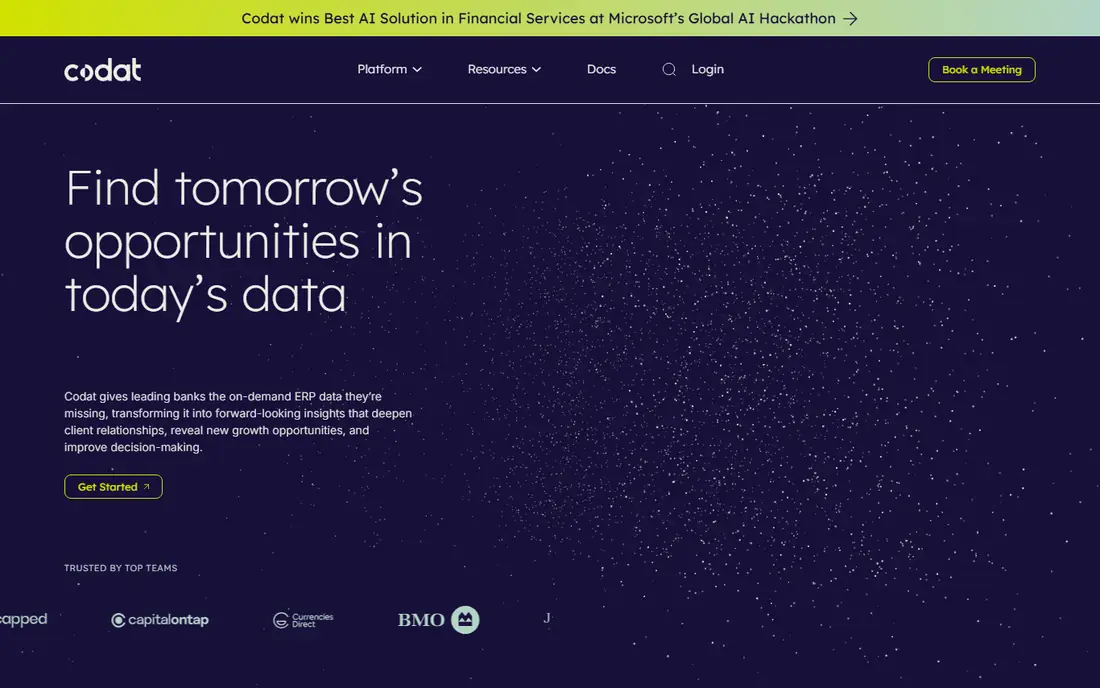
Codat is the closest match to Rutter for financial data depth, because both vendors normalise accounting, banking, and commerce data into one model for B2B financial products. Its homepage now leads with commercial banking, with advisory intelligence and spend insights built on the same connected data, while its Connect product still serves fintech teams. The platform supports QuickBooks, Xero, NetSuite, Sage, and other major systems, with standardised endpoints, webhooks, and SDKs.
What we like- Deep financial data model for accounting, banking, and commerce, two-way sync for bills, invoices, and payments, bank-grade security with ISO 27001 and SOC 2 Type II audits, and products for underwriting, bill pay, expense management, and bank feeds
Watch out for- No published price and no self-serve signup, so budgeting and evaluation start with a sales conversation, and the general accounting API is described by third-party checks as closed to some new clients, so you should confirm access for your use case before you plan around it
#4
Nango
Best for: Developer-led teams that want to build and own their integrations with managed auth and sync
Visit nango.dev
Starting price50 dollars per month pay-as-you-go, with a 50 dollar monthly minimum returned as credits, checked 12 Nov 2026
Free planYes, free for 10 connections
Nango is the developer toolkit alternative in this guide, rather than a fully managed unified API. It gives teams managed auth, syncing, webhooks, and observability, while engineers write the integration code and own the data models. That trade-off suits technical teams that want control, speed, and low cost, and it suits AI agent products that need tools across many APIs.
What we like- Lowest entry cost in this guide, transparent usage-based pricing, support for more than 1,200 APIs with 10,000 prebuilt tools, open approach that lets engineers write integration logic in code, and strong fit for AI agent integrations
Watch out for- You build more yourself than with a fully managed unified API, because prebuilt unified data models are fewer than those from Merge or Unified.to, and compute and data transfer charges add to the connection fee
#5
Unified.to
Best for: Teams that want usage-based pricing, unlimited connections, and live pass-through data
Visit unified.to
Starting price750 dollars per month for Grow, including 750,000 API calls, checked 12 Nov 2026
Free planNo free plan for production, 30-day free trial on Grow and Pro with no credit card required
Unified.to is a real-time unified API and MCP platform that covers 39 categories and more than 2,200 integrations, which makes it one of the broadest catalogs in this guide. Every call goes live against the source API, so data is always fresh, and no customer records rest in the integration layer. Pricing is usage-based by API call: Grow costs 750 dollars per month for 750,000 calls, Pro costs 1,500 dollars per month for 2 million calls, and Scale costs 3,000 dollars per month for 6 million calls, with overage rates falling from 1.00 dollar per 1,000 calls on Grow to 0.50 dollars on Scale.
What we like- Unlimited customers and connections on every plan, real-time pass-through with no customer records stored at rest, more than 2,200 integrations across 39 categories, and a hosted MCP server for AI agents
Watch out for- The 750 dollar monthly minimum is high for a very small team, and there is no permanent free tier, so early testing must fit inside the 30-day trial or a paid plan
#6
Railz
Best for: Financial institutions, lenders, and fintech teams that need accounting and banking data with analytics
Visit railz.ai
Starting priceQuote only, no public price on the vendor site, checked 12 Nov 2026
Free planNo permanent free plan listed, trial available on request through FIS
Railz still loads at railz.ai, but the product is now presented as FIS Accounting Data as a Service, formerly Railz, which is an important change for buyers to understand. The site describes a financial data API that transforms how financial institutions, fintechs, and developers push and pull data from accounting, banking, and ecommerce systems. The API connects to Dynamics 365 Business Central, FreshBooks, Oracle NetSuite, QuickBooks, Sage, Xero, Wave, and Zoho Books, with real-time access to transactions, reports, analytics, and insights.
What we like- Real-time access to accounting, banking, and ecommerce data through one API, normalised data with analytics, forecasting, and financial ratios, sandbox mode for testing, and support for QuickBooks, Xero, NetSuite, Sage, FreshBooks, and Zoho Books
Watch out for- Railz is now sold as FIS Accounting Data as a Service, so buyers deal with a large enterprise vendor and a sales-led process, and the commerce coverage is narrower than Rutter, with Shopify and Square as the main ecommerce links
#7
Paragon
Best for: SaaS teams that want embedded integrations with a white-label connect portal and workflow builder
Visit useparagon.com
Starting priceQuote only, Pro and Enterprise plans both show Talk to sales on the vendor pricing page, checked 12 Nov 2026
Free planNo free plan, 14-day free trial reported by third-party comparisons
Paragon is an embedded integration platform rather than a pure unified API, and that difference shapes who should choose it. Its Workflows product lets product teams build integrations with a drag-and-drop builder or in headless mode, while Managed Sync keeps a normalised copy of customer data, and ActionKit exposes per-vendor actions to code and AI agents. The Connect Portal is a key feature, because customers can authorise apps and configure integrations inside your product without leaving it.
What we like- More than 130 built-in connectors with a low-code workflow builder, a hosted Connect Portal where customers authorise apps themselves, Managed Sync with a normalised model, and ActionKit for AI agent actions across customer tools
Watch out for- No published price and no self-serve paid plan, so cost is only known after a sales quote, and implementation can take months when custom connectors or complex logic are needed
#8
Cyclr
Best for: SaaS teams that want a white-label embedded iPaaS with multi-tenant control and private cloud options
Visit cyclr.com
Starting price1,595 dollars per month for Pay As You Go, checked 12 Nov 2026
Free planNo free plan, free trial available
Cyclr is a native embedded iPaaS built for B2B SaaS products that need customer-facing integrations delivered inside their own application. Its multi-tenant design gives each customer a ring-fenced account, which suits teams that must keep customer data and integration settings separate. The platform includes a visual workflow builder, embeddable tools, an API for headless access, and MCP support for AI connectivity, so integrations can be surfaced through a product UI, a customer portal, or an agent.
What we like- Published pricing with unlimited users and unlimited integration flows, more than 600 connectors across CRM, ERP, marketing, support, finance, and other categories, multi-tenant architecture with ring-fenced customer accounts, and private cloud deployment options
Watch out for- The entry price is high for a small team, connectors beyond the included allowance cost 100 dollars per connector per month, and onboarding fees are custom, so the total first-year cost is higher than the headline monthly rate
Frequently asked questions
What is the best Rutter API alternative for a small SaaS team?
Nango is the best Rutter alternative for a small SaaS team that has engineers who can build integrations, because it starts with a free tier for ten connections and pay-as-you-go pricing from 50 dollars per month. Merge is the best managed option, because its Launch plan is free for three linked accounts and then costs 650 dollars per month for up to ten.
Does Rutter still exist in 2026?
Yes, Rutter still exists in 2026 as a unified API for B2B financial products, and its homepage at rutter.com was live on 12 Nov 2026. The platform covers more than 60 accounting, commerce, payments, and ads systems through one data model, with Rutter Link for authentication and a dashboard for monitoring. Production pricing is quote-only, with a free 30-day Starter plan for sandbox work, so teams should request a quote before they plan a production launch.
How much does it cost to replace Rutter with a unified API?
The cost to replace Rutter depends on the vendor and the billing unit, and prices checked 12 Nov 2026 range from 50 dollars per month for Nango to 1,595 dollars per month for Cyclr. Apideck starts at 599 dollars per month, Merge at 650 dollars per month, and Unified.to at 750 dollars per month, while Codat, Railz, and Paragon are quote-only.
Which Rutter alternative has the best commerce coverage?
Merge and Unified.to have the strongest general commerce coverage in this guide, because both cover commerce alongside many other categories with large connector catalogs. Rutter itself covers Shopify, Amazon, WooCommerce, BigCommerce, eBay, and Etsy, so any replacement should be checked against the exact storefronts your customers use. Apideck covers ecommerce as one of eight categories, while Codat and Railz focus more on accounting and banking data, so they suit financial products rather than storefront-led products.
Should I choose a unified API or an embedded iPaaS as a Rutter alternative?
Choose a unified API when your engineers will write the integration logic and you need the same records from many providers in one schema, which is the model that Merge, Apideck, Codat, Unified.to, and Railz follow. Choose an embedded iPaaS when your customers will configure integrations themselves inside your product, which is the model that Paragon and Cyclr follow with a connect portal and workflow builder.
Sources we checked (18)
- https://www.rutter.com/
- https://www.rutter.com/product/commerce-api
- https://www.rutter.com/pricing
- https://www.merge.dev/
- https://www.merge.dev/pricing
- https://www.apideck.com/
- https://www.apideck.com/pricing
- https://www.codat.io/
- https://www.nango.dev/
- https://www.nango.dev/pricing
- https://unified.to/
- https://unified.to/pricing
- https://railz.ai/
- https://www.useparagon.com/
- https://www.useparagon.com/pricing
- https://cyclr.com/
- https://cyclr.com/product/native-embedded-ipaas
- https://apis.io/plans/rutter/rutter-plans-pricing/
Is your product missing or out of date?
We review this list regularly. Vendors can request a listing, send updated pricing or ask about featured placement.

Shihab Mia · Founder, Rankite
Shihab has 5+ years in B2B and SaaS SEO. He writes Rankite's software buying guides from pricing pages, documentation and public user reviews. More about Shihab.