How we make this list: we compare pricing pages, product documentation and public user reviews. Ratings come from G2, Capterra or Trustpilot, with the date we checked them.
Key takeaways
- As of October 2026, T-Mobile has the best overall 5G network in the United States on the published measurements: Ookla's first half 2026 report scored it the top network overall and the top 5G network.
- Ookla's 2026 Speedtest results put T-Mobile's median 5G download near 309 Mbps, ahead of Verizon near 214 Mbps and AT&T near 173 Mbps.
- Verizon still wins on geographic coverage in Ookla's coverage scoring, and Opensignal's July 2026 US report gave Verizon its Coverage Experience award.
- Resellers such as Visible, Metro, Cricket, and Google Fi sell you the same 5G as their host network, usually cheaper, sometimes with lower data priority.
- Every figure here is a national average from crowdsourced tests. Your street, your building, and your phone can reverse the order, so test before you switch.
Quick comparison
| Tool | Best for | Starting price | Free plan |
|---|
 T-Mobile | Fastest overall 5G and most time on 5G | See website | No |
 Verizon | Widest geographic coverage | See website | No |
 AT&T | Balanced network and fast standalone 5G | See website | No |
 Boost Mobile | Budget 5G on its own core and AT&T towers | See website | No |
 Visible | Cheap unlimited on Verizon 5G | See website | No |
 Metro by T-Mobile | Prepaid 5G with store support | See website | No |
 Cricket Wireless | Prepaid 5G on AT&T with family pricing | See website | No |
 Google Fi Wireless | Flexible 5G for travellers on T-Mobile towers | See website | No |
Is your product missing or out of date?
We review this list regularly. Vendors can request a listing, send updated pricing or ask about featured placement.
The best 5G networks by company
Starting priceSee website
Free planNo
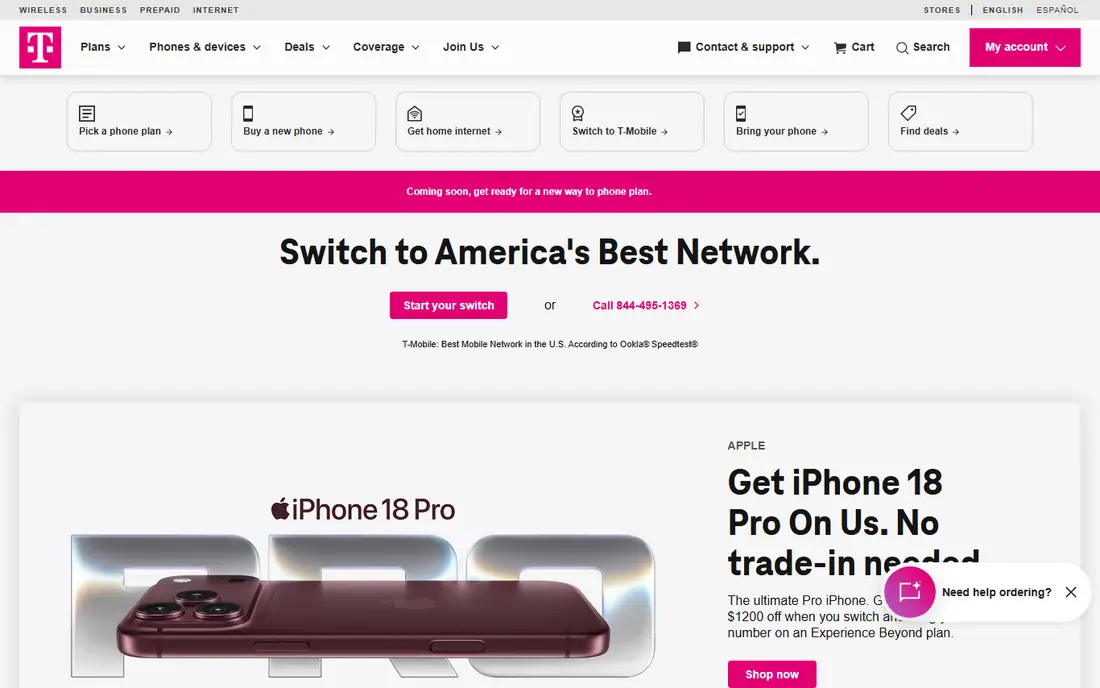
T-Mobile is the measured answer to this article's question. Ookla's US Connectivity Report for the first half of 2026 gave T-Mobile the top overall network score, 80.12 against Verizon's 74.12 and AT&T's 72.82, and the top 5G score as well. Its median 5G download speed near 309 Mbps is roughly half again as fast as Verizon's. Opensignal's July 2026 US report awarded T-Mobile 12 of its 16 categories, including reliability and consistent quality.
The reason is spectrum. T-Mobile's mid band 5G covers most of the population with real capacity, and its standalone 5G, where the phone never falls back to 4G, reached users about 71 percent of the time in Opensignal's October 2026 standalone report, far ahead of rivals. The weakness is geography: drive far enough from cities and Verizon still reaches places T-Mobile does not.
What we like- Top overall and top 5G network in Ookla's 1H 2026 report
- Median 5G download around 309 Mbps in Ookla testing
- Won 12 of 16 Opensignal US awards in July 2026
- Users spend about 80 percent of time on 5G in global awards data
Watch out for- Geographic coverage still trails Verizon in rural areas
- Ookla coverage score was the lowest of the big three
- In store and plan pricing has crept up
- Standalone coverage outside cities is thinner than its marketing suggests
Starting priceSee website
Free planNo
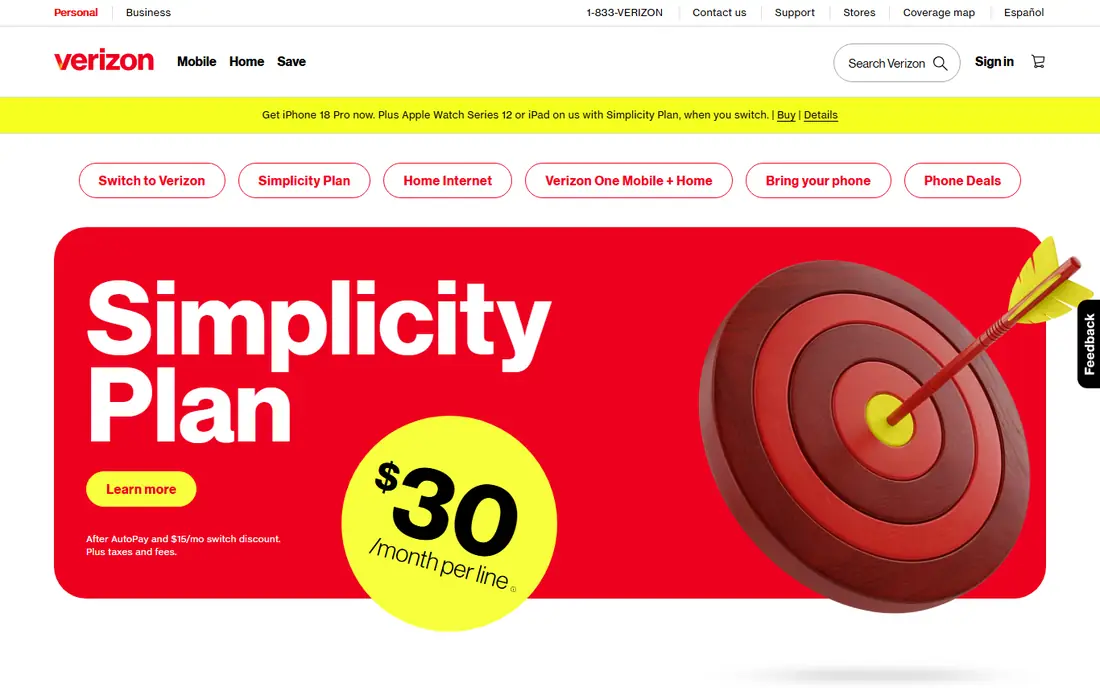
Verizon built its brand on coverage, and the measurements still back it on that one axis. Ookla's first half 2026 report gave Verizon the highest US coverage score at 30.4 percent, ahead of AT&T at 26.8 and T-Mobile at 24.8, and Opensignal's July 2026 US awards gave Verizon Coverage Experience plus its 5G video categories. For rural users and road travellers, Verizon remains the safest bet.
Where Verizon loses is speed and 5G availability. Its median 5G download, around 214 Mbps in Ookla's testing, is well behind T-Mobile, and Opensignal's US report measured its users spending less time on 5G than T-Mobile or AT&T customers. If your priority is a signal almost everywhere over the fastest signal in the city, Verizon is your network.
What we like- Highest US coverage in Ookla's 1H 2026 scoring at 30.4 percent
- Won Opensignal's US Coverage Experience award
- Strongest rural and highway reach of the three
- 5G video awards in Opensignal's US report
Watch out for- Median 5G download near 214 Mbps trails T-Mobile
- Opensignal measured lower 5G availability than rivals in the US report
- Premium plan pricing
- Ultra wideband 5G is concentrated in dense areas
#3
AT&T
Best for: Balanced network and fast standalone 5G
Visit att.com
Starting priceSee website
Free planNo
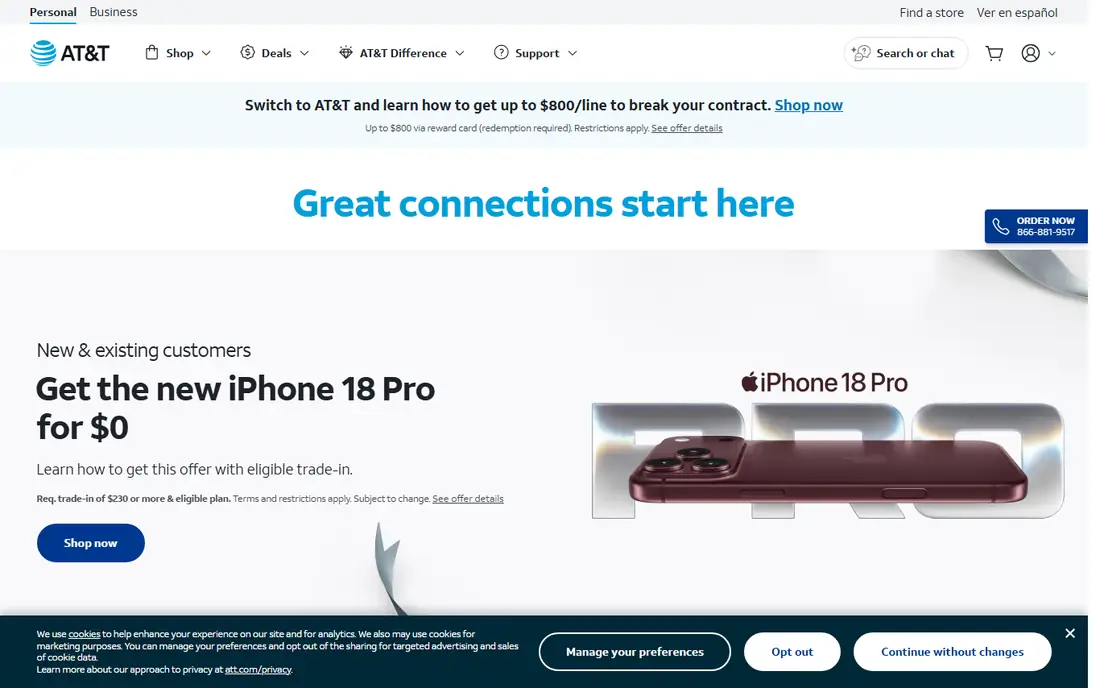
AT&T is the balanced network. Opensignal's July 2026 US report placed its coverage score a point behind Verizon's and ahead of T-Mobile's, it won the Time on Network award, and in the standalone 5G report it posted the fastest standalone download speed at 344.7 Mbps. In Opensignal's 2026 global awards it earned Rising Star recognition for download speed improvement, helped by the low and mid band spectrum it bought.
The catch is that its best technology reaches few users so far: standalone connections were about 4 percent of its users' time in that report. AT&T suits buyers who want solid coverage and a network visibly improving, and it remains the default for many business and first responder contracts.
What we like- Coverage score between Verizon and T-Mobile in Opensignal's US report
- Fastest standalone 5G download at 344.7 Mbps in Opensignal testing
- Won Opensignal's Time on Network award
- Rising Star for 5G download improvement in global awards
Watch out for- Median overall 5G download near 173 Mbps is third of the three
- Standalone 5G reach is still small, users on it about 4 percent of time
- No category defining win in US reports
- Plan pricing matches premium rivals
Starting priceSee website
Free planNo
Boost Mobile is the one budget carrier trying to be a real network. It built its own 5G core and some of its own towers, and since November 2025 its parent EchoStar has carried most customer traffic on AT&T's network while keeping Boost's core. The result is AT&T grade 5G coverage under a cheaper, simpler brand.
Buyers should know the situation is fluid. The network strategy has changed with EchoStar's spectrum sales, so Boost's long term shape is less certain than the big three. Today, though, it is a genuine way to get major network 5G at prepaid prices, with stores for people who want help in person.
What we like- Cheaper plans than the big three
- Runs its own 5G core with traffic carried on AT&T's network since late 2025
- Stores in many cities
- No contract pricing
Watch out for- Its own radio network build is being wound back in favour of the AT&T deal
- Coverage depends on AT&T in most places
- Smaller company with a restructuring parent
- Fewer premium perks
Starting priceSee website
Free planNo
Visible is Verizon's own budget brand, sold only online. Its 5G is Verizon 5G, with the same coverage map, which makes Visible the cheapest way onto the network that tops the coverage rankings. The plans are simple, unlimited, and priced well under Verizon's own.
The compromise is priority. On the base plan, your data can be slowed behind Verizon's direct customers at busy times and places, and support runs through chat rather than a store. The higher tier removes much of the priority gap. If Verizon wins at your address and you want it for less, Visible is the honest shortcut.
What we like- Owned by Verizon, so 5G is Verizon's network
- Simple unlimited plans at low prices
- ESIM activation in minutes
- Higher tier adds priority data and faster hotspot
Watch out for- Online only, no stores
- Base plan data can be slowed when Verizon's network is busy
- Customer support is chat based
- Device deals are thinner than the parent brand
Starting priceSee website
Free planNo
Metro by T-Mobile is T-Mobile's prepaid brand, with T-Mobile's network behind it. That means the fastest measured 5G speeds in this article, sold at prepaid prices through a large store network, with taxes and fees folded into the sticker price. For many households it is the practical way to buy the best network without a contract or a credit check.
The compromise matches Visible's: when towers are busy, T-Mobile's direct customers go first. In most places at most times the difference is small. Where Metro wins over app only rivals is the store on the corner when something goes wrong.
What we like- Runs on T-Mobile's network, the fastest measured 5G here
- Stores across the country for in person help
- Taxes and fees included in advertised plan prices
- Regular phone promotions for switchers
Watch out for- Data priority sits below T-Mobile's own customers
- Video streaming limits on some plans
- Deals often need a new line or a port in
- Coverage is T-Mobile's, rural gaps included
Starting priceSee website
Free planNo
Cricket is AT&T's prepaid brand, and it sells AT&T's network, which this article ranks as the balanced third, at family friendly prices. Multi line discounts are its signature: several lines on one account bring the per line cost down to budget levels while keeping AT&T's coverage footprint, which Opensignal scored just behind Verizon's in the US.
The limits are the standard prepaid ones. Some plans cap speeds, priority sits below AT&T's own customers, and the phone deals are modest. For a family that wants AT&T coverage without AT&T's postpaid bill, Cricket is the established route.
What we like- AT&T's network at prepaid prices
- Multi line discounts suit families
- Stores nationwide
- Simple plan structure with taxes included in many offers
Watch out for- Top Cricket speeds can be capped on some plans
- Priority below AT&T direct customers
- Fewer premium phone deals
- AT&T's 5G is third on speed in the national tests
#8
Google Fi Wireless
Best for: Flexible 5G for travellers on T-Mobile towers
Visit fi.google.com
Starting priceSee website
Free planNo
Google Fi resells T-Mobile's network with Google's billing and two ideas of its own: a flexible plan that charges per gigabyte for light users, and international data that works in a long list of countries without a new SIM. Since it rides T-Mobile, its 5G speed inherits the fastest network in the national tests.
Fi fits a specific person: light to moderate data use, frequent travel, and comfort with app based support. Heavy users pay more per gigabyte than on unlimited rivals, and iPhone users still miss a few features Android users get. For travellers on the T-Mobile footprint, it is a tidy package.
What we like- Runs on T-Mobile's network with strong 5G speeds
- International data in many countries on flexible plans
- Pay per gigabyte option suits light users
- Clean app and billing from Google
Watch out for- IPhone support still lacks some features
- Per gigabyte pricing punishes heavy data users
- Priority can drop on the cheapest plan
- No stores, support is remote
How we chose
We based the verdicts on published network measurement reports available in October 2026, chiefly Ookla's US Connectivity Report for the first half of 2026 and Opensignal's US Mobile Network Experience report of July 2026, its 2026 global 5G awards, and its October 2026 standalone 5G report. Speed, availability, coverage, and reliability figures in the entries come from those reports. Resellers are included because most buyers can pick them, and each entry states which host network it uses, since the host decides its 5G. We did not test networks ourselves, and we present national averages as what they are: averages.
What to look for in a 5G network
Check your own locations first. National rankings describe the average user, and you are not average: you live, work, and travel in specific places. Each carrier publishes a coverage map, and each will sell you a plan with a return window. The reliable test is a trial or a prepaid month on your own phone, at your own address, during your own commute.
Then weigh what the reports weigh. Raw speed headlines come from mid band 5G in cities. Coverage scores reflect how much of the map has any 5G at all. Time on 5G, where T-Mobile leads by a wide margin, predicts how often you actually get the faster service. Finally, remember that resellers change price and priority, not physics. If a host network wins at your house, its budget brands are worth a look, with the priority fine print read.
Frequently asked questions
Which company has the best 5G network in 2026?
On published measurements, T-Mobile. Ookla's first half 2026 report named it the top overall network and the top 5G network in the US, with the fastest median 5G download near 309 Mbps, and Opensignal's July 2026 US report gave it 12 of 16 awards. Verizon beats it on geographic coverage, so the best network for a rural user can still be Verizon.
Which carrier has the best 5G coverage?
Verizon, on reach. Ookla's 1H 2026 coverage scoring put Verizon first at 30.4 percent, then AT&T at 26.8 and T-Mobile at 24.8, and Opensignal gave Verizon its US Coverage Experience award. T-Mobile counters with the best 5G coverage among large countries in Opensignal's global awards, which scores populated coverage rather than empty land.
Do budget carriers get the same 5G?
The signal is the same, because Visible runs on Verizon, Metro and Google Fi on T-Mobile, and Cricket and Boost largely on AT&T. What changes is priority and features. In busy places, a host can serve its own customers first, and top speeds or hotspot allowances may be capped. Off peak, most users cannot tell the difference.
Why do the reports disagree with each other?
They measure different things. Ookla leans on user run speed tests, which over represent people testing fast connections. Opensignal samples real usage in the background, which captures ordinary experience, including weak signal areas. Coverage can mean land covered, people covered, or time connected. Read the metric before the headline, and treat any single report as one view.
Sources we checked (0)
Is your product missing or out of date?
We review this list regularly. Vendors can request a listing, send updated pricing or ask about featured placement.

Shihab Mia · Founder, Rankite
Shihab has 5+ years in B2B and SaaS SEO. He writes Rankite's software buying guides from pricing pages, documentation and public user reviews. More about Shihab.