How we make this list: we compare pricing pages, product documentation and public user reviews. Ratings come from G2, Capterra or Trustpilot, with the date we checked them.

Stripe has the best API documentation, with a three-column layout, code samples in seven languages and live test-mode calls in the browser. Twilio is the best for task-based guides, and GitHub is the best for versioning. Shopify, Slack, Google Maps, SendGrid and Postman round out the list with docs worth copying.
Key takeaways
- The best API docs share three habits: copy-paste code samples, a runnable example or explorer, and clear error and versioning guidance.
- Stripe, Twilio and GitHub are the most-cited references in 2026 API documentation roundups, and every serious docs team studies them.
- Good docs shorten the path from first read to first successful call, which is the metric that matters more than page count.
- Pay-as-you-go pricing means the docs are free to evaluate: every platform here lets you test the API before paying.
- Copy the structure, not the branding: three-column layouts, task-based guides and webhook examples work for any API.
| Platform | Best for | Starting price | Free plan |
| Stripe | Payments docs with live test calls | 2.9% + 30 cents per card transaction | Test mode free |
| Twilio | Messaging, voice and email guides | Pay as you go, SMS from about $0.0079 | Trial credit |
| GitHub | REST and GraphQL docs with clear versioning | Free; Team from $4 per user per month | Yes |
| Slack | Event-driven platform and Web API docs | Free; Pro from $7.25 per user per month | Yes |
| Shopify | Commerce APIs with GraphQL reference | Basic from $29 per month billed yearly | Trial, dev stores free |
| Google Maps | Maps, Places and geocoding docs | $200 monthly free credit, then pay as you go | $200 monthly credit |
| SendGrid | Email API docs with simple examples | Free 100 emails per day; Essentials from $19.95 per month | Yes, 100 emails per day |
| Postman | API testing docs and living collections | Free; Basic from $14 per user per month | Yes |
What makes API documentation good?
Good API documentation answers three questions fast: what does this call do, what do I send, and what comes back. The best docs show a copy-paste code sample beside the explanation, so the reader never has to guess the request shape. They include an interactive explorer or a sandbox where the reader can make a real call without setting up a local environment. They document errors, webhooks and versioning, because production work breaks on those three things more than on the happy path. They organise content by task rather than by endpoint, so a developer building SMS verification finds one guide instead of ten reference pages. Stripe, Twilio and GitHub do all of this, which is why they top every 2026 roundup. Bad docs list endpoints without examples, hide authentication in a footnote and leave error handling to trial and error.
Start with the quickstart and time yourself. A good quickstart gets you a working call in under 15 minutes with a free account and test keys. Check the code samples: they should cover your language, show the full request and response, and work when pasted. Check the error section: it should list the error codes, what each means and how to fix it. Check versioning: the docs should state the current version, the changelog and how breaking changes are announced. Check webhooks: the docs should show the payload, the retry behaviour and how to verify the signature. Finally, check the status page and the changelog, since a platform that documents its outages and changes will also document its API honestly. If any of these are missing, budget extra integration time.
Do great docs mean a great API?
Not always, but the overlap is strong. A platform that invests in documentation usually invests in the API itself, because the same team owns both. Stripe's docs are good because the API is consistent: every resource follows the same patterns for errors, idempotency and pagination. Twilio's docs are good because the products are organised around real jobs such as sending a message or verifying a number. A confusing API can still have polished docs, so test the happy path and one error path before committing. Send a real request, trigger an error on purpose and read the webhook payload. If the docs match reality on all three, the API is probably as good as its documentation suggests.
Should you copy Stripe's docs structure for your own API?
Yes, copy the structure and adapt it to your scale. The three-column layout works well: navigation on the left, explanation in the middle and code samples on the right. Keep the reference and the guides in one navigation tree so readers do not have to guess where a topic lives. Publish code samples in the languages your users actually use, and keep them runnable. Add an interactive explorer if you can, since trying a call beats reading about one. Document errors, webhooks and versioning from day one, because adding them later is harder. Do not copy the branding or the page count: a small API needs a small docs site, and a clear quickstart matters more than a hundred reference pages.
Quick comparison
| Tool | Best for | Starting price | Free plan |
|---|
 Stripe | Payments API docs with live test-mode calls in the browser | 2.9% + 30 cents per successful domestic card transaction, no monthly fee on standard pricing, vendor pricing page, third-party reported, checked 13 Nov 2026 | Free to start; test mode with test keys at no cost |
 Twilio | Messaging, voice and email APIs organised around real tasks | Pay as you go; SMS from about $0.0079 per message in the US, third-party reported, checked 13 Nov 2026 | Free trial credit for new accounts |
 GitHub | REST and GraphQL API docs with the clearest versioning | Free plan; Team from $4 per user per month, third-party reported, checked 13 Nov 2026 | Free plan available |
 Slack | Event-driven platform docs and a deep Web API reference | Free plan; Pro from $7.25 per user per month billed yearly, third-party reported, checked 13 Nov 2026 | Free plan available |
 Shopify | Commerce API docs with GraphQL Admin and Storefront references | Basic from $29 per month billed yearly, $39 month to month, third-party reported, checked 13 Nov 2026 | Free trial; development stores free for partners |
 Google Maps | Maps, Places and geocoding docs with live demos and a getting-started guide | $200 monthly free credit, then pay as you go, third-party reported, checked 13 Nov 2026 | $200 monthly credit covers small usage |
 SendGrid | Email API docs that keep it simple and interactive | Free plan with 100 emails per day; Essentials from $19.95 per month, third-party reported, checked 13 Nov 2026 | Free plan, 100 emails per day |
 Postman | API testing docs and collections that act as living documentation | Free plan; Basic from $14 per user per month, third-party reported, checked 13 Nov 2026 | Free plan available |
Is your product missing or out of date?
We review this list regularly. Vendors can request a listing, send updated pricing or ask about featured placement.
#1Stripe
Best for: Payments API docs with live test-mode calls in the browser4.2/5 on
G2 (462 reviews, checked Oct 2026)
Visit docs.stripe.com
Starting price2.9% + 30 cents per successful domestic card transaction, no monthly fee on standard pricing, vendor pricing page, third-party reported, checked 13 Nov 2026
Free planFree to start; test mode with test keys at no cost
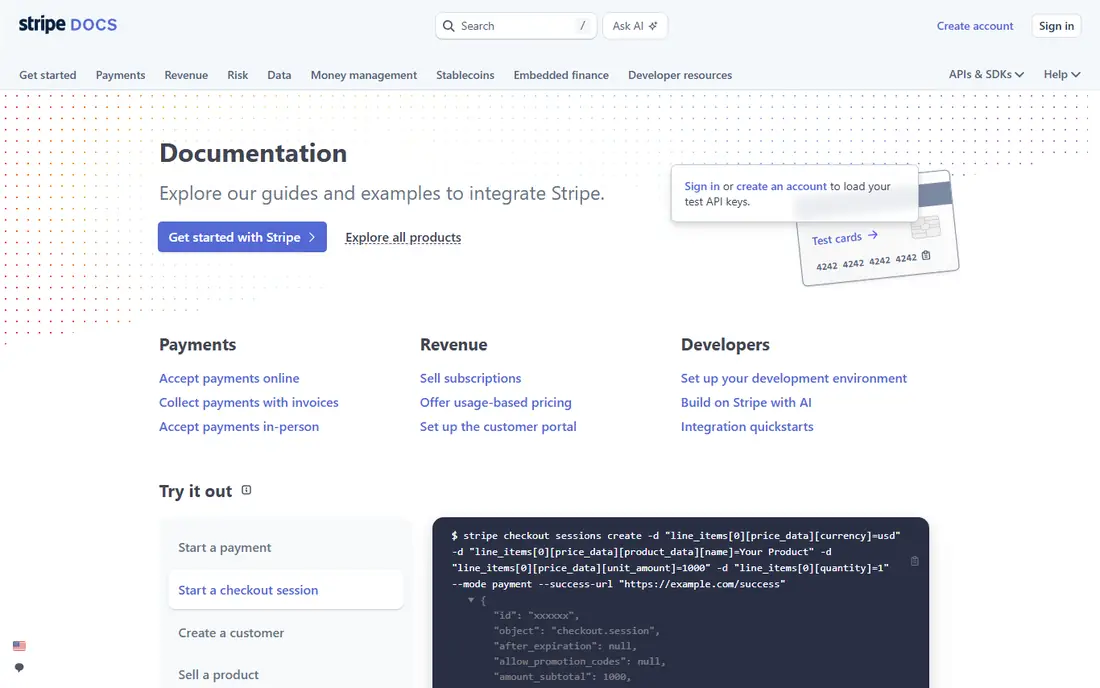
Stripe is the most-cited reference for excellent API documentation, and the praise is specific. The three-column layout puts navigation on the left, prose in the middle and code samples on the right that update as you click through, in Python, Node, Ruby, PHP, Java, Go and .NET. The API explorer lets developers make real test-mode calls in the browser with their own test keys, and the responses shown are live data from the test account rather than static JSON.
What we like- Three-column layout with code samples in seven languages, interactive API explorer with live test data, clear error and idempotency guidance, changelog-aware versioning
Watch out for- The sheer size of the surface area can overwhelm newcomers, and Billing adds a separate 0.7 percent fee on top of card processing
#2Twilio
Best for: Messaging, voice and email APIs organised around real tasks4.1/5 on
G2 (529 reviews, checked Oct 2026)
Visit twilio.com
Starting pricePay as you go; SMS from about $0.0079 per message in the US, third-party reported, checked 13 Nov 2026
Free planFree trial credit for new accounts
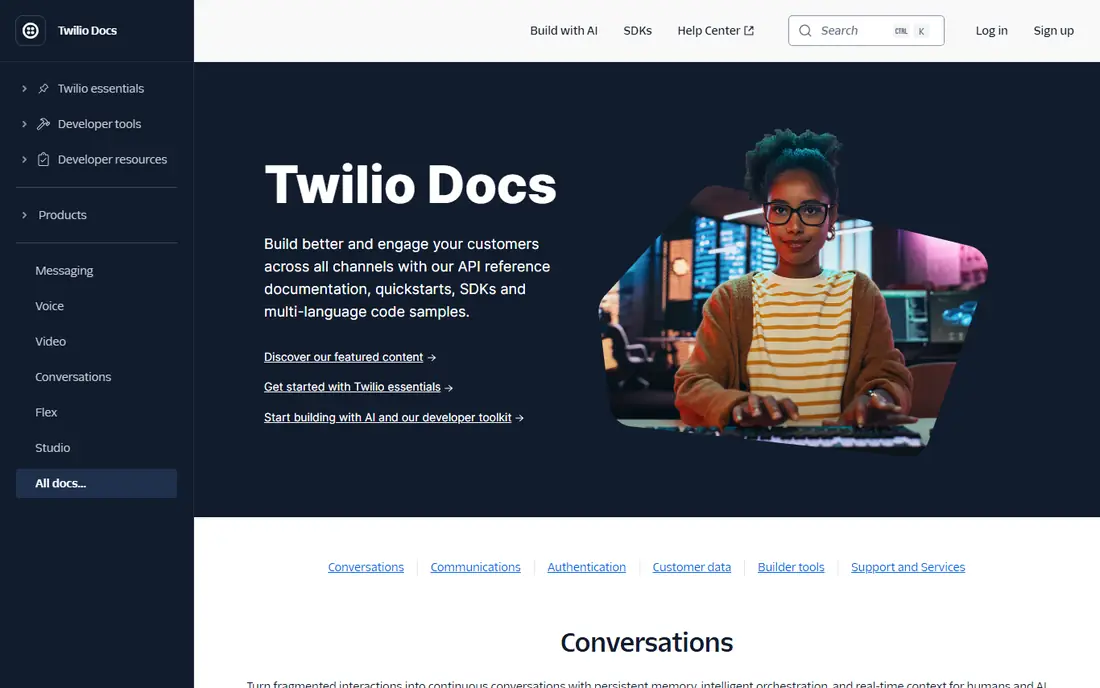
Twilio pioneered the build-it-as-you-read-it doc model, and its documentation still sets the standard for task-based guides. Instead of forcing every developer through one abstract reference layer, the docs organise content around product journeys: send an SMS, make a call, verify a number, send an email. Each guide shows real-world payloads, the webhook callback, and how retries should be handled, which is the part most docs skip. The Code Exchange offers full runnable applications rather than fragments, and the reference docs are searchable and OpenAPI-driven.
What we like- Task-oriented guides with runnable sample apps, real-world payloads and webhook behaviour shown, Code Exchange with full applications, docs in many languages including Node.js, C#, PHP, Ruby, Python, Java and curl
Watch out for- The product surface is very large, so finding the right guide takes care, and pricing varies by country and carrier
#3GitHub
Best for: REST and GraphQL API docs with the clearest versioning4.7/5 on
G2 (2,412 reviews, checked Oct 2026)
Visit docs.github.com
Starting priceFree plan; Team from $4 per user per month, third-party reported, checked 13 Nov 2026
Free planFree plan available
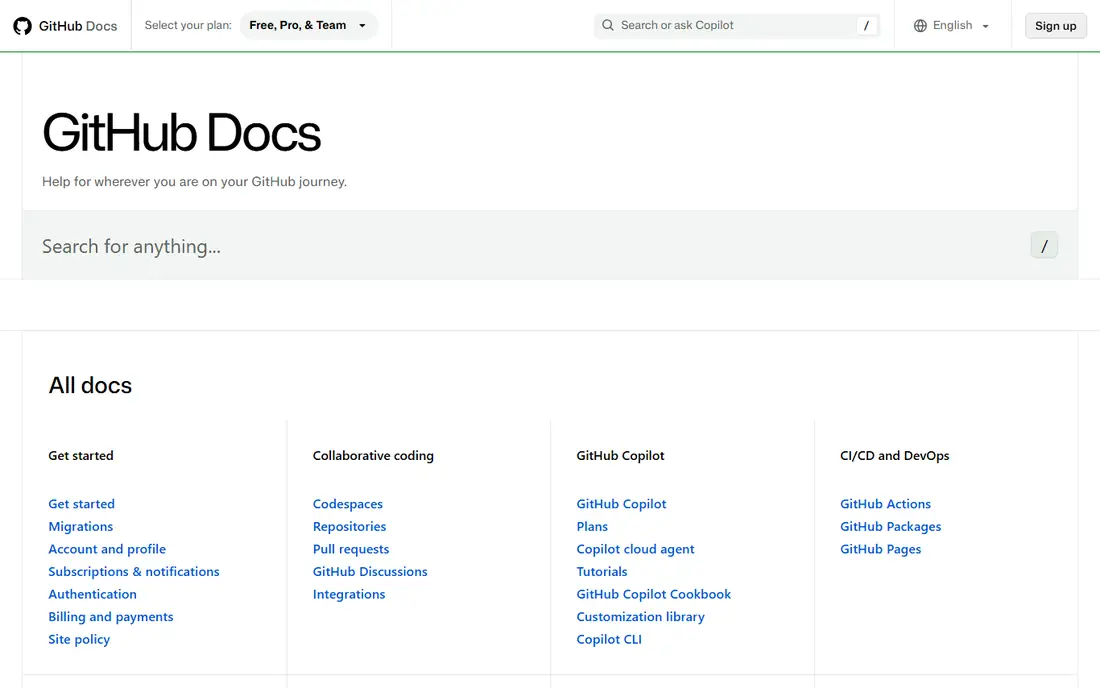
GitHub's REST API documentation is one of the clearest examples of how to communicate versioning without confusing people. Every resource page follows the same logic, so developers can scan for parameters, request shapes, response objects and errors without relearning the layout each time. The GraphQL reference sits beside the REST reference, and webhook documentation shows the payload, the delivery behaviour and how to verify signatures. The docs are versioned, searchable and maintained in public, which means errors get fixed quickly.
What we like- Clear versioning with a stated API version and changelog, REST and GraphQL references in one place, webhook docs with payload examples, large community and public issue tracking
Watch out for- The docs cover the whole GitHub platform, so API topics sit beside product docs, and some advanced topics assume Git knowledge
#4Slack
Best for: Event-driven platform docs and a deep Web API reference4.5/5 on
G2 (39,944 reviews, checked Oct 2026)
Visit docs.slack.dev
Starting priceFree plan; Pro from $7.25 per user per month billed yearly, third-party reported, checked 13 Nov 2026
Free planFree plan available
Slack is one of the best examples of documenting an event-driven platform without making it feel opaque. The Web API reference covers more than 200 methods, each with parameters, response shapes and examples, and the Events API documentation explains how to subscribe to events that are pushed to your app. Bolt framework guides show how to build apps in JavaScript, Python and Java, and the Block Kit builder lets developers design interactive messages visually.
What we like- Clear Web API methods reference with more than 200 methods, Events API docs that explain event-driven design, Bolt framework guides, Block Kit builder for interactive messages
Watch out for- The platform has grown past chat, so the docs cover apps, workflows, canvases and AI agents as well as messaging, which adds navigation depth
#5Shopify
Best for: Commerce API docs with GraphQL Admin and Storefront references4.4/5 on
G2 (5,144 reviews, checked Oct 2026)
Visit shopify.dev
Starting priceBasic from $29 per month billed yearly, $39 month to month, third-party reported, checked 13 Nov 2026
Free planFree trial; development stores free for partners
Shopify's developer docs are the reference for commerce APIs. The GraphQL Admin API is versioned, with a stable release every quarter and a changelog that tracks breaking and non-breaking changes, so app developers know exactly when a field will disappear. The Storefront API covers headless builds, the Ajax API covers theme work, and the OAuth and webhook guides explain authentication and event handling step by step. Development stores are free for partners, so a developer can build and test without paying for a store.
What we like- GraphQL Admin API with versioned releases, Storefront API for headless builds, clear OAuth and webhook guides, changelog that tracks breaking and non-breaking changes
Watch out for- REST Admin API is being deprecated in favour of GraphQL, so older tutorials go stale, and the API surface is large for a first-time app developer
Starting price$200 monthly free credit, then pay as you go, third-party reported, checked 13 Nov 2026
Free plan$200 monthly credit covers small usage
Google Maps Platform documentation is the reference for location APIs. The getting-started guide walks a developer through account creation, API key generation and enabling the right APIs and SDKs, and demo keys let you try Maps JavaScript API and Places features without billing information. The docs cover Maps SDKs, the Static API, Geocoding, Places and the new Places UI Kit, with code samples for web, iOS and Android.
What we like- Getting-started guide with API key setup, live demo keys that need no billing information, Maps JavaScript API and Places UI Kit docs, clear SDK coverage for web, iOS and Android
Watch out for- Pricing is usage-based across many SKUs, so the bill is hard to predict from the docs alone, and the product list is very wide
Starting priceFree plan with 100 emails per day; Essentials from $19.95 per month, third-party reported, checked 13 Nov 2026
Free planFree plan, 100 emails per day
SendGrid's API documentation is a prime example of how simplicity improves the developer experience. The quickstart gets a developer sending mail in minutes with a copy-paste example, and the reference stays short and focused instead of burying the reader in options. Webhook and event documentation shows how delivery, opens, clicks and bounces are reported, which is the part email developers actually debug. The free plan with 100 emails per day means the docs can be tested without a card.
What we like- Simple quickstart with copy-paste examples, interactive learning in the docs, clear webhook and event guidance, API reference that stays short and focused
Watch out for- The docs are simpler than Stripe or Twilio, so advanced topics such as dedicated IPs and subuser management get less depth
#8Postman
Best for: API testing docs and collections that act as living documentation4.6/5 on
G2 (1,795 reviews, checked Oct 2026)
Visit learning.postman.com
Starting priceFree plan; Basic from $14 per user per month, third-party reported, checked 13 Nov 2026
Free planFree plan available
Postman takes a different angle: its learning center teaches developers how to document, test and share APIs, and its collections turn documentation into something runnable. A collection holds the requests, the examples, the tests and the environment variables in one shareable file, so the docs never drift from the API. The public API Network hosts real collections from companies that publish them, which gives new developers working examples to copy.
What we like- Learning center with step-by-step guides, collections that document and test an API in one place, public API Network with real examples, mock servers and monitors
Watch out for- It documents other people's APIs rather than its own, so the quality of the examples varies, and the learning center assumes some API knowledge
We compared 2026 API documentation roundups from DreamFactory, HeroThemes, Dokly, Apidog and independent reviewers, and kept the platforms that appear in most of them. We favoured platforms whose docs include code samples, an interactive element and webhook guidance, because those three habits decide whether a developer ships. We checked each platform's docs address by search on 13 Nov 2026. Prices marked third-party reported come from vendor pricing pages and 2026 pricing coverage read via search, not from a page we opened directly, so confirm them with the vendor before budgeting. We did not build against any of these APIs ourselves.
Match the platform to the job first and the docs second. Payments need Stripe. Messaging needs Twilio. Code hosting needs GitHub. Team chat needs Slack. Commerce needs Shopify. Location needs Google Maps. Transactional email needs SendGrid. API testing needs Postman. Then judge the docs by timing the quickstart: a working call in under 15 minutes is a good sign. Check the error and webhook sections before you commit, since those decide how painful production will be. Finally, check the changelog and the status page, because a platform that documents its changes will also support its API honestly.
Frequently asked questions
Why is Stripe's API documentation considered the best?
Stripe's docs are praised for three things: a unified left-rail navigation that combines reference and tutorials, side-by-side code samples in seven languages that update as you click through, and dedicated API explorer pages that let you make real test-mode calls in the browser. The docs also cover errors, idempotency and webhooks in depth, and versioning is changelog-aware.
What should good API documentation include?
Good API documentation includes a quickstart that works in under 15 minutes, copy-paste code samples in the languages users actually use, a full reference with request and response shapes, error codes with fixes, webhook payloads and retry behaviour, and a versioning policy with a changelog. It should also include an interactive explorer or sandbox, authentication guidance, and rate limit documentation.
How do webhooks fit into API documentation?
Webhooks let an API push events to your server instead of making you poll for changes, and the docs must show the payload, the retry behaviour and how to verify the signature. Stripe, Twilio, GitHub and Slack all document webhooks well, because production integrations break on webhook handling more than on the happy path.
Is Postman documentation or a tool?
Postman is both. Its learning center teaches API documentation, testing and collaboration, and its collections turn documentation into runnable requests with tests and environment variables. A collection documents an API and tests it in one place, so the docs cannot drift from the real behaviour. Many companies publish their API as a public Postman collection, which gives developers a working example to copy instead of a static reference page.
How often should API documentation be updated?
API documentation should be updated with every release, and the changelog should record breaking and non-breaking changes separately. Stripe, Shopify and GitHub all version their APIs and publish changelogs, so developers know when a field will disappear. Docs that lag behind the API cause the most common integration bug: code written against an example that no longer matches reality.
Sources we checked (11)
- https://blog.dreamfactory.com/8-api-documentation-examples
- https://herothemes.com/blog/api-documentation-examples/
- https://www.dokly.co/blog/api-documentation-examples
- https://apidog.com/blog/api-documentation-example/
- https://preprod.stripe.com/pricing
- https://docs.stripe.com/apis
- https://www.twilio.com/docs
- https://docs.github.com
- https://docs.slack.dev/apis/web-api/
- https://shopify.dev
- https://developers.google.com/maps/documentation
Is your product missing or out of date?
We review this list regularly. Vendors can request a listing, send updated pricing or ask about featured placement.

Shihab Mia · Founder, Rankite
Shihab has 5+ years in B2B and SaaS SEO. He writes Rankite's software buying guides from pricing pages, documentation and public user reviews. More about Shihab.