How we make this list: we compare pricing pages, product documentation and public user reviews. Ratings come from G2, Capterra or Trustpilot, with the date we checked them.
Key takeaways
- Interactive Brokers is the strongest all-round platform for experienced traders, thanks to global markets, advanced order types, and tiered pricing.
- Webull, moomoo, and Robinhood offer $0 stock and ETF commissions with strong mobile and desktop charting for newer active traders.
- tastytrade is the specialist pick for options day traders, with $0 stock commissions and a fee cap on closing options legs.
- TradeStation suits systematic traders, but learning curves and data fees raise the real cost.
- This is not financial advice. Day trading carries a high risk of loss, so compare commissions, margin rules, data fees, and order tools before funding an account.
Quick comparison
| Tool | Best for | Starting price | Free plan |
|---|
 Interactive Brokers | Experienced multi-market traders | $0 | Yes |
 Webull | Active US stock and options traders | $0 | Yes |
 Robinhood | Simple mobile day trading | $0 | Yes |
 moomoo | Charting and Level 2 data at no commission | $0 | Yes |
 tastytrade | Options day traders | $0 | Yes |
 TradeStation | Systematic stock and futures traders | See website | No |
 Charles Schwab | Full-service broker with strong tools | $0 | Yes |
 Fidelity | Low-cost trading with strong research | $0 | Yes |
Is your product missing or out of date?
We review this list regularly. Vendors can request a listing, send updated pricing or ask about featured placement.
Starting price$0
Free planYes
Interactive Brokers fits traders who already know order types, margin, and market structure, and who want one account for many markets. Trader Workstation offers Level 2 quotes, scanners, complex orders, and customizable layouts, while the mobile app covers monitoring and simple orders on the go. IBKR Lite offers $0 commissions on US stocks and ETFs, while IBKR Pro uses tiered pricing from $0.0035 per share, which can suit high-volume traders who value routing control.
The catch is complexity. New traders can feel lost in Trader Workstation, and data subscriptions, exchange fees, and margin interest need careful reading before the first trade. Paper trading helps, and new users should practice order entry, stop placement, and position sizing there first. Interactive Brokers rewards experience, but it does not simplify day trading for someone still learning the basics.
What we like- Access to stocks, options, futures, forex, and bonds worldwide
- Trader Workstation with advanced order types
- Tiered pricing for high-volume traders
Watch out for- Platform learning curve is steep
- Market data fees and tiered commissions add complexity for beginners
Starting price$0
Free planYes
Webull suits active traders who want professional-looking charts without paying stock or options commissions. The desktop and mobile platforms include technical indicators, drawing tools, Level 2 data options, screeners, and extended-hours trading, which cover most intraday workflows. Paper trading lets new users practice entries and exits with virtual funds before risking real money, and the $0 commission structure keeps small, frequent trades from being eaten by fees.
The limits show up in short selling and support. Hard-to-borrow names, a common focus for small-cap day traders, can be unavailable or costly to borrow, and help channels are thinner than at Schwab or Fidelity. Webull also focuses mainly on US markets, so traders who want global futures or forex need a second broker. For US stock and options day trading on a clear, modern platform, Webull is a strong, low-cost choice.
What we like- $0 commissions on US stocks, ETFs, and options
- Strong charting on mobile and desktop
- Paper trading included
Watch out for- Short selling can be limited for hard-to-borrow stocks
- Customer support and research depth lag full-service brokers
Starting price$0
Free planYes
Robinhood fits new day traders who want to start on a phone with a simple layout and no stock commission. Buying, selling, and setting basic limit orders takes only a few taps, and the app shows price charts, news, and a watchlist without clutter. Options trading also carries $0 commission with no per-contract fee on the standard plan, which keeps costs predictable for small options trades.
The trade-off is depth. Robinhood lacks the advanced hotkeys, direct routing, custom screeners, and detailed Level 2 tools that specialist platforms offer, and some of those features sit behind Robinhood Gold at $5 per month after a trial. Traders who scalp, use complex spreads, or need fast multi-monitor setups will outgrow it quickly. Use Robinhood to learn the mechanics of day trading with small size, and move to a specialist platform when order speed and charting depth start to matter.
What we like- $0 commissions on stocks, ETFs, and options
- Very simple mobile interface
- Instant access to basic charting and news
Watch out for- Charting and order tools are lighter than specialist platforms
- Gold subscription adds cost for Level 2 data and margin features
Starting price$0
Free planYes
moomoo suits traders who want a feature-rich platform without paying commissions, and who value data visibility. Free Level 2 market data, earnings calendars, heat maps, stock screeners, and paper trading give active traders tools that other brokers charge for or reserve for paid tiers. The desktop platform supports multi-monitor layouts, custom indicators, and drawing tools, while the mobile app keeps the same core workflow on the go.
The limits are product range and margin cost. moomoo does not offer crypto, bonds, or mutual funds in the way a full-service broker does, so long-term investors need a second account for those assets. Margin interest, listed in vendor comparisons at around 10.5 to 11.5 percent, is high, so traders who hold margin balances overnight should compare that cost carefully. For commission-free intraday stock and options trading with strong charting, moomoo is hard to beat on features per dollar.
What we like- $0 commissions on US stocks, ETFs, and options
- Free real-time Level 2 market data
- Paper trading and earnings tools included
Watch out for- No crypto, bond, or mutual fund trading in the main offering
- Margin interest rates are high compared with some rivals
Starting price$0
Free planYes
tastytrade fits traders whose day trading centers on options. The platform was built around spread trading, volatility analysis, and managing several options positions at once, so the layout, order ticket, and risk views reflect that focus. Stock commissions are $0, and options trades carry no opening commission on stock options, with closing fees capped at $10 per leg, which keeps frequent spread trading costs clear and bounded.
For pure stock day traders, tastytrade is less compelling than Webull or moomoo, because its charting and stock research tools are narrower. Traders who mainly trade stocks, and only occasionally trade options, may prefer a broader broker. Traders who trade options daily, manage spreads, and watch volatility and Greeks closely will find tastytrade purpose-built for that work, with an open API for traders who automate parts of their workflow.
What we like- $0 stock commissions
- Options closing fees capped at $10 per leg
- Built for spreads, volatility, and position management
Watch out for- Stock charting and research are less broad than full-service brokers
- Futures and crypto coverage is narrower than Interactive Brokers
Starting priceSee website
Free planNo
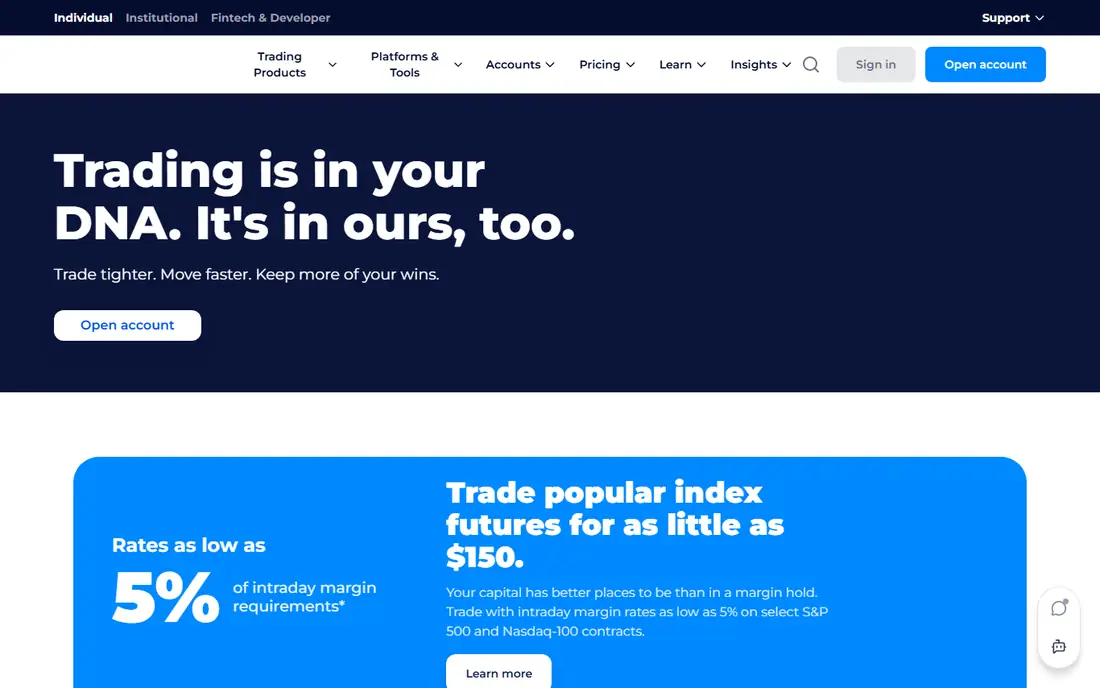
TradeStation suits systematic traders who test ideas, build custom indicators, and trade from charts with speed. EasyLanguage lets traders code indicators, signals, and automated strategies without learning a full programming language, and market replay supports backtesting against past price action. The platform links with TradingView for charting, and it covers stocks, over-the-counter stocks, options, futures, and crypto in a single account, which helps traders who move between asset types.
The cost of entry is higher than commission-free mobile brokers. Vendor listings note a $2,500 minimum deposit for US traders, and market data fees apply on top of commissions, so the total monthly cost depends on the data packages chosen. The interface rewards time invested, but new traders should expect a learning period. TradeStation is best for traders who already have a method and want tools to test, refine, and execute it systematically.
What we like- Powerful charting and backtesting
- EasyLanguage for custom indicators and strategies
- Stocks, options, futures, and crypto in one account
Watch out for- Higher learning curve
- Minimum deposit and data fees raise the starting cost
- Interface can feel dense for new traders
#7Charles Schwab
Best for: Full-service broker with strong tools1.5/5 on
Trustpilot (786 reviews, checked Oct 2026)
Visit schwab.com
Starting price$0
Free planYes
Charles Schwab fits traders who want a full-service broker behind their day trading account. The thinkorswim platform, originally built for active traders, offers deep charting, custom studies, paper trading, and complex options tools, while Schwab itself provides banking, retirement accounts, research, and branch and phone support. Stock and ETF commissions are $0, and the account works for both active trading and long-term investing, so traders do not need a separate broker for each job.
Options traders pay $0.65 per contract, which is higher than Webull, Robinhood, moomoo, or tastytrade for frequent options trades. thinkorswim also takes time to learn, and casual traders may find its depth unnecessary for simple stock trades. Schwab is the best choice for traders who want strong tools, broad support, and a single broker for trading and investing, and who accept the per-contract options fee.
What we like- $0 stock and ETF commissions
- Thinkorswim platform with deep charting
- Broad research and customer support
Watch out for- Options cost $0.65 per contract
- Thinkorswim learning curve is steep for casual traders
Starting price$0
Free planYes
Fidelity suits traders who value research, education, and low costs alongside active trading. Active Trader Pro offers customizable layouts, streaming quotes, charting, and options tools on desktop, while the mobile app handles monitoring and simple orders. Research, screeners, and learning materials help new traders understand order types, risk, and position sizing before increasing size. Stock and ETF commissions are $0, and Fidelity offers a wide range of accounts for investing beyond day trading.
The limits mirror Schwab. Options cost $0.65 per contract, so high-volume options traders pay more than at $0-contract brokers. Active Trader Pro, while functional, looks dated compared with Webull, moomoo, or TradeStation, and its workflow takes adjustment. Fidelity is best for traders who want a low-cost, well-supported broker with strong research, and who trade stocks mainly, with options as a secondary activity.
What we like- $0 stock and ETF commissions
- Strong research, screeners, and education
- Active Trader Pro for desktop trading
Watch out for- Options cost $0.65 per contract
- Active Trader Pro feels dated next to newer platforms
How we chose
We compared pricing pages, vendor documentation, and public reviews on G2, Capterra, and Reddit, alongside commissions, options fees, account minimums, market data costs, and platform tools. We checked charting depth, order types, Level 2 data, paper trading, extended-hours access, and asset coverage, because day traders need execution tools, not just a low headline commission. We also weighed fit for different traders, since a beginner, an options specialist, and a systematic futures trader need different platforms. This is not financial advice, and no platform in this list can improve trading results on its own.
What to compare before you fund an account
Total cost, not just commission
A $0 stock commission does not mean a $0 trading month. Check options per-contract fees, futures commissions, market data subscriptions, margin interest, and any platform fees. A trader who trades options daily will feel a $0.65 per-contract fee quickly, while a stock-only trader may never notice it. Add up your expected trades, data, and margin use before choosing.
Order tools and speed for your style
Scalpers need hotkeys, fast order entry, and Level 2 data. Spread traders need options chains, risk views, and position management. Systematic traders need backtesting and custom indicators. Test the platform with paper trading first, and practice the exact orders you plan to use, including stops, limits, and bracket orders, before risking real funds.
Margin and day trading rules
Margin rules and day trading limits changed in the United States during 2026, and brokers are moving to new risk-based standards over different timelines. Do not assume an old rule still applies to your account. Read your broker's current margin, buying power, and day trading pages, and confirm the rules for cash versus margin accounts before you trade.
Risk controls and position size
Set a maximum loss per trade and per day, use stop orders where your strategy calls for them, and keep position sizes small while learning a new platform. Day trading can produce rapid losses, especially with margin, options, or futures, and a good platform does not remove that risk. Paper trade a new strategy, review losing trades, and increase size only after consistent, disciplined execution.
Frequently asked questions
What is the best day trading platform for beginners?
Webull or moomoo are good starting points for beginners, thanks to $0 stock commissions, strong charting, and paper trading. Robinhood is simpler still, but its tools are lighter. Beginners should paper trade first, keep size small, and learn order types before trading with real money.
Which platform has the lowest day trading commissions?
For US stocks and ETFs, Webull, Robinhood, moomoo, Schwab, and Fidelity all offer $0 commissions. For options, Webull, Robinhood, and moomoo charge $0 per contract, while Schwab and Fidelity charge $0.65 per contract. For high-volume stock trading, Interactive Brokers Pro tiered pricing can be competitive, depending on share volume and routing.
Do I need $25,000 to day trade?
Not necessarily, and the answer depends on your broker and account type. The old pattern day trader rule in the United States was deleted by FINRA effective June 2026, with brokers moving to new risk-based intraday margin standards over a transition period. Check your broker's current rules for margin and cash accounts, because limits still vary by broker.
Is day trading profitable?
Day trading carries a high risk of loss, and most short-term traders lose money, especially when using margin or borrowed funds. No platform, indicator, or fee structure changes that risk. Treat day trading as a skill that requires practice, risk controls, and capital you can afford to lose, and seek independent financial advice for your own situation.
Can I day trade on my phone?
Yes, for simple stock and options trades, and Webull, moomoo, Robinhood, Schwab, and Fidelity all offer capable mobile apps. For scalping, complex spreads, or multi-monitor work, a desktop platform such as Trader Workstation, thinkorswim, TradeStation, or Active Trader Pro gives faster order entry and deeper charting.
Should I use one broker or several?
Many active traders use more than one broker, such as a commission-free broker for stocks, a specialist for options, and a separate broker for futures. That approach adds complexity in tracking positions, taxes, and margin, so start with one broker that covers your main market, and add a second only when a clear gap appears.
Sources we checked (8)
- https://www.interactivebrokers.com
- https://www.webull.com
- https://robinhood.com
- https://www.moomoo.com
- https://www.tastytrade.com
- https://www.tradestation.com
- https://www.schwab.com
- https://www.fidelity.com
Is your product missing or out of date?
We review this list regularly. Vendors can request a listing, send updated pricing or ask about featured placement.

Shihab Mia · Founder, Rankite
Shihab has 5+ years in B2B and SaaS SEO. He writes Rankite's software buying guides from pricing pages, documentation and public user reviews. More about Shihab.