How we make this list: we compare pricing pages, product documentation and public user reviews. Ratings come from G2, Capterra or Trustpilot, with the date we checked them.
Key takeaways
- Pinecone is the simplest managed replacement for Weaviate, while Qdrant and Milvus give self-hosters more control at lower cost.
- Chroma is the fastest path from prototype to production for small teams, and it runs locally with a single install.
- Vespa and Elasticsearch suit teams that need keyword search, vector search, and ranking in one system rather than a pure vector store.
- Retrieval quality depends more on chunking, embeddings, and reranking than on the database engine, so pick the operating model first.
Quick comparison
| Tool | Best for | Starting price | Free plan |
|---|
 Pinecone | Managed, zero-ops vector search | Pay as you go | Yes |
 Qdrant | Self-hosted performance and filtering | See website | See website |
 Milvus | Billion-scale open-source retrieval | See website | Yes |
 Chroma | Local development and serverless search | See website | Yes |
 Vespa | Search plus ranking at scale | See website | Yes |
 LanceDB | Multimodal data and training sets | See website | Yes |
 Elasticsearch | Hybrid search with analytics | See website | Yes |
 MongoDB Atlas | Vector search inside an app database | See website | See website |
Is your product missing or out of date?
We review this list regularly. Vendors can request a listing, send updated pricing or ask about featured placement.
The best Weaviate alternatives
#1Pinecone
Best for: Managed, zero-ops vector search4.5/5 on
G2 (71 reviews, checked Oct 2026)
Visit pinecone.io
Starting pricePay as you go
Free planYes
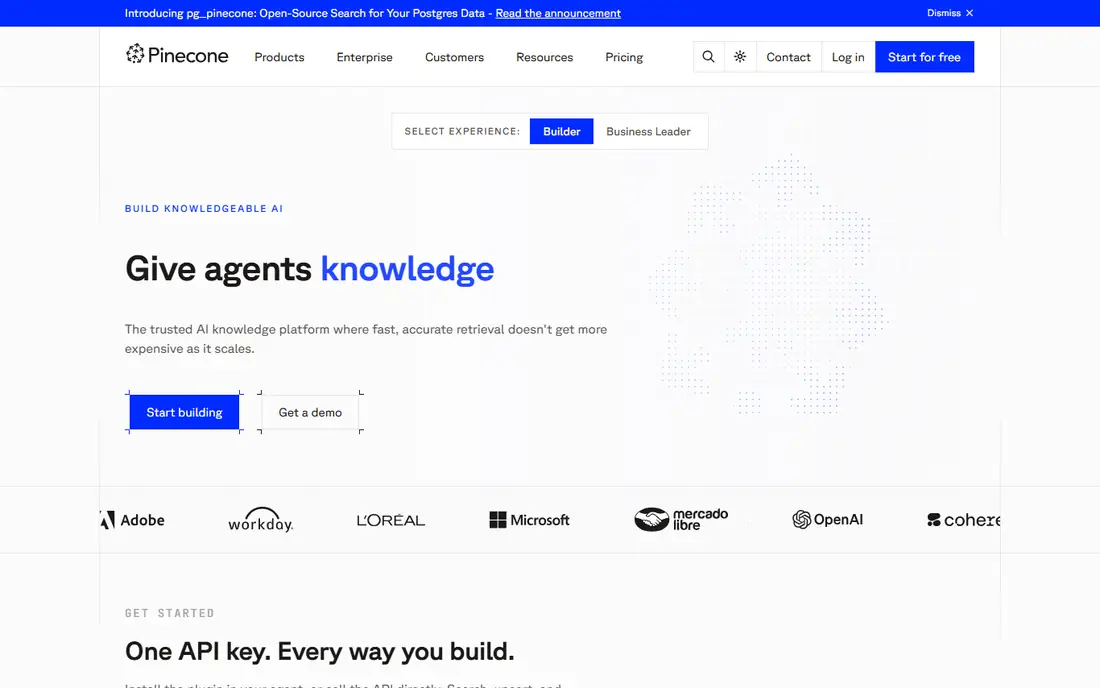
Pinecone is the most direct managed alternative to Weaviate Cloud. It is a fully managed vector database built for AI, with automatic indexing and no tuning required. Writes are acknowledged in under 100 milliseconds and become searchable within seconds, and the platform now wraps its database in a broader knowledge platform with governed enterprise data access.
The appeal is operational simplicity. There are no clusters to size, no index rebuilds to schedule, and no infrastructure to maintain. You create an index for free and pay as you go when you scale. The trade-off is control. Pinecone is cloud-only, so teams with data residency rules or air-gapped requirements must look at Qdrant or Milvus instead. At very large scale, managed pricing can also exceed the cost of running an open-source engine yourself.
What we like- Fully managed with automatic indexing
- Writes searchable within seconds
- Queries stay fast at any scale
Watch out for- Managed-only, so no self-hosted option
- Costs can grow with large indexes
#2Qdrant
Best for: Self-hosted performance and filtering4.5/5 on
G2 (12 reviews, checked Oct 2026)
Visit qdrant.tech
Starting priceSee website
Free planSee website
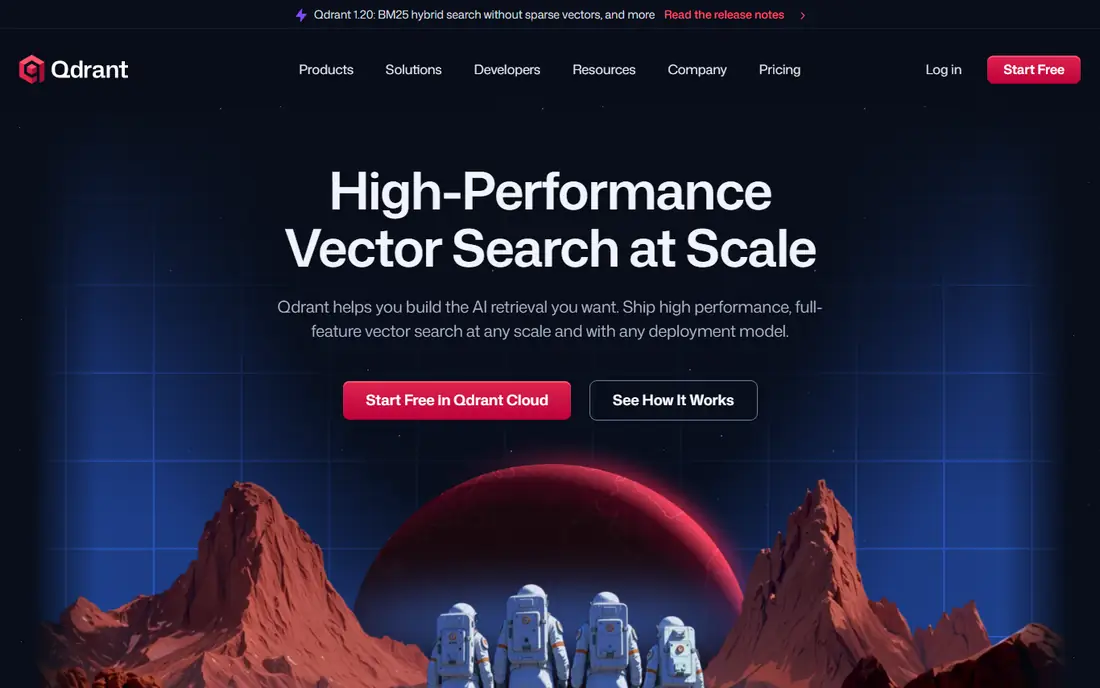
Qdrant is an open-source vector search engine written in Rust, and it is the favorite of teams that want speed and filtering without giving up self-hosting. Its storage engine uses quantization to cut memory use by up to 64 times while keeping search quality, and filters apply during index traversal rather than before or after it. That design keeps recall high even under complex conditions.
Native hybrid search blends dense vectors with sparse methods such as BM25, and built-in reranking covers score boosting and late-interaction models. Qdrant Cloud exists for teams that want managed hosting, but the open-source core is the main draw. The honest catch is operational work. Running Qdrant well at scale means owning upgrades, backups, and monitoring, which is exactly the burden Pinecone removes.
What we like- Rust-based engine with fast queries
- Rich metadata filtering
- Native hybrid dense and sparse search
Watch out for- Self-hosting needs DevOps effort
- Smaller managed ecosystem than Pinecone
Starting priceSee website
Free planYes
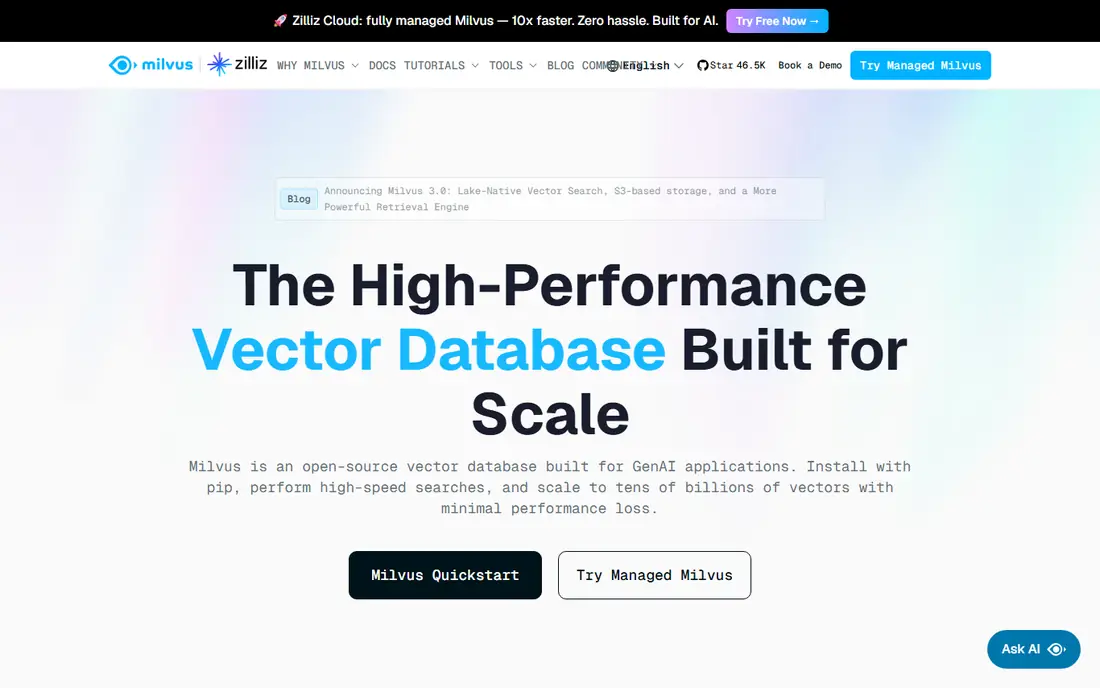
Milvus is the most widely adopted open-source vector database, and it is built for the largest retrieval workloads. It ships in three shapes: Milvus Lite as a library for notebooks and laptops, Standalone for single-machine production up to millions of vectors, and Distributed for horizontal scaling to billions. The fully managed version runs as Zilliz Cloud in serverless and dedicated forms.
For teams outgrowing Weaviate at scale, Milvus offers the most headroom and the largest community. It supports hybrid search, metadata filtering, and multi-vector retrieval. The downside is complexity at the top end. A distributed Milvus deployment is a real piece of infrastructure, and small teams may find Lite or Standalone enough while larger ones need dedicated DevOps attention.
What we like- Kubernetes-native distributed design
- Scales to tens of billions of vectors
- Lite, Standalone, and Distributed editions
Watch out for- Distributed setup is complex
- Managed option (Zilliz Cloud) is a separate product
#4Chroma
Best for: Local development and serverless search4.2/5 on
G2 (6 reviews, checked Oct 2026)
Visit trychroma.com
Starting priceSee website
Free planYes
Chroma started as the simplest local vector store for AI prototypes and has grown into open-source search infrastructure with a serverless cloud. The open-source core is Apache 2.0, downloads run into the millions per month, and the cloud version builds indexes on object storage for low cost. Search covers vectors, full text with BM25, sparse vectors, regex, and metadata filtering, plus dataset versioning and forking for experiments.
New users get $5 in free credits, and local development needs nothing more than a package install. Chroma is the right pick when you want to move fast and keep costs down. Its limits show at extreme scale, where per-collection caps and throughput ceilings matter, and teams with billion-vector workloads should compare Milvus or Qdrant first.
What we like- Installs in seconds with pip or npm
- Vector, full-text, regex, and metadata search
- Serverless cloud with object-storage economics
Watch out for- Smaller scale ceiling per collection than Milvus or Qdrant
- Cloud pricing details require a sales conversation
Starting priceSee website
Free planYes
Vespa is different from the other tools here because it is a full AI search platform, not only a vector database. It queries vectors, tensors, text, and structured data, scales to billions of items with thousands of queries per second at latencies below 100 milliseconds, and runs machine-learned ranking models inside the platform. That combination suits search, recommendation, and personalization systems where relevance tuning matters as much as retrieval.
Vespa is open source and fully managed hosting is available. The catch is expertise. Getting the most from Vespa means learning its ranking framework and schema model, which is more work than pointing an embedding pipeline at Pinecone. Teams that need keyword search, vector search, and ranking in one system, and that have search engineers, will find it hard to beat.
What we like- Vector, text, and structured data in one platform
- Distributed machine-learned ranking
- Proven at Spotify and Yahoo scale
Watch out for- Steeper learning curve than pure vector stores
- Ranking configuration takes real expertise
Starting priceSee website
Free planYes
LanceDB describes itself as a multimodal lakehouse for AI, and that framing explains its place on this list. Instead of treating a vector index as a separate system, it stores raw data, features, metadata, and embeddings together in the open Lance format, with versioning, branching, and rollback built in. Search covers vectors, full text, and hybrid queries with SQL filters against the same table.
This matters most for teams building training datasets and agentic retrieval together, since curation, feature engineering, and retrieval share one store. Companies such as Midjourney and Runway use LanceDB in production. The trade-off is focus. If you only need a vector index for a chatbot, LanceDB adds concepts you may not need, and its community is smaller than those of Milvus or Qdrant.
What we like- Open Lance format unifies data, features, and embeddings
- Vector, full-text, and hybrid search in one table
- Strong training-data workflow
Watch out for- Newer and more training-focused than pure retrieval rivals
- Smaller community than Milvus
Starting priceSee website
Free planYes
Elasticsearch is the veteran on this list, an open-source distributed search and analytics engine that now handles vector data as a first-class citizen. It stores structured, unstructured, and vector data together, runs hybrid search with filters and reranking, and adds inference services that run embedding models where the data lives. Deployment spans serverless cloud, hosted cloud on AWS, Google Cloud, and Azure, and on-prem installs.
The reason to pick Elasticsearch over Weaviate is breadth. One cluster can serve app search, log analytics, security analytics, and RAG retrieval, which reduces the number of systems a team maintains. The cost is footprint. Elasticsearch clusters need tuning and capacity planning, and it is more machinery than a team needs for a single RAG app. Teams already running Elastic for logs or security get the most value.
What we like- Vector, full-text, and analytics in one engine
- 350+ integrations
- Serverless, hosted, and on-prem deployment
Watch out for- Larger operational footprint than a pure vector store
- Licensing and pricing need care at scale
#8MongoDB Atlas
Best for: Vector search inside an app database4.5/5 on
G2 (904 reviews, checked Oct 2026)
Visit mongodb.com
Starting priceSee website
Free planSee website
MongoDB Atlas takes the consolidation idea furthest. Its vector search runs inside the same platform as the operational document database, so application data and embeddings live together. That removes the sync jobs and dual writes that come with a separate vector store, and teams can build semantic search, recommendations, Q and A systems, and RAG context from the same collections they already query.
The honest limit is specialization. Atlas vector search is excellent for app-level retrieval, but dedicated engines such as Qdrant or Milvus offer deeper filtering, quantization, and retrieval controls at extreme scale. Choose Atlas when your app already runs on MongoDB and your retrieval needs are moderate. Choose a dedicated vector database when retrieval is the product itself.
What we like- Operational and vector data in one platform
- No separate vector store to sync
- Familiar document model and aggregation pipeline
Watch out for- Vector search is an add-on to a document database, not a dedicated engine
- Large-scale retrieval may lag pure vector stores
How we chose
We compared databases that can replace Weaviate for RAG and semantic search, covering managed cloud, self-hosted open source, and hybrid options. We opened each vendor homepage to confirm the product name, current positioning, and deployment model, and we used "See website" for prices we could not verify on vendor pages. We favored tools with real production use and excluded narrow libraries and single-feature services. Public comparisons, vendor documentation, and pricing pages informed the strengths and weaknesses.
What to check before you switch
Start with your operating model, not the benchmark table. Managed services remove operations but charge per use and limit data control. Self-hosted engines cost less at scale but need engineers. Then check your query pattern. Simple top-k similarity is easy everywhere, while filtered search, hybrid keyword plus vector queries, and reranking separate the serious options from the simple ones.
Scale and cost planning
Estimate your vector count, dimension size, and query rate before comparing prices. A million 384-dimension vectors is a different problem from a billion 1536-dimension ones. Managed pricing grows with storage and queries, while self-hosted cost grows with machines and engineering time. Run a realistic load test with your own embeddings, since vendor benchmarks rarely match your data distribution.
Retrieval quality work
The database is rarely the bottleneck in a RAG system. Chunk size, embedding model choice, metadata quality, and reranking usually matter more. Pick a database that supports your filtering and hybrid search needs, then spend the saved effort on pipeline quality. Revisit the choice only when scale or latency forces it, not because a new engine appears.
Frequently asked questions
Is Weaviate being discontinued?
No, Weaviate remains an active open-source and cloud product. Teams switch because they want a managed service, self-hosting control, lower cost, or a different feature set, not because Weaviate has shut down.
Which Weaviate alternative is best for a small project?
Chroma is the easiest start, since it installs locally in seconds and offers a serverless cloud. Pinecone is the easiest managed option, with a free first index and pay-as-you-go pricing.
Can I self-host a Weaviate alternative for free?
Yes. Qdrant, Milvus, Chroma, Vespa, LanceDB, and Elasticsearch all offer open-source editions you can run on your own infrastructure. You pay for machines and operations rather than a license.
Which alternative handles the largest scale?
Milvus Distributed and Vespa are built for the largest workloads, with billion-vector scale and distributed designs. Qdrant also scales to billions with quantization. Managed Pinecone scales similarly but at a usage-based price.
Should I use a dedicated vector database or add vector search to my existing database?
Use your existing database, such as MongoDB Atlas or Elasticsearch, when retrieval is one feature among many. Use a dedicated vector database when retrieval quality, filtering, or scale is central to your product.
Sources we checked (8)
- https://www.pinecone.io
- https://qdrant.tech
- https://milvus.io
- https://www.trychroma.com
- https://vespa.ai
- https://lancedb.com
- https://www.elastic.co/elasticsearch
- https://www.mongodb.com
Is your product missing or out of date?
We review this list regularly. Vendors can request a listing, send updated pricing or ask about featured placement.

Shihab Mia · Founder, Rankite
Shihab has 5+ years in B2B and SaaS SEO. He writes Rankite's software buying guides from pricing pages, documentation and public user reviews. More about Shihab.