How we make this list: we compare pricing pages, product documentation and public user reviews. Ratings come from G2, Capterra or Trustpilot, with the date we checked them.
Key takeaways
- Nutanix is the best full-stack enterprise replacement, with one hybrid cloud platform for apps, data, and AI, trusted by 32,000-plus companies.
- Proxmox VE is the best open-source pick, with free software, enterprise support options, and tens of thousands of customers.
- Red Hat OpenShift Virtualization is the best container-plus-VM platform, running VMs alongside containers on a unified hybrid cloud foundation.
- Scale Computing and VergeIO suit distributed and cost-focused estates, with DCIG Top 5 VMware alternative recognition and single-license models.
- Microsoft Hyper-V suits Windows-centric shops, with deep Windows Server integration and failover clustering built in.
Quick comparison
Is your product missing or out of date?
We review this list regularly. Vendors can request a listing, send updated pricing or ask about featured placement.
The best VMware alternatives for enterprise
Starting priceSee website
Free planSee website
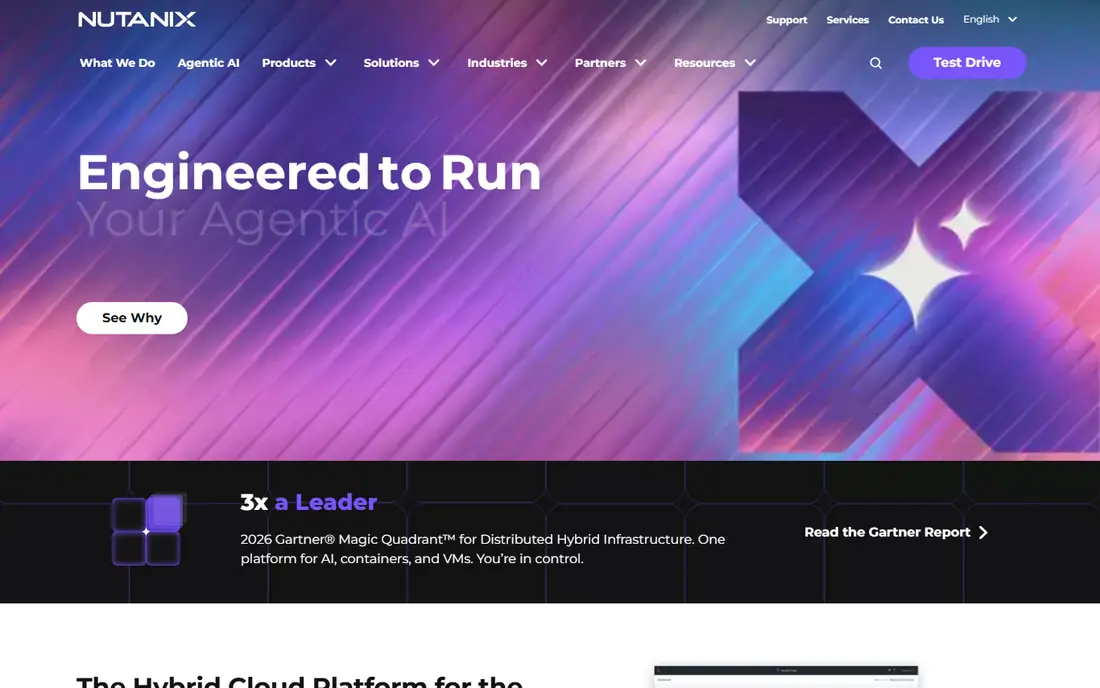
Nutanix calls itself one platform to run apps, data, and AI anywhere, and its homepage leads with the hybrid cloud platform for the AI-powered enterprise: one platform, one operating model, engineered to run your AI, apps, and data anywhere. Its pitch covers innovating faster with agentic AI workflows, modernizing now with a dual-native platform, and running better with secure, governed, resilient infrastructure, plus an explicit migrate from VMware on your terms message.
For enterprises seeking the most complete VMware replacement, Nutanix is the best pick, with storage, networking, and management unified under one platform. Smaller teams may find its enterprise pricing and scope heavier than Proxmox, but for large estates, Nutanix is the default alternative.
What we like- One platform, one operating model for AI, apps, and data anywhere
- Dual-native platform running VMs and containers consistently
- Recognized as a Leader in the Gartner Magic Quadrant for Distributed Hybrid Infrastructure
- Trusted by 32,000-plus companies
Watch out for- Pricing is quote-led, so budgeting requires a sales conversation
- Full platform scope may exceed teams that only need a hypervisor
Starting priceFree
Free planYes
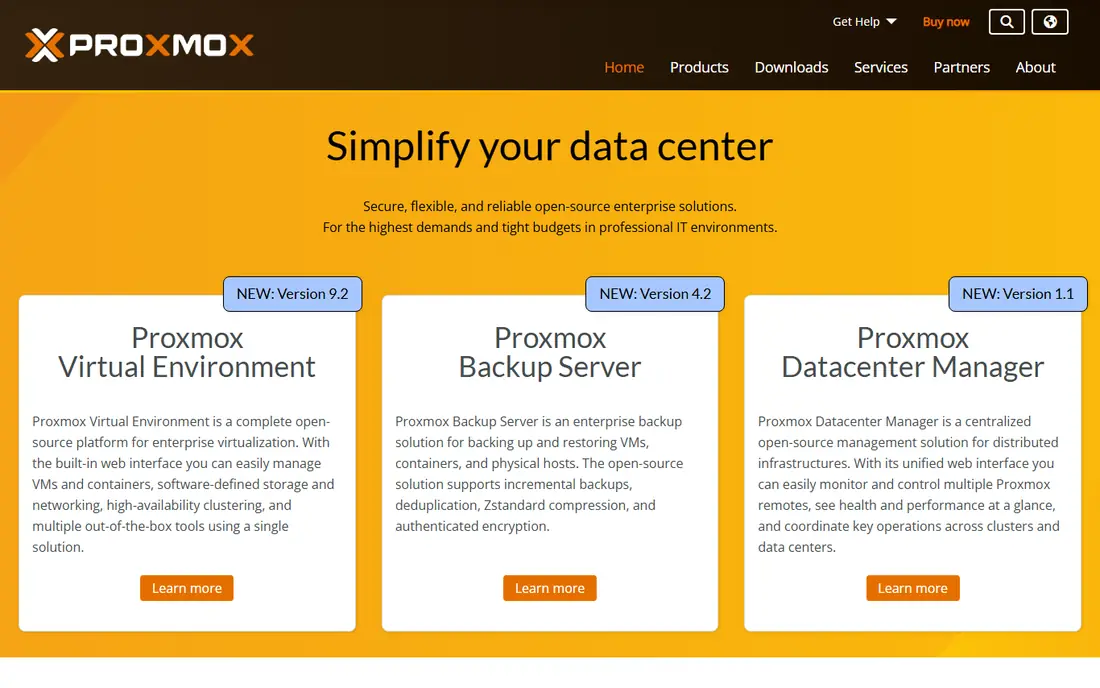
Proxmox describes itself as powerful open-source server solutions, and its homepage emphasizes the support model: enterprise support and flexible services tailored to your goals, from conception to successful implementation of your data center strategy, with experienced partners at your side. Its offerings span support, implementation, training, and documentation, with a commitment to open source shared with customers and the global community.
For teams that want VMware-class virtualization without license fees, Proxmox VE is the best pick, since the software is free and enterprise support is optional rather than mandatory. Organizations needing vendor-backed SLAs should buy the support subscription, but the core platform costs nothing to run.
What we like- Powerful open-source server solutions with enterprise support, implementation, and training available
- Trusted by tens of thousands of customers
- Comprehensive documentation and a strong global community
- No license cost for the software itself
Watch out for- Support and services are paid separately from the free software
- Smaller vendor ecosystem than Nutanix or Red Hat for some enterprise integrations

#3
Red Hat OpenShift Virtualization
Best for: VMs plus containers
Visit redhat.com
Starting priceSee website
Free planSee website
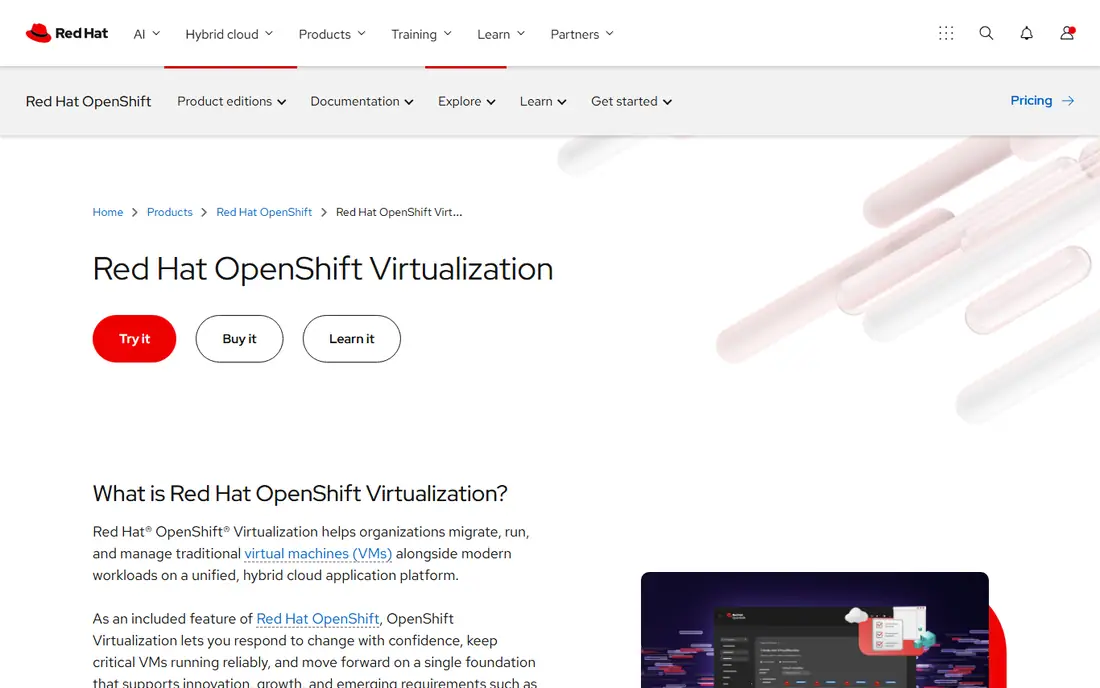
Red Hat OpenShift Virtualization helps organizations migrate, run, and manage traditional virtual machines alongside modern workloads on a unified, hybrid cloud application platform. Its homepage explains the value: as an included feature of Red Hat OpenShift, it lets you respond to change with confidence, keep critical VMs running reliably, and move forward on a single foundation supporting innovation, growth, and AI, with simplified VM migrations through included migration services.
For enterprises already moving to containers or Kubernetes, Red Hat OpenShift Virtualization is the best VMware alternative, since it unifies VM and container operations under one set of tools. Teams that only need VMs may prefer the streamlined OpenShift Virtualization Engine, a cost-efficient VM-only solution Red Hat also offers.
What we like- Built on the trusted open-source KVM hypervisor and included with any Red Hat OpenShift edition
- Migrate and run VMs alongside containers and serverless workloads
- Leader in the 2026 Gartner Magic Quadrant for Server Virtualization Platforms
- Emirates NBD migrated 9,000 VMs across multiple datacenters in 6 months
Watch out for- Requires OpenShift adoption, so it is a platform decision, not just a hypervisor swap
- Pricing follows OpenShift editions
Starting priceSee website
Free planSee website
Citrix describes its platform with the promise to secure the work, trusting Citrix to deliver improved user experiences, more productivity, and tailored security at an optimized cost. Its homepage highlights centralized app and desktop management for distributed workforces, mission-critical application delivery with risk-adaptive access, and zero trust app access for SaaS and web applications, plus hybrid multi-cloud solutions that reduce e-waste and carbon emissions.
For enterprises whose VMware use centers on virtual desktops and app delivery, Citrix is the best alternative, with the strongest DaaS positioning in this list. Pure server virtualization estates should pair Citrix with a hypervisor like Nutanix or Proxmox, since Citrix solves the delivery layer rather than the compute layer alone.
What we like- Secure app and desktop delivery to any device with tailored security at optimized cost
- New Citrix Platform Flex offers persona-based licensing with predictable cost
- Ranked first in all five DaaS use cases in the 2025 Gartner Critical Capabilities report
- 4,300-plus healthcare customers worldwide
Watch out for- Focus is app and desktop delivery rather than pure server virtualization, so it complements rather than replaces a hypervisor for some estates
- Pricing is quote-led
Starting priceSee website
Free planSee website
Scale Computing calls itself one platform for all your edge locations, with the promise of one platform, thousands of sites, and zero on-site IT. Its platform combines compute, storage, and networking in one compact system designed to cut costs and complexity at every location, with edge computing, datacenter, cloud-managed SD-WAN, and managed network service provider solutions, plus a TCO calculator for personalized cost analysis.
For distributed enterprises with many remote sites, Scale Computing is the best VMware alternative, since its self-healing, right-sized infrastructure runs critical apps where they are needed without local IT staff. Single-site datacenters may find Nutanix or Red Hat a better fit, but for retail, branch, and edge estates, Scale Computing leads.
What we like- One platform for all edge locations with compute, storage, and networking in one compact platform
- SC//HyperCore hypervisor with self-healing infrastructure
- DCIG Top 5 Enterprise VMware vSphere Alternative for 2026-27
- Zero on-site IT positioning for thousands of sites
Watch out for- Edge-first positioning may suit distributed estates more than single large datacenters
- Pricing is quote-led
Starting priceSee website
Free planSee website
Microsoft's Windows Server page describes Hyper-V as offering strong hardware-based virtualization and isolation, virtualization-based security, and advanced capabilities such as GPU partitioning and failover clustering. Its broader Windows Server 2025 story covers hybrid, multicloud, and on-premises infrastructure, with Azure Arc connecting on-premises servers to cloud services for hotpatching, best practices assessment, and disaster recovery.
For Windows-centric enterprises already licensed for Windows Server, Hyper-V is the best VMware alternative, since it adds no separate hypervisor cost and integrates deeply with Active Directory, Azure Arc, and Microsoft management tools. Linux-heavy shops should compare Proxmox or Red Hat instead, but for Microsoft estates, Hyper-V is the natural switch.
What we like- Hyper-V offers strong hardware-based virtualization with virtualization-based security, GPU partitioning, and failover clustering
- Windows Server VMs support up to 240 TB of RAM and 2048 virtual processors
- Deep Azure Arc hybrid management with hotpatching and pay-as-you-go options
Watch out for- Windows-centric, so Linux-first estates may prefer KVM-based platforms
- Licensing follows Windows Server editions
Starting priceSee website
Free planSee website
VergeIO calls VergeOS the private cloud OS that modernizes your stack, with five products becoming one: virtualization, data protection, storage, automation, and networking, integrated into a single OS running on your existing servers. Its homepage claims you can migrate from VMware in minutes, cut infrastructure costs by half, and future-proof your datacenter, with one codebase, one GUI, one API, and one license per host, plus ransomware protection through unlimited immutable snapshots.
For cost-focused enterprises wanting to replace VMware, vSAN, and NSX with one system, VergeIO is the best alternative, since its single-license model and hardware reuse directly attack the cost problem. Teams wanting the broadest ecosystem should still compare Nutanix, but for TCO-driven exits, VergeOS is a strong contender.
What we like- Private cloud OS integrating virtualization, storage, networking, backup, and automation into one OS
- Rated DCIG Top 5 VMware Alternative
- Migrate from VMware in minutes with one license per host
- Global deduplication reducing capacity needs by up to 4x
Watch out for- Smaller vendor than Nutanix or Red Hat, so ecosystem and partner depth are narrower
- Single-OS model requires committing to the full stack
Starting priceFree
Free planYes
XCP-ng describes itself as XenServer based and community powered, offering turnkey server virtualization with a modern web UI, live migration, scale, and security. Its homepage highlights easy migration out of Broadcom VMware, with Xen Orchestra directly migrating VMware VMs to XCP-ng by directly streaming them from any accessible ESXi host, including remote locations, plus GPG-signed repositories and ISOs for security.
For teams wanting a free, open VMware exit with a clear migration path, XCP-ng is the best pick, since its VMware migration tooling is explicit and its LTS release is current. Organizations needing a large vendor behind the platform should compare Nutanix or Red Hat, but for open-source purists, XCP-ng is the strongest Xen-based option.
What we like- Turnkey server virtualization based on XenServer and community powered
- Current 8.3 LTS release with live migration and modern web UI via Xen Orchestra
- Easy migration out of Broadcom VMware with tools streaming VMs from any accessible ESXi host
- Commercial support from Vates
Watch out for- Community-driven project, so enterprise support comes through Vates rather than a single large vendor
- Smaller ecosystem than KVM-based platforms for some integrations
How we chose
We compared enterprise virtualization platforms on vendor homepages, weighing hypervisor maturity, hyperconverged and storage integration, migration tooling from VMware, container support, edge and distributed capabilities, licensing models, and pricing transparency. We favored tools with live homepages and current offerings, and we included both commercial and open-source options because VMware exits range from large enterprises to cost-driven teams.
What to check before you commit
Start with your workload mix. VM-only estates suit Proxmox, XCP-ng, or VergeOS, while VM-plus-container estates suit Red Hat OpenShift Virtualization, and app-delivery estates suit Citrix. Edge and branch estates should shortlist Scale Computing first.
Next, run a migration pilot with your hardest workloads. Test clustered databases, GPU workloads, and remote sites, since VergeOS specifically calls out clustered SQL Server and small remote sites as common exit blockers. Measure migration time, downtime, and performance on your real hardware before committing the full estate.
Finally, model total cost honestly. Free software still needs support, storage, backup, and networking, while single-license models like VergeOS bundle those costs. Compare three-year TCO including support, not just license price, and confirm hardware reuse, since running on existing servers is a major saving for VergeOS and Proxmox migrations.
Frequently asked questions
What is the best VMware alternative for enterprise overall?
Nutanix for full-stack enterprise, Proxmox VE for open source, and Red Hat OpenShift Virtualization for VMs plus containers. Scale Computing leads for distributed sites, while VergeIO leads for cost-focused private cloud.
Is there a free VMware alternative?
Yes. Proxmox VE and XCP-ng are both free and open source, with paid enterprise support available separately. Proxmox is trusted by tens of thousands of customers, while XCP-ng offers an 8.3 LTS release with VMware migration tooling.
Which alternative is best for edge locations?
Scale Computing, with one platform for thousands of sites, self-healing infrastructure, and zero on-site IT positioning. Its SC//HyperCore hypervisor combines compute, storage, and networking in one compact platform.
Which alternative runs VMs and containers together?
Red Hat OpenShift Virtualization, built on KVM and included with OpenShift, managing VMs alongside containers and serverless workloads with unified tools. It also offers a VM-only engine for teams that do not need containers yet.
Which alternative is best for Windows environments?
Microsoft Hyper-V, included with Windows Server, with GPU partitioning, failover clustering, and Azure Arc hybrid management. It suits shops already licensed for Windows Server and Active Directory.
Which alternative offers the simplest licensing?
VergeIO, with one license per host covering virtualization, storage, networking, backup, and automation in a single OS. Proxmox and XCP-ng are simpler still, with free software and optional paid support.
Sources we checked (8)
- https://www.nutanix.com
- https://www.proxmox.com
- https://www.redhat.com/en/technologies/cloud-computing/openshift/virtualization
- https://www.citrix.com
- https://www.scalecomputing.com
- https://www.microsoft.com/en-us/windows-server
- https://verge.io
- https://xcp-ng.org
Is your product missing or out of date?
We review this list regularly. Vendors can request a listing, send updated pricing or ask about featured placement.

Shihab Mia · Founder, Rankite
Shihab has 5+ years in B2B and SaaS SEO. He writes Rankite's software buying guides from pricing pages, documentation and public user reviews. More about Shihab.
 Nutanix
 Proxmox VE
 Citrix
 Scale Computing
 Microsoft Hyper-V
 VergeIO
 XCP-ng