How we make this list: we compare pricing pages, product documentation and public user reviews. Ratings come from G2, Capterra or Trustpilot, with the date we checked them.
Key takeaways
- MinIO is the best Ceph alternative for S3-compatible object storage, with 77 percent of the Fortune 500 using it and throughput up to 23.5 TiB per second for AI training.
- Longhorn and OpenEBS are the best free Kubernetes-native picks, both 100 percent open source with no licence cost.
- SeaweedFS is the most versatile open-source option, serving S3 objects, POSIX files, and Iceberg tables from one cluster.
- StorPool is the performance pick, with sub-100-microsecond latency and 113 million IOPS for cloud builders.
Quick comparison
| Tool | Best for | Starting price | Free plan |
|---|
 MinIO | S3-compatible object storage for AI and analytics | See website | Yes |
 GlusterFS | Simple open-source distributed file storage | $0 | Yes |
 Longhorn | Kubernetes persistent block storage without cost | $0 | Yes |
 OpenEBS | Container-native storage that follows workloads | $0 | Yes |
 Portworx | Enterprise Kubernetes storage and data management | See website | Free trial |
 LINSTOR | DRBD replicated block storage for Linux clusters | See website | Yes |
 SeaweedFS | One cluster for objects, files, and tables | $2/TB/month | Yes |
 StorPool | Ultra-fast block storage for cloud builders | See website | Free demo |
Is your product missing or out of date?
We review this list regularly. Vendors can request a listing, send updated pricing or ask about featured placement.
The best ceph alternatives
#1MinIO
Best for: S3-compatible object storage for AI and analytics4.3/5 on
G2 (17 reviews, checked Oct 2026)
Visit min.io
Starting priceSee website
Free planYes

MinIO has grown from an S3-compatible object store into a data and memory foundation for enterprise AI. Its AIStor platform builds a governed lakehouse from enterprise data for analytics, AI applications, and agents, adds long-term agent memory, and delivers sub-10-millisecond inference context memory, with throughput up to 23.5 TiB per second feeding GPU clusters. Native support for NVIDIA's STX architecture and Databricks keeps it inside the reference architectures enterprises actually deploy.
The open-source core remains free, with enterprise subscriptions for support and advanced features. For teams whose Ceph use is object storage, especially for AI and analytics workloads, MinIO is the most proven alternative.
What we like- S3-compatible API with AIStor lakehouse and agent memory layers
- Up to 23.5 TiB per second throughput for GPU training
- Used by 77 percent of the Fortune 500
- 2 billion downloads
Watch out for- Object-focused, so block and file needs require other tools
- Enterprise pricing sits behind sales
- AI positioning may be more than simple storage users need
Starting price$0
Free planYes
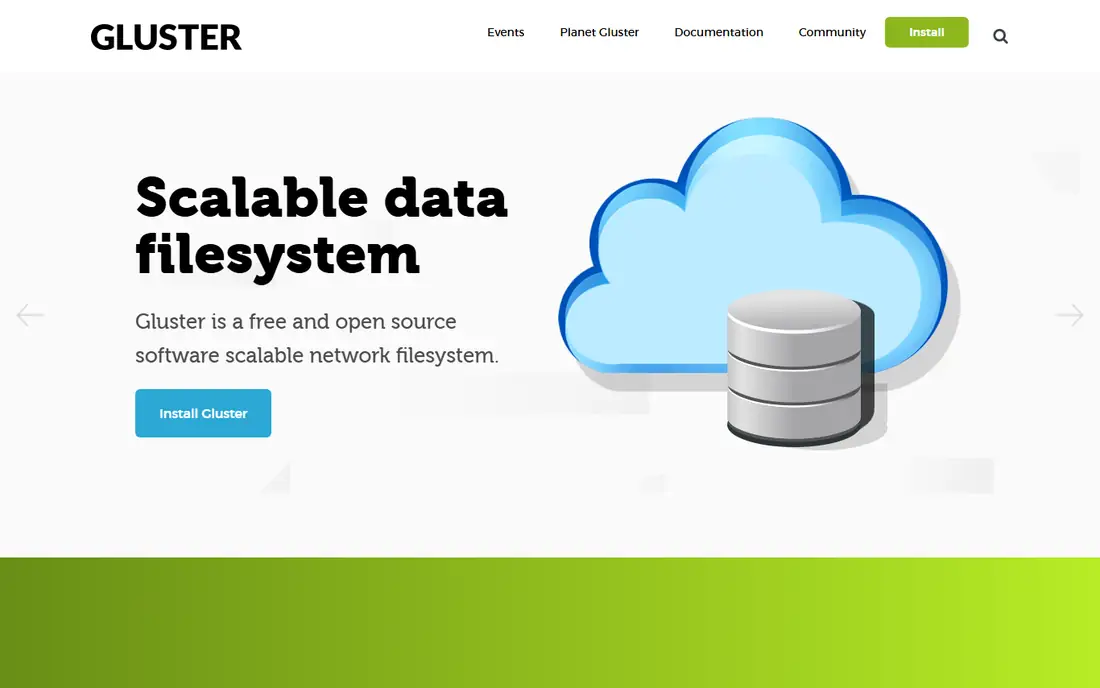
GlusterFS is the veteran scale-out file system: it pools storage across commodity servers into a single namespace, with replication and distribution for availability, and it has served production file workloads for well over a decade. Its simplicity appeals to teams that want a POSIX file system without the operational weight of Ceph's monitors, managers, and placement groups.
One honest flag: the gluster.org homepage shows dated blog content, with the latest visible posts from 2020, so this listing rests on domain confirmation plus the project's established open-source profile. Support is community-based. For a free, simple distributed file system where active feature development is not the priority, GlusterFS still earns its place.
What we like- Fully open source with no licence cost
- Scale-out NAS-style file storage across commodity servers
- Long history in production use
Watch out for- Homepage content is dated, with the latest visible posts from 2020, so this listing rests on domain confirmation and the project's established profile
- Community support only
- Less active development than newer projects
#3
Longhorn
Best for: Kubernetes persistent block storage without cost
Visit longhorn.io
Starting price$0
Free planYes
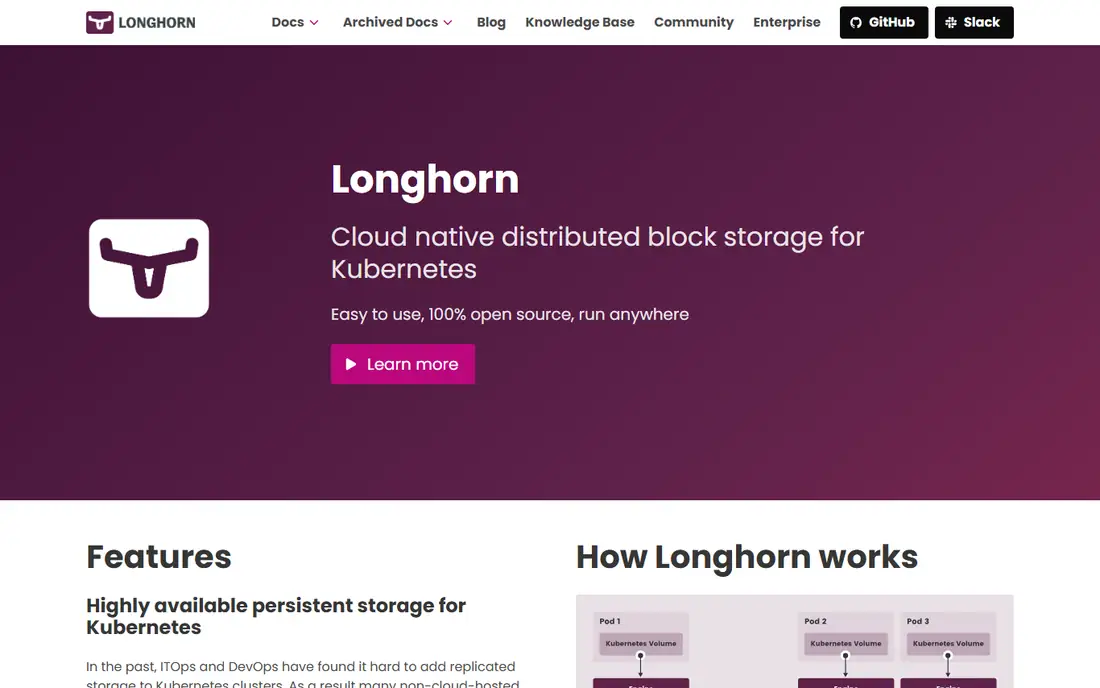
Longhorn solves the problem that kept many on-premises Kubernetes clusters without persistent storage: external arrays are non-portable and expensive. It delivers cloud-native persistent block storage that is simple to deploy and upgrade, with incremental snapshots, scheduled backups, and a free management UI. Unlike external replication that re-copies an entire data store after a disk failure, Longhorn's granular replication recovers faster, and disaster recovery volumes in a second cluster let you fail over with a defined recovery point and time.
The project is fully open source with no proprietary tiers. For Kubernetes teams that want Ceph-like replicated block storage without Ceph's complexity or cost, Longhorn is the best free pick.
What we like- 100 percent open source with no open-core limits
- Easy to deploy and upgrade
- Built-in incremental snapshots and backups
- Disaster recovery volumes with defined RPO and RTO
Watch out for- Kubernetes-only, so not a general storage platform
- Performance depends on node disks
- Enterprise support is separate from the project
#4
OpenEBS
Best for: Container-native storage that follows workloads
Visit openebs.io
Starting price$0
Free planYes
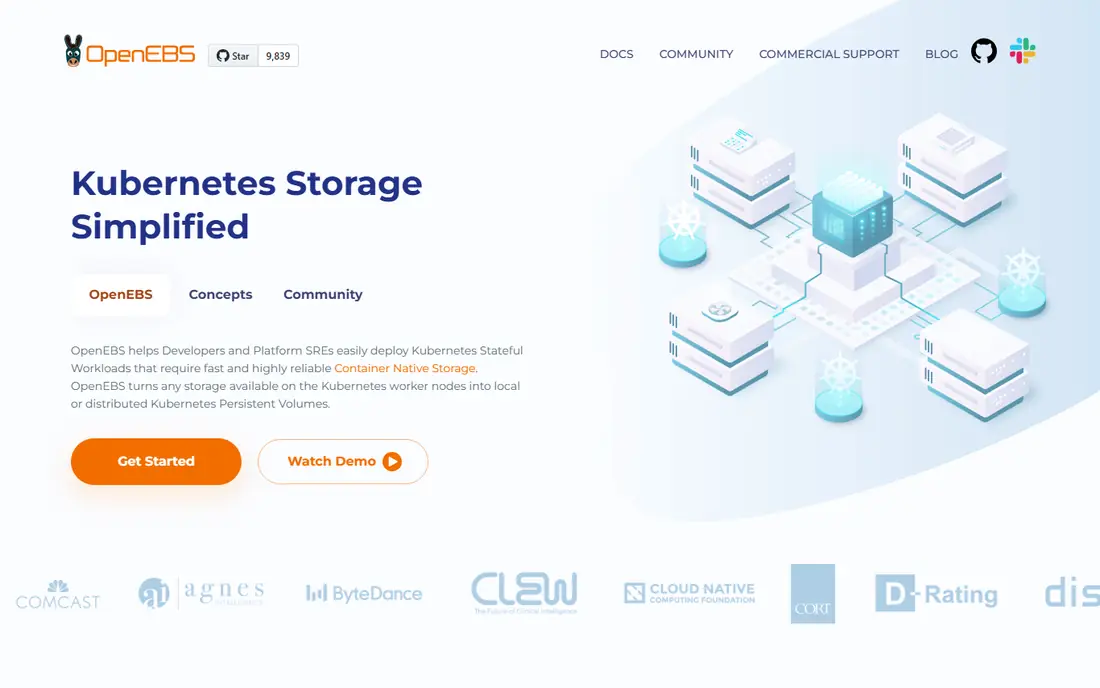
OpenEBS is the CNCF container-native storage project that turns whatever storage exists on Kubernetes worker nodes into local or distributed persistent volumes. It operates entirely in userspace, removing Linux kernel dependencies and simplifying deployment and maintenance, with thin provisioning and ephemeral storage to control cloud storage spend. Storage follows workloads, with per-workload controls and no vendor lock-in.
The project is sponsored and maintained by DataCore and installs with a single Helm command. For platform teams that want storage as a Kubernetes-native concern rather than an external system, OpenEBS is the most cloud-native Ceph alternative.
What we like- 100 percent open source CNCF project
- Turns any node storage into local or distributed persistent volumes
- Runs in userspace with no kernel dependencies
- Maintained by DataCore
Watch out for- Kubernetes-only scope
- Local storage options need capacity planning
- Enterprise support is separate
Starting priceSee website
Free planFree trial
Portworx makes storage an app-centric, platform-managed capability for Kubernetes. It delivers automated storage with Kubernetes-native lifecycle management, backup, encryption, and high availability and disaster recovery, with operational consistency across hybrid and multicloud environments. Integrations span AWS, Azure, Google Cloud, IBM, Oracle, Red Hat, and SUSE, and customer results cite 25,000 transactions per second with reliable deployments.
Pricing sits behind a trial conversation, and the platform targets enterprises rather than hobby clusters. For organizations that need Ceph-class data management with enterprise support and multicloud mobility, Portworx is the strongest commercial pick.
What we like- App-centric storage with lifecycle management, backup, encryption, and HA/DR
- Works across on-premises, public, and hybrid cloud
- 25,000 transactions per second in customer results
Watch out for- Pricing is not shown on the homepage
- Enterprise positioning means higher cost than open-source tools
- Free access is trial-based
#6
LINSTOR
Best for: DRBD replicated block storage for Linux clusters
Visit linbit.com
Starting priceSee website
Free planYes
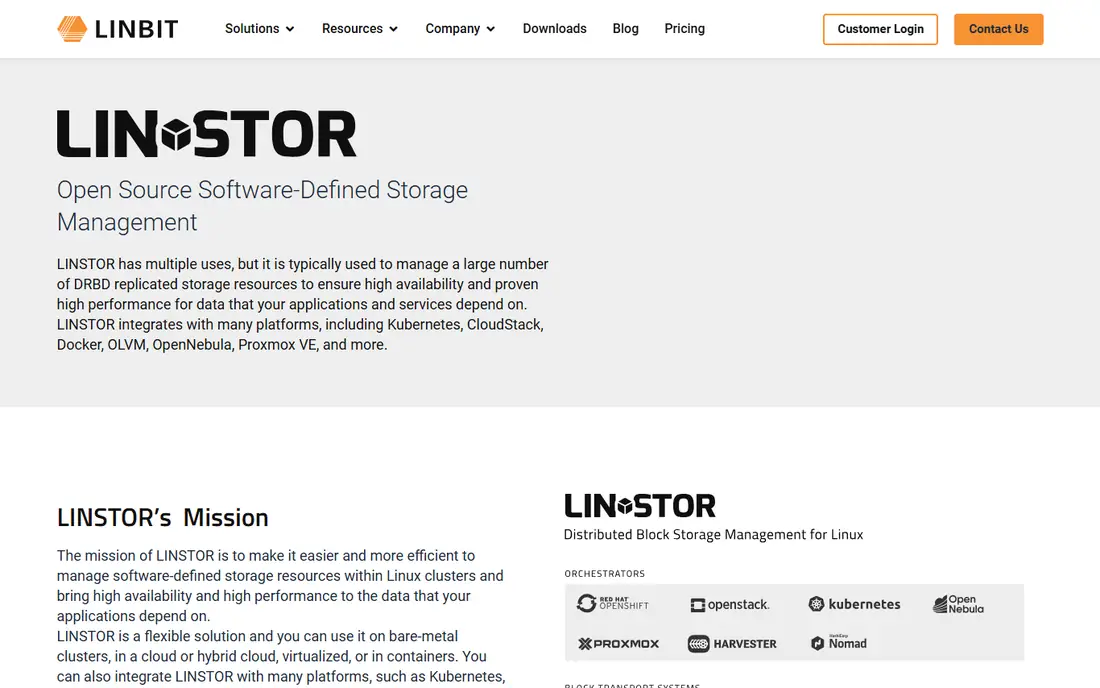
LINSTOR is the management layer for DRBD replicated storage, built to make software-defined storage in Linux clusters easier and more efficient. A controller manages cluster configuration while satellites manage resources on each node, with a command-line utility or platform integrations for control. It runs on bare metal, cloud, hybrid cloud, virtualized, or container environments, and its CSI driver brings persistent block storage to Kubernetes and OpenShift, with snapshot shipping for disaster recovery.
LINBIT offers an enterprise subscription, LINBIT SDS, bundling LINSTOR, DRBD, utilities, and expert support. The open-source core is free. For Linux teams that trust DRBD's replication record and want it managed at scale, LINSTOR is the best Ceph alternative.
What we like- Manages large DRBD clusters for proven high availability and performance
- Kubernetes CSI driver plus CloudStack, Proxmox, OpenNebula, and Docker integrations
- Open-source core with LINBIT SDS enterprise subscription
Watch out for- DRBD expertise helps for troubleshooting
- Enterprise pricing sits behind the SDS subscription
- Block-focused, so object and file needs require other tools
Starting price$2/TB/month
Free planYes
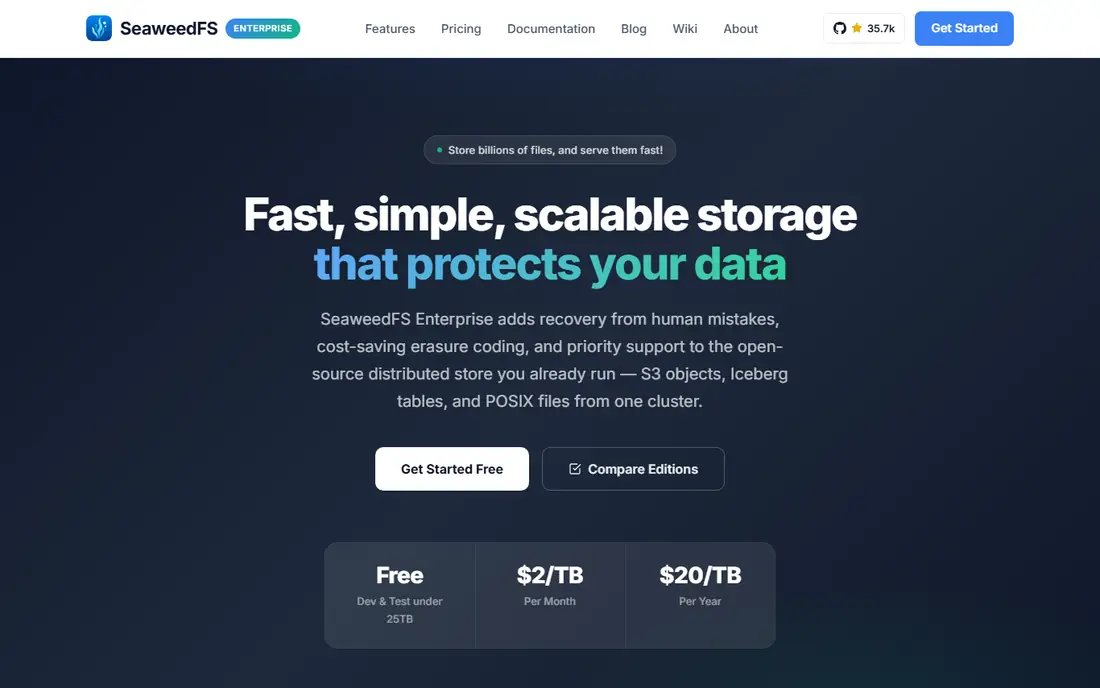
SeaweedFS is the most versatile open-source storage engine in this list. One cluster serves as an S3-compatible object store scaling linearly from gigabytes to petabytes, a 100 percent POSIX file mount over FUSE or kernel mount, and an Apache Iceberg catalog with background compaction, all with data that stays portable. Every file resolves in a single disk seek, so read latency stays flat whether you store millions or billions of files, and append-only writes keep ingestion fast.
The open-source core is free, while Enterprise adds undelete, point-in-time recovery, self-healing storage, automatic erasure-coding repair, and priority support at $2 per TB per month, free for dev and test under 25TB. Trusted by Cisco, NVIDIA, Proton, and TrueNAS. For teams that want one system instead of three, SeaweedFS is the best fit.
What we like- S3 object store, POSIX file mount, and Iceberg catalog from one cluster
- O(1) disk reads with sub-millisecond lookups
- Erasure coding at 1.2x overhead with a 20+4 ratio
- Free for dev and test under 25TB
Watch out for- Enterprise features like undelete and point-in-time recovery need the $2 per TB per month licence
- Smaller enterprise support organization than MinIO
- Learning curve for filer and volume concepts
Starting priceSee website
Free planFree demo
StorPool turns standard servers into a high-performance storage platform for modern cloud infrastructure, with latency under 100 microseconds, 113 million IOPS, and 945 GB per second throughput. It is KVM-optimized and API-first, scales to 60 petabytes, and offers a fully managed storage-as-a-service model with 24/7 expert support. Integrations cover OpenNebula, OpenStack, CloudStack, Kubernetes via CSI, OLVM, and Proxmox, with 3-copy synchronous replication for private clouds.
Customers include NASA, the European Space Agency, and CERN, which speaks to reliability at mission-critical scale. Pricing sits behind a demo. For cloud providers and large private clouds where storage speed is the business, StorPool is the fastest Ceph alternative.
What we like- Sub-100-microsecond latency with 113 million IOPS and 945 GB per second
- Scales to 60PB
- KVM-optimized with API-first design
- Trusted by NASA, ESA, and CERN
Watch out for- Pricing is not shown on the homepage
- Cloud-builder focus means less fit for small clusters
- Fully managed service model suits providers more than DIY teams
How we chose
We compared each platform on storage models covered, Kubernetes support, replication and erasure coding, performance, open-source availability, and pricing transparency. Every homepage above was opened to confirm it loads and belongs to the product, except GlusterFS, whose homepage shows dated content; that listing rests on domain confirmation and is flagged. Prices come from vendor pages where shown; where the homepage did not display pricing, the field reads "See website" rather than a guessed figure. Ceph itself was excluded as the product being replaced.
What to check before you switch
Start with your storage model. Object-only workloads point to MinIO or SeaweedFS. File workloads point to GlusterFS or SeaweedFS's POSIX mount. Kubernetes block storage points to Longhorn, OpenEBS, Portworx, LINSTOR, or StorPool's CSI driver. Mixed workloads point to SeaweedFS.
Next, weigh operations against performance. Ceph's complexity is the usual reason teams leave, so prefer Longhorn or OpenEBS for simplicity, MinIO for object scale, and StorPool or LINSTOR when performance or DRBD replication justifies expert operations. Check erasure coding overhead too: SeaweedFS's 1.2x ratio beats 2x to 3x replication for cold data. Finally, trial with your real workload: run the same benchmark and failure test, pulling a node mid-write, on two finalists before migrating production data.
Frequently asked questions
Is Ceph shutting down?
No. Ceph remains an actively developed open-source storage platform. Teams usually look for alternatives because of operational complexity, a narrower workload focus, or a preference for Kubernetes-native or object-only tools.
Which alternative is closest to Ceph?
SeaweedFS is the closest in breadth, covering object, file, and table storage from one cluster. For Ceph's block storage role, Longhorn and LINSTOR are the closest, and for object storage, MinIO is the closest.
What is the best free option?
Longhorn, OpenEBS, and GlusterFS are fully free and open source. MinIO and SeaweedFS offer free open-source cores with paid enterprise tiers, and SeaweedFS Enterprise is free for dev and test under 25TB.
Do these tools work with Kubernetes?
Yes, most of them. Longhorn, OpenEBS, Portworx, LINSTOR, SeaweedFS, and StorPool all offer CSI drivers for Kubernetes persistent volumes.
Can I keep my S3-compatible applications?
Yes, with MinIO or SeaweedFS, both of which expose S3-compatible APIs that existing applications can use without changes.
How hard is migration from Ceph?
Migration means moving data, not just configuration: use S3-compatible tooling for object data, rsync or storage-level replication for file data, and volume migration for block data. Run the new system alongside Ceph until a full failure test passes.
Sources we checked (8)
- https://min.io
- https://www.gluster.org
- https://longhorn.io
- https://openebs.io
- https://portworx.com
- https://linbit.com/linstor/
- https://seaweedfs.com
- https://storpool.com
Is your product missing or out of date?
We review this list regularly. Vendors can request a listing, send updated pricing or ask about featured placement.

Shihab Mia · Founder, Rankite
Shihab has 5+ years in B2B and SaaS SEO. He writes Rankite's software buying guides from pricing pages, documentation and public user reviews. More about Shihab.