How we make this list: we compare pricing pages, product documentation and public user reviews. Ratings come from G2, Capterra or Trustpilot, with the date we checked them.

Key takeaways
- Cube and Datarails are the best fits for teams that want to keep working in Excel while fixing disconnected data.
- Anaplan and Pigment lead for enterprise wide connected planning across finance, sales, and operations.
- Planful and Prophix suit mid market teams that want planning, close, and reporting in one platform.
- Workday Adaptive Planning fits organizations already running Workday HCM and wanting collaborative planning.
- Jedox is the pick for data heavy teams that need complex multidimensional models with an Excel like interface.
Quick comparison
| Tool | Best for | Starting price | Free plan |
|---|
 Anaplan | Enterprise connected planning | See website | Free trial |
 Planful | Mid market financial performance | See website | Free trial |
 Workday Adaptive Planning | Workday users | See website | Free trial |
 Cube | Spreadsheet native FP&A | See website | Free trial |
 Datarails | Excel based finance teams | See website | Free trial |
 Prophix | Mid market plan to close | See website | Free trial |
 Pigment | Cross functional planning | See website | Free trial |
 Jedox | Complex multidimensional models | See website | Free trial |
Is your product missing or out of date?
We review this list regularly. Vendors can request a listing, send updated pricing or ask about featured placement.
The best Vena alternatives
#1Anaplan
Best for: Enterprise connected planning4.6/5 on
G2 (481 reviews, checked Oct 2026)
Visit anaplan.com
Starting priceSee website
Free planFree trial
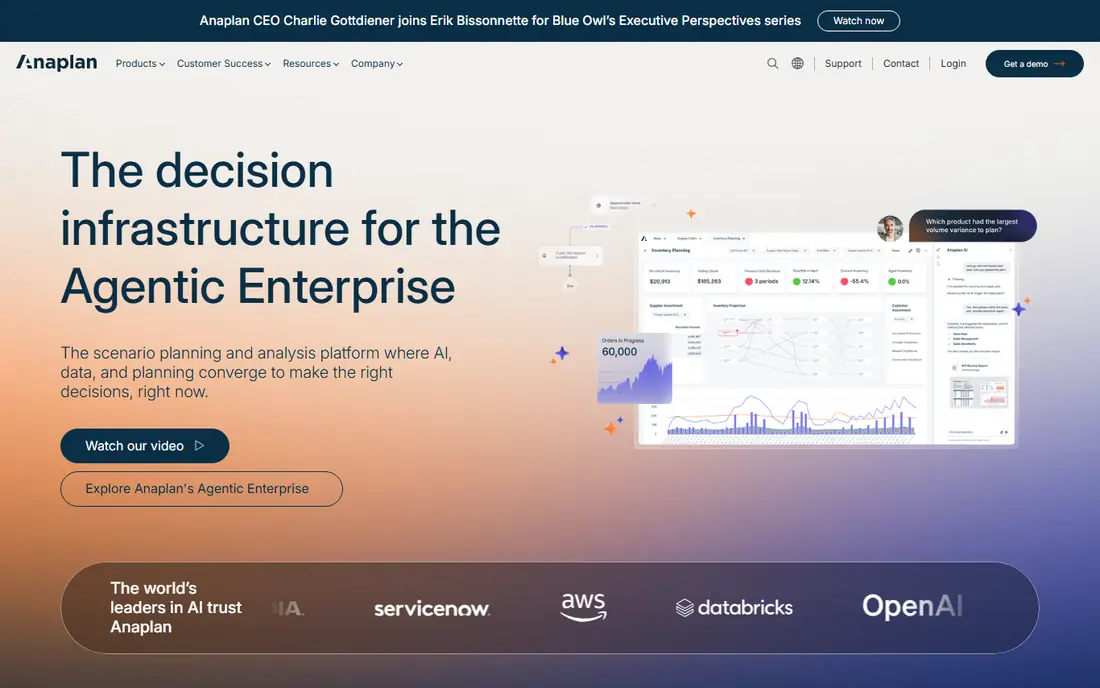
Anaplan calls itself the decision infrastructure for the agentic enterprise, a scenario planning platform where AI, data, and planning converge. Its homepage covers finance, supply chain, sales and marketing, HR and workforce, and retail planning, with a calculation engine built for accuracy and auditability. Customer logos include NVIDIA, ServiceNow, AWS, Databricks, OpenAI, and Google, and Anaplan reports that 48 percent of the Fortune 50 are customers.
The trade-off is scale. Anaplan is built for large organizations with complex planning needs, and smaller teams will find the platform and its pricing heavier than alternatives like Cube or Datarails. But for enterprises that need finance, supply chain, and sales plans to stay connected in real time, with AI assisting scenario analysis, Anaplan is the most established option on this list.
What we like- Scenario planning across finance, supply chain, sales, and HR
- Deterministic calculation engine paired with AI
- Strong enterprise customer base
Watch out for- Enterprise pricing and implementation effort
- Overkill for small finance teams
#2Planful
Best for: Mid market financial performance4.3/5 on
G2 (509 reviews, checked Oct 2026)
Visit planful.com
Starting priceSee website
Free planFree trial

Planful connects planning, close, consolidation, and reporting in one financial performance management platform, trusted by more than 1,500 companies. Its homepage stresses that adding an entity, department, or reporting requirement adjusts the platform without a rebuild, and that its support team talks finance rather than just tickets. AI enhanced forecasting and scenario planning round out the offer for finance teams.
The weak spot is pricing transparency: Planful does not publish entry prices, so buyers need a sales conversation. That is normal for this category, but it slows comparison shopping. Planful fits mid market and growing companies that want one system for the full financial cycle, from budget to close to board reporting, with a support team that understands finance workflows.
What we like- Planning, close, consolidation, and reporting in one platform
- Finance fluent support team
- Scales as entities are added
Watch out for- Pricing is quote based
- Advanced features may need onboarding support
#3Workday Adaptive Planning
Best for: Workday users4.3/5 on
G2 (409 reviews, checked Oct 2026)
Visit workday.com
Starting priceSee website
Free planFree trial
Workday Adaptive Planning is the planning product from Workday, built for collaborative budgeting, forecasting, and reporting. Comparison sources describe it as flexible and well suited to organizations already using Workday HCM, where workforce and financial planning can share one system. That integration is its main selling point: headcount plans flow into financial plans without manual reconciliation.
The caveat is evidence. The vendor page we opened confirmed the product but returned little detail in this extract, so buyers should request a demo and confirm current features and pricing directly. Adaptive Planning fits Workday customers who want planning inside their existing HCM ecosystem rather than bolting on a separate platform.
What we like- Flexible collaborative planning
- Natural fit with Workday HCM
- Strong for workforce planning
Watch out for- Vendor homepage is thin on detail in this extract
- Pricing is quote based
Starting priceSee website
Free planFree trial
Cube is an FP&A platform built around a simple idea: finance teams live in spreadsheets, executives live in chat and slides, and everyone should see the same governed numbers. Its homepage shows actuals syncing into Excel models, variances explained in Slack and Teams, and board decks refreshing automatically, with every AI insight tracing back to its source transaction. Security features include SOC 1 and 2 Type 2 certification, role based access, and a full audit trail.
The trade-off is that Cube is less a standalone modeling studio than a governed data layer that meets teams where they work. Teams that want to build complex models entirely in a web interface may prefer Anaplan or Jedox. For lean finance teams that want to automate FP&A without abandoning Excel or Sheets, Cube is one of the strongest Vena alternatives available.
What we like- Live governed numbers in Excel, Sheets, Slack, Teams, and PowerPoint
- Audit trail to the transaction
- AI agents for routine work
Watch out for- Pricing is quote based
- Spreadsheet centric approach may not suit teams wanting a full web model builder
#5Datarails
Best for: Excel based finance teams4.6/5 on
G2 (388 reviews, checked Oct 2026)
Visit datarails.com
Starting priceSee website
Free planFree trial
Datarails positions its FinanceOS as the governed, Excel connected operating layer for finance, linking insights to live data from more than 600 sources. Its homepage covers reporting, planning, analysis, cash forecasting, spend control, and month end close, with version control, permission settings, centralized business logic, and AI outputs designed to be accurate, repeatable, and auditable. The vendor reports finance teams at more than 2,000 companies run on Datarails.
The catch is the same as Cube: Datarails is built for teams that love Excel and want to fix its chaos, not replace it. Web first teams may prefer a platform with a fuller native interface. For finance teams whose models live in Excel today, Datarails removes the manual data pulls and version confusion while keeping the models analysts already trust.
What we like- Keep existing Excel models with live data from 600 plus sources
- Version control and audit trails
- Strong user ratings
Watch out for- Pricing is quote based
- Excel centric design suits spreadsheet teams more than web first teams
Starting priceSee website
Free planFree trial
Prophix One connects every finance workflow from plan to close, covering financial planning and analysis, close and consolidation, and reporting and analytics. Its homepage highlights structured driver based models, automated workflows, built in audit trails, and AI agents that shrink budget cycles, plus consolidation that handles multi currency, multi lingual, and multi GAAP requirements with AI powered matching for GL and intercompany balances.
The trade-off is scope. Prophix targets the mid market, so the largest enterprises with the most complex planning may need Anaplan or OneStream instead. For mid size firms moving away from pure Excel, Prophix offers an easy to use automation layer with a genuine close story, which many FP&A tools lack. It fits teams that want budgeting, consolidation, and reporting in one governed platform.
What we like- Plan to close in one platform
- Driver based models with audit trails
- Multi currency and multi GAAP consolidation
Watch out for- Pricing is quote based
- Mid market focus means less enterprise scale than Anaplan
#7Pigment
Best for: Cross functional planning4.6/5 on
G2 (118 reviews, checked Oct 2026)
Visit pigment.com
Starting priceSee website
Free planFree trial
Pigment is an integrated business planning platform powered by agentic AI, helping teams analyze, model, and plan across finance, sales, HR, and supply chain. Its homepage shows AI agents operating directly inside the planning environment on governed data and live models, plus a new interface builder that creates custom views on the live model. Customer logos include Unilever, Siemens, Anthropic, Danone, Carta, Uber, and Figma.
The caveat is maturity. Pigment is younger than Anaplan or Workday, so buyers should check references in their industry and confirm support coverage. The payoff is flexibility: Pigment adapts to the business rather than forcing the business into rigid templates, and its elastic engine adds data, users, or scenarios without pre sizing. It fits companies that want finance, sales, and HR planning in one connected model.
What we like- Planning across finance, sales, HR, and supply chain in one place
- Agentic AI inside the planning environment
- Elastic engine scales without pre sizing
Watch out for- Newer vendor than Anaplan or Workday
- Pricing is quote based
#8Jedox
Best for: Complex multidimensional models4.3/5 on
G2 (189 reviews, checked Oct 2026)
Visit jedox.com
Starting priceSee website
Free planFree trial
Jedox is an adaptable AI driven FP&A and performance management platform built for finance teams that need serious modeling power. Its homepage stresses hyperautomating FP&A processes, understanding drivers with a digital twin, and aligning stakeholders around a single source of truth, with an Excel like interface and add in for Excel 365 to speed adoption. Users can build any model or scenario and run unlimited simulations with drag and drop dashboards and ad hoc reporting.
The trade-off is implementation effort. Powerful modeling tools take time to configure well, and Jedox pricing requires a quote. For data heavy organizations with complex multidimensional models, that effort pays off in a platform that handles intricate business logic without forcing teams to abandon Excel familiarity. Jedox fits finance teams that outgrew simple budgeting tools and need real modeling depth.
What we like- Excel like interface with powerful modeling
- JedoxAI digital twin for what if analysis
- Unlimited simulations
Watch out for- Pricing is quote based
- Implementation can be involved for complex models
How we chose
We compared tools that replace Vena for financial planning and analysis: budgeting, forecasting, reporting, consolidation, and scenario modeling. Each vendor homepage was opened to confirm the product exists today and matches its category. Pricing in this category is almost always quote based, so we wrote See website where the vendor does not publish prices, rather than repeating third party figures. We kept a mix of spreadsheet native tools, mid market platforms, and enterprise modeling engines, since Vena buyers range from lean finance teams to large enterprises.
Switching from Vena without losing your models
Start by mapping your current Vena models: drivers, dimensions, data sources, and report outputs. That map decides the replacement, since a spreadsheet native team and an enterprise modeling team need different tools. Export and validate historical actuals early, and rebuild one planning cycle in the new tool before migrating the rest.
Test the features Vena users most often miss: real time ERP data integration, report building ease, and granular user permissions. Run a parallel cycle where the old and new tools produce the same forecast, and reconcile differences before cutover. Finally, plan training around the new interface, especially if moving from Excel native Vena to a web first platform, since adoption is where migrations most often stall.
Frequently asked questions
What is the best Vena alternative for small finance teams?
Cube and Datarails are the strongest fits for smaller teams, since both keep analysts in Excel and Sheets while automating data and reporting. Planful and Prophix suit mid market teams that want a fuller platform.
Does any Vena alternative offer a free plan?
Most FP&A platforms in this category offer free trials rather than free plans, and pricing is usually quote based. Request a demo and confirm trial terms directly with the vendor before committing.
How is Anaplan different from Vena?
Anaplan is an enterprise connected planning platform covering finance, supply chain, sales, and HR in one model, with a deterministic calculation engine and AI assisted scenario analysis. Vena is more Excel native and finance focused, so Anaplan fits larger organizations with cross department planning needs.
Can FP&A tools replace Excel entirely?
Some can, but most successful teams keep Excel in the workflow. Cube and Datarails are designed around Excel, while Anaplan, Pigment, and Jedox offer web modeling with Excel add ins. The right answer depends on how your analysts actually work.
What should I check before switching FP&A tools?
Check ERP and data source integrations, report building flexibility, user permissions, consolidation features, and AI forecasting claims. Run a parallel planning cycle and reconcile outputs before cutting over.
Is Vena itself still available?
Yes, Vena remains a widely used Excel native FP&A platform. Teams switch for reasons like real time ERP integration, report building ease, or enterprise scale, not because Vena has closed. Compare current features directly before deciding.
Sources we checked (8)
- https://www.anaplan.com
- https://planful.com
- https://www.workday.com/en-us/products/adaptive-planning.html
- https://www.cubesoftware.com
- https://datarails.com
- https://prophix.com
- https://pigment.com
- https://jedox.com
Is your product missing or out of date?
We review this list regularly. Vendors can request a listing, send updated pricing or ask about featured placement.

Shihab Mia · Founder, Rankite
Shihab has 5+ years in B2B and SaaS SEO. He writes Rankite's software buying guides from pricing pages, documentation and public user reviews. More about Shihab.