How we make this list: we compare pricing pages, product documentation and public user reviews. Rankite is independent; if a vendor ever pays for a featured spot, that listing is clearly labeled Partner.
Key takeaways
- A fundraise has three data room phases: the pitch (deck analytics, $10-45/month), diligence (permissions, audit trail, Q&A), and closing (controlled disclosure). Match the tool to the phase.
- Free and cheap paths exist: Carta's data room is free on its Launch plan, Papermark starts at €99/month, and DocSend Personal tracks your deck for $10/user/month.
- Verified prices (October 2026): DocSend Personal $10/user/mo, DocSend Advanced Data Rooms $180/mo, CapLinked Team $399/mo, FirmRoom $395/mo, SecureDocs $250/mo (12-month term), ContractZen €9.50/mo.
- ContractZen is included as an honest adjacent pick: it is board and governance software with data room features, not a pure VDR.
Quick comparison
| Tool | Best for | Starting price | Free plan |
|---|
 DocSend DocSend | Founders tracking who reads their deck | $10/user/month (Personal, billed annually) | Free trial |
 Carta Carta | Startups already on Carta raising a round | $0 (data room included on Launch plan) | Yes |
 Papermark Papermark | Budget-conscious founders wanting a real VDR | €99/month | No |
 CapLinked CapLinked | Series A/B raises needing DRM and flat pricing | $399/month (Team) | Free trial |
 FirmRoom FirmRoom | Teams wanting a self-serve VDR with published tiers | $395/month (2 GB, 1 active room) | Free trial |
 SecureDocs SecureDocs | Single-deal rooms at a simple monthly price | $250/month (12-month term) | Free trial |
 iDeals iDeals | Diligence-heavy rounds needing support and ease of use | See website (quote-based) | Free trial |
 Ellty Ellty | Founders wanting a fundraising-focused standalone room | See website | No |
 ContractZen ContractZen | Boards and small teams wanting governance plus a room | €9.50/month | Free trial |
Is your product missing or out of date?
We review this list regularly. Vendors can request a listing, send updated pricing or ask about featured placement.
The best virtual data room software
Most founders meet the data room in three phases. Phase one is the pitch: you send a deck to twenty investors and want to know who opened it, which pages they lingered on, and who forwarded it to a partner. Phase two is diligence: investors ask for the cap table, financials, contracts and customer data, and you need permissions, an audit trail, and a Q&A process. Phase three is closing: documents go out under control, and nothing leaks. Different phases justify different tools, and buying an enterprise VDR for phase one is the classic founder mistake.
The nine tools below are evaluated for fundraising, not M&A auctions. Some are purpose-built VDRs, some are fundraising tools with rooms attached, and one is governance software with a room inside. Prices were checked against vendor pricing pages and current third-party reporting in October 2026.
Starting price$10/user/month (Personal, billed annually)
Free planFree trial
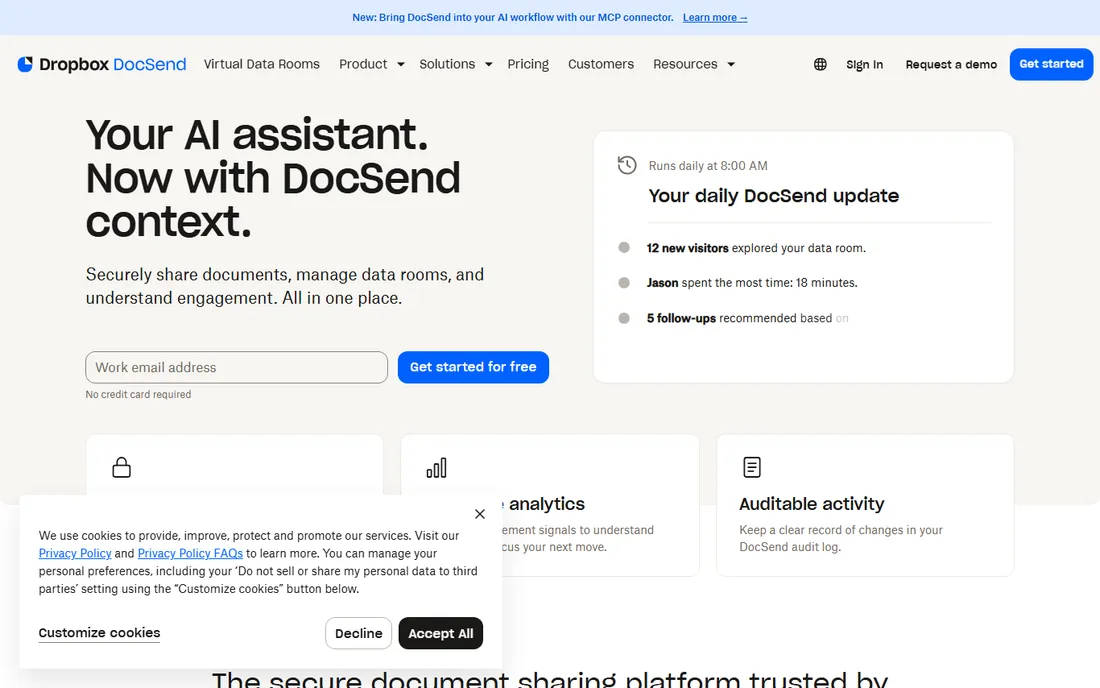
DocSend is where most raises start, because it answers the founder's first question: did anyone read the deck? Personal at $10 a user a month (annual) gives page-by-page analytics on single files per link. Standard at $45 adds multi-file Spaces, and the folder-and-permission data rooms founders actually need start on Advanced at $150 a month for 3 users, with Advanced Data Rooms at $180 adding NDAs, watermarks and deeper controls.
DocSend is document tracking first and a VDR second, and we say that plainly: for phase-one pitching it is the best tool here, and for full diligence you will either pay for the Advanced tiers or graduate to a purpose-built VDR below. It suits founders running their first raise who need analytics now and can upgrade as diligence gets serious.
What we like- The fundraising standard investors already know
- Page-by-page analytics show exactly who read what
- Cheap entry for deck tracking
Watch out for- Real data rooms with folders and permissions start at Advanced ($150/mo) or Advanced Data Rooms ($180/mo)
- Not a full diligence platform at the lower tiers
#2
Carta
Best for: Startups already on Carta raising a round
Visit carta.com
Starting price$0 (data room included on Launch plan)
Free planYes
If your cap table lives on Carta, your data room can too. Carta's own pages confirm that Launch customers and fund admins can create a data room for free, sitting alongside cap table, SAFEs, financials and governance documents. Launch is free for companies with under 25 stakeholders and under $1M raised, which covers most pre-seed and seed raises.
The catch is the ecosystem lock: once you pass Launch limits, Carta's paid plans are negotiated and broker data shows early-stage companies paying $3,000 to $8,000 a year. The data room itself is simpler than a dedicated VDR, with fewer diligence workflows. Carta suits founders already committed to the platform who want one system for the raise. If you are not on Carta, do not adopt it just for the room.
What we like- Free data room for Launch customers and fund admins
- Sits next to the cap table investors already trust
- No second vendor to manage
Watch out for- Only free within the Carta ecosystem
- Paid Carta plans escalate quickly past 25 stakeholders
- The room is simpler than dedicated VDRs
Starting price€99/month
Free planNo
Papermark is the value play: a real virtual data room at a flat €99 a month, with transparent pricing in a category famous for hiding it. It covers the diligence essentials, secure sharing, analytics and access controls, in an interface that feels like a modern file tool rather than legacy deal software. An open-source version exists for teams that want to self-host.
It will not match iDeals or Firmex on enterprise compliance depth, and there is no free tier, so pre-seed founders tracking a deck should start with DocSend or Papermark's own lower commitment. Papermark suits seed and Series A founders who need a genuine data room for diligence but refuse to pay $400-plus a month for features their round does not need.
What we like- Flat €99/month with transparent pricing
- Open-source option for self-hosting
- Modern interface investors open without training
Watch out for- No free plan
- Smaller vendor with less enterprise track record
- Advanced compliance features trail the big VDRs
Starting price$399/month (Team)
Free planFree trial
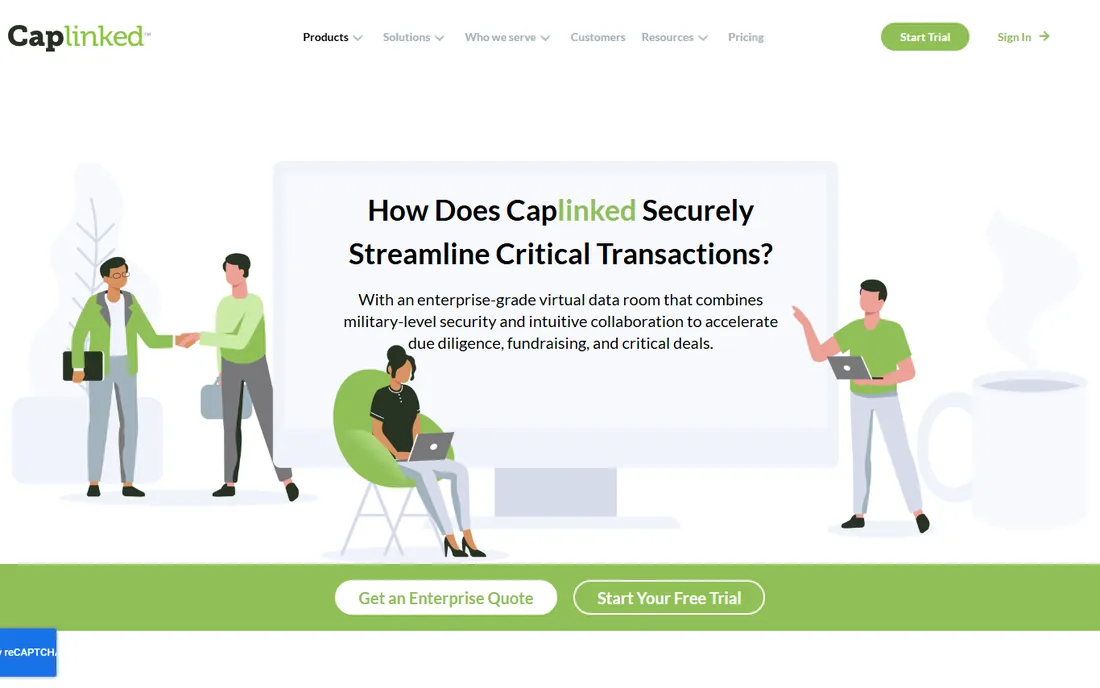
CapLinked publishes its prices, which is rarer than it should be: Team at $399 a month flat with 5 GB storage, unlimited guest users and no long-term contract; Enterprise from $500 a month or $5,000 a year with flexible storage, SSO and a dedicated success manager. Built-in FileProtect DRM prevents copying, printing and forwarding even after download, and the entry tier includes custom watermarking, activity tracking, OCR search and structured Q&A.
The flat fee and no-contract terms fit a raise's shape: two to four intense months, then done. CapLinked suits Series A and B founders who need real diligence controls, revocable downloads and an audit trail of who viewed the financials, without per-page billing or a year-long commitment.
What we like- Flat monthly pricing published on its own pricing page
- Built-in DRM blocks copying and printing even after download
- 14-day free trial with no sales call
Watch out for- 5 GB storage on the entry plan
- No long-term contract means monthly cost for a multi-month raise
- No AI diligence features
#5
FirmRoom
Best for: Teams wanting a self-serve VDR with published tiers
Visit firmroom.com
Starting price$395/month (2 GB, 1 active room)
Free planFree trial
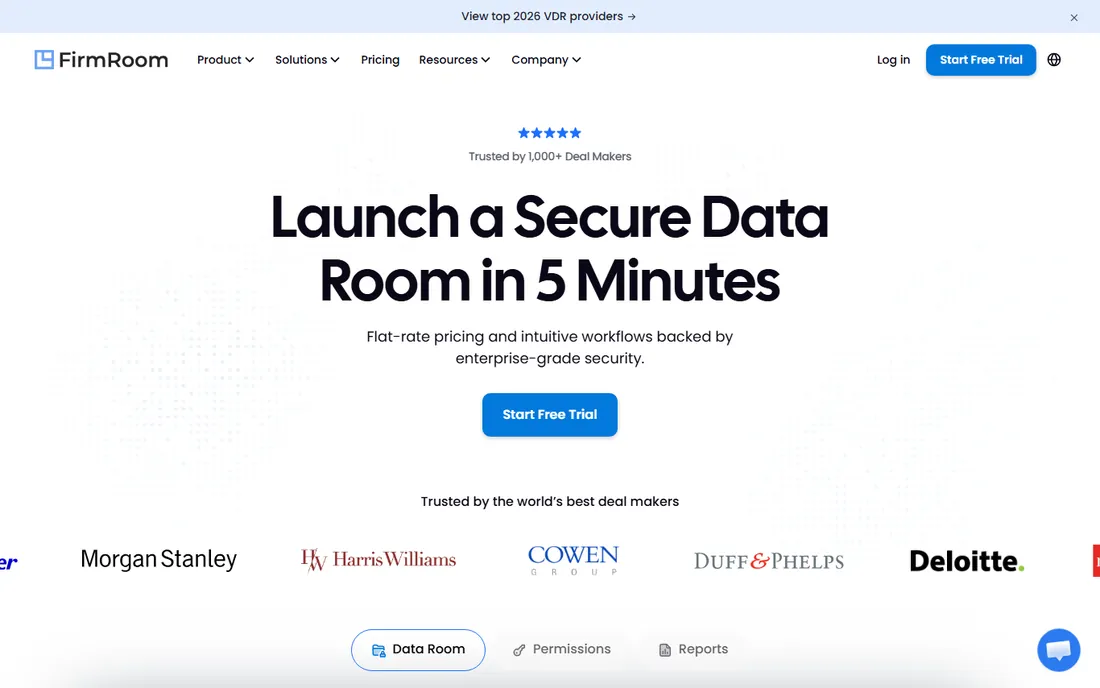
FirmRoom is the self-serve VDR: $395 a month for 2 GB and one active room, $795 for 5 GB and three rooms, $1,195 for 10 GB and five rooms, all with unlimited users and monthly-only billing, verified on its own pricing page in October 2026. Overage is published at $150 per GB per month and extra rooms at $250 a month, so the costs are knowable before you commit.
Watch the storage math: diligence sets grow, and overage at $150/GB adds up fast on the 2 GB tier. FirmRoom suits small deal teams and founders who want a proper VDR without a sales process, and who can size their storage honestly upfront. DealRoom's sister product is aimed at serial acquirers; FirmRoom is the single-deal answer.
What we like- Transparent published pricing ladder
- Unlimited users on every tier
- Monthly billing with no annual lock-in
Watch out for- Storage is shared across rooms and overage runs $150/GB/month
- Extra rooms cost $250/month
- Setup is self-service on lower tiers
Starting price$250/month (12-month term)
Free planFree trial
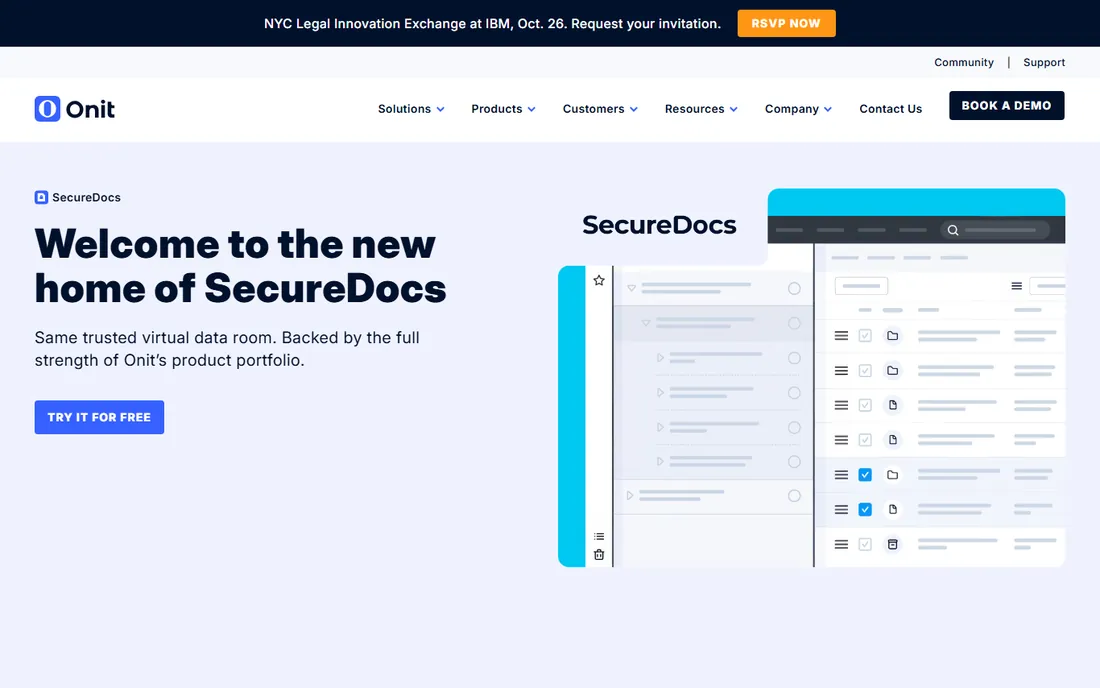
SecureDocs keeps it simple: $250 a month on a 12-month term or $400 a month on a 3-month term, unlimited users and documents either way. The 3-month option is the honest fit for a raise, since most fundraises do not need a room for a year. A free trial lets you test the setup before paying.
It is now part of Onit, which is worth knowing if you care about vendor independence, and the feature set is lighter than the diligence-heavy tools. SecureDocs suits founders who want one room, one price, and no surprises for a single fundraising round. Compare CapLinked if you need DRM, or Papermark if you want a lower monthly number.
What we like- Simple two-rate pricing with unlimited users and documents
- The 3-month $400/month term fits a short raise
- Free trial to test before committing
Watch out for- Now inside Onit's portfolio, so the roadmap is less independent
- Fewer advanced diligence features than iDeals or CapLinked
- The 12-month term outlasts most raises
Starting priceSee website (quote-based)
Free planFree trial
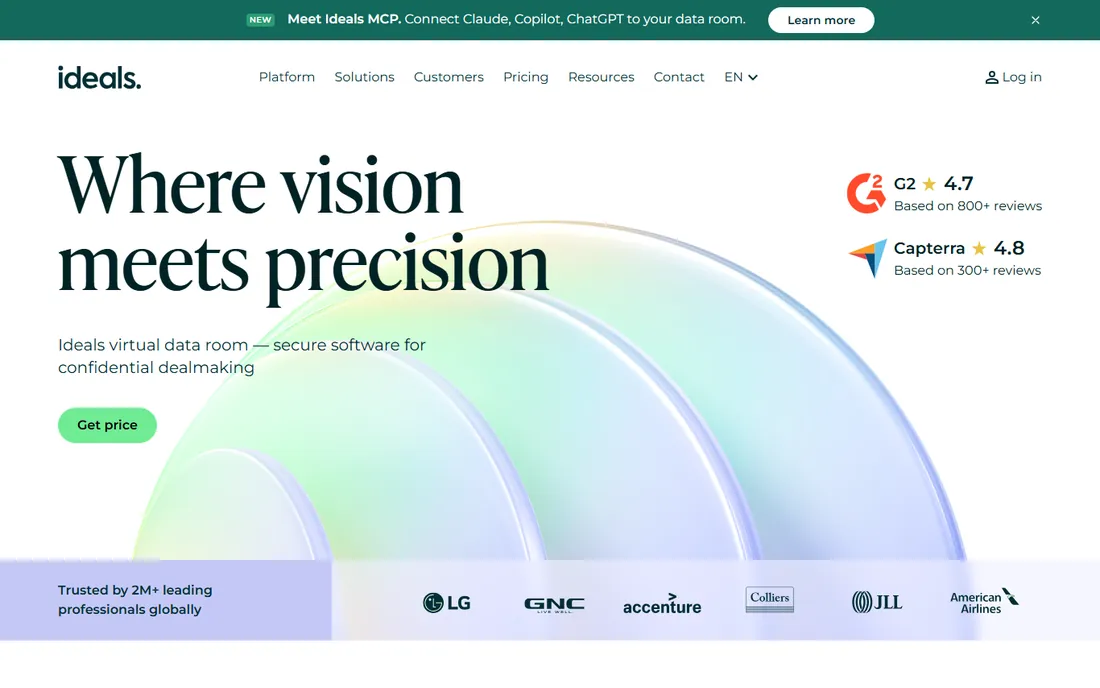
iDeals is the usability pick among serious VDRs: reviewers on G2 praise its intuitive setup, granular permission controls and support quality, scoring above DocSend on ease of setup and quality of support. The platform handles the full diligence workflow, Q&A, permissions, audit trails, with an interface outside reviewers open without training.
Pricing is quote-based, with buyer reports putting entry around $500 to $1,000 a month, and the tier names (Core, Premier, Enterprise) carry no dollar figures. iDeals suits founders whose round involves real diligence volume, multiple investors and their lawyers, where support quality and ease of use justify a sales conversation. For a simple deck-tracking phase, it is too much tool.
What we like- Consistently praised for ease of use and responsive support
- Granular permissions and audit trails
- Strong fit for investor diligence workflows
Watch out for- Quote-based pricing with no published rates
- Buyer-reported entry around $500-$1,000/month
- Limited integrations
#8
Ellty
Best for: Founders wanting a fundraising-focused standalone room
Visit ellty.com
Starting priceSee website
Free planNo
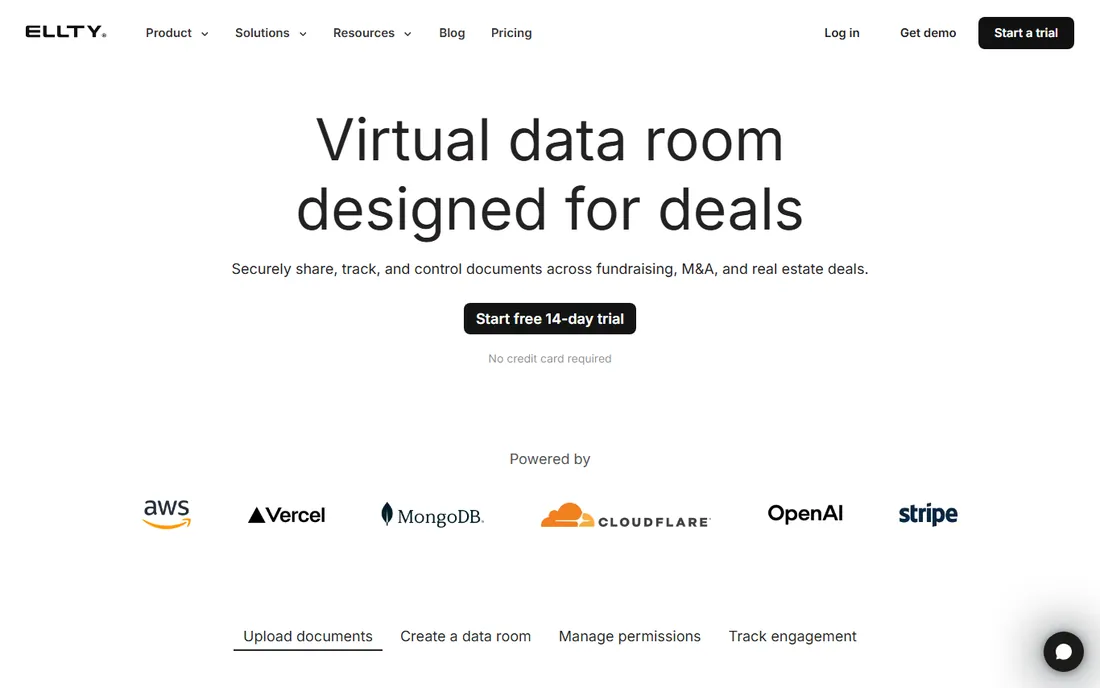
Ellty is built for the fundraise specifically, not adapted from M&A deal work. Third-party comparisons place it around $500 to $1,000 a year as a standalone fundraising room, sitting between deck-analytics tools and full VDRs. The focus is the founder workflow: share materials, track engagement, control access, close the round.
The trade-off is transparency: no published pricing and no free plan, so you will talk to the vendor. Ellty suits founders who have outgrown DocSend's document tracking but do not need a $400-a-month VDR, and who want a tool designed for raises rather than auctions. Verify current pricing directly before shortlisting.
What we like- Built specifically around fundraising rather than M&A
- Standalone focus keeps the workflow founder-friendly
- Positioned between deck tools and enterprise VDRs
Watch out for- No published pricing
- No free plan
- Smaller vendor with less third-party review coverage
Starting price€9.50/month
Free planFree trial
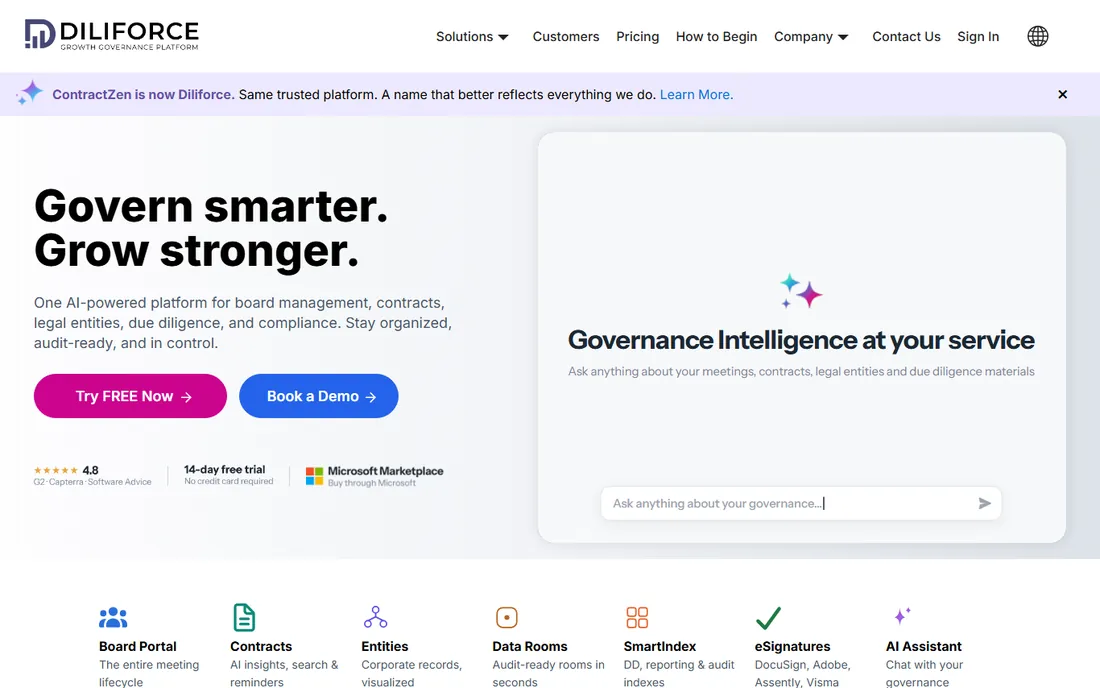
ContractZen is the honest adjacent pick: board management and contract software with secure data room features included, starting at €9.50 a month with a 30-day free trial. For a small team that needs board materials, contracts and a simple room for sharing diligence documents, it covers all three at a price every other tool here beats by 10x or more.
It is not a VDR in the diligence sense: no DRM, no structured Q&A, no deal-grade audit trails. ContractZen suits very early teams and boards that need governance plus light document sharing, and founders who want one cheap tool before the raise justifies a real room. Label it correctly in your stack and it earns its place.
What we like- The cheapest entry here by far
- Combines contracts, board work and data room features
- 30-day free trial
Watch out for- An adjacent tool, not a pure VDR
- Diligence workflows are lighter than dedicated rooms
- Priced in euros, which complicates US budgeting slightly
Match the room to your round
Pre-seed and angel rounds rarely need a VDR. A DocSend Personal link with analytics, or a well-organized shared folder, covers deck sharing, and the money is better spent on the product. The exception is regulated or IP-heavy startups where even early investors expect controlled disclosure; then Papermark at €99 a month is the cheapest real room.
Seed and Series A is where data rooms earn their keep. Diligence involves the cap table, financials, contracts and customer data going to multiple investors and their lawyers, and you need to know who opened what. Shortlist Papermark, CapLinked and SecureDocs on price and control features, add Carta if you are already on the platform, and consider iDeals if the diligence volume is high.
Series B and beyond usually means lawyers run the process and the VDR choice follows their preference. CapLinked's Enterprise tier, iDeals and FirmRoom's upper plans all fit here; the differentiators become Q&A workflows, bulk permissions and the audit trail your counsel will rely on at closing.
How we chose
We built the longlist from founder-focused reviews, G2 comparisons, VC tech-stack roundups and legal-tech coverage, then verified prices on each vendor's own pricing page where available and against current third-party reporting in October 2026 for the rest. We required real fundraising use cases, favoring tools founders actually use at each round stage, and we clearly labeled adjacent tools like ContractZen. No vendor paid for placement and we did not run hands-on trials; the write-ups reflect published facts and reviewer consensus.
Frequently asked questions
What is a virtual data room?
A secure online repository for sharing confidential documents during fundraising, M&A or other transactions, with access controls, audit trails and document protection. Unlike a shared drive folder, a VDR shows who viewed or downloaded each file and lets you revoke access.
How much does a virtual data room cost for a fundraise?
For fundraising specifically, entry points we verified in October 2026: Carta free on Launch, Papermark €99/month, DocSend Personal $10/user/month, SecureDocs $250/month (annual term), FirmRoom $395/month, CapLinked $399/month. Enterprise M&A rooms run far higher, but a fundraise rarely needs them.
Do startups need a virtual data room to raise money?
Not at the pitch stage: deck analytics tools like DocSend suffice. Once investors request the cap table, financials and contracts for diligence, a room with permissions and an audit trail becomes expected, typically from seed stage onward. Series A investors and their lawyers will ask where the room is.
What is the difference between DocSend and a virtual data room?
DocSend is document tracking with analytics: it shows who read your deck page by page. A VDR adds folders, granular permissions, NDAs, watermarks, Q&A workflows and audit trails for multi-document diligence. DocSend's Advanced Data Rooms tier bridges the gap, but pure VDRs go further on diligence controls.
Can I just use Google Drive as a data room?
For the earliest stage, many founders do. Drive lacks page-level analytics, dynamic watermarks, download revocation, NDA gates and a real audit trail, which is why investors and lawyers push for a proper room once diligence starts. The risk is not just leaks; it is looking unprepared.
When should we set up the data room?
Before the first serious diligence request, not after. Building the room takes a few days of organizing documents, and scrambling to set one up while investors wait signals disorganization. Many founders prepare the room during the pitch phase and open it when diligence begins.
Sources we checked (11)
- https://carta.com/learn/startups/equity-management/data-room/
- https://www.ellty.com/blog/carta-data-room
- https://www.caplinked.com/blog/virtual-data-room-pricing/
- https://www.caplinked.com/blog/best-data-room-for-startups/
- https://www.peony.ink/blog/virtual-data-room-cost-guide
- https://www.peony.ink/blog/top-10-virtual-data-room-providers
- https://www.peony.ink/blog/data-room-for-investors
- https://www.papermark.com/blog/datasite-vs-firmroom-comparison
- https://www.g2.com/compare/dropbox-docsend-vs-ideals-virtual-data-room
- https://altwow.com/best-investor-data-rooms-for-fundraising/
- https://vestbee.com/insights/articles/vc-tech-stack-virtual-data-rooms-for-vc-funds
Is your product missing or out of date?
We review this list regularly. Vendors can request a listing, send updated pricing or ask about featured placement.

Shihab Mia · Founder, Rankite
Shihab has spent more than a decade helping SaaS and e-commerce brands grow through search. He writes Rankite's software buying guides from pricing pages, documentation and public user reviews. More about Shihab.