How we make this list: we compare pricing pages, product documentation and public user reviews. Ratings come from G2, Capterra or Trustpilot, with the date we checked them.
Key takeaways
- Retell AI is the best all-round Vapi alternative, with ~600ms latency, 95.7 percent workflow accuracy in independent benchmarks, and $10 in free credits.
- Bland AI is the pick for high-stakes regulated calls, running its own speech, language, and voice models end to end with sub-400ms latency.
- LiveKit and Pipecat are the open-source developer picks, giving full code-level control over voice agents with free tiers.
- Decagon suits enterprises that want voice, chat, and email agents managed from one platform with natural-language workflows.
Quick comparison
| Tool | Best for | Starting price | Free plan |
|---|
 Retell AI | Production phone agents with measurable quality | $0.07/minute | Yes |
 Bland AI | Regulated, high-stakes calls that cannot go wrong | See website | Free demo |
 Synthflow | Enterprises that want their own telephony network | See website | Free to build |
 Cartesia | Teams that need the fastest realtime voice models | See website | Free trial |
 Deepgram | Developers building voice agents with APIs | See website | Free credits |
 LiveKit | Developers who want open-source voice agent infrastructure | See website | Yes |
 Pipecat | Open-source multimodal agent orchestration | $0 (open source) | Yes |
 Decagon | Enterprises that want voice, chat, and email in one platform | See website | Free demo |
Is your product missing or out of date?
We review this list regularly. Vendors can request a listing, send updated pricing or ask about featured placement.
The best vapi alternatives
Starting price$0.07/minute
Free planYes
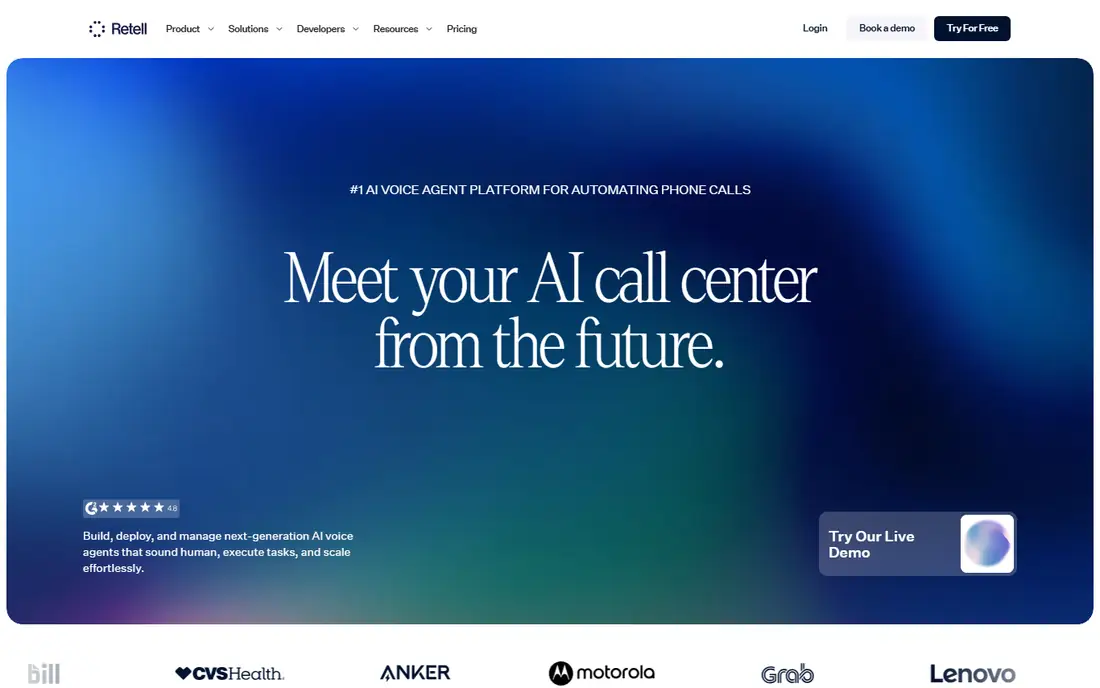
Retell AI calls itself the number one AI voice agent platform for automating phone calls, and its numbers back the claim: an independent benchmark across 414 calls scored it 95.7 percent workflow accuracy, the highest of six platforms tested. Agents handle reception, appointment setting, lead qualification, customer service, debt collection, and surveys, with drag-and-drop call flows, simulation testing, outbound campaigns, IVR navigation, live monitoring with instant takeover, and CRM write-back.
Pricing runs $0.07 to $0.31 per minute depending on models, voice, and add-ons, with no annual contract, and signup includes $10 in free credits with full platform access. For teams that want a production-ready Vapi replacement with measurable quality, Retell AI is the best starting point.
What we like- ~600ms latency with proprietary turn-taking
- $10 in free credits at signup with 20 free concurrent calls
- Visual flow builder plus QA on up to 100 percent of calls
- HIPAA, SOC 2 Type II, GDPR, and ISO 27001 compliant
Watch out for- Per-minute pricing of $0.07 to $0.31 varies with models and voices
- Enterprise features need higher tiers
- Smaller brand than Twilio-style incumbents
#2Bland AI
Best for: Regulated, high-stakes calls that cannot go wrong5.0/5 on
G2 (11 reviews, checked Oct 2026)
Visit bland.ai
Starting priceSee website
Free planFree demo
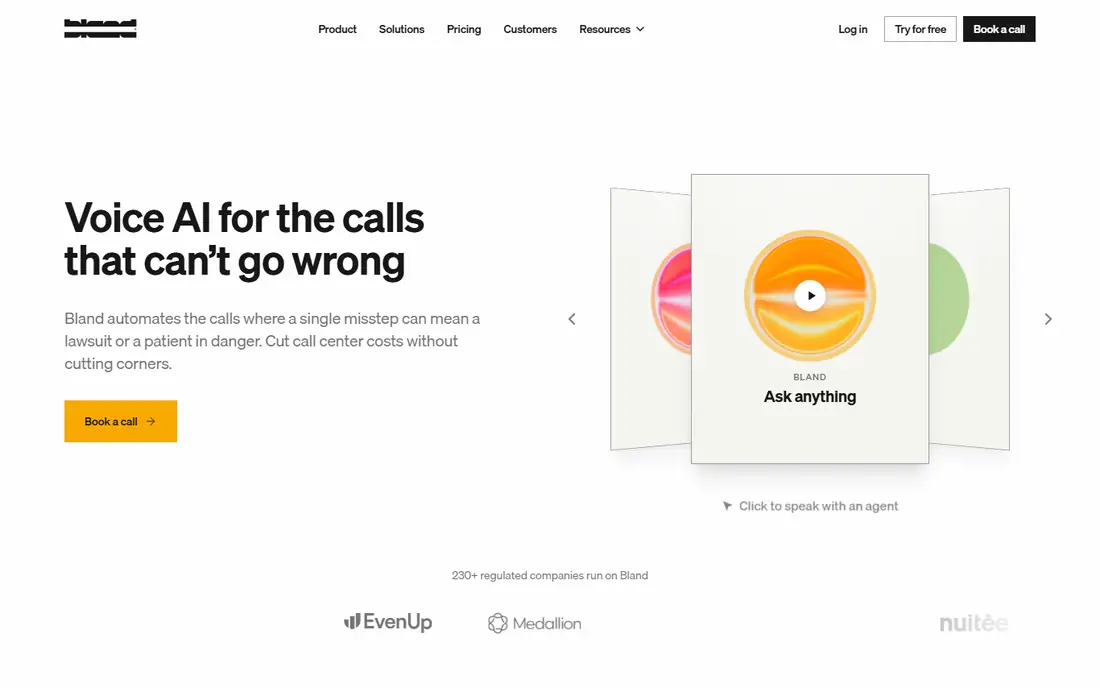
Bland is built for the calls where a single misstep can mean a lawsuit or a patient in danger. Unlike platforms that stitch third-party vendors together, Bland runs its entire stack in-house: speech-to-text, language model, and text-to-speech built and run by one team, so customer data never leaves to a third party and never trains other models. Its voice ranks number one for realism on an audio realism bench, ahead of human speech's 0.99 with a 0.91 score.
More than 230 regulated companies run on Bland, across banking, healthcare, legal, and government, with 40+ languages and real-time translation in 23. Pricing is per-minute covering model, speech, and telephony with no token charges, and enterprise plans are contracted by volume. For regulated calls, Bland is the safest Vapi alternative.
What we like- Own STT, LLM, and TTS stack built and run by one team
- Sub-400ms latency
- Ranked number one for voice realism
- SOC 2 Type I and II, HIPAA, and PCI DSS with self-hosted options
Watch out for- Pricing is not shown on the homepage
- Enterprise focus means longer sales cycles
- 2 to 6 week deployment for production agents
#3Synthflow
Best for: Enterprises that want their own telephony network4.5/5 on
G2 (1,016 reviews, checked Oct 2026)
Visit synthflow.ai
Starting priceSee website
Free planFree to build
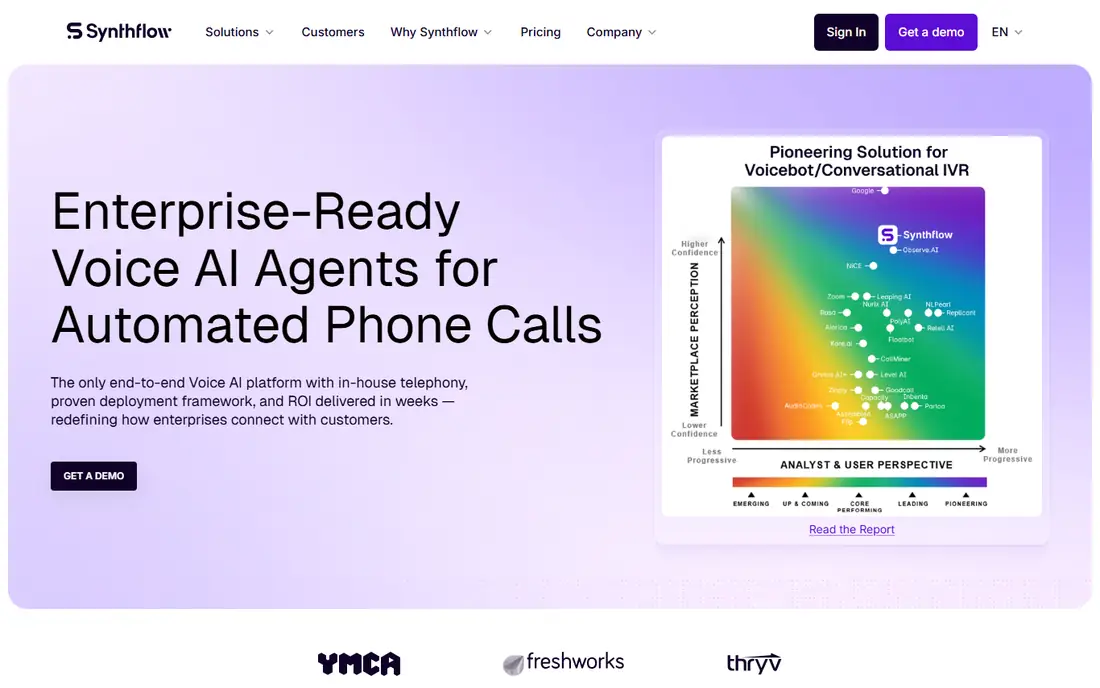
Synthflow is the end-to-end voice AI operating system for enterprises. Its BELL framework connects build, evaluate, launch, and learn into one repeatable process: a visual Flow Designer for call logic, a Test Center for simulated calls, deployment through Synthflow's own telephony network, and Auto-QA that analyzes every live conversation. Running its own network means control over routing, latency, and regional delivery, with 200+ integrations to CRMs, CCaaS platforms, and calendars.
The platform has handled 500 million customer calls with 4 million hours saved and a 45 percent increase in answered calls. Building is free, with pay-as-you-go pricing once agents launch. For enterprises that want telephony control plus a proven deployment path, Synthflow is the strongest Vapi alternative.
What we like- Own enterprise telephony network with sub-100ms latency and 99.99 percent uptime
- BELL framework for build, evaluate, launch, and learn
- 500 million customer calls handled
- Free to build with pay-as-you-go launch
Watch out for- Pricing is not shown on the homepage
- Enterprise positioning suits larger teams
- Deployment support leans on forward-deployed engineers
#4Cartesia
Best for: Teams that need the fastest realtime voice models4.3/5 on
G2 (43 reviews, checked Oct 2026)
Visit cartesia.ai
Starting priceSee website
Free planFree trial
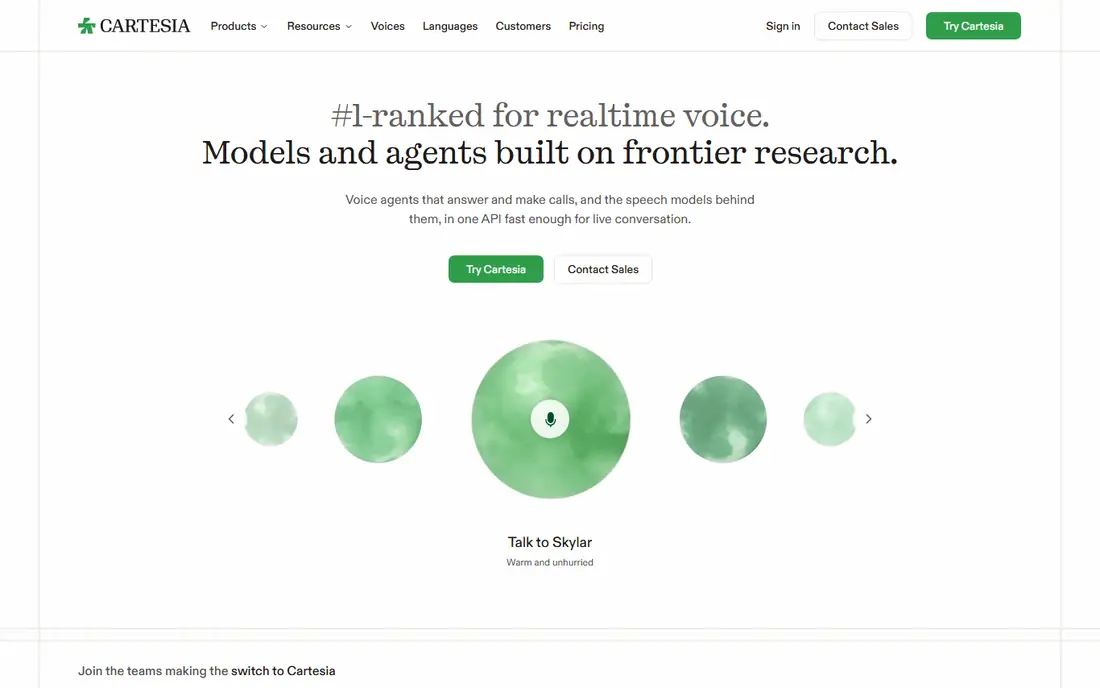
Cartesia builds the models behind the agents. Its speech models rank number one on the Speech Arena and Speech-to-Text leaderboards, built on state space model architectures including Mamba and H-Nets that the team pioneered. The Managed Agents platform lets teams build and ship enterprise voice agents on those models, with deployment across cloud, on-premises, and on-device to meet latency, data residency, and compliance needs.
EliseAI runs 5 million voice calls a month on Cartesia, a sign of production scale. Pricing is not shown on the homepage, and a playground lets you try the models. For teams whose top priority is voice quality and latency at the model layer, Cartesia is the best Vapi alternative.
What we like- Ranked number one on speech leaderboards
- Managed Agents platform for enterprise voice agents
- State space models for low latency at scale
- Cloud, on-premises, and on-device deployment
Watch out for- Pricing is not shown on the homepage
- Model-first positioning means less no-code tooling than Retell
- Newer agent platform than the incumbents
#5Deepgram
Best for: Developers building voice agents with APIs4.6/5 on
G2 (482 reviews, checked Oct 2026)
Visit deepgram.com
Starting priceSee website
Free planFree credits
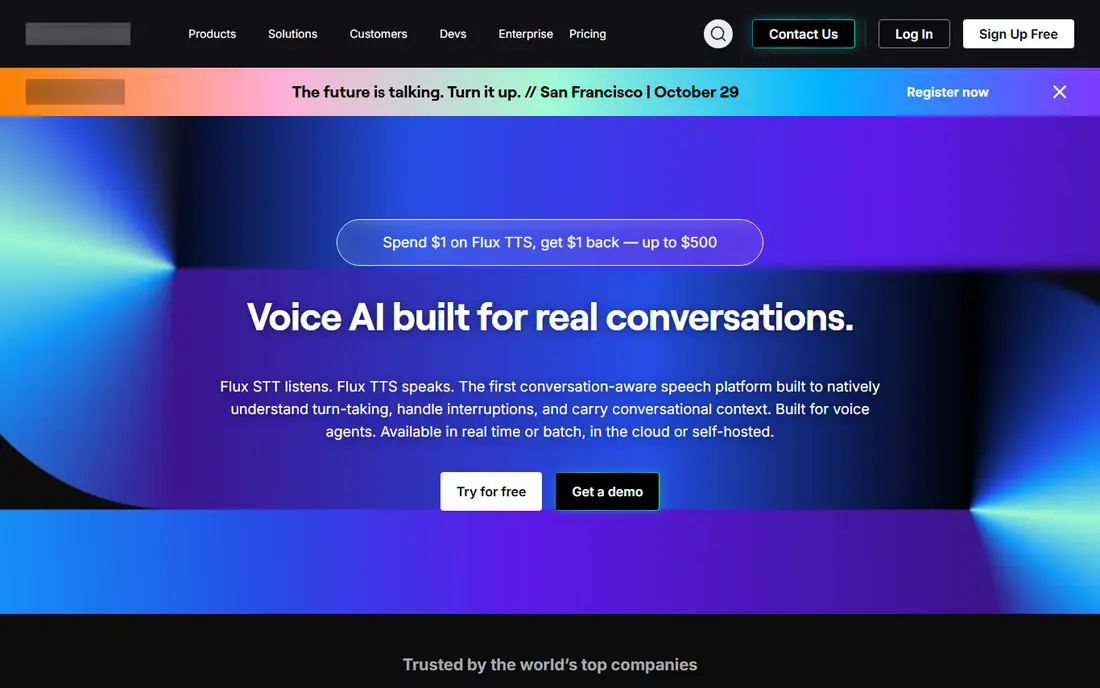
Deepgram is the infrastructure pick. Instead of stitching separate components, its Voice Agent API unifies speech-to-text, text-to-speech, and LLM orchestration into a single API call, cutting complexity, latency, and cost. Flux STT handles turn-taking, interruptions, and conversational context natively, while Flux TTS holds tone and continuity across a whole conversation with latency as low as 80 milliseconds.
Notably, Deepgram's own testimonial page confirms Vapi builds on Deepgram APIs, along with Twilio, Sierra, and Decagon, which speaks to its production reliability. Pricing is not shown on the homepage, with free credits for building. For developer teams that want API control rather than a managed platform, Deepgram is the best foundation.
What we like- Unified Voice Agent API combining STT, TTS, and LLM orchestration in one call
- Flux TTS latency as low as 80ms
- Cloud or self-hosted
- Powers Vapi itself plus Twilio, Sierra, and Decagon
Watch out for- Pricing is not shown on the homepage
- API-first approach needs developer skills
- No-code agent building is thinner than Retell or Synthflow
#6
LiveKit
Best for: Developers who want open-source voice agent infrastructure
Visit livekit.io
Starting priceSee website
Free planYes
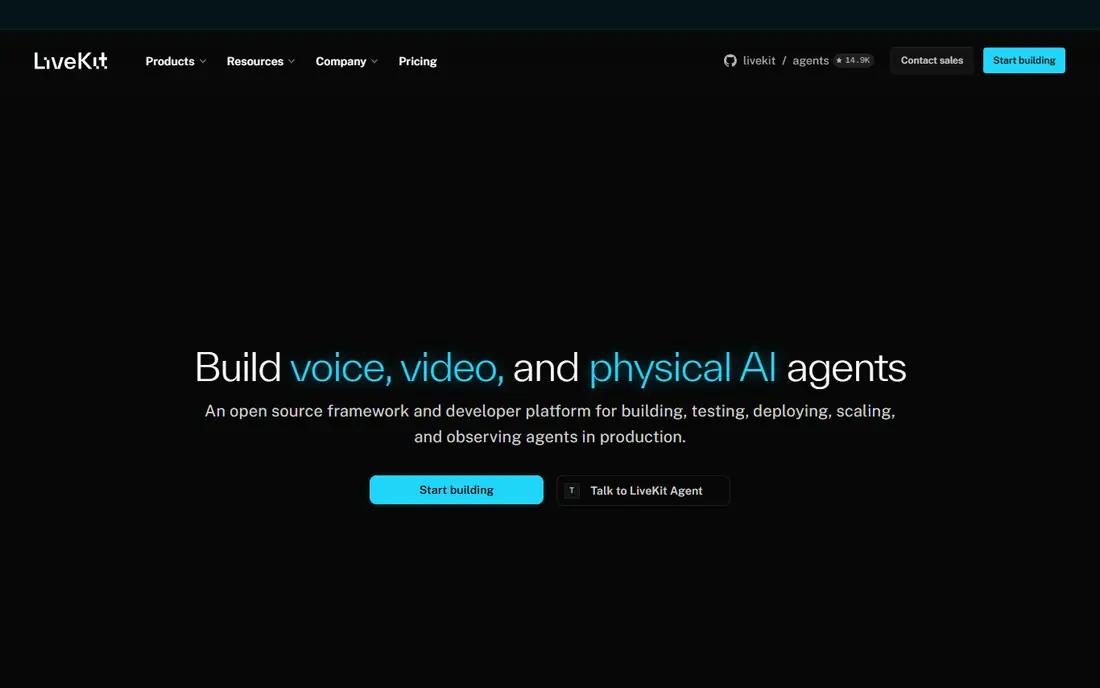
LiveKit is the developer platform for voice, video, and physical AI agents. Its open-source framework lets you build a voice agent in Python or Node.js in under 10 minutes, with an inference gateway for STT, LLM, and TTS models, SIP integrations and phone numbers for telephony, and full-stack observability for every session. OpenAI built ChatGPT's Advanced Voice on LiveKit Cloud, and Retell AI itself moved to LiveKit Cloud for telephony flexibility and low-latency global calls.
The platform runs 3 billion calls a year with 99.99 percent uptime, SOC 2 Type 2, HIPAA, and GDPR compliance, and a free account includes 1,000 agent session minutes monthly. For teams that want code-level control with proven scale, LiveKit is the best open Vapi alternative.
What we like- Open-source framework plus cloud platform
- 1,000 free agent session minutes monthly with no credit card
- Automatic turn detection and interruption handling
- 3 billion calls annually at 100ms global latency
Watch out for- Pricing for scale is not shown on the homepage
- Code-first approach needs engineering time
- Telephony setup is more involved than managed platforms
Starting price$0 (open source)
Free planYes
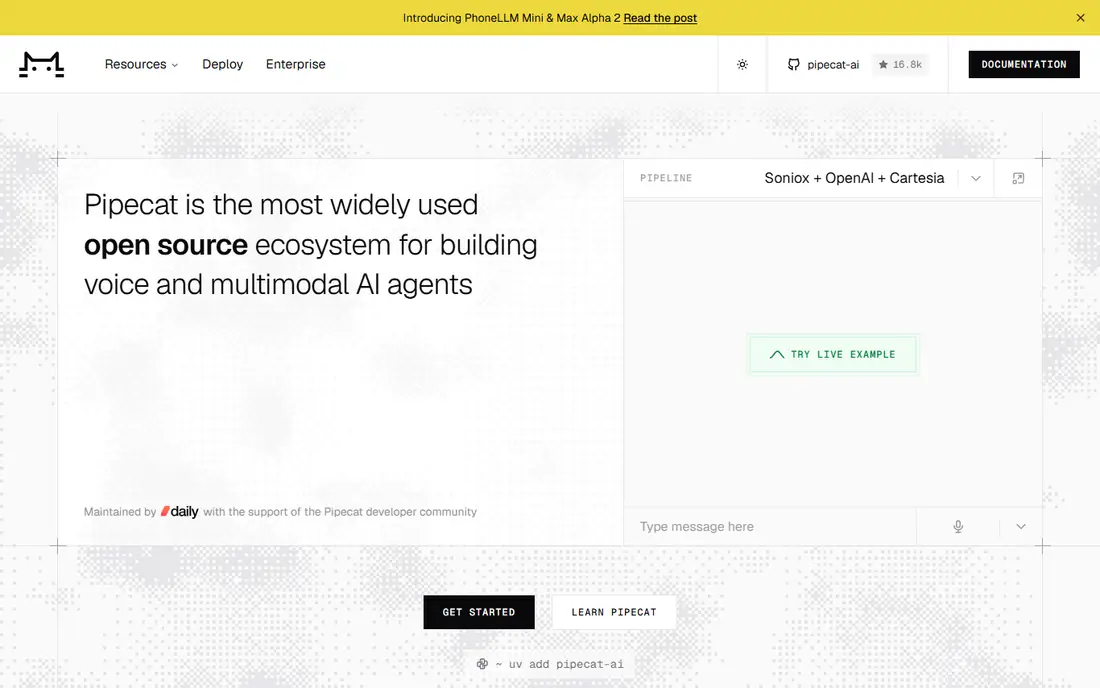
Pipecat is the open-source framework for production-grade voice and video agents. Its pipeline model streams frames as they are produced, so agents start responding while you are still talking, with interruption handling, turn detection, and smart context management for natural conversation. You can swap speech, language, and vision services from 200+ providers, usually with one line of code, and hand off to subagents for long-running tools through Pipecat Flows.
Deployment runs from your own servers to Pipecat Cloud to enterprise environments on AWS, Azure, and GCP, and the CLI scaffolds runnable projects with MCP support for coding agents. For teams that want maximum flexibility with no licence cost, Pipecat is the most open Vapi alternative.
What we like- Fully open source with 200+ provider integrations
- Frame-level control over voice, video, text, and images
- WebRTC, SIP, and PSTN transports
- Pipecat Cloud for managed deployment
Watch out for- Cloud pricing is not shown on the homepage
- Framework approach needs developers
- Enterprise support is a separate engagement
#8Decagon
Best for: Enterprises that want voice, chat, and email in one platform4.8/5 on
G2 (29 reviews, checked Oct 2026)
Visit decagon.ai
Starting priceSee website
Free planFree demo
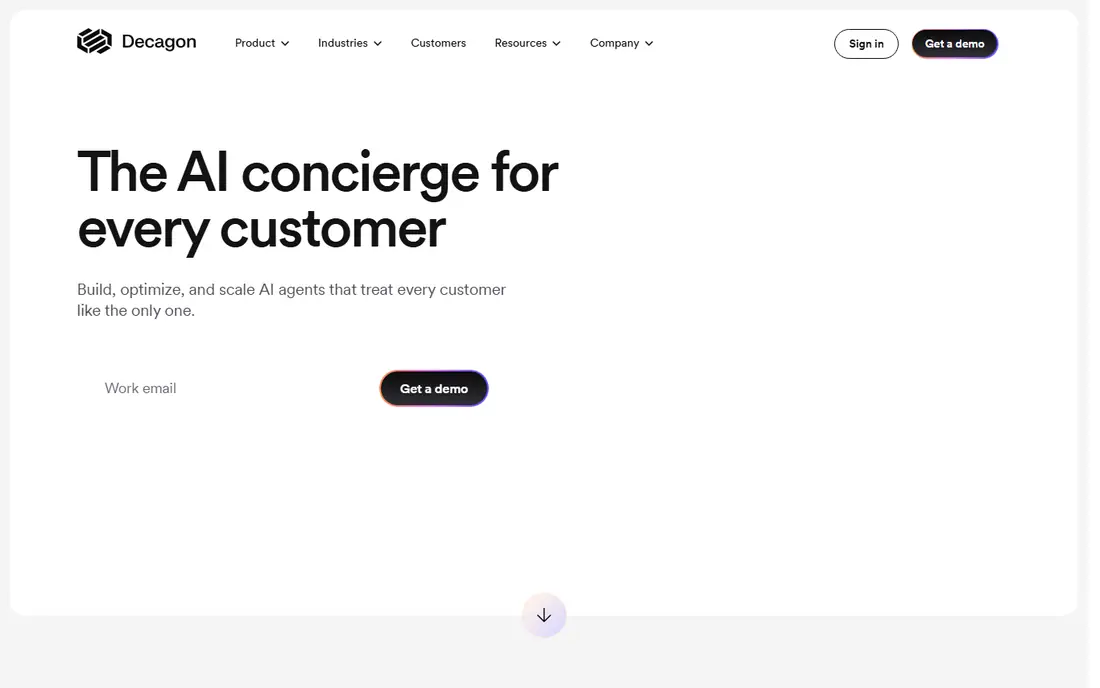
Decagon is the AI concierge for every customer, unifying chat, voice, and email in a single intelligence layer so experiences stay consistent across channels. Its Agent Operating Procedures let teams define workflows in natural language instead of complex configuration languages, so behavior can be refined as fast as the business moves, with testing, observability, and experimentation built in.
Customers report 70 percent chat and voice resolution, 80 percent deflection rates, and up to 95 percent cost reduction, with $1 million in revenue from fully AI-handled conversations in one case. Deepgram powers its voice capabilities, per Deepgram's own customer page. Pricing sits behind a demo. For enterprises that want one agent platform across every channel, Decagon is the best Vapi alternative.
What we like- Omnichannel agents across voice, chat, and email with shared memory
- Agent Operating Procedures define workflows in natural language
- 70 percent chat and voice resolution
- Customers report up to 95 percent cost reduction
Watch out for- Pricing is not shown on the homepage
- Enterprise focus means demo-led sales
- Voice is one channel among three rather than the sole focus
How we chose
We compared each platform on latency, voice quality, phone deployment, developer control, compliance, and pricing transparency. Every homepage above was opened to confirm it loads and belongs to the product. Two planned tools could not be verified, one blocked by the browsing tool's policy and one unresolvable, and neither was retried; Cartesia and Decagon were substituted after their homepages were confirmed. Prices come from vendor pages where shown; where the homepage did not display pricing, the field reads "See website" rather than a guessed figure. Vapi itself was excluded as the product being replaced.
What to check before you switch
Start with who builds the agent. No-code and low-code teams should weigh Retell AI, Bland AI, and Synthflow, which offer visual builders and managed deployment. Developer teams should weigh Deepgram, LiveKit, and Pipecat, which offer API and code-level control. Enterprises with omnichannel needs should weigh Decagon.
Next, test latency and voice quality on real calls, not demos. Latency figures here range from sub-100ms to ~600ms, but real network conditions and model choices change the experience, so run the same test script through two finalists. Check compliance too: HIPAA, SOC 2, and TCPA rules for outbound calling vary by use case, and regulated teams should prefer Bland, Retell, or Synthflow. Finally, compare per-minute costs at your real volume, since model and voice choices move Retell's $0.07 to $0.31 range significantly.
Frequently asked questions
Is Vapi shutting down?
No. Vapi remains an operating voice agent platform. Teams usually look for alternatives because of pricing, latency, compliance needs, open-source control, or a preference for a managed versus developer-first platform.
Which alternative is closest to Vapi?
Retell AI is the closest managed alternative, with a similar developer-friendly platform and phone focus. Deepgram is the closest at the infrastructure layer, since Vapi itself builds on Deepgram's voice APIs.
What is the cheapest way to start?
Retell AI offers $10 in free credits, LiveKit offers 1,000 free agent session minutes monthly, Synthflow is free to build, and Pipecat is free open source. For production, compare per-minute rates at your volume.
Do these tools handle outbound calls?
Yes. Retell AI, Bland AI, and Synthflow all support outbound campaigns with pacing, retries, and voicemail handling. Remember that US outbound calling requires prior consent under the TCPA.
Can I use my own phone numbers?
Yes. Retell AI supports SIP trunking with existing numbers, Synthflow connects through your own carriers or SIP trunks, and LiveKit offers phone numbers plus SIP integrations.
How do I measure voice agent quality?
Track workflow accuracy on multi-step calls, latency under real network conditions, interruption handling, and resolution rates. Retell AI's QA tools measure up to 100 percent of calls, and Synthflow's Auto-QA analyzes every live conversation.
Sources we checked (8)
- https://www.retellai.com
- https://www.bland.ai
- https://synthflow.ai
- https://cartesia.ai
- https://deepgram.com
- https://livekit.io
- https://www.pipecat.ai
- https://decagon.ai
Is your product missing or out of date?
We review this list regularly. Vendors can request a listing, send updated pricing or ask about featured placement.

Shihab Mia · Founder, Rankite
Shihab has 5+ years in B2B and SaaS SEO. He writes Rankite's software buying guides from pricing pages, documentation and public user reviews. More about Shihab.