How we make this list: we compare pricing pages, product documentation and public user reviews. Ratings come from G2, Capterra or Trustpilot, with the date we checked them.
Key takeaways
- Employee experience software splits into two camps: survey and listening platforms (Culture Amp, Qualtrics, Viva Glint, Peakon, CultureMonkey, Officevibe) and people-development or recognition tools (Leapsome, Lattice, Bonusly, Motivosity). Pick the camp before you compare features.
- Microsoft Viva Glint lists at $2.00 per user per month on an annual commitment, and Bonusly has a free plan for up to 8 users. Most other vendors on this list sell by quote only.
- Recognition tools like Bonusly and Motivosity price the software separately from the rewards. Rewards are paid at face value, so budget for both.
- Enterprise platforms (Qualtrics, Peakon) give the deepest analytics, but they assume you have an HR analyst or a dedicated people team to run them.
- Whatever you buy, the survey is the easy part. The tools that pay off are the ones that push action plans to managers, so check that workflow in every demo.
Quick comparison
| Tool | Best for | Starting price | Free plan |
|---|
 Culture Amp | Survey science plus performance in one platform | See website | See website |
 Qualtrics EmployeeXM | Large organizations with in-house analysts | See website | See website |
 Microsoft Viva Glint | Microsoft 365 shops that want low-cost surveys | $2.00 per user/month (paid yearly) | No |
 Workday Peakon Employee Voice | Continuous listening at enterprise scale | See website | See website |
 Officevibe | Small teams that want simple weekly pulses | See website | See website |
 Leapsome | Teams combining engagement, reviews and learning | See website | See website |
 Lattice | HR teams that already run performance cycles | See website | See website |
 Bonusly | Peer recognition on a small budget | $3 per user/month (Team plan without Bizy AI, billed annually) | Yes |
 Motivosity | Culture-first recognition with gifting | Custom quote (small business plans from $3,000 per year) | No |
 CultureMonkey | Mid-size teams that want advisory included | See website | See website |
Is your product missing or out of date?
We review this list regularly. Vendors can request a listing, send updated pricing or ask about featured placement.
The best employee experience software
Starting priceSee website
Free planSee website
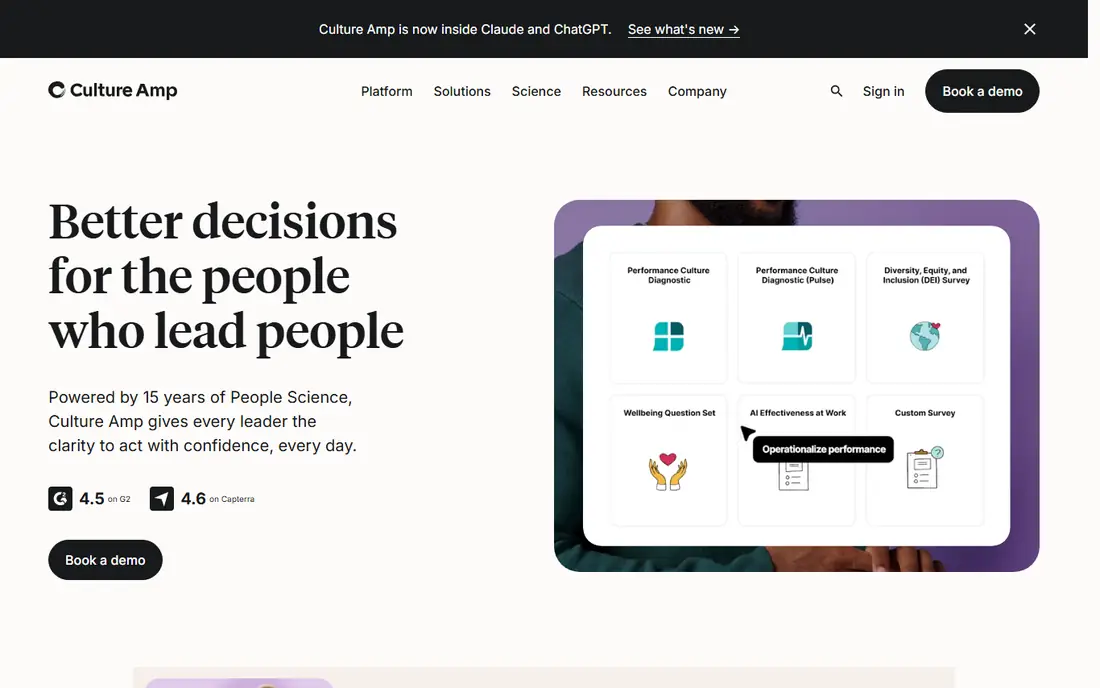
Culture Amp is usually the first name on shortlists, and for good reason. It began as an engagement survey tool and expanded into performance reviews and development planning, so one vendor can cover the full employee cycle. HR teams tend to like the survey templates and the benchmarking against other companies.
The catch is cost and complexity. Pricing is not published on a simple per-seat page, so you will need a sales conversation to get a number, and review-site comments often mention annual contracts. Small companies with one HR generalist may find the reporting more than they will use.
What we like- Well-established engagement survey templates and benchmarking
- Covers engagement, performance and development
- Widely reviewed on G2 and Capterra
Watch out for- Pricing is quote-based
- Can feel heavy for companies under 100 people
#2
Qualtrics EmployeeXM
Best for: Large organizations with in-house analysts
Visit qualtrics.com
Starting priceSee website
Free planSee website
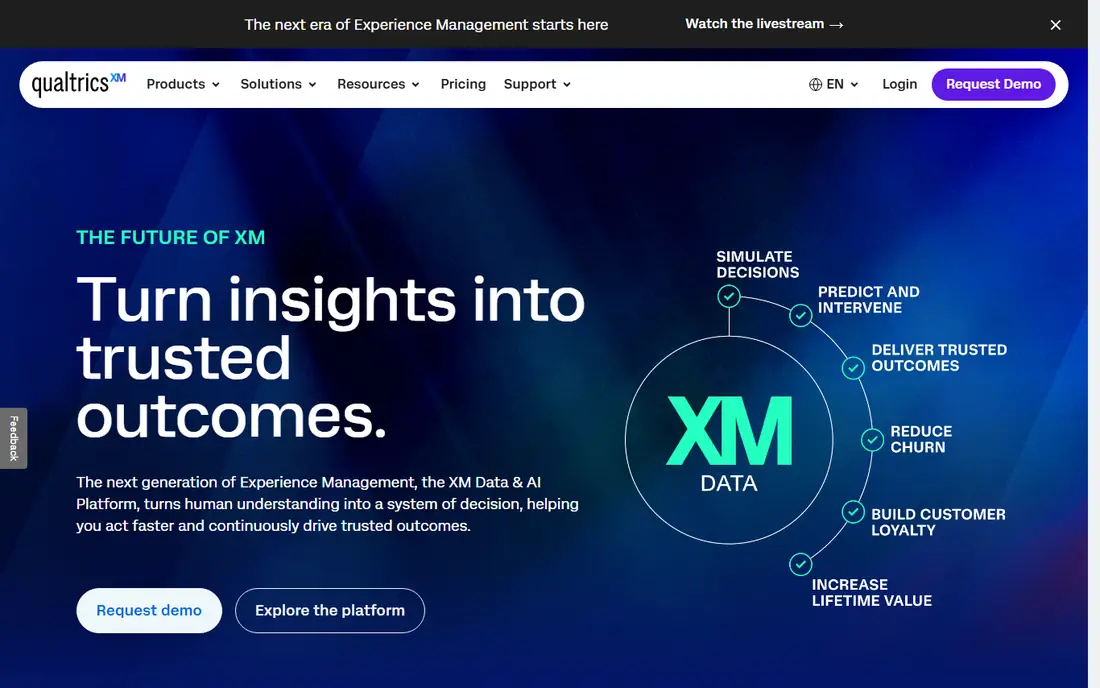
Qualtrics comes from the research-survey world, and it shows. You can build almost any survey flow, segment results many ways and connect findings to other experience programs, such as customer feedback. If your people analytics team already lives in dashboards, this is the most flexible option on the list.
That flexibility is also the drawback. Setup takes real planning, and a company without an analyst may leave most of the product unused. For a 150-person business, it is probably more tool than you need.
What we like- Deep analytics and survey logic
- Covers the whole employee lifecycle (engagement, onboarding, exit)
- Strong for custom research designs
Watch out for- Quote-based and generally priced for enterprise budgets
- Needs skilled admins to get full value
#3
Microsoft Viva Glint
Best for: Microsoft 365 shops that want low-cost surveys
Visit microsoft.com
Starting price$2.00 per user/month (paid yearly)
Free planNo
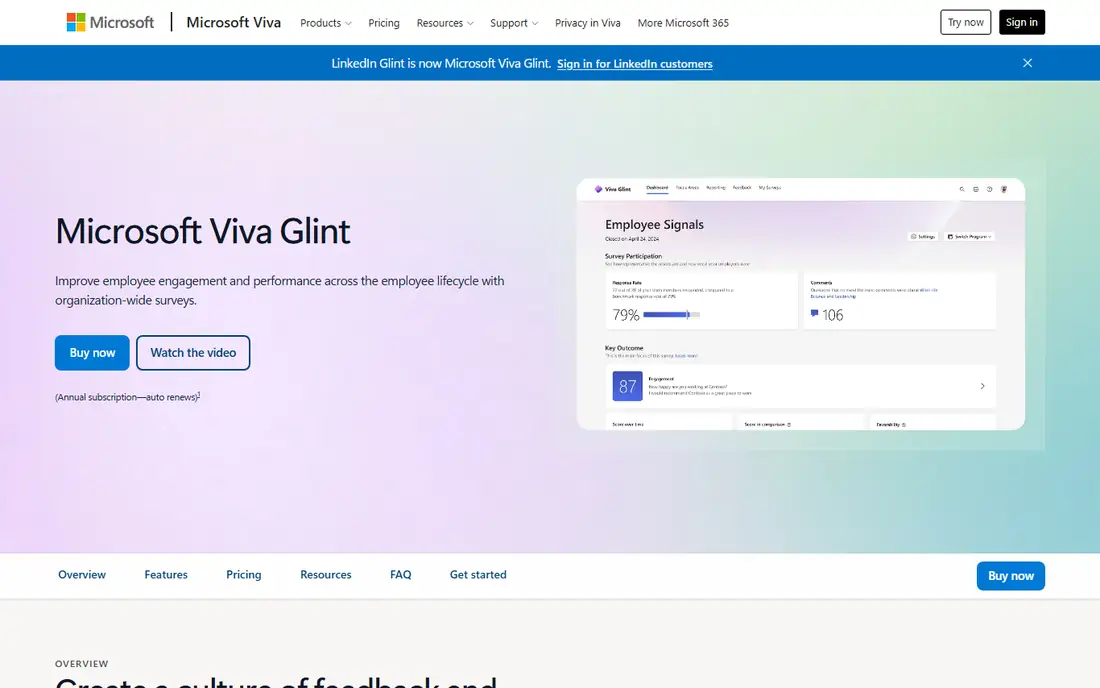
Glint is the rare enterprise-grade listening tool with a price printed on the page. Microsoft lists it at $2.00 per user per month, paid yearly, with an annual commitment that auto-renews. A higher bundle, Viva Workplace Analytics and Employee Feedback, is listed at $6.00 per user per month and adds manager insights and brief team surveys.
For a company that already uses Teams and Microsoft 365 every day, the fit is natural, and procurement is simpler because it sits under an existing Microsoft agreement. The weakness is breadth. Glint measures and recommends, but it is not a recognition or performance tool, so you will need other software for those jobs.
What we like- Published, low per-user price
- Fits naturally into Teams and Microsoft 365
- Feedback surveys with recommended actions
Watch out for- Annual commitment that auto-renews
- Best value only if your company already runs on Microsoft
#4
Workday Peakon Employee Voice
Best for: Continuous listening at enterprise scale
Visit workday.com
Starting priceSee website
Free planSee website
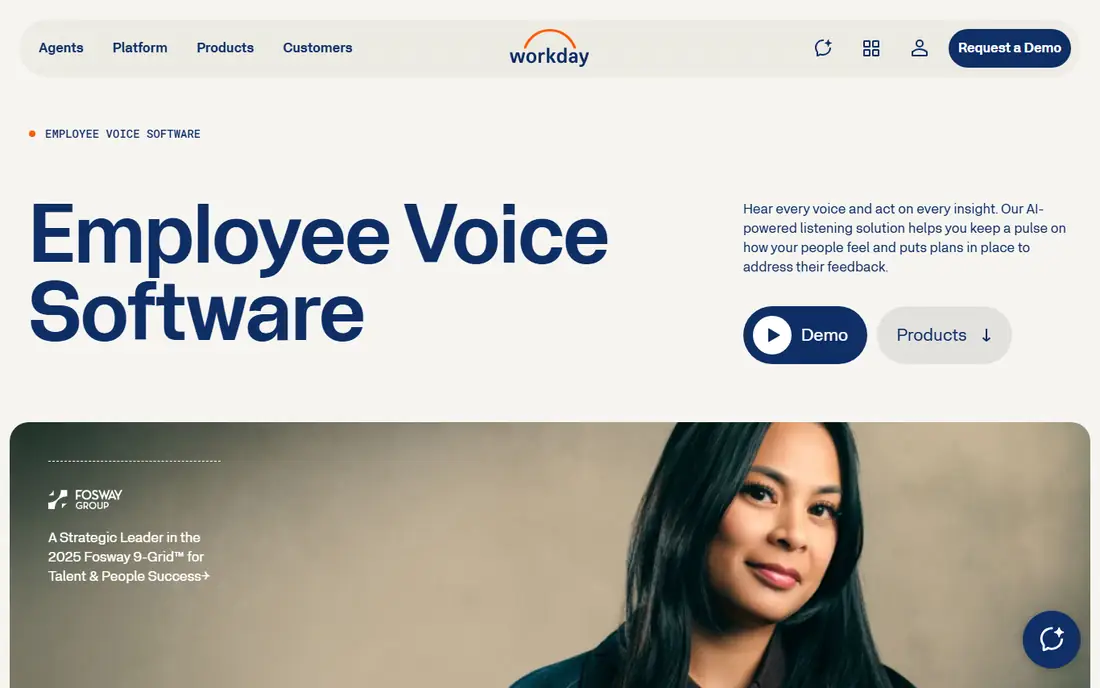
Workday describes Peakon Employee Voice as a listening platform that delivers AI-assisted insights across the employee lifecycle. In practice, its appeal is the way results reach managers. Each leader sees their own team's dashboard and action tools, which helps surveys turn into follow-up instead of an HR slide deck.
You do not need to be a Workday HCM customer in principle, but the product makes the most sense inside bigger organizations that value benchmarking over time. Smaller companies will find the sales process and contract scale out of proportion to their needs.
What we like- Captures sentiment across the employee lifecycle (engagement, well-being, diversity)
- Benchmarking dataset for comparisons
- Dashboards and action tools for managers, not only HR
Watch out for- Quote-based
- Aimed at larger organizations
Starting priceSee website
Free planSee website
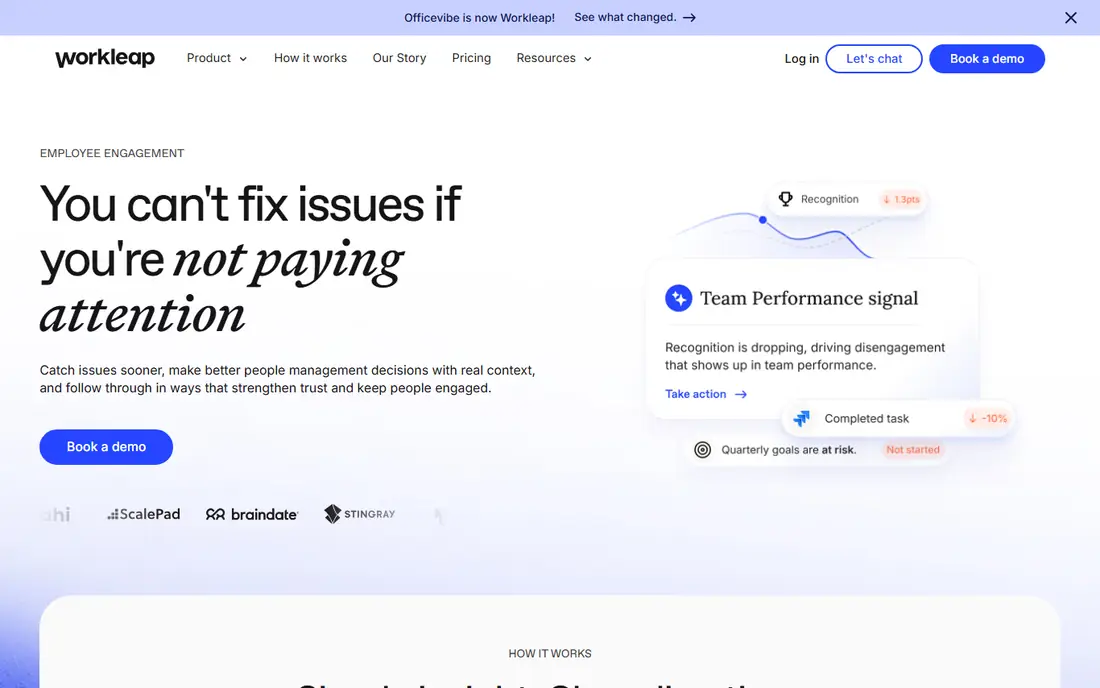
Officevibe is a good fit when nobody on your staff is a full-time people analyst. Managers get short, regular pulse surveys and a feed of anonymous comments, and they are nudged toward small conversation starters in one-on-ones. It is deliberately simple.
The simplicity has a ceiling. If your leadership team wants cross-company driver analysis or heavy segmentation, you will outgrow it. Third-party pricing trackers quote per-employee monthly ranges, but those are estimates, so confirm current rates with Workleap directly.
What we like- Lightweight weekly pulse surveys that take minutes to set up
- Anonymous feedback channel
- Part of the Workleap suite
Watch out for- Less depth in analytics than enterprise tools
- Custom questions and integrations sit on higher tiers
#6Leapsome
Best for: Teams combining engagement, reviews and learning4.8/5 on
G2 (2,571 reviews, checked Oct 2026)
Visit leapsome.com
Starting priceSee website
Free planSee website
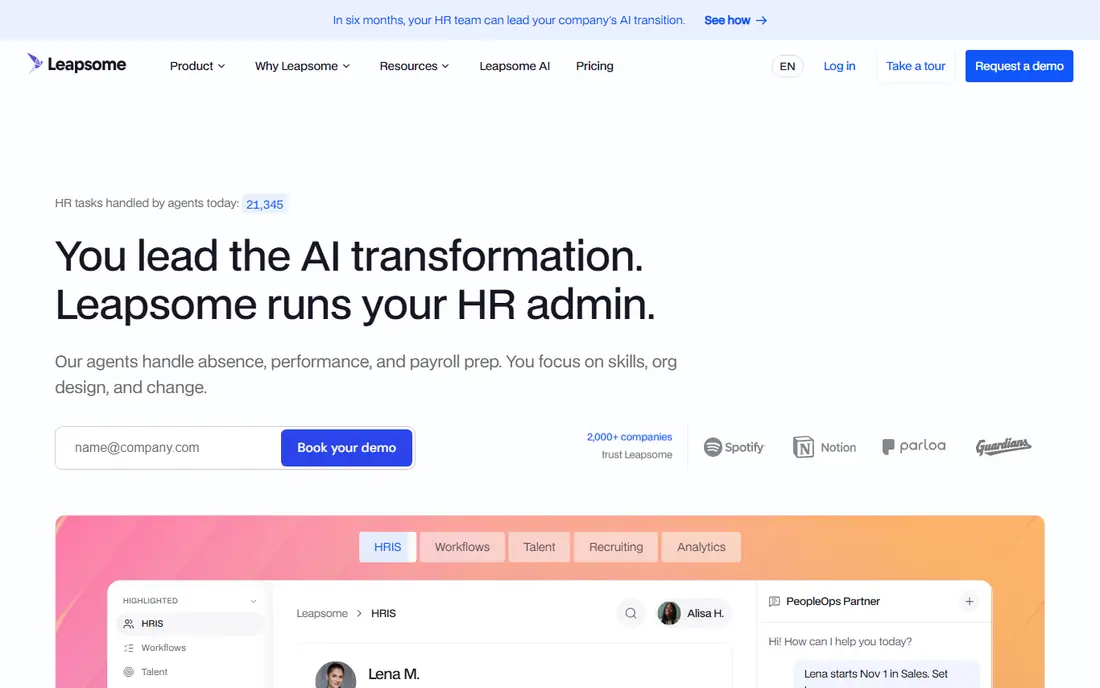
Leapsome sells modules, so you can start with engagement surveys and add goals, reviews or learning later. That suits a 100 to 500 person company that wants to consolidate several HR tools without buying the biggest suite on the market.
The cost of that modularity is a more involved quote and a longer rollout than a single-purpose pulse tool. Reviewers often praise the breadth, but you should confirm exactly which modules sit in your price before signing.
What we like- Modular platform (engagement, performance, goals, learning)
- Flexible survey and review templates
- Good for growing teams that want one tool
Watch out for- Module-based quotes make total cost hard to predict
- Broad scope means longer setup
#7Lattice
Best for: HR teams that already run performance cycles4.6/5 on
G2 (4,117 reviews, checked Oct 2026)
Visit lattice.com
Starting priceSee website
Free planSee website
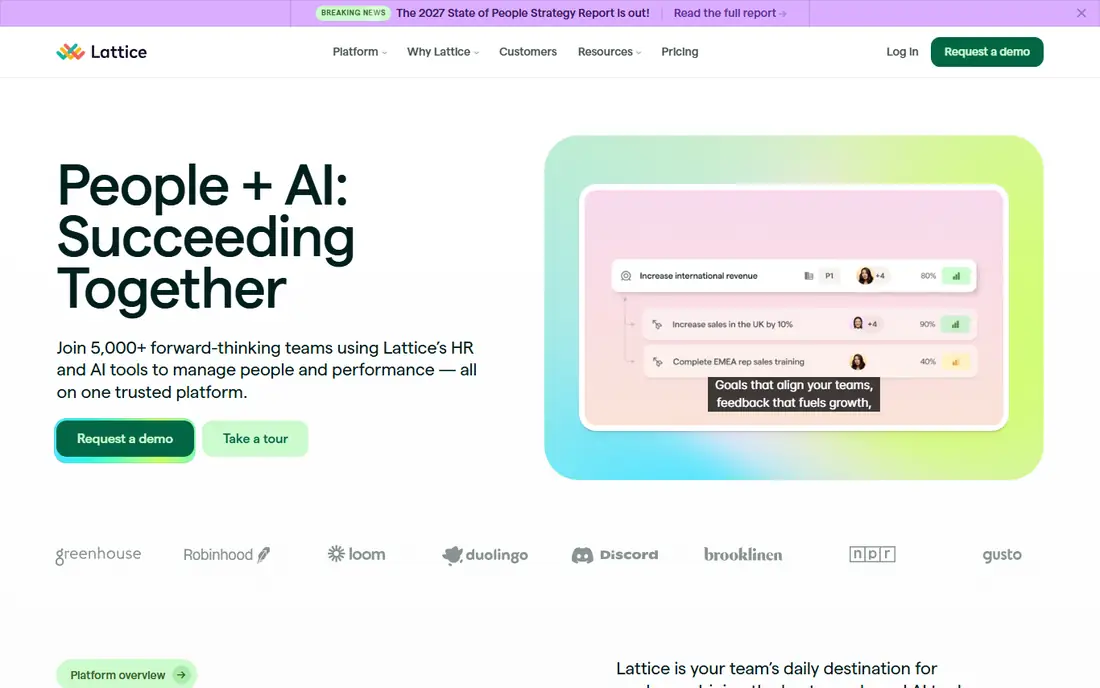
Lattice made its name in performance management, and engagement surveys are best understood as an extension of that. If managers already log in for reviews and one-on-ones, adding pulses to the same place keeps adoption high.
Its engagement tooling is less deep than a specialist such as Culture Amp or Qualtrics, and per-seat pricing means the bill scales steadily as you hire. Compare the combined cost of the modules you actually need, not the headline starting figure.
What we like- Performance reviews, goals and engagement in one interface
- Familiar to HR teams that run review cycles
- Add-on structure lets you buy only what you need
Watch out for- Engagement is a separate paid add-on
- Per-seat costs grow with headcount
#8Bonusly
Best for: Peer recognition on a small budget4.7/5 on
G2 (7,394 reviews, checked Oct 2026)
Visit bonusly.com
Starting price$3 per user/month (Team plan without Bizy AI, billed annually)
Free planYes
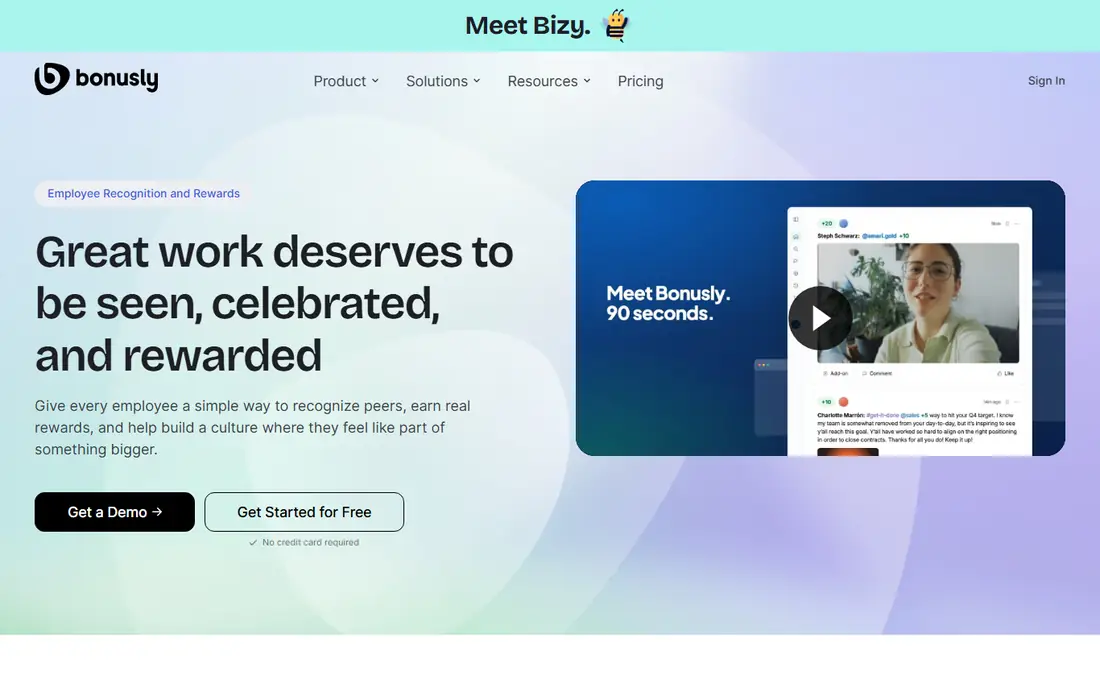
Bonusly is the most affordable way on this list to start. The free plan covers up to 8 users with peer recognition, and the Team plan is listed at $3 per user per month (or $30 per user paid annually) without the Bizy AI assistant. Including Bizy, Team is $5 per user per month, or $50 per user per year.
Rewards are billed separately. A $10 gift card costs you $10, and you never prepay for unused funds. That is friendlier than many alternatives, but the engagement and survey features are lighter, so treat Bonusly as a culture layer rather than a full listening platform.
What we like- Free plan for up to 8 users
- Rewards paid at face value with no upfront funding
- 30-day trial of Team or Organization plans
Watch out for- Recognition-first, so survey depth is limited
- Bizy AI assistant costs extra on some options
#9Motivosity
Best for: Culture-first recognition with gifting4.7/5 on
G2 (3,735 reviews, checked Oct 2026)
Visit motivosity.com
Starting priceCustom quote (small business plans from $3,000 per year)
Free planNo
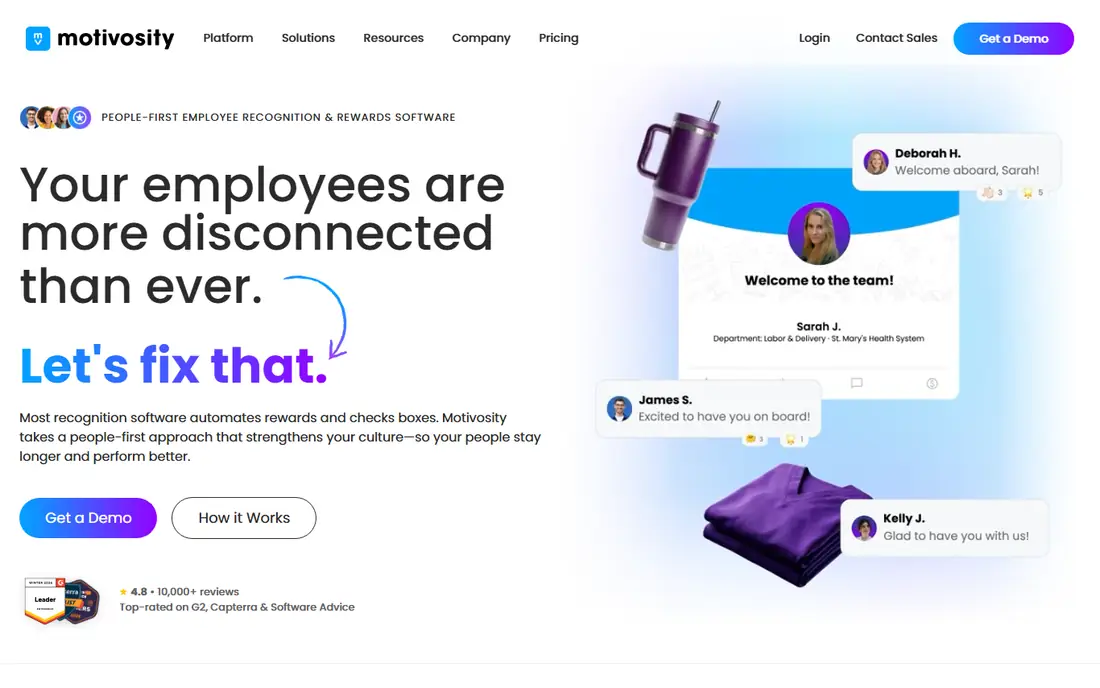
Motivosity is the pick for companies where recognition and appreciation are the center of the culture plan. Its pricing page describes a small platform fee per employee plus modules, and says small business plans start at $3,000 annually. Mid-market ranges the vendor cites run from $7,500 to $75,000 per year depending on size.
That makes it more of a budgeted program than a quick credit card purchase. You will talk to sales, and the final cost depends on which modules you add. For teams that want recognition but not an annual contract, Bonusly is easier to start with.
What we like- Peer recognition, rewards and engagement tools in one platform
- Unlimited integrations and 70+ supported languages listed
- Tailored quotes by company size
Watch out for- No public per-seat price
- Modules add to the base platform fee
#10CultureMonkey
Best for: Mid-size teams that want advisory included4.7/5 on
G2 (67 reviews, checked Oct 2026)
Visit culturemonkey.io
Starting priceSee website
Free planSee website
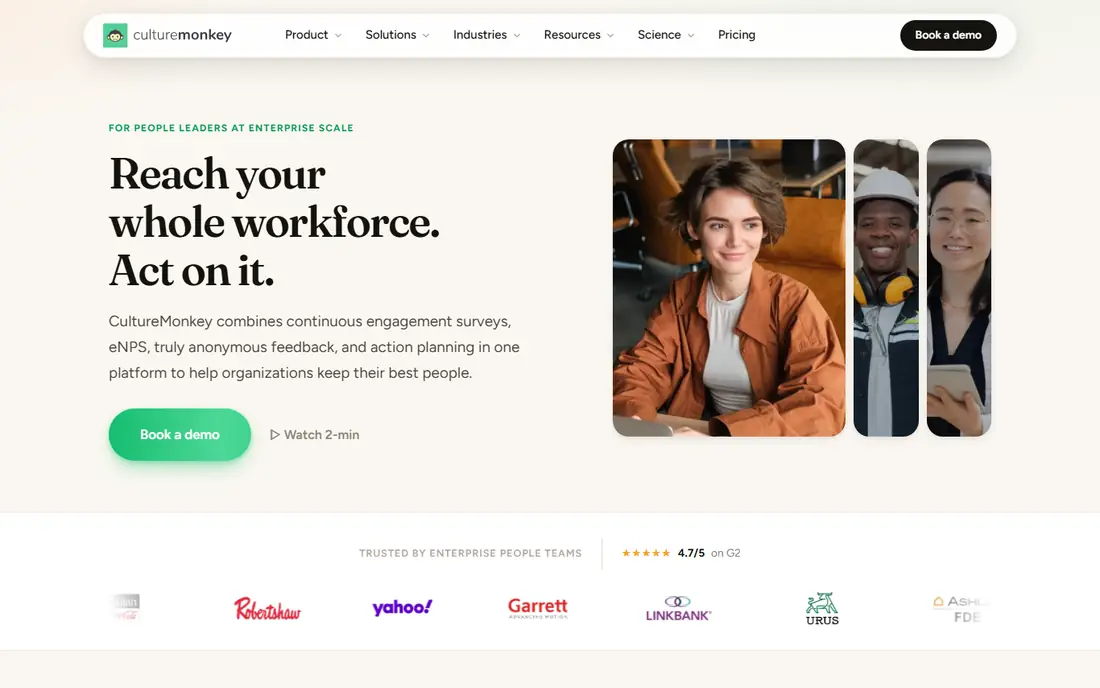
CultureMonkey is a newer challenger, and its pitch is that onboarding, survey design help and ongoing people-science advice are included in the subscription. For a company without a research background, that support can matter more than another dashboard.
Anonymity is handled so that results stay anonymous while still being broken down by team, location or manager, which is the hard part at small group sizes. The tradeoff is the usual one with younger vendors: fewer public reviews and a smaller integration track record than the big names.
What we like- Engagement, pulse, eNPS and lifecycle surveys (onboarding, 30-60-90, exit) in one tool
- Pricing tiered by company size with no separate license fee
- Onboarding and survey design help included
Watch out for- Smaller vendor with less brand recognition
- Quote required for pricing
How we chose
We did not run hands-on trials. Instead, we compared each product using its own pricing and product pages, documentation, public reviews on G2, Capterra and Reddit, and the features and integrations each vendor lists. We looked at who each tool really fits by company size, how it is priced (per seat, per module or flat), and what the contract looks like.
We also mixed established leaders with smaller vendors so you can see more than one price tier. Where a vendor does not publish a price on its own site, we say "See website" rather than quote a third-party estimate. Check current terms with the vendor before you buy, because pricing changes often.
Decide what problem you are solving
If the goal is to understand why people leave, you want a listening platform with driver analysis (Culture Amp, Qualtrics, Peakon, Glint, CultureMonkey). If it is to improve manager habits and development, look at Leapsome or Lattice. If you mostly want people to feel appreciated, Bonusly and Motivosity are closer to the target.
Mixing these goals is where companies overspend. A 120-person business rarely needs enterprise analytics and recognition and reviews, all from separate vendors.
Match the tool to your company size
Under 100 people, simple pulses and recognition are usually enough, and a free plan or low per-seat fee is the sensible start. Between 100 and 1,000, modular suites such as Leapsome or Culture Amp cover most needs. Above that, enterprise tools justify their cost if someone owns the program full time.
Ask these questions in every demo
- What does the first-year total cost, including onboarding and any add-on modules?
- How long is the contract, and does it auto-renew?
- Can you export raw survey data if you leave?
- Which HRIS and chat tools does it connect to (Slack, Teams, Workday, BambooHR)?
- How does it protect anonymity for small teams?
- Who at your company will read the results, and what happens next?
Plan the follow-through
Software only measures. Name an owner for each action plan, set a date for sharing results with employees, and run the next pulse to see whether anything changed. Skipping that step is the most common reason survey programs lose credibility.
Frequently asked questions
What is employee experience software?
It is a set of tools that collect and act on employee feedback across the work lifecycle, from onboarding to exit. That usually means engagement surveys, pulse checks, recognition and sometimes performance or learning. The better platforms help managers act on results, not just report them.
How much does employee experience software cost?
It ranges from free or a few dollars per user per month to custom enterprise contracts. Microsoft Viva Glint lists $2.00 per user per month, paid yearly, and Bonusly has a free plan for up to 8 users. Many vendors, including Culture Amp, Qualtrics and Peakon, require a quote.
Which tool is best for a small business?
Bonusly is the easiest low-cost start, especially for recognition, and Officevibe suits simple weekly pulses. Motivosity also offers small business plans, listed from $3,000 per year. Check each vendor's current terms before committing.
Do I need separate tools for surveys and recognition?
Not always. Some suites combine surveys with performance or recognition, but the survey depth often drops. Many companies pair a listening platform with a lighter recognition tool, so check the integrations before you buy both.
How long does implementation take?
Pulse tools can be live in a day or two once your employee list is loaded. Enterprise platforms with custom survey design and HRIS integration take weeks. Ask each vendor for a realistic timeline for your headcount.
Sources we checked (8)
- https://www.microsoft.com/en-us/microsoft-viva/glint
- https://www.microsoft.com/en-us/microsoft-viva/pricing
- https://bonusly.com/pricing
- https://www.motivosity.com/pricing
- https://www.workday.com/en-us/products/employee-voice/overview.html
- https://www.culturemonkey.io/
- https://www.culturemonkey.io/pricing/
- https://www.vendr.com/marketplace/officevibe
Is your product missing or out of date?
We review this list regularly. Vendors can request a listing, send updated pricing or ask about featured placement.

Shihab Mia · Founder, Rankite
Shihab has 5+ years in B2B and SaaS SEO. He writes Rankite's software buying guides from pricing pages, documentation and public user reviews. More about Shihab.