How we make this list: we compare pricing pages, product documentation and public user reviews. Ratings come from G2, Capterra or Trustpilot, with the date we checked them.
Key takeaways
- Every tool here has a free, self-hosted core, but none of them is free to run. Budget for hosting, a developer or agency, payment fees and security updates.
- WooCommerce, PrestaShop and OpenCart suit store owners who want a admin panel, themes and add-ons out of the box. Medusa, Saleor, Sylius and Vendure suit teams with developers who want a headless backend.
- Managed hosting prices vary widely. Medusa Cloud starts at $29 per month, while Saleor Cloud starts at $1,599 per month and also takes a share of GMV above its plan cap.
- Open source licenses differ. Vendure Core uses GPLv3, Medusa mixes an open core with some commercially licensed enterprise modules, and Saleor uses BSD-3-Clause, so check the license before you build a business on it.
- If nobody on your team writes code, pick a tool with a large plugin catalog. If you have engineers, pick the framework whose language they already know.
Quick comparison
| Tool | Best for | Starting price | Free plan |
|---|
 WooCommerce | WordPress sites adding a store | Free (open source); hosting, extensions and payment fees are extra | Yes |
 PrestaShop | Standalone stores in multiple languages | Free (open source); hosted and partner options See website | Yes |
 OpenCart | Small catalogs on a tight budget | Free (open source); OpenCart Cloud See website | Yes |
 Medusa | Custom headless commerce on Node.js | Free self-hosted; Medusa Cloud from $29 per month | Yes |
 Saleor | High-volume headless stores on Python | Free self-hosted; Saleor Cloud from $1,599 per month | Yes (self-hosted; Cloud sandboxes are non-commercial) |
 Sylius | Custom B2B and B2C builds on Symfony | Free (Community Edition); Sylius Plus See website | Yes |
 Vendure | TypeScript teams building B2B commerce | Free (Vendure Core); paid plans See website | Yes |
 Bagisto | Laravel teams and marketplaces | Free (open source) | Yes |
Is your product missing or out of date?
We review this list regularly. Vendors can request a listing, send updated pricing or ask about featured placement.
The best open source ecommerce CMS software
#1WooCommerce
Best for: WordPress sites adding a store4.4/5 on
G2 (1,283 reviews, checked Oct 2026)
Visit woocommerce.com
Starting priceFree (open source); hosting, extensions and payment fees are extra
Free planYes
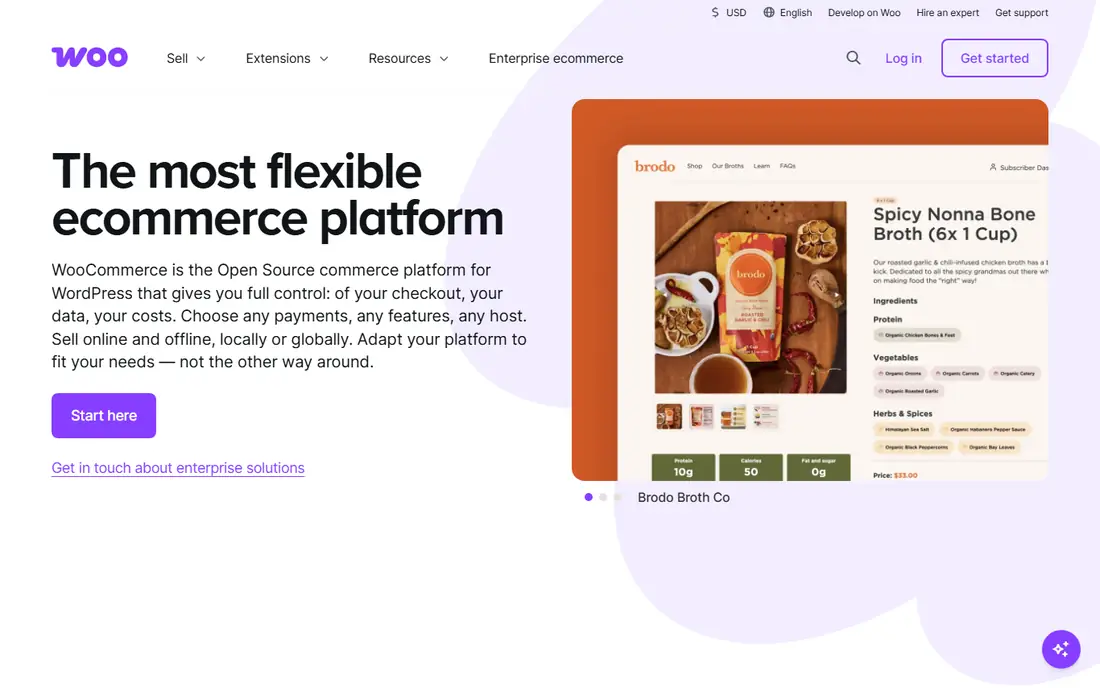
WooCommerce is the obvious pick if you already run a WordPress site and want to start selling from it. The vendor describes it as the free, open source ecommerce platform for WordPress, with no platform fees and no revenue share. A store can be live in an afternoon if your catalog is small and you stick to common payment gateways.
Its strength is the ecosystem. Almost any feature you want, from subscriptions to bookings to shipping rate tables, exists as an extension, and thousands of agencies and freelancers know the platform. That makes hiring help easy and keeps you from being locked to one developer. Because it sits on WordPress, blogging and SEO content are natural parts of the same site.
The catch is that "free" only covers the plugin. You pay for hosting (published estimates range from a few dollars a month for shared plans to far more for managed hosting), plus premium extensions, and each extension is another thing to keep updated. Large catalogs and heavy traffic need tuned hosting and caching, or the store gets slow.
What we like- Runs inside WordPress, so content and commerce live in one admin
- Huge extension and theme catalog
- No revenue share or platform fees
Watch out for- Hosting, security and updates are your job
- Stacking many extensions can slow the site
#2PrestaShop
Best for: Standalone stores in multiple languages4.3/5 on
G2 (159 reviews, checked Oct 2026)
Visit prestashop.com
Starting priceFree (open source); hosted and partner options See website
Free planYes
PrestaShop is a dedicated ecommerce application built in PHP, so you get products, orders, shipping and taxes without installing a content system first. It is a good fit for merchants who sell across several countries and need multiple languages and currencies handled in the core. The company says it serves around 250,000 online merchants, though that is its own figure.
The back office is more complete out of the box than a bare WooCommerce install, and the open source core means you can move your store to or from the platform without a license barrier. Data lives in your own database, so exporting products and customers is a matter of standard database and CSV tools.
The honest weakness is the add-on economy. Themes and modules from the PrestaShop marketplace are often paid, and quality varies between vendors. PrestaShop is also more popular in Europe than in the US, so finding a local agency that knows it well can take more effort.
What we like- Full store platform with no dependence on WordPress
- Strong multilingual and multi-currency orientation
- Open source core with no vendor lock-in
Watch out for- Many useful modules are paid add-ons
- Smaller developer pool than WooCommerce in the US
#3OpenCart
Best for: Small catalogs on a tight budget4.3/5 on
G2 (106 reviews, checked Oct 2026)
Visit opencart.com
Starting priceFree (open source); OpenCart Cloud See website
Free planYes
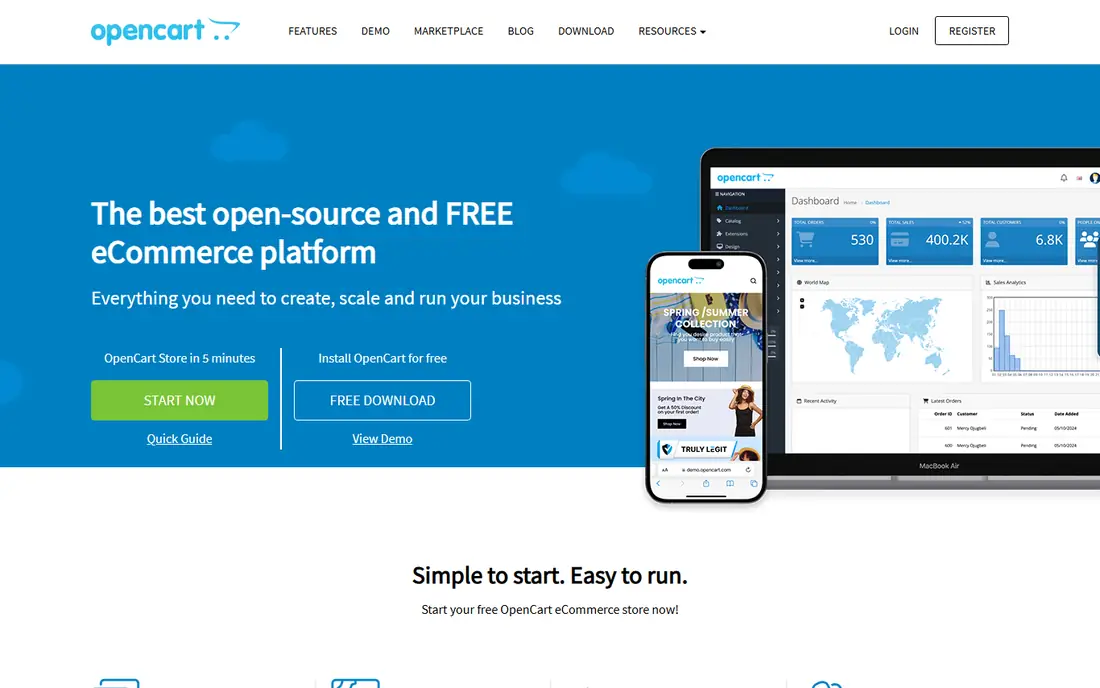
OpenCart is the lightest option on this list. It is a PHP and MySQL application that installs on inexpensive hosting, which makes it a sensible choice for a shop with a few hundred products and a founder who wants to manage things without a developer on retainer. The project states that downloads and updates are free and that there are no monthly fees.
You can either host it yourself or use the vendor's hosted OpenCart Cloud product, which removes server work. Support comes in two forms: free community help, or dedicated commercial support if you need someone accountable.
Where it falls short is depth. Complex pricing rules, B2B features and advanced multi-store logic usually mean buying extensions or custom code, and the extension marketplace is uneven. If you expect to grow into a large, complicated catalog, plan the move to something heavier early.
What we like- Lightweight and quick to install
- Free downloads and updates with no monthly fees
- Community support plus paid commercial support
Watch out for- Dated admin interface compared with newer tools
- Extensions vary in quality
Starting priceFree self-hosted; Medusa Cloud from $29 per month
Free planYes
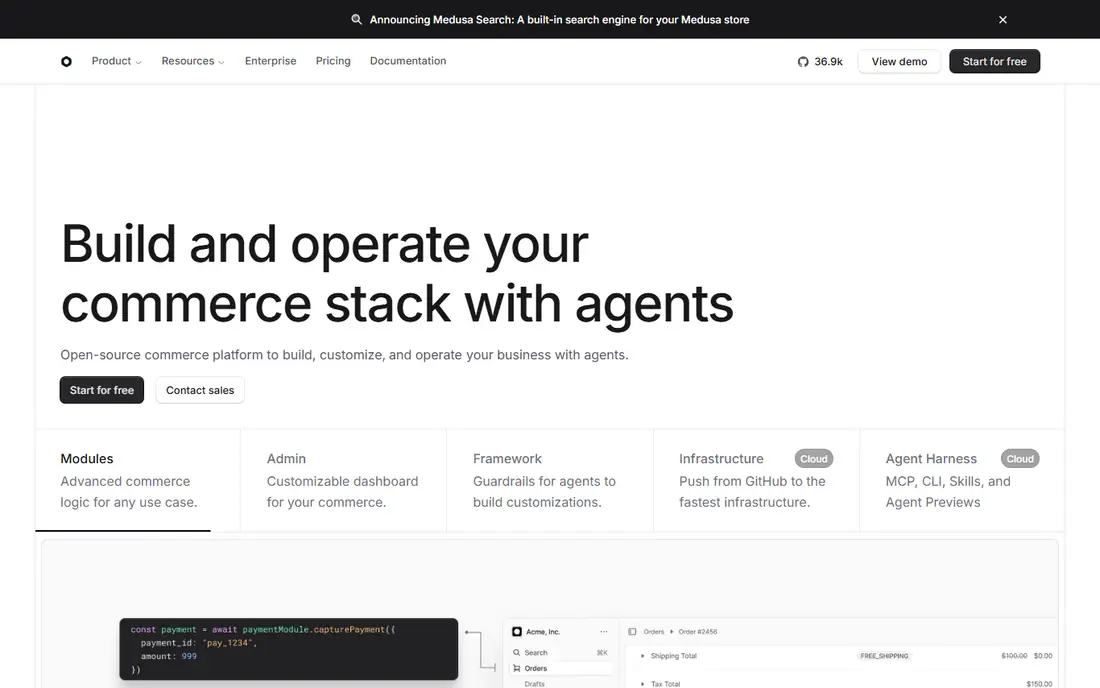
Medusa is built for teams that want to assemble their own commerce backend instead of adapting a packaged store. It is a TypeScript and Node.js platform with modular building blocks, and it is popular for custom storefronts, B2B portals and marketplace projects. A JavaScript team will feel at home quickly.
The pricing model is friendly to growing merchants. The core is free to self-host, and Medusa Cloud starts at $29 per month for its Develop tier, with higher tiers at $99 and $299 per month. The vendor states there is no GMV tax and no extra licenses on Cloud, and usage items such as email volume and compute are metered above included amounts.
The trade-off is that you are building, not installing. There is no theme store giving you a finished shop, so expect design and development time before launch. The core is MIT licensed, but check which modules fall under the commercial enterprise license before you rely on them.
What we like- Modular TypeScript and Node.js architecture
- Cloud plans with no GMV-based fees
- Lets you build custom B2B and marketplace flows
Watch out for- Needs developers
- Some enterprise modules are under a commercial license
Starting priceFree self-hosted; Saleor Cloud from $1,599 per month
Free planYes (self-hosted; Cloud sandboxes are non-commercial)
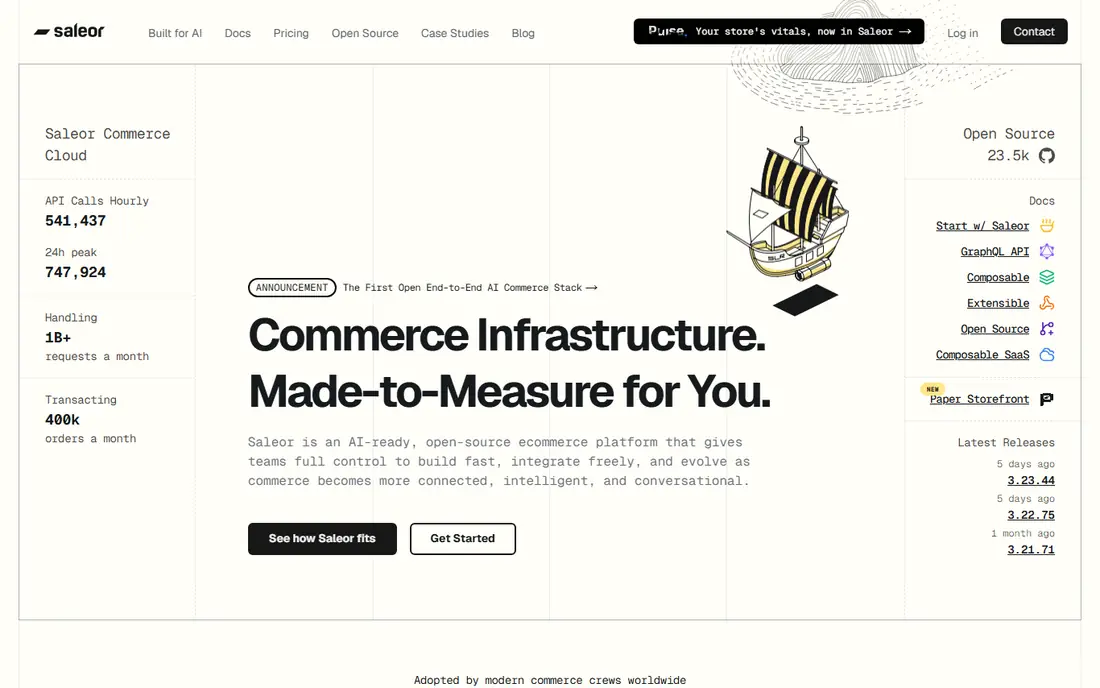
Saleor targets merchants with real volume and an engineering team. It is an open source, headless platform written in Python and Django, with a GraphQL API at its center. Teams already working in Python tend to find its structure easier to extend than a PHP monolith.
You can self-host the open source code for free, or buy Saleor Cloud. The Select plan lists at $1,599 per month for up to $200,000 in monthly GMV, with 0.8% charged on orders above that cap. The Volume plan is $3,999 per month for up to $1,000,000 in monthly GMV, and Enterprise is negotiated. The free sandbox on Cloud is for non-commercial use only.
That pricing makes Saleor Cloud a poor match for a small shop. If you self-host, you take on infrastructure, upgrades and scaling yourself, and you will want engineers comfortable with GraphQL. Saleor rewards technical teams with a clean architecture, and it punishes teams that just wanted a quick store.
What we like- GraphQL-first API on Python and Django
- BSD-3-Clause license
- Managed Cloud handles scaling and reliability
Watch out for- Cloud pricing is steep for small businesses
- Cloud adds a percentage fee above the GMV cap
#6Sylius
Best for: Custom B2B and B2C builds on Symfony4.2/5 on
G2 (9 reviews, checked Oct 2026)
Visit sylius.com
Starting priceFree (Community Edition); Sylius Plus See website
Free planYes
Sylius calls itself an open source headless ecommerce platform for mid-market and enterprise brands that need custom solutions. It is built on Symfony, and its API uses API Platform, which means PHP teams with Symfony experience can extend it with familiar tools. It fits projects where the pricing, fulfillment or catalog rules do not match a standard store.
The Community Edition is the free open source version. The vendor also sells Sylius Plus, a commercial edition with extra features, along with services such as technical audits, upgrades and expert support. It also offers preconfigured starting points for B2B (manufacturers and wholesalers) and marketplace models.
This is not a tool for someone who wants to pick a theme and start selling. Expect to work with a development partner, and expect that the cost sits in the build, not the license. For a company with an unusual model and a budget for custom work, that flexibility is the point.
What we like- Built on Symfony with an API-first design
- Very flexible for unusual business rules
- Community Edition has no license fee
Watch out for- Aimed at agencies and developers, not DIY owners
- Paid Plus edition pricing is not public
Starting priceFree (Vendure Core); paid plans See website
Free planYes
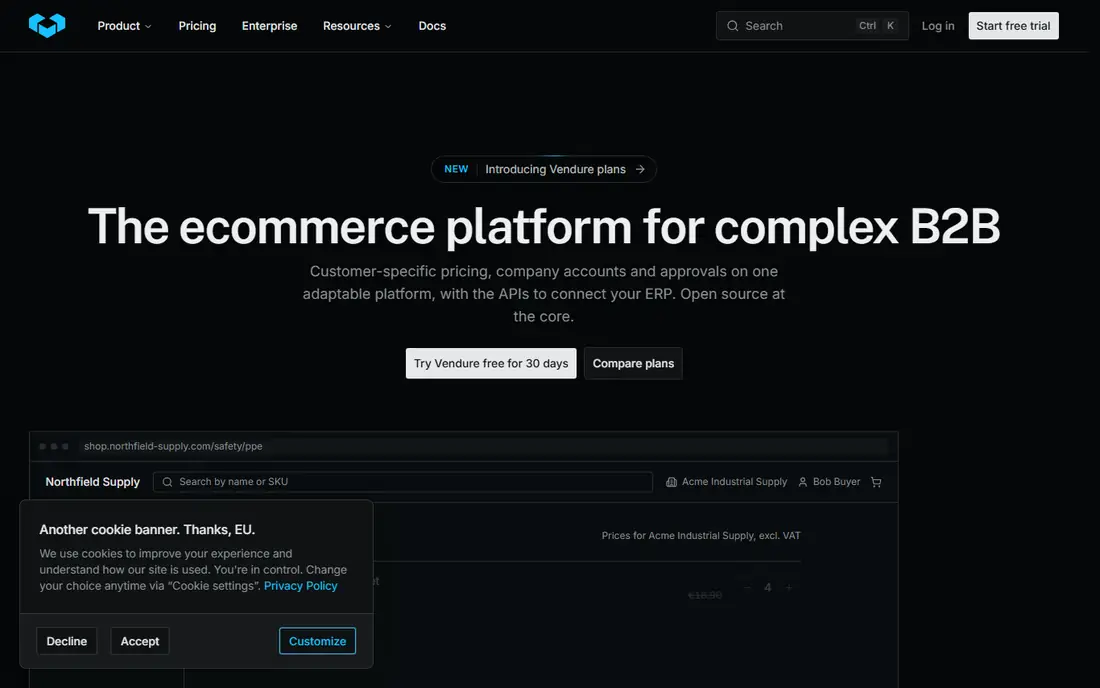
Vendure is a headless commerce framework for developers who like TypeScript and NestJS. The Core package covers catalog, orders, customers, payments, the dashboard, the APIs and the plugin model, and the vendor says it stays free under GPLv3. It is self-hosted, so you choose your own cloud provider and database.
The company sells Starter, Growth, Scale and Enterprise plans on top of the open repository. These add B2B capabilities such as company accounts, quotes, contract pricing and approvals on a flat monthly price. Flat pricing is easier to forecast than a percentage of sales, which is a point in its favor for wholesale businesses.
Be sure your legal or technical lead reads the GPLv3 terms before you build a commercial product on top of it. Also, like the other headless options, Vendure gives you a backend only. You will need to build or buy the storefront, and that is where much of the project cost goes.
What we like- Core is free forever under GPLv3
- TypeScript, NestJS and GraphQL stack
- Paid plans add features without removing any from Core
Watch out for- GPLv3 may matter for some proprietary modifications
- B2B features such as quotes and company accounts need a paid plan
Starting priceFree (open source)
Free planYes
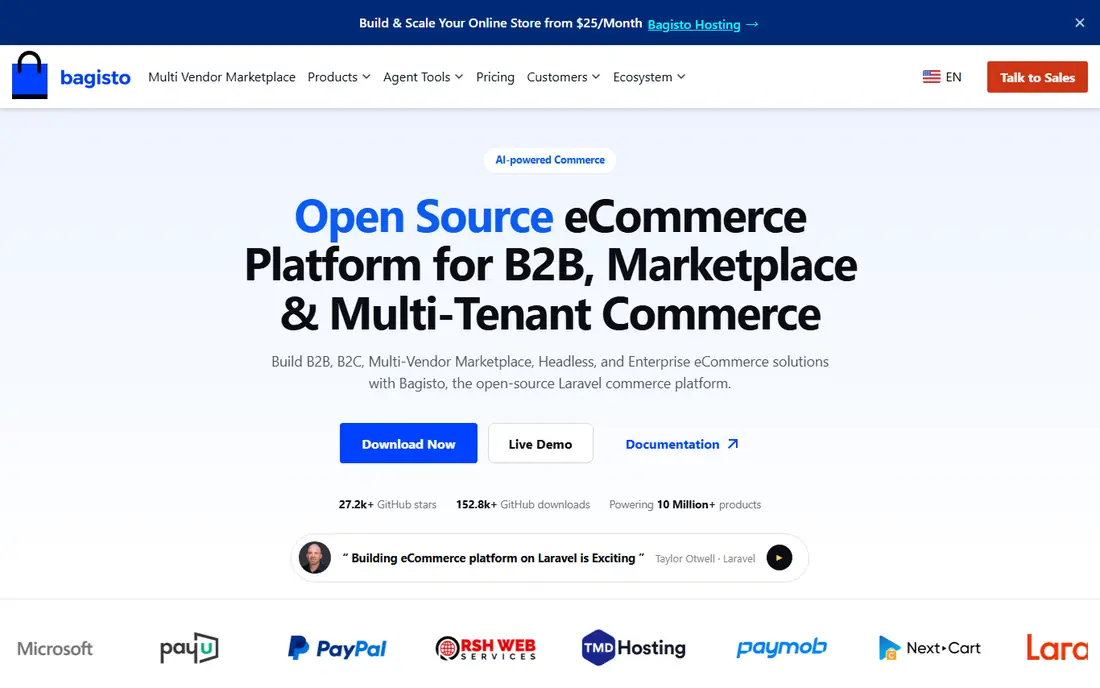
Bagisto fits teams that already build with Laravel. It is an open source ecommerce framework that the project positions for building marketplaces, mobile apps and headless commerce. If your developers know Laravel and Vue.js, the code structure will feel natural, and you avoid learning a separate framework just to sell products.
The project also publishes a mobile app built with Flutter and Laravel on GitHub, which is useful if you want a storefront app without starting from scratch. The code is public, so you can audit it and host it anywhere.
The catch is maturity. The plugin catalog, agency network and pool of freelancers are smaller than those around WooCommerce or PrestaShop. For a standard small store you would likely be better served by one of those two. Bagisto makes more sense when your own developers are the reason you pick it.
What we like- Built on Laravel and Vue.js, a familiar stack for many PHP teams
- Supports marketplace, mobile app and headless builds
- Free to use
Watch out for- Younger ecosystem than WooCommerce or PrestaShop
- Paid extensions are needed for some features
How we chose
We did not run hands-on tests of these platforms. We worked from each vendor's own website and pricing page, official documentation and public code repositories, then checked what real users say on review sites such as G2 and Capterra and in community threads on Reddit. We looked at licensing, hosting options, integrations, support models and who each tool is realistically built for.
We kept the list to platforms whose core is open source and which can run a real online store. We mixed long-established names (WooCommerce, PrestaShop, OpenCart) with newer headless frameworks (Medusa, Saleor, Vendure). Where a vendor did not publish a price, we wrote "See website" instead of estimating. Pricing and license terms change, so confirm them on the vendor site before you commit.
What "open source" really costs you
The license fee is zero for all eight tools, but the total bill is not. Self-hosting means paying for servers or managed hosting, backups, SSL, monitoring and someone to apply security patches. Payment processors still take their normal fee on every sale, and that is true on any platform.
A fair rule of thumb: the more flexible the platform, the more of the cost moves into development time. A WooCommerce store using standard extensions may need a freelancer for a few days. A custom Sylius or Medusa build usually needs a team for weeks or months.
Packaged store or headless framework?
A packaged platform (WooCommerce, PrestaShop, OpenCart) gives you an admin panel, themes and a built-in storefront. You can often launch without writing code. The downside is that heavy customization fights the platform's structure.
A headless framework (Medusa, Saleor, Sylius, Vendure) separates the commerce backend from the storefront. You get freedom to build any front end, and to connect mobile apps or kiosks to the same backend. In return you must build or buy that front end, which pushes the project toward a developer-led effort.
Match the tool to the team you have
Check your team's language before anything else. A JavaScript or TypeScript team will move faster with Medusa or Vendure. Python developers will favor Saleor, Symfony shops will pick Sylius, and Laravel teams will look at Bagisto. If nobody on staff writes code, stay with WooCommerce, PrestaShop or OpenCart, and hire a specialist for setup.
Check licensing and data export
Read the license text. GPLv3 (Vendure Core), MIT (Medusa core), BSD-3-Clause (Saleor) and the licenses used by the PHP platforms have different rules about modification and redistribution. Some vendors also reserve features for paid editions, so confirm the feature you need is in the free version.
Because you host your own data, export is usually straightforward with database dumps and CSV exports. Even so, test it on a small sample before you pick a platform, and confirm you can move product images, customer records and order history.
Plan for security and updates
Self-hosted stores are a target for automated attacks, especially popular platforms. Assign someone to apply updates, remove unused extensions and monitor for problems. If that sounds like a burden, price a managed host or a vendor-hosted option such as Medusa Cloud, Saleor Cloud or OpenCart Cloud.
Frequently asked questions
Is open source ecommerce software really free?
The software license is free, but running a store is not. You still pay for hosting, a domain, payment processing fees, extensions and developer time. Vendor-hosted plans, such as Medusa Cloud or Saleor Cloud, add a subscription on top of that.
Which open source ecommerce platform is easiest for beginners?
WooCommerce is usually the easiest if you already use WordPress, and OpenCart is a simple choice for small catalogs. Both have large communities and plenty of tutorials. Headless tools such as Medusa, Saleor, Sylius and Vendure need developers.
What is the difference between an ecommerce CMS and a headless commerce platform?
An ecommerce CMS bundles content, product management and a storefront in one system. A headless platform runs only the commerce backend and exposes it through an API, so you build the front end separately. Headless gives more freedom but takes more development work.
Can I switch platforms later?
Yes, though it takes planning. Because you control the database, you can export products, customers and orders, but URLs, themes and extensions rarely carry over. Plan for a migration project, and ask a developer to map your data before you decide.
Do I need a developer to use these tools?
For WooCommerce, PrestaShop and OpenCart, a capable non-developer can launch a basic store. For anything custom, such as complex pricing, integrations or a unique checkout, you will want developer help. For the headless frameworks, a developer is required from the start.
Sources we checked (15)
- https://woocommerce.com/pricing/
- https://woocommerce.com/
- https://prestashop.com/discover-prestashop/
- https://www.opencart.com/
- https://medusajs.com/pricing
- https://docs.medusajs.com/cloud/pricing
- https://ecommerceguide.com/platforms/medusa/
- https://saleor.io/pricing
- https://sylius.com/
- https://vendure.io/core
- https://github.com/vendurehq/vendure
- https://bagisto.com/en/
- https://github.com/bagisto
- https://www.cloudways.com/blog/woocommerce-pricing/
- https://webkul.com/blog/top-5-open-source-headless-ecommerce/
Is your product missing or out of date?
We review this list regularly. Vendors can request a listing, send updated pricing or ask about featured placement.

Shihab Mia · Founder, Rankite
Shihab has 5+ years in B2B and SaaS SEO. He writes Rankite's software buying guides from pricing pages, documentation and public user reviews. More about Shihab.