How we make this list: we compare pricing pages, product documentation and public user reviews. Ratings come from G2, Capterra or Trustpilot, with the date we checked them.
Key takeaways
- Oracle Database and SQL Server remain the safest picks for enterprises that need contractual uptime guarantees and vendor support behind their failover architecture.
- PostgreSQL paired with Patroni gives you enterprise-grade automatic failover without license fees, but you own the operational complexity.
- CockroachDB and YugabyteDB take a different path entirely: distributed design means the database survives node and region failures by default, with no standby servers to manage.
- Amazon Aurora and Google Cloud Spanner are the pragmatic choices if you already live on AWS or Google Cloud and want the provider to handle replication and failover.
- Match the tool to your team's skills first and your uptime target second: the best HA technology is the one your DBAs can actually operate at 3 a.m.
Quick comparison
| Tool | Best for | Starting price | Free plan |
|---|
 Oracle Database Oracle Database | enterprises that need RAC and Data Guard | See website | No |
 Microsoft SQL Server Microsoft SQL Server | Windows-centered teams needing Always On | See website | Free Developer edition |
 PostgreSQL PostgreSQL | teams that want proven HA without license fees | Free (open source) | Yes (open source) |
 MySQL MySQL | web applications needing Group Replication | See website | Yes (Community edition) |
 MariaDB MariaDB | teams wanting Galera multi-master clustering | See website | Yes (Community edition) |
 MongoDB MongoDB | document workloads that need replica sets | See website | Free tier (Atlas) |
 CockroachDB CockroachDB | teams that want survival by design, not by standby | See website | Free tier available |
 YugabyteDB YugabyteDB | PostgreSQL shops going distributed | See website | Free tier available |
 Amazon Aurora Amazon Aurora | AWS teams that want the provider to handle HA | See website | No |
 Google Cloud Spanner Google Cloud Spanner | global applications needing multi-region consistency | See website | No |
Is your product missing or out of date?
We review this list regularly. Vendors can request a listing, send updated pricing or ask about featured placement.
The best database software for high availability
#1
Oracle Database
Best for: enterprises that need RAC and Data Guard
Visit oracle.com
Starting priceSee website
Free planNo
Oracle is the reference point for database high availability. Real Application Clusters lets multiple servers run the same database simultaneously, so a node failure does not interrupt service, while Data Guard maintains synchronized standbys for disaster recovery. For banks, telcos, and retailers where minutes of downtime cost real money, this is the technology entire industries were built on.
The price of that maturity is literal. Oracle licensing is famously expensive and famously complicated, and running RAC well requires DBAs who specialize in it. Smaller teams should think twice: you are buying not just software but a long-term staffing commitment. If your uptime requirements and budget both clear the enterprise bar, though, nothing else has this much battle history.
What we like- Real Application Clusters for active-active HA
- Data Guard for disaster recovery
- Decades of enterprise hardening
Watch out for- Licensing is expensive and complex
- Demands specialized DBA skills
Starting priceSee website
Free planFree Developer edition
SQL Server's Always On Availability Groups replicate databases to secondary servers with automatic failover, and the technology has been refined across many releases. For organizations standardized on Windows and .NET, the integration story is excellent: failover clustering, Azure hybrid options, and management tooling that DBAs already know.
Watch the edition boundary. The serious HA features live in Enterprise edition, which is priced per core and gets expensive quickly. Standard edition covers basic availability needs but with real limits. The free Developer edition is great for building and testing your HA design, but it cannot go to production. Price the Enterprise cores before you fall in love with the architecture diagrams.
What we like- Always On Availability Groups are mature and well documented
- Deep Windows and Azure integration
- Strong tooling
Watch out for- Licensing costs add up fast
- Best HA features need Enterprise edition
Starting priceFree (open source)
Free planYes (open source)
PostgreSQL gives you the database engine for free and a genuinely good replication story: streaming replication to standby servers has been production-hardened for years. Add Patroni, the widely adopted open-source HA manager, and you get automatic failover, leader election, and cluster management that rivals commercial offerings.
The catch is ownership. There is no vendor support contract unless you buy one from a company like EDB, and designing, testing, and operating the failover architecture is your team's job. Organizations with strong PostgreSQL skills routinely run it for tier-one workloads and save a fortune. Teams without that depth should budget for either training or a support vendor before betting uptime on it.
What we like- Free and open source
- Streaming replication is solid
- Patroni adds automatic failover
Watch out for- No single vendor to call
- You assemble and operate the HA stack yourself
#4
MySQL
Best for: web applications needing Group Replication
Visit mysql.com
Starting priceSee website
Free planYes (Community edition)
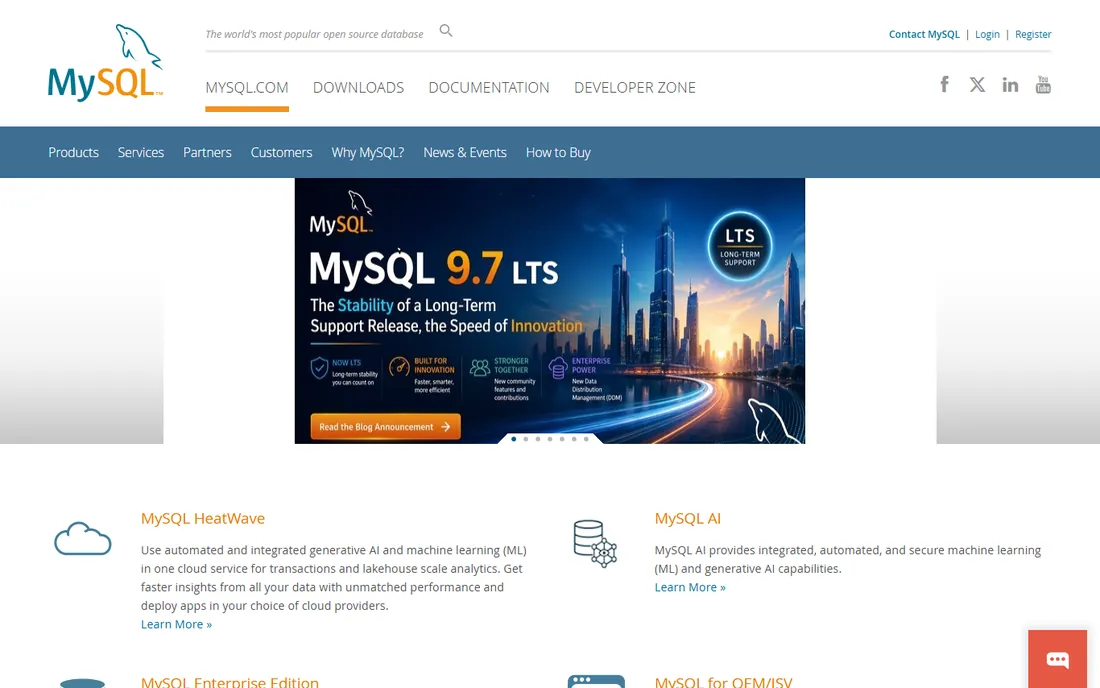
MySQL's InnoDB Cluster bundles Group Replication, MySQL Router, and MySQL Shell into a workable high-availability setup with automatic failover. For the enormous base of web applications already running MySQL, this is the path of least resistance to better uptime: same database, better resilience.
The Community edition is free, but note that some of the nicer management and monitoring pieces are reserved for the commercial Enterprise edition. And while MySQL remains hugely popular, Oracle's ownership has pushed some teams toward MariaDB or PostgreSQL over the years. If you are already on MySQL 8, though, InnoDB Cluster is a solid, well-documented upgrade.
What we like- Group Replication and InnoDB Cluster for automatic failover
- Huge ecosystem
- Free Community edition
Watch out for- Advanced HA tooling sits in the commercial edition
- Oracle's stewardship worries some teams
Starting priceSee website
Free planYes (Community edition)
MariaDB's headline HA feature is Galera Cluster, which provides synchronous multi-master replication: every node can take writes, and a failed node does not block the cluster. For write-heavy workloads that need every node active, that architecture has real appeal over primary-standby designs.
MariaDB Server is free and open source, with commercial subscriptions adding management tooling and support. The community is smaller than MySQL's or PostgreSQL's, which matters when you are troubleshooting at odd hours. But for teams that want MySQL compatibility with a more open governance model and multi-master HA, MariaDB is a legitimate choice.
What we like- Galera Cluster gives true multi-master replication
- Drop-in MySQL compatibility
- Open development model
Watch out for- Smaller ecosystem than MySQL
- Enterprise features need the commercial subscription
Starting priceSee website
Free planFree tier (Atlas)
High availability is not an add-on in MongoDB; replica sets with automatic primary election are how the database is designed to run. A three-node replica set survives a node failure without application intervention, and the managed Atlas service extends that to automated backups, multi-region clusters, and hands-off failover.
The Atlas free tier is genuinely useful for development and small projects. At scale, costs are usage-based and need watching. Also note the licensing history: MongoDB's SSPL license pushed it out of some Linux distributions and raised eyebrows among open-source purists. For document workloads that need built-in resilience, though, the technology itself is proven.
What we like- Replica sets with automatic failover are core to the design
- Atlas handles HA for you
- Flexible document model
Watch out for- HA across regions needs planning
- Licensing changes have annoyed some users
Starting priceSee website
Free planFree tier available
CockroachDB reframes the availability question. Instead of a primary with standbys, data is distributed across nodes with automatic replication and rebalancing, so the cluster keeps serving through node failures, zone failures, and even region failures. There is no failover to configure because there is no primary to fail over from.
That design shines for global applications and for teams tired of babysitting replication. The trade-offs are real, though: the operational model is different from a traditional database, some SQL features behave differently than in PostgreSQL despite the compatibility layer, and for a simple single-region app it may be more machinery than you need. A free tier lets you evaluate without commitment.
What we like- Distributed architecture survives node and region loss automatically
- PostgreSQL-compatible SQL
- Strong consistency
Watch out for- Operational model differs from traditional RDBMS
- Can be overkill for single-region apps
Starting priceSee website
Free planFree tier available
YugabyteDB offers a similar distributed proposition with a sharper PostgreSQL compatibility story: it aims to run your existing Postgres applications, extensions included, on a database that survives region failures without data loss. For teams invested in the PostgreSQL ecosystem who have outgrown single-node limits, that compatibility lowers the migration risk considerably.
The open-source core and a free managed tier make evaluation easy. Like any distributed database, it rewards teams that learn its tuning model; write-heavy single-row workloads need more care than in plain PostgreSQL. But if your roadmap points toward multi-region active-active operation, YugabyteDB deserves a serious look alongside CockroachDB.
What we like- Full PostgreSQL compatibility
- Distributed resilience with zero data loss failover
- Open-source core
Watch out for- Younger ecosystem than CockroachDB
- Distributed tuning has a learning curve
Starting priceSee website
Free planNo
Aurora's trick is moving replication into the storage layer: your data is replicated six ways across three availability zones by default, with failover typically completing in seconds. You get MySQL or PostgreSQL compatibility without managing any of the replication machinery yourself.
For teams already committed to AWS, this is often the pragmatic answer to the availability question. The downsides are the ones that come with any managed service: you are tied to AWS, and the I/O-based pricing can produce surprising bills under heavy write loads. Model your workload costs carefully, but for managed HA on AWS, Aurora is the default choice for good reason.
What we like- Storage-level replication across three availability zones
- Fast failover
- MySQL and PostgreSQL compatibility
Watch out for- AWS lock-in
- Costs scale with I/O and can surprise
Starting priceSee website
Free planNo
Spanner is the most ambitious HA story here: a globally distributed database with synchronous replication and strong consistency across regions, built on Google's TrueTime infrastructure. Failover between regions is automatic and measured in seconds, with no data loss. For applications that must stay up and consistent worldwide, there is nothing quite like it.
You pay for that ambition. Spanner is priced at a premium, and it only makes sense on Google Cloud. Regional applications should not bother; Aurora or a well-run PostgreSQL cluster will serve them for less. But if your requirements genuinely span continents with strong consistency, Spanner is in a class of its own.
What we like- Synchronous multi-region replication
- Strong consistency at global scale
- Fully managed
Watch out for- Premium pricing
- Google Cloud lock-in
- Overkill for regional apps
How we chose
We focused on database systems where high availability is a first-class, documented capability, not a marketing claim. That meant looking for concrete mechanisms: clustering, synchronous replication, automatic failover, or distributed consensus, each verifiable in vendor documentation. We drew on vendor technical docs, practitioner guides, and community experience from places like Reddit's database communities and engineering blogs. Pricing follows a strict rule: unless the vendor publishes the price on its own site, we mark it See website. Open-source databases are marked free where the core engine genuinely costs nothing, with commercial editions noted separately.
What to look for when buying for availability
Start with your recovery targets, not the technology. Define your RTO (how fast you must recover) and RPO (how much data you can afford to lose) in writing, because everything else follows from those two numbers. A standby that takes ten minutes to promote is fine for some workloads and a disaster for others.
Next, decide who operates the failover. Managed services like Aurora and Spanner, or distributed databases like CockroachDB, remove whole categories of operational work, but they move you toward a vendor or a cloud. Self-managed options like PostgreSQL with Patroni or SQL Server Always On keep you in control but demand real DBA expertise and, critically, regular failover testing. An untested failover plan is a hope, not a plan.
Finally, test the failure modes you actually fear. Node failure, zone failure, network partitions, and human error each stress different parts of the architecture. Whatever you choose, rehearse failovers in staging until they are boring, monitor replication lag as a first-class metric, and make sure your application handles connection retries gracefully. The database is only half of an availability story; the application is the other half.
Mistakes teams make with database HA
The classic mistake is confusing backups with availability. Backups protect against data loss; they do nothing for uptime. If your plan for a failed primary is "restore from last night's backup," you do not have high availability, you have a recovery procedure with hours of downtime.
Another common error is never testing failover under load. A standby that promotes cleanly in a quiet staging environment can behave very differently when it suddenly inherits production traffic. Schedule failure drills, measure actual promotion times, and fix what breaks before it matters.
The third mistake is ignoring the application layer. Connection pools that do not retry, DNS caches that hold stale addresses, and health checks that flap can turn a thirty-second database failover into a ten-minute outage. Availability is a system property, and the database is one component of that system.
Frequently asked questions
What is the difference between high availability and disaster recovery?
High availability keeps the database running through component failures, usually within the same region, with failover measured in seconds to minutes. Disaster recovery protects against larger events like region loss, often with longer recovery times and possible data loss windows. Most serious deployments need both: HA for the common failures, DR for the rare catastrophes.
Is PostgreSQL good enough for high availability?
Yes, with the right architecture. PostgreSQL's streaming replication plus a manager like Patroni delivers automatic failover that many enterprises run in production. What you do not get is a vendor support contract or a single throat to choke, unless you buy support from a company like EDB. Teams with PostgreSQL expertise do very well; teams without it should factor in the learning curve.
Do distributed databases replace traditional HA setups?
For new applications with global ambitions, often yes. CockroachDB, YugabyteDB, and Spanner build survival into the architecture instead of bolting it on with standbys. For existing applications on Oracle or SQL Server, though, migrating to a distributed database is a major project, and improving the current HA setup is usually the pragmatic path.
How much downtime does automatic failover actually involve?
It depends on the technology. Storage-level systems like Aurora typically fail over in tens of seconds. Patroni-managed PostgreSQL usually promotes a standby within a minute or two. Active-active systems like Oracle RAC or distributed databases may show no application-visible interruption at all for single-node failures. Always measure with your own workload rather than trusting datasheet numbers.
Should I use a managed database for high availability?
If your team lacks deep DBA expertise, usually yes. Managed services handle replication, patching, backups, and failover testing as part of the service. The trade-off is less control, potential vendor lock-in, and usage-based pricing that needs monitoring. Teams with strong database operations sometimes prefer self-managed for cost and control, but they earn that control with staffing.
Sources we checked (11)
- https://www.oracle.com
- https://www.microsoft.com
- https://www.postgresql.org
- https://www.mysql.com
- https://www.mariadb.com
- https://www.mongodb.com
- https://www.cockroachlabs.com/
- https://www.yugabyte.com/
- https://aws.amazon.com
- https://cloud.google.com
- https://www.wondermentapps.com/blog/oracle-vs-postgresql/
Is your product missing or out of date?
We review this list regularly. Vendors can request a listing, send updated pricing or ask about featured placement.

Shihab Mia · Founder, Rankite
Shihab has 5+ years in B2B and SaaS SEO. He writes Rankite's software buying guides from pricing pages, documentation and public user reviews. More about Shihab.