How we make this list: we compare pricing pages, product documentation and public user reviews. Rankite is independent; if a vendor ever pays for a featured spot, that listing is clearly labeled Partner.
Key takeaways
- Microsoft 365 shops should evaluate Microsoft Purview DLP first: native coverage across email, Teams, SharePoint, and endpoints, licensed through E5 or a Purview add-on.
- Symantec (Broadcom), Forcepoint, and Digital Guardian are the deep-coverage enterprise picks, spanning endpoint, network, and cloud with mature policy engines.
- Email-centric organizations get the most from Proofpoint, which built its DLP around the channel where most exfiltration happens.
- Palo Alto Networks, Check Point, and Trend Micro make sense when you already run their firewalls or endpoint agents: DLP becomes an extension, not a new platform.
- Netwrix Endpoint Protector is the focused endpoint option for smaller teams that want device control without an enterprise suite.
The 10 top data loss prevention software picks

#1
Microsoft Purview DLP
Best for: Microsoft 365 organizations wanting native, built-in DLP
Visit microsoft.com
Starting priceSee website (licensed via Microsoft 365 E5 or a Purview add-on)
Free planYes (trial available)
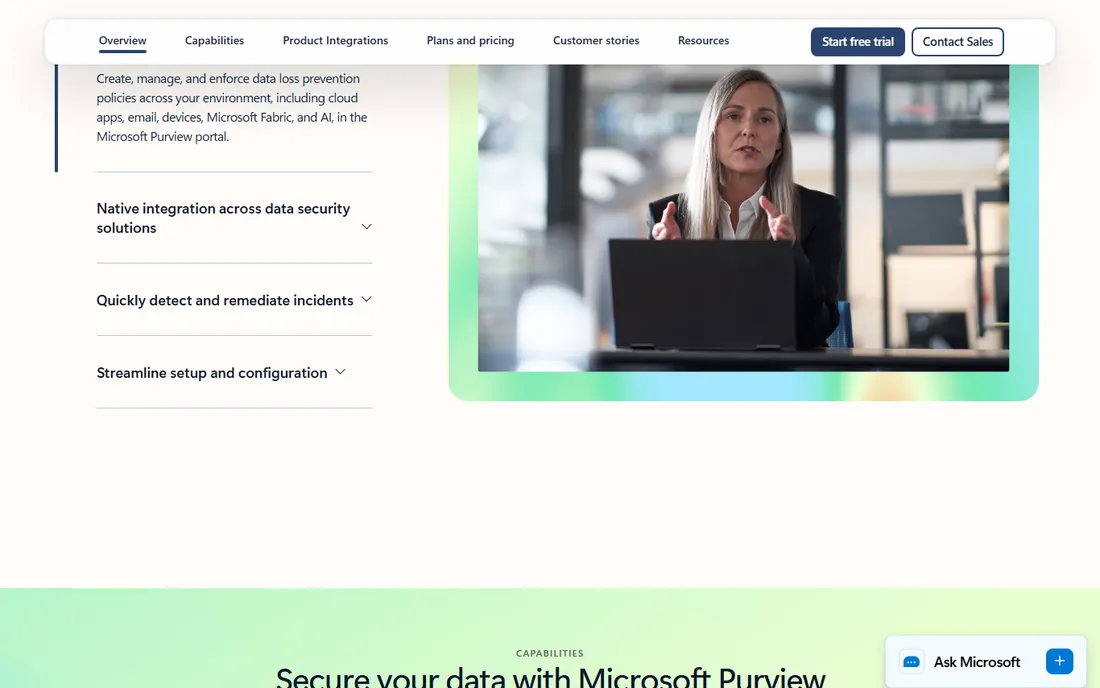
If your company lives in Microsoft 365, Purview DLP is the path of least resistance. Policies defined once apply to email, Teams messages, SharePoint, OneDrive, and managed endpoints, and sensitivity labels let classification travel with documents wherever they go. For organizations already paying for E5, much of this capability is already licensed, which makes the business case easy.
The honest limit is the non-Microsoft world. Google Workspace shops, mixed SaaS environments, and companies with heavy non-Windows endpoints will find gaps that a dedicated DLP vendor fills better. Price it against your actual Microsoft licensing before assuming it is free: E5 or the Purview add-on is where the cost sits.
What we like- Native enforcement across Exchange, Teams, SharePoint, OneDrive, and endpoints
- Sensitivity labels carry protection with the file
- No extra agents for the Microsoft stack
Watch out for- Coverage thins outside Microsoft 365
- Licensing is bundled, so true cost depends on your existing Microsoft agreements

#2
Symantec DLP (Broadcom)
Best for: Large enterprises needing endpoint, network, and cloud coverage from one vendor
Visit broadcom.com
Starting priceSee website (custom enterprise pricing)
Free planNo
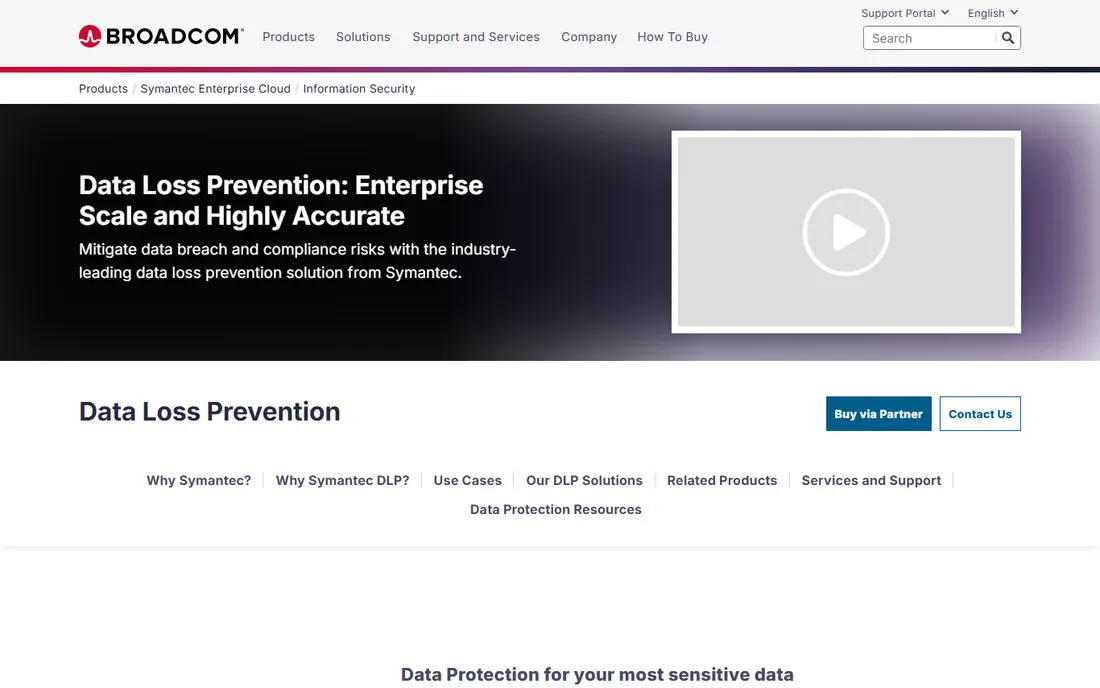
Symantec DLP, now sold through Broadcom, is the product other vendors get compared against. It monitors data at rest, in use, and in motion across endpoints, network traffic, and cloud storage, with a policy engine refined over many years of enterprise deployments. Incident management, SmartResponse remediation workflows, and broad platform support are the reasons large regulated companies stay with it.
This is not a product you buy casually. Pricing is quote-based, deployments are projects, and the policy engine's power is also its complexity: misconfigured policies generate noise that buries real incidents. Organizations with dedicated security staff and serious compliance obligations are the fit. Smaller teams will drown in it.
What we like- One of the most mature DLP policy engines in the industry
- Covers endpoint, network, cloud storage, and discovery
- Deep incident management workflows
Watch out for- Custom pricing only
- Deployment and tuning require experienced staff

#3
Proofpoint
Best for: Organizations where email is the main exfiltration channel
Visit proofpoint.com
Starting priceSee website (custom pricing)
Free planNo
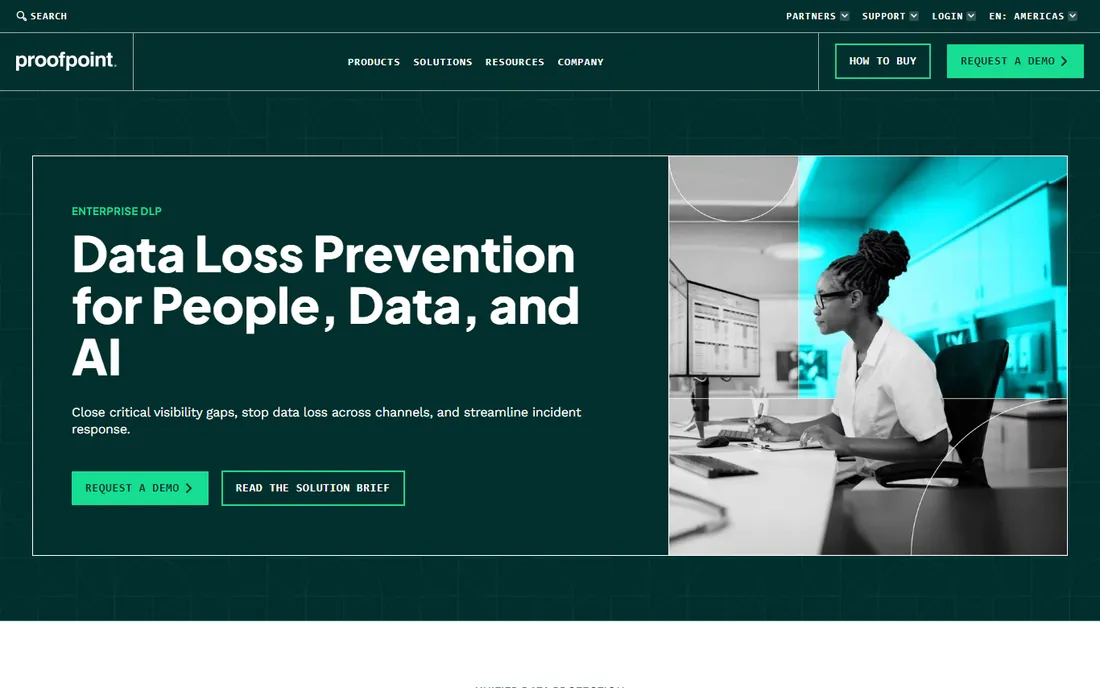
Proofpoint approaches DLP from the channel that causes most data loss: email. Its platform combines traditional content inspection with adaptive controls that learn how individual users normally handle data, so a finance clerk emailing a spreadsheet to an accountant looks different from the same clerk emailing it to a personal address. That people-centric model cuts false positives, which is the chronic disease of DLP.
Companies whose sensitive data moves mostly through email and cloud collaboration will get the most value. If your risk is engineers copying source code to USB drives, an endpoint-heavy vendor like Digital Guardian or Symantec fits better. Price it as part of a broader Proofpoint email security conversation, since most buyers bundle.
What we like- Email-first DLP with strong adaptive controls
- People-centric risk scoring
- Deep threat intelligence from its email security heritage
Watch out for- Custom pricing only
- Strongest story is email, less so pure endpoint scenarios

#4
Forcepoint
Best for: Enterprises wanting one policy enforced across every channel
Visit forcepoint.com
Starting priceSee website (custom pricing)
Free planNo
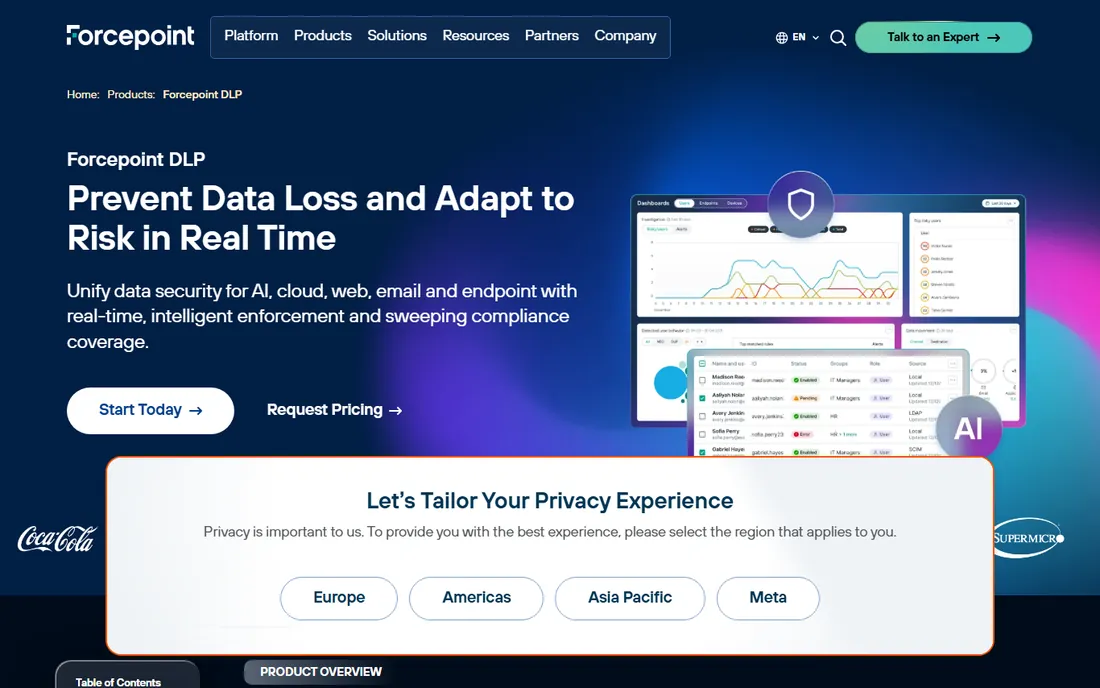
Forcepoint's pitch is consistency: define a policy once and enforce it across endpoints, web, email, network, SaaS apps, and now generative AI tools. The Risk Adaptive Protection model scores user behavior and adjusts enforcement dynamically, so low-risk users get coaching while high-risk actions get blocked. With thousands of predefined classifiers covering regulations across dozens of countries, compliance teams get a head start.
The trade is the usual enterprise one. Unified coverage means a bigger deployment project and a longer tuning period before false positives settle. But for organizations standardizing on one data security platform instead of stitching point tools together, Forcepoint is one of the two or three names that belong in the evaluation.
What we like- Unified policy engine across endpoint, web, email, SaaS, and GenAI
- Risk-adaptive enforcement that adjusts to user behavior
- 2,000+ predefined classifiers
Watch out for- Custom pricing only
- Breadth means longer deployment and tuning cycles

#5
Palo Alto Networks Enterprise DLP
Best for: Palo Alto customers extending network security into data protection
Visit paloaltonetworks.com
Starting priceSee website (custom pricing)
Free planNo
Palo Alto Networks built Enterprise DLP as a cloud-delivered service that rides on its existing security platform: firewalls, Prisma SASE, and cloud security already see the traffic, so DLP becomes a policy layer rather than a new appliance fleet. Precision AI classification, exact data matching, and OCR give it modern detection, and the single cloud engine keeps policies consistent across locations.
Standalone buyers get less of the story. The economics and the architecture both favor organizations already invested in Palo Alto, where DLP slots into the platform they operate. If you are not a Palo Alto shop, evaluate it against Symantec and Forcepoint on detection quality alone, because the integration advantage will not apply to you.
What we like- Cloud-delivered service with consistent policy everywhere
- Precision AI-powered classification
- Natively integrated with the Palo Alto security platform
Watch out for- Custom pricing only
- Best value requires existing Palo Alto infrastructure

#6
Check Point DLP
Best for: Check Point gateway customers adding DLP to existing firewalls
Visit checkpoint.com
Starting priceSee website (custom pricing)
Free planNo
Check Point sells DLP as a blade that runs on the gateways you may already own, managed from the same console as the firewall. For network-centric organizations, that is an elegant story: data leaving through web, email, and file transfers gets inspected at the gateway with policies you manage alongside access rules. Predefined templates cover common regulations without starting from a blank page.
The limitation is architectural. Gateway DLP sees network traffic, not what happens on the endpoint before encryption or after download. Companies worried about USB copies, screenshots, or offline exfiltration need endpoint coverage from elsewhere. As an add-on to a Check Point estate, though, it is the natural first step.
What we like- Runs as a software blade on Check Point gateways
- Unified management with the firewall estate
- Solid predefined policy templates
Watch out for- Custom pricing only
- Gateway-centric, so endpoint depth trails dedicated endpoint vendors

#7
Trend Micro
Best for: Businesses already running Trend Micro endpoint and email security
Visit trendmicro.com
Starting priceSee website (custom pricing)
Free planNo
Trend Micro folds DLP into its broader Vision One platform rather than selling it as a standalone flagship. Endpoint DLP watches data movement on managed devices, email DLP integrates with the email security stack, and everything reports into one console. For the many mid-size businesses already running Trend Micro for endpoint protection, turning on DLP is an incremental decision, not a new vendor evaluation.
Do not expect the policy depth of Symantec or Forcepoint. Trend Micro's DLP is good at the common cases: blocking sensitive attachments, watching USB transfers, flagging risky uploads. Exotic data types and complex multi-channel policies are where the specialists pull ahead. For mainstream needs inside an existing Trend Micro deployment, it is the pragmatic choice.
What we like- DLP integrated with the Trend Vision One platform
- Endpoint and email coverage from one console
- Strong in the mid-market
Watch out for- Custom pricing only
- DLP depth trails the dedicated enterprise DLP specialists

#8
Digital Guardian (Fortra)
Best for: IP-heavy companies that need deep endpoint visibility and control
Visit fortra.com
Starting priceSee website (custom pricing)
Free planNo
Digital Guardian, now part of Fortra, built its reputation on seeing everything that happens to data on the endpoint, down to the kernel level. For manufacturers, engineering firms, and pharmaceutical companies whose crown jewels are CAD files, formulas, and designs, that depth matters: the product can tell the difference between legitimate engineering work and a file being staged for exfiltration.
The managed service option is worth noting. DLP programs fail more often from operational neglect than from product gaps, and Digital Guardian will run the program for you. The endpoint-centric design means network and cloud channels need companion controls. Buy it when the endpoint is where your IP lives.
What we like- Kernel-level visibility into data movement on endpoints
- Strong for protecting intellectual property and designs
- Managed service deployment option
Watch out for- Custom pricing only
- Endpoint focus means network and cloud need separate attention

#9
Trellix
Best for: Trellix and McAfee endpoint customers extending to data protection
Visit trellix.com
Starting priceSee website (custom pricing)
Free planNo
Trellix, formed from McAfee Enterprise and FireEye, sells DLP as part of a unified endpoint story. The appeal is operational: one console, one agent footprint, policies managed alongside endpoint protection. Pre-configured options for common compliance frameworks shorten the path to a working deployment, and the single-vendor model simplifies support.
As with the other platform vendors, the value concentrates for existing customers. A Trellix endpoint shop adding DLP gets integration and simplicity. A greenfield buyer comparing pure DLP depth should also look at Symantec and Forcepoint. Trellix wins on consolidation; the specialists win on policy depth.
What we like- Single console for endpoint security and DLP
- Streamlined policy administration
- Pre-configured compliance reporting
Watch out for- Custom pricing only
- Ecosystem play favors existing Trellix customers

#10
Netwrix Endpoint Protector
Best for: Small and mid-size teams that want focused endpoint DLP
Visit netwrix.com
Starting priceSee website (custom pricing)
Free planNo
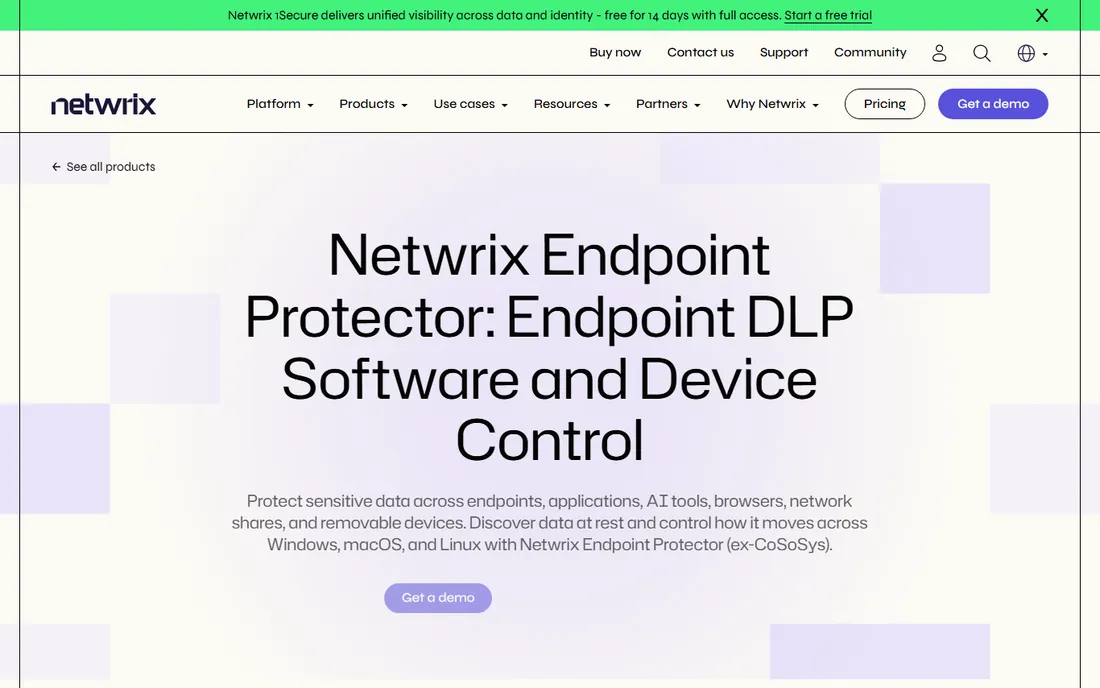
Endpoint Protector, now under Netwrix, is the specialist at the smaller end of this list. It does endpoint DLP and does not pretend to be a full data security platform: device control for USB and peripherals, content-aware inspection of files in motion, and monitoring of endpoint data activity across Windows, Mac, and Linux. Deployment is measured in days, not quarters.
That focus is the whole pitch. A 200-person company worried about USB drives and email attachments does not need a multi-channel enterprise suite. It needs device control and content inspection that IT can actually operate. Larger organizations with network and cloud exfiltration paths will outgrow it, but for its target buyer, the simplicity is the feature.
What we like- Focused endpoint DLP: device control, content inspection, and monitoring
- Simpler deployment than enterprise suites
- Cross-platform Windows, Mac, and Linux support
Watch out for- Custom pricing only
- Endpoint-only scope, no network or cloud DLP story
Quick comparison
| Tool | Best for | Starting price | Free plan |
|---|
| Microsoft Purview DLP | Microsoft 365 organizations wanting native, built-in DLP | See website (licensed via Microsoft 365 E5 or a Purview add-on) | Yes (trial available) |
| Symantec DLP (Broadcom) | Large enterprises needing endpoint, network, and cloud coverage from one vendor | See website (custom enterprise pricing) | No |
| Proofpoint | Organizations where email is the main exfiltration channel | See website (custom pricing) | No |
| Forcepoint | Enterprises wanting one policy enforced across every channel | See website (custom pricing) | No |
| Palo Alto Networks Enterprise DLP | Palo Alto customers extending network security into data protection | See website (custom pricing) | No |
| Check Point DLP | Check Point gateway customers adding DLP to existing firewalls | See website (custom pricing) | No |
| Trend Micro | Businesses already running Trend Micro endpoint and email security | See website (custom pricing) | No |
| Digital Guardian (Fortra) | IP-heavy companies that need deep endpoint visibility and control | See website (custom pricing) | No |
| Trellix | Trellix and McAfee endpoint customers extending to data protection | See website (custom pricing) | No |
| Netwrix Endpoint Protector | Small and mid-size teams that want focused endpoint DLP | See website (custom pricing) | No |
Is your product missing or out of date?
We review this list regularly. Vendors can request a listing, send updated pricing or ask about featured placement.
How we chose these picks
We started with the vendors that appear most often in enterprise DLP evaluations and analyst coverage, then filtered for products that are actively sold and supported as DLP in 2026. For each candidate we confirmed the current product name and URL on the vendor's own site, accounting for acquisitions (Symantec under Broadcom, Digital Guardian under Fortra, Endpoint Protector under Netwrix). Every vendor here prices by quote, so all starting prices read "See website" rather than third-party estimates. We weighted coverage breadth, policy maturity, platform integration, and fit for different company sizes.
What actually drives DLP cost
Nobody publishes DLP prices, so learn the levers before the sales calls. The first is user count, but vendors count differently: some license every employee, some only licensed users of covered apps, some charge per endpoint. Get the counting rule in writing.
The second is channel coverage. Endpoint-only deployments cost less than endpoint plus network plus cloud, and each channel adds implementation work. The third is services: most DLP purchases include professional services for policy tuning, and the first year of tuning is where programs succeed or fail. Budget for it explicitly.
The fourth is your existing stack. Purview inside E5, DLP blades on Check Point gateways you own, or extensions to Trend Micro and Trellix agents you already deploy can cut the incremental cost dramatically. The cheapest DLP is often the one riding on infrastructure you already pay for.
Endpoint vs. network vs. cloud DLP: pick your coverage
DLP vendors talk about three control points, and most buyers only need to get serious about two. Endpoint DLP lives on the device and sees data before encryption and after download: USB copies, screenshots, local file moves. If your risk is insiders and departing employees, endpoint coverage is non-negotiable.
Network DLP sits at the gateway and inspects traffic leaving the company: web uploads, email attachments, file transfers. It is blind to encrypted traffic it cannot inspect and to anything that never crosses the network, but it covers unmanaged devices that will never run your agent.
Cloud DLP covers SaaS apps and cloud storage directly through APIs: sharing settings in Google Drive, uploads to personal cloud accounts, data in Salesforce. As work moves into browsers and SaaS, this channel keeps growing in importance.
Map your actual exfiltration paths before buying. A company on managed laptops with heavy SaaS use needs endpoint plus cloud. A company with a big office network and unmanaged contractors needs network plus cloud. Buying all three from one vendor is convenient; buying the two you need from the best vendor for each is often more effective.
Frequently asked questions
Sources we checked (10)
- https://www.microsoft.com/en-us/security/business/information-protection/microsoft-purview-data-loss-prevention
- https://www.broadcom.com/products/cybersecurity/information-protection/data-loss-prevention
- https://www.proofpoint.com/us/products/data-loss-prevention
- https://www.forcepoint.com/product/dlp-data-loss-prevention
- https://www.paloaltonetworks.com/sase/enterprise-data-loss-prevention
- https://www.checkpoint.com/quantum/data-loss-prevention/
- https://www.trendmicro.com
- https://www.fortra.com/product-lines/digital-guardian
- https://www.trellix.com/products/dlp/
- https://www.netwrix.com/en/products/endpoint-protector/
Is your product missing or out of date?
We review this list regularly. Vendors can request a listing, send updated pricing or ask about featured placement.

Shihab Mia · Founder, Rankite
Shihab has spent more than a decade helping SaaS and e-commerce brands grow through search. He writes Rankite's software buying guides from pricing pages, documentation and public user reviews. More about Shihab.