How we make this list: we compare pricing pages, product documentation and public user reviews. Rankite is independent; if a vendor ever pays for a featured spot, that listing is clearly labeled Partner.
Key takeaways
- Microsoft is the only vendor on this list with published list pricing: Dynamics 365 Finance costs $210 per user per month billed annually ($300 for Finance Premium).
- NetSuite, Sage Intacct, Acumatica, SAP Business ByDesign, Workday, Certinia and Oracle Fusion Cloud ERP all price by quote, so get every module, user type and renewal term in writing before you budget.
- Multi-entity consolidation is the real dividing line: NetSuite OneWorld, Sage Intacct, Dynamics 365 Finance and Oracle Fusion handle it natively.
- Already standardized on Salesforce? Certinia keeps the ledger on the same platform as your CRM instead of bolting on a separate ERP.
- Acumatica licenses unlimited users and prices by transaction volume, which can beat per-seat pricing once you have many occasional users.
Quick comparison
| Tool | Best for | Starting price | Free plan |
|---|
 Oracle NetSuite Oracle NetSuite | Mid-market companies needing ERP plus accounting in one cloud system | See website (custom quote) | No |
 Sage Intacct Sage Intacct | Mid-sized finance teams that live in reporting and multi-entity close | See website (custom quote; UK page lists plans from £1,000/month) | No |
 Microsoft Dynamics 365 Finance Microsoft Dynamics 365 Finance | Enterprises standardized on Microsoft 365 and Azure | $210/user/month billed annually (Finance Premium $300/user/month) | No |
 Acumatica Acumatica | Growing companies with many occasional users across departments | See website (custom quote) | No |
 SAP Business ByDesign SAP Business ByDesign | Midsize businesses and subsidiaries that want SAP without S/4HANA | See website (custom quote) | No |
 Workday Financial Management Workday Financial Management | Large services and headcount-driven organizations | See website (custom quote) | No |
 Certinia Certinia | Professional services firms already running on Salesforce | See website (custom quote) | No |
 Oracle Fusion Cloud ERP Oracle Fusion Cloud ERP | Global enterprises with complex multi-GAAP, multi-currency operations | See website (custom quote) | No |
Is your product missing or out of date?
We review this list regularly. Vendors can request a listing, send updated pricing or ask about featured placement.
The best corporate accounting software
The month-end close is where accounting software earns its keep or gets fired. If your team spends two weeks stitching spreadsheets across entities, chasing intercompany balances and rebuilding the board pack from scratch, the software is the bottleneck. Corporate accounting software exists for exactly this stage of a company: multiple entities, multiple currencies, audit trails, revenue recognition rules and a close process that has to stand up to scrutiny.
These eight systems are built for that job. They sit above small-business tools like QuickBooks and Xero, and they all handle the corporate basics: a real general ledger, payables and receivables, fixed assets, budgeting, consolidations and controls. Where they differ is scope, pricing transparency and the kind of company each one fits. The pricing each vendor actually publishes is noted for every tool.
#1
Oracle NetSuite
Best for: Mid-market companies needing ERP plus accounting in one cloud system
Visit netsuite.com
Starting priceSee website (custom quote)
Free planNo
NetSuite is the default answer when a growing company outgrows small-business accounting. It was the first major cloud ERP, and it still wins on breadth: financials, order management, inventory, procurement, CRM and HR in one database, so the numbers never need reconciling between systems. OneWorld, its multi-subsidiary management layer, lets global businesses run separate charts of accounts per company or a single chart across all of them, with real-time currency consolidation.
The trade is transparency. Oracle publishes no list price for NetSuite, so budgeting starts with a quote that depends on the base platform fee, user count and modules. Implementation is a real project: expect a partner-led deployment measured in months for multi-entity rollouts, and get the scope fixed in writing. Companies that want one system for finance and operations, and can staff the selection process properly, get the most out of it.
What we like- One cloud system covering financials, inventory, CRM, HR and ecommerce
- NetSuite OneWorld handles multi-subsidiary consolidation with local tax compliance
- Large partner ecosystem and SuiteApp marketplace for extensions
Watch out for- No published pricing, so every deal starts with a sales conversation
- Implementations for complex multi-entity setups commonly run for months
#2
Sage Intacct
Best for: Mid-sized finance teams that live in reporting and multi-entity close
Visit sage.com
Starting priceSee website (custom quote; UK page lists plans from £1,000/month)
Free planNo
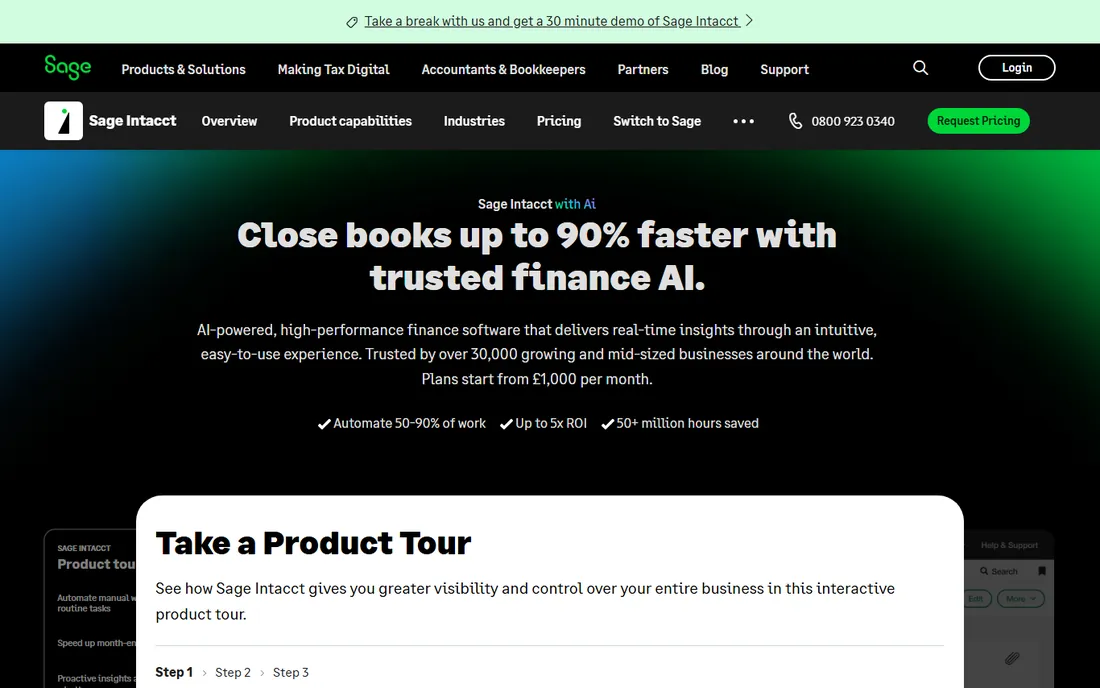
Sage Intacct takes a finance-first approach where NetSuite leads with ERP breadth. Its signature idea is dimensions: instead of building a giant chart of accounts, you tag every transaction with dimensions like department, customer, project or location, then slice reports any way the board asks. Finance teams that spend their lives in reporting tend to love this. Consolidation across entities runs in seconds with automated intercompany eliminations, and the 2026 releases added AI agents that track close tasks, read incoming bills and flag unusual journal entries.
The catch is that Intacct is a platform you buy with help. There is no self-serve signup; Sage or a certified partner scopes, implements and trains, which adds to the first-year bill on top of the subscription. US pricing is quote-only (the UK page lists plans starting from £1,000 per month as a rough anchor). It fits services, SaaS, nonprofit and healthcare finance teams that care more about the close than about warehouses.
What we like- Dimensional general ledger tags transactions by department, project or location without a bloated chart of accounts
- Multi-entity consolidation with automated eliminations across dozens of entities
- Built-in AI agents for close tracking, AP automation and anomaly detection
Watch out for- No published US pricing, so early budgeting means talking to sales
- Implementation runs through Sage professional services or a certified partner, adding first-year cost
#3
Microsoft Dynamics 365 Finance
Best for: Enterprises standardized on Microsoft 365 and Azure
Visit microsoft.com
Starting price$210/user/month billed annually (Finance Premium $300/user/month)
Free planNo
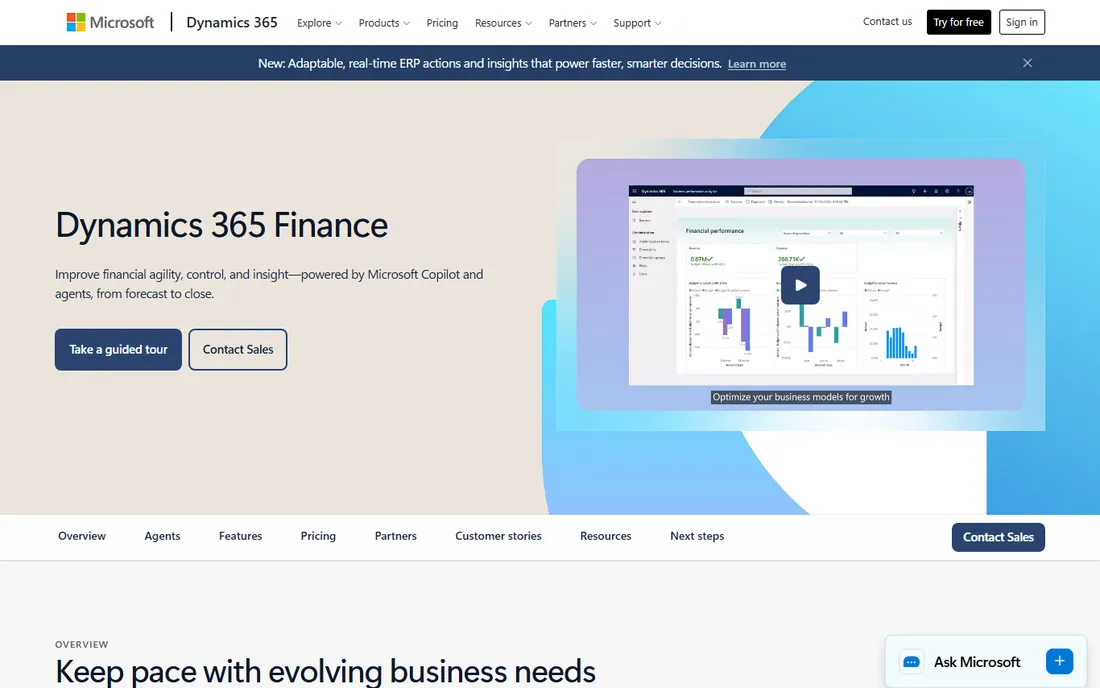
Dynamics 365 Finance is the only product here with a price you can put in a spreadsheet today: $210 per user per month billed annually, or $300 for Finance Premium with higher entitlements and Copilot credits. That transparency is a genuine differentiator when every competitor says "contact sales." The product itself is a full enterprise finance suite: general ledger, payables, receivables, fixed assets, budgeting, cash management and tax, with financial dimensions for reporting and "open in Excel" for high-volume journal work.
It makes the most sense inside the Microsoft ecosystem, where users live in Excel and Teams and IT already runs Azure. The honest math: 20 users at $210 is $4,200 per month before implementation, and Finance is usually bought alongside Supply Chain Management for operations. Smaller companies should look at Dynamics 365 Business Central ($80 to $110 per user per month) instead; Finance is built for scale.
What we like- Published per-user pricing, which is rare in this category
- Excel, Teams, Outlook and Power BI integration your finance team already knows
- Handles high transaction volumes, intercompany accounting and global tax rules
Watch out for- The standard plan carries a 20-user minimum that prices out smaller teams
- Most deployments need a Microsoft partner and a serious implementation budget
#4
Acumatica
Best for: Growing companies with many occasional users across departments
Visit acumatica.com
Starting priceSee website (custom quote)
Free planNo
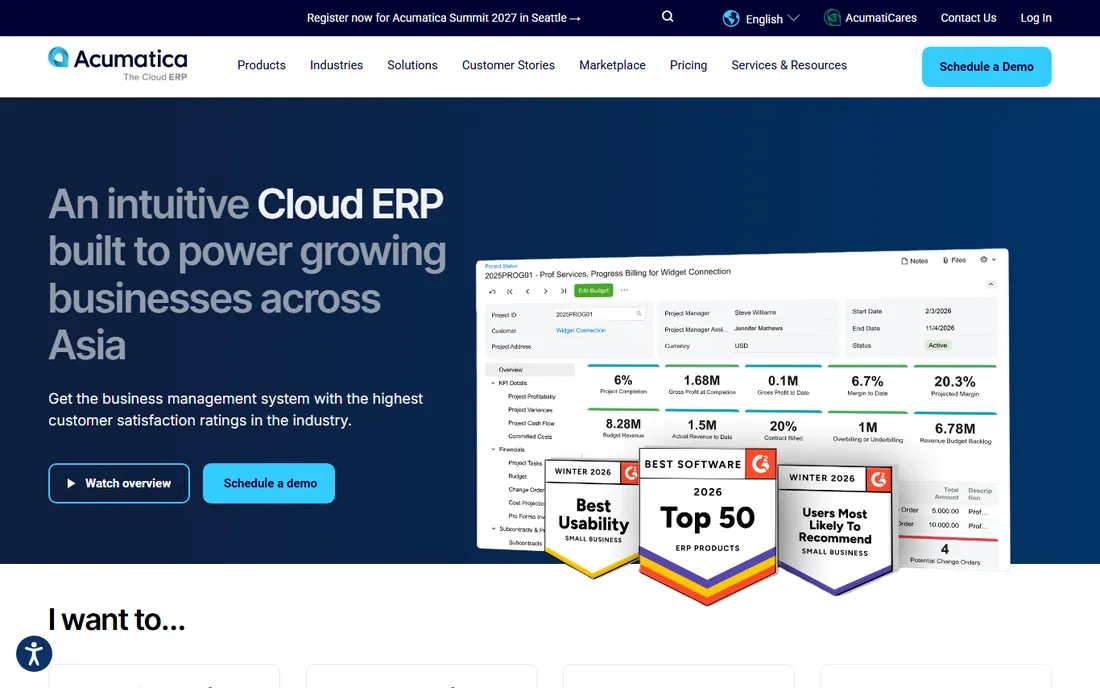
Acumatica's licensing model is its whole pitch. Every other system on this list charges per named user, which punishes companies where fifty people log in occasionally. Acumatica charges by resource consumption, roughly transaction volume, and lets you add unlimited users. A 200-person company with the same transaction count as a 50-person company pays the same license. For distributors, manufacturers and construction firms with big occasional-user populations, that math often wins.
The product is a genuine cloud ERP: financials, distribution, manufacturing, project accounting, field service and CRM, with industry editions that ship configured for the vertical. Deployment can be SaaS or private cloud. The caveats are the partner model, Acumatica sells and implements through VARs, so your experience depends heavily on the partner you pick, and there is no public price list to anchor negotiations.
What we like- Unlimited-user licensing priced by transaction volume instead of seats
- Full ERP scope with editions for manufacturing, distribution, construction and retail
- Open API and a large partner network for customization
Watch out for- Support and implementation run through partners, and quality varies
- Quote-only pricing makes early budget planning difficult
#5
SAP Business ByDesign
Best for: Midsize businesses and subsidiaries that want SAP without S/4HANA
Visit sap.com
Starting priceSee website (custom quote)
Free planNo
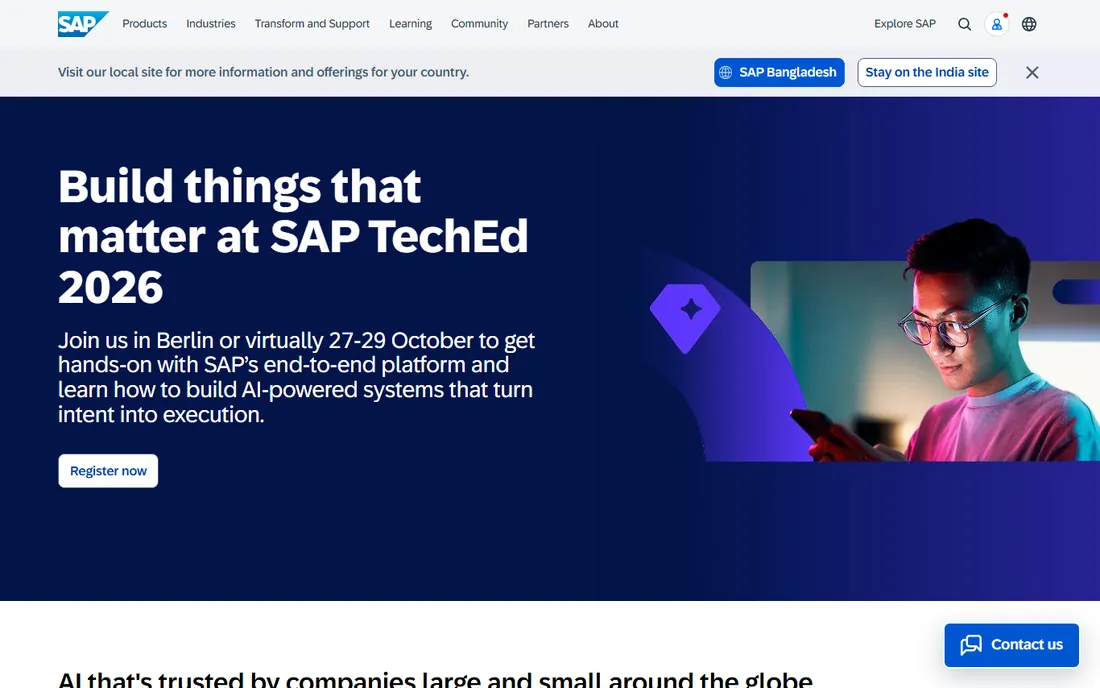
Business ByDesign is SAP's answer for companies too small for S/4HANA but too complex for entry-level accounting. It is a true cloud ERP, launched in 2007 and aimed at midsize firms and subsidiaries of large groups, covering financials, human resources, sales, procurement, supply chain and project management in one system. SAP ships it with preconfigured best-practice processes, which keeps standard deployments faster than a ground-up S/4HANA project.
The positioning cuts both ways. You get the SAP name, global compliance coverage and an upgrade path inside the SAP family, but you accept the guardrails of a standardized cloud product: deeper customization means workarounds or a bigger SAP product. Pricing is entirely quote-based, built from a base package plus user types, so midsize buyers should budget for both licenses and partner-led implementation.
What we like- Single cloud system for finance, HR, procurement, supply chain, project management and CRM
- Prebuilt best-practice processes speed up standard deployments
- A natural step within the SAP family if the company later needs S/4HANA
Watch out for- Customization is more limited than SAP's larger products
- Quote-only pricing and implementations that need specialized expertise
#6
Workday Financial Management
Best for: Large services and headcount-driven organizations
Visit workday.com
Starting priceSee website (custom quote)
Free planNo
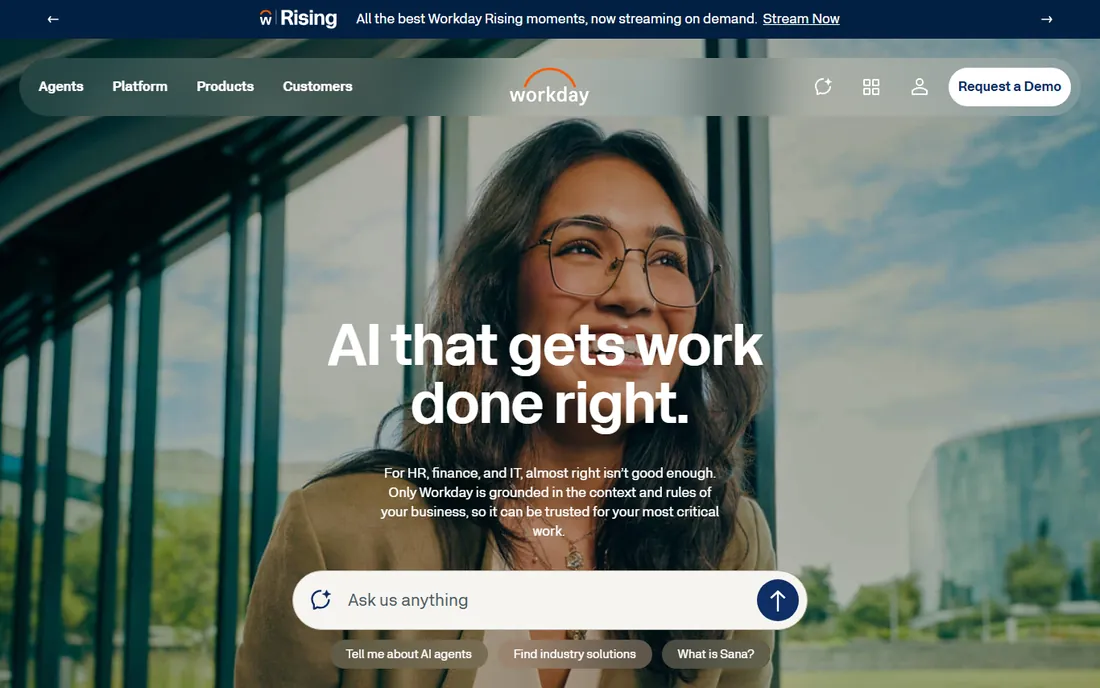
Workday comes at corporate accounting from the people side. Where most ERPs bolt HR onto finance, Workday built both on one object model, which makes it unusually strong for services businesses, healthcare, education and any organization where headcount is the business. Workforce planning, project accounting, procurement, expenses and the ledger all read from the same data, and its planning and reporting tools are among the best in the category.
Everything about Workday signals enterprise: quote-only pricing typically tied to employee count, implementations measured in quarters, and a customer base concentrated in the mid-market's upper end and above. A 50-person company should not be looking here. A 2,000-person services firm consolidating finance and HR on one platform should.
What we like- Finance and HCM share one data model, so workforce planning and accounting stay aligned
- Strong planning, consolidation and controls for complex organizations
- Continuous cloud delivery with no version upgrades to manage
Watch out for- Priced and scoped for large enterprises, it is overkill below a few hundred employees
- Selection and implementation are major projects with long timelines
#7
Certinia
Best for: Professional services firms already running on Salesforce
Visit certinia.com
Starting priceSee website (custom quote)
Free planNo
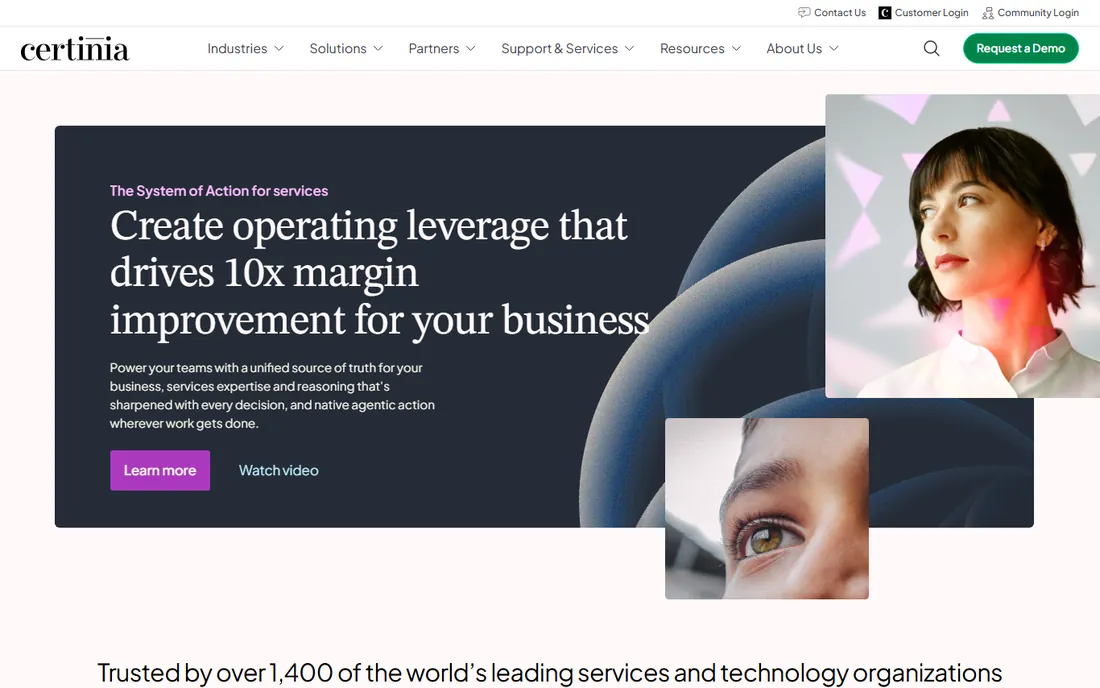
Certinia, formerly FinancialForce until its 2023 rebrand, is the odd one out in a useful way: it is not a standalone ERP but a set of ERP and PSA applications that run inside your Salesforce org. For consulting firms, agencies, IT services companies and software businesses that already live in Salesforce, that removes an entire integration layer. Delivery, billing, revenue recognition and the general ledger all work off the same customer record the sales team uses.
The economics need a clear eye. You pay for Salesforce platform licenses plus Certinia subscriptions, so total cost runs high, and Certinia publishes no prices at all. It is also services-only: manufacturers and distributors should look elsewhere. But for a Salesforce-centric services firm, the alternative is integrating a separate ERP to the CRM, which is its own expensive project.
What we like- Built natively on the Salesforce platform, sharing the same customer record as the CRM
- Strong professional services automation plus revenue recognition for ASC 606 and IFRS 15
- Real-time project profitability, billing and resource planning
Watch out for- Requires Salesforce licenses on top of Certinia, which raises total cost
- No manufacturing, warehouse or asset management, so it suits services businesses only
#8
Oracle Fusion Cloud ERP
Best for: Global enterprises with complex multi-GAAP, multi-currency operations
Visit oracle.com
Starting priceSee website (custom quote)
Free planNo
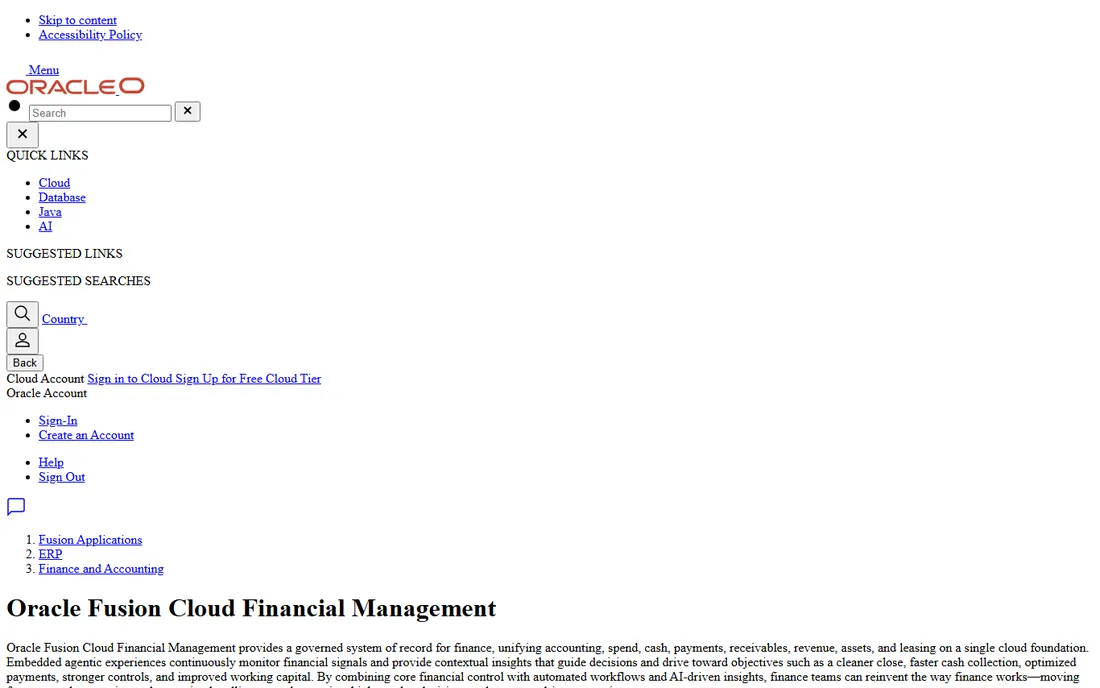
Oracle Fusion Cloud ERP is the heavyweight on this list. Fusion Cloud Financial Management is built for global enterprises running complex operations across countries, currencies and accounting standards: IFRS 15 and ASC 606 revenue recognition, IFRS 16 and ASC 842 lease accounting, automated intercompany, and continuous close monitoring. Oracle's 2026 positioning leans hard into embedded AI agents that watch the ledger, automate invoice ingestion and matching, and flag anomalies before they hit the close.
None of that comes cheap or fast. Oracle publishes no list price, third-party estimates put typical deals far above mid-market budgets, and implementations are measured in quarters with systems-integrator involvement. This is the system for the large enterprise that has outgrown everything else on this list, including NetSuite. Everyone else should treat it as the ceiling, not the starting point.
What we like- Governed financial system of record unifying accounting, spend, cash, payments and assets on one cloud foundation
- Embedded AI agents for close, payables, expenses and collections
- Multi-entity, multi-currency and multi-GAAP support for global operations
Watch out for- Enterprise pricing and long implementations put it out of reach for mid-market budgets
- The best value comes with the broader Oracle stack
What actually decides the total cost
The license quote is the smaller part of the decision. Across this category, the first-year bill is typically dominated by implementation: scoping, configuration, data migration, integrations and training, delivered by the vendor or a partner. Before signing, get the implementation quote fixed in writing with named deliverables, because "time and materials" ERP projects are where budgets go to die.
Then check what the license actually includes. Payroll, expense management, planning and budgeting, and advanced revenue recognition are often separate modules or products. Count your user types honestly: most vendors price full users, self-service users and read-only users differently, and the mix changes the quote more than the headline rate. Ask about the renewal cap in the contract, because year-two pricing is where quote-only vendors make their margin. Finally, confirm the close calendar: a system that cannot consolidate your entities in the first demo will not learn how in implementation.
Do you need a full ERP, or is finance-only enough?
Not every company on this list needs to run its warehouse on the same system as its ledger. Sage Intacct and Certinia are finance-led: they do accounting, close, planning and billing exceptionally well and integrate with best-of-breed operations tools. If your complexity is financial, multi-entity reporting, revenue recognition, project accounting, grant tracking, that is often the better buy: faster to deploy, easier for the finance team to own.
You need the full ERP suite when operations and finance cannot be separated. Manufacturers tracking work-in-progress, distributors managing inventory valuation, construction firms doing job costing, retailers reconciling point-of-sale: those companies should shortlist NetSuite, Acumatica, Dynamics 365 Finance, SAP Business ByDesign or Oracle Fusion, where inventory, procurement and production post to the ledger automatically. The wrong choice in either direction is expensive, so map your top ten month-end pain points before you take a single demo.
How we chose
We started with the categories buyers actually search: corporate accounting software, enterprise accounting software, mid-market ERP and financial management software. For each candidate we opened the vendor's own site and pricing pages, checked prices against public reviews on G2 and Capterra and practitioner discussion on Reddit, and compared consolidation capability, revenue recognition, integration depth and company-size fit. Where a vendor publishes no price we wrote "See website" rather than repeating a reseller's estimate. We did not run hands-on trials; enterprise ERP selections live and die in guided demos, not 14-day trials.
Frequently asked questions
How much does corporate accounting software cost?
It depends on users, entities and modules. Microsoft publishes the clearest anchor: $210 per user per month for Dynamics 365 Finance billed annually. Third-party deal analyses put typical mid-market annual licenses roughly between $15,000 and $100,000 depending on scope, with implementation commonly adding a large fraction of the license cost again in year one. Enterprise deals for Workday or Oracle Fusion run far higher. Treat every number as a starting point and get a written quote.
What is the difference between corporate accounting software and ERP?
Corporate accounting software centers on the finance function: the general ledger, close, consolidation, budgeting and compliance. ERP is broader: it adds operations like inventory, manufacturing, procurement and HR to the same system. Several products on this list are full ERPs (NetSuite, Acumatica, Dynamics 365 Finance, SAP Business ByDesign, Oracle Fusion), while Sage Intacct and Certinia are finance-led systems that integrate with operational tools.
How long does implementation take?
Longer than the sales deck suggests. Finance-led systems like Sage Intacct can go live in a few months for a straightforward single-entity deployment. Multi-entity ERP rollouts on NetSuite, Acumatica or Dynamics 365 typically run three to nine months, and global Oracle Fusion or Workday programs are measured in quarters. Data migration quality is usually the bottleneck, so start cleansing the chart of accounts early.
Can these systems handle multiple entities and currencies?
Yes, that is the core reason to buy them. NetSuite OneWorld, Sage Intacct, Dynamics 365 Finance, Acumatica, SAP Business ByDesign, Workday and Oracle Fusion all support multi-entity structures, multi-currency transactions and consolidated reporting, with automated intercompany eliminations. Test your actual entity structure in the demo rather than accepting a slideware promise.
Should we replace QuickBooks or Xero with one of these?
Only when the pain is real. The usual triggers: the close takes more than a week, you maintain consolidation spreadsheets, you need audit trails and approval workflows, or you are adding entities and currencies QuickBooks cannot model. Below that threshold, the implementation cost of a corporate system will exceed the pain it removes.
Is Certinia a real ERP if it runs on Salesforce?
It is a real ERP for services businesses, with qualifications. Certinia delivers financials, professional services automation, billing and revenue management as native Salesforce applications, which is a genuine ERP scope for firms whose business is people and projects. It does not do manufacturing, distribution or asset-heavy operations, so product companies need a general-purpose ERP instead.
Sources we checked (11)
- https://www.netsuite.com
- https://www.sage.com/en-gb/sage-business-cloud/intacct-2/
- https://microsoft.com/en-us/dynamics-365/products/finance/pricing
- https://www.acumatica.com
- https://www.sap.com
- https://www.workday.com
- https://www.certinia.com
- https://www.Oracle.Com/asean/erp/financial-management/
- https://www.g2.com/categories/accounting
- https://www.capterra.com/accounting-software/
- https://www.erpresearch.com/en-us/accounting-software-for-services
Is your product missing or out of date?
We review this list regularly. Vendors can request a listing, send updated pricing or ask about featured placement.

Shihab Mia · Founder, Rankite
Shihab has spent more than a decade helping SaaS and e-commerce brands grow through search. He writes Rankite's software buying guides from pricing pages, documentation and public user reviews. More about Shihab.