How we make this list: we compare pricing pages, product documentation and public user reviews. Ratings come from G2, Capterra or Trustpilot, with the date we checked them.
Key takeaways
- Credit agreement software for private funds splits into three jobs: reading and benchmarking documents (Hebbia, Ontra), monitoring covenants after close (CovenantIQ, Cardo AI, Allvue), and servicing the loan (LoanStreet, Finley). Few tools do all three well.
- None of the seven vendors publishes a price on its website. Expect a demo, a scoped quote and, in most cases, an annual contract.
- If your deal team negotiates many bespoke agreements, start with a document-intelligence tool. If your pain is chasing borrower financials every quarter, start with a monitoring tool.
- Allvue and LoanStreet fit funds that want credit agreement data tied directly to portfolio accounting or loan servicing, which cuts re-keying between systems.
- Ask every vendor how a human checks AI-extracted terms, and whether you can export the structured data if you leave.
Quick comparison
| Tool | Best for | Starting price | Free plan |
|---|
 Hebbia | Deal team research and covenant benchmarking | See website | No |
 Ontra Insight for Credit | Comparing covenants across a credit agreement library | See website | No |
 Allvue Systems | Credit managers wanting monitoring inside a full portfolio platform | See website | No |
 Cardo AI | Private credit and asset-based finance surveillance | See website | No |
 LoanStreet | Loan servicing and agency, boarded from the agreement | See website | No |
 Finley | Digitized credit agreements and compliance calculations | See website | No |
 CovenantIQ | Covenant and KPI monitoring from borrower financial data | See website | No |
Is your product missing or out of date?
We review this list regularly. Vendors can request a listing, send updated pricing or ask about featured placement.
The best credit agreement software for private funds
#1
Hebbia
Best for: Deal team research and covenant benchmarking
Visit hebbia.com
Starting priceSee website
Free planNo
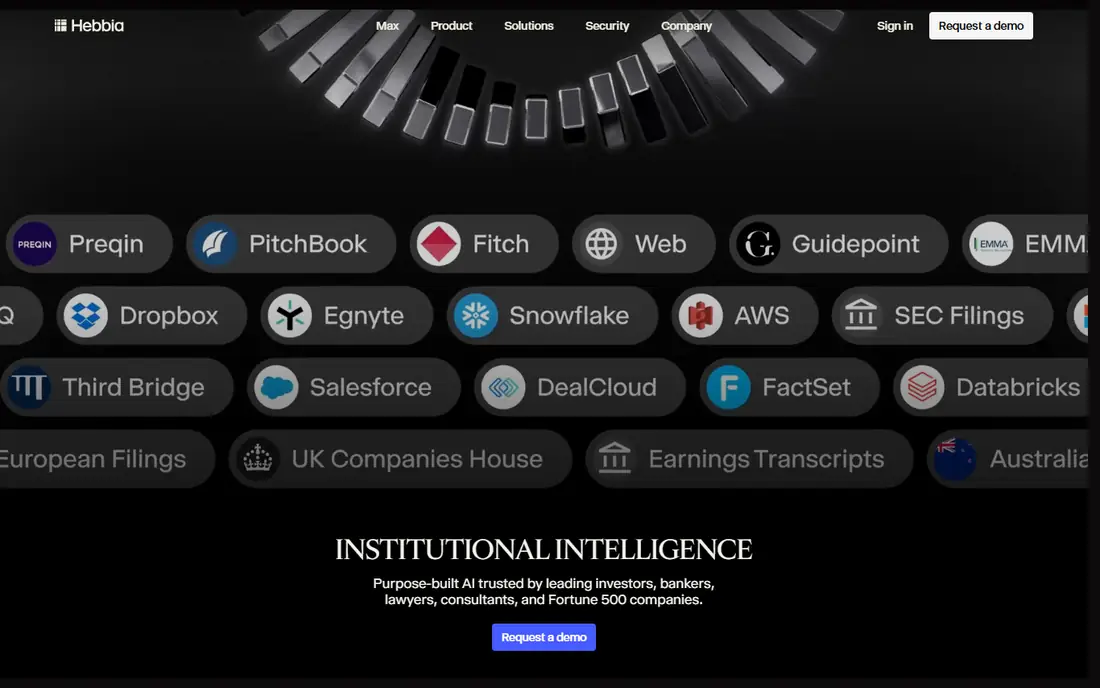
Hebbia is the pick for a credit team that spends its days reading. Its own material for private credit describes four uses: building a library of investment committee memos, screening new deals, finding overlooked opportunities, and analyzing credit agreements. That last use is the one that matters here, since the product pulls covenant terms and baskets from a stack of agreements and lets you compare them side by side.
What stands out is the research angle. You are not only abstracting one agreement into a spreadsheet. You can ask how leverage definitions or EBITDA add-backs differ across the last twenty deals you closed, and get an answer tied to the underlying text. For firms that lean on outside counsel for every first-pass review, that can shorten a lot of back and forth.
The catch is scope. Hebbia helps you understand documents, but it is not a covenant compliance engine that collects borrower reporting and tests ratios each quarter. Pair it with a monitoring tool if post-close tracking is the bigger need, and get pricing in writing before a pilot, because it is quote-based.
What we like- Extracts covenants, baskets and carve-outs across many agreements
- Natural language search across diligence files and past IC memos
- Answers point back to the source text
Watch out for- Built for analysis, not for ongoing compliance workflows
- Pricing is not public
#2
Ontra Insight for Credit
Best for: Comparing covenants across a credit agreement library
Visit ontra.ai
Starting priceSee website
Free planNo
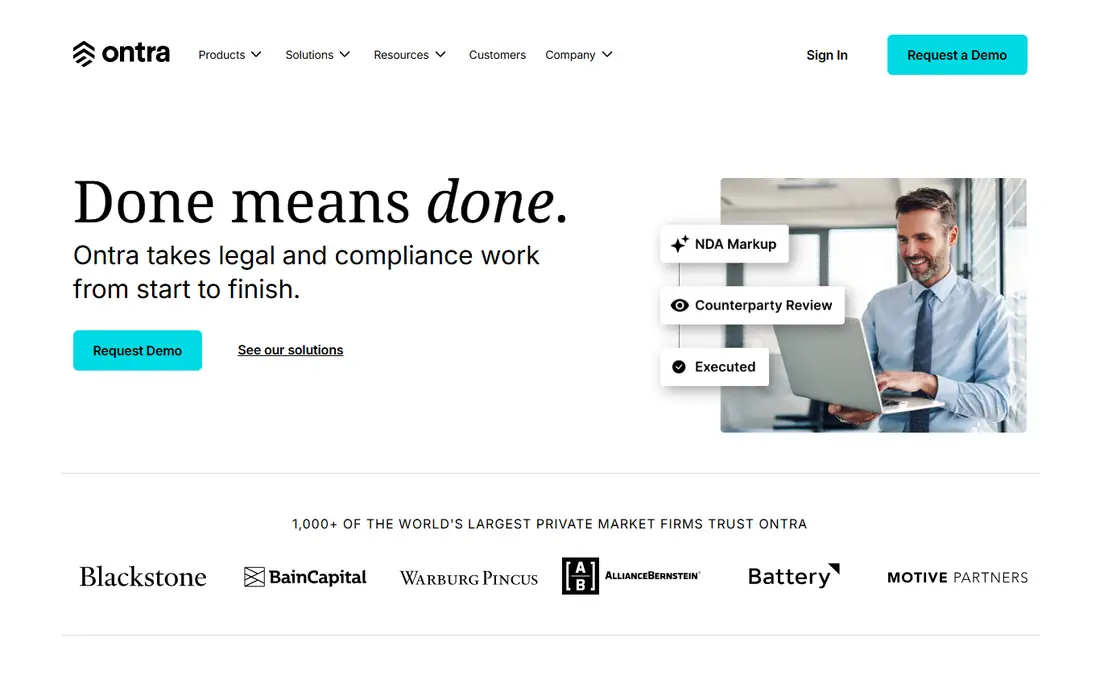
Ontra comes at the problem from the legal side of private markets. Its Insight for Credit product digitizes credit agreements and term sheets, then sorts covenants into names, descriptions and categories. The AI generates those labels and Ontra's trained specialists review them, which is a useful safeguard if your compliance team will not accept raw model output.
The practical strength is the repository. Agreements live in one searchable place, and a redline feature compares a provision against a base version. That suits a fund with dozens of facilities where the question is usually "how does this deal differ from our standard?"
The honest limit is that Insight is about terms, not borrower performance data. If you need ratio testing against fresh financials, you will still need something else. Ontra also sells a wider set of legal and fund operations products, so it makes the most sense if you would use more than one.
What we like- Groups similar clauses across agreements automatically
- AI output is reviewed by Ontra-trained specialists
- Central searchable repository with redline comparison
Watch out for- Better for legal and operations teams than for quant-style monitoring
- Pricing is not public
#3Allvue Systems
Best for: Credit managers wanting monitoring inside a full portfolio platform5.0/5 on
G2 (3 reviews, checked Oct 2026)
Visit allvuesystems.com
Starting priceSee website
Free planNo
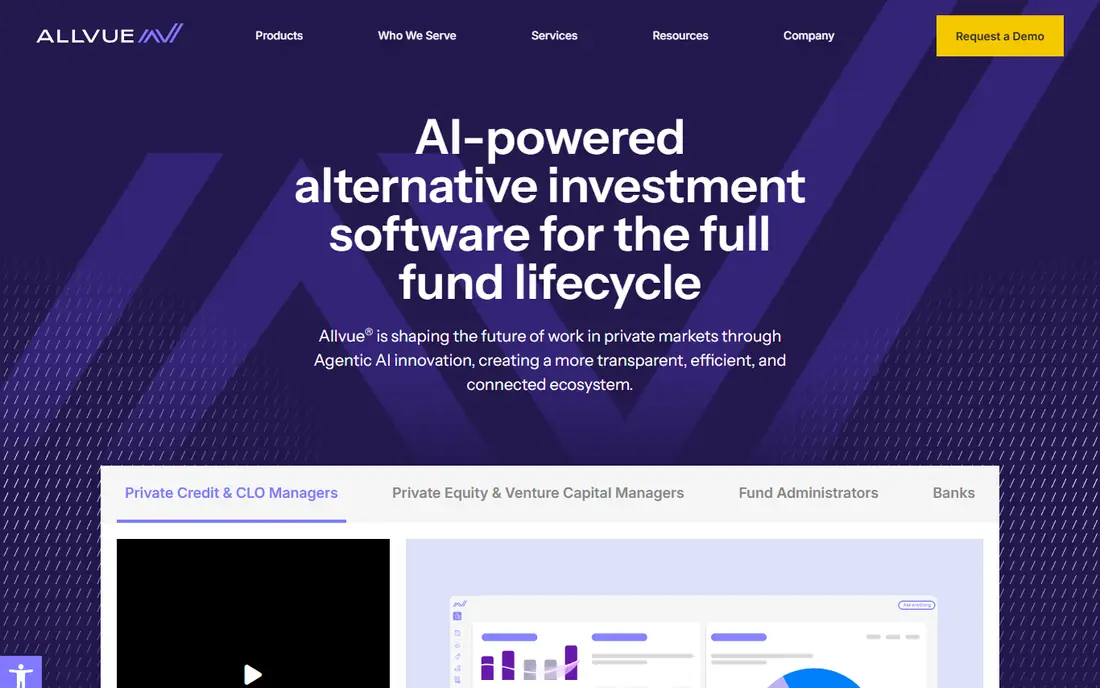
Allvue is the choice for a manager that wants the credit agreement to feed a single system of record. The company sells software for private debt, direct lending and CLO managers, and its Private Credit Monitor product adds loan and deal-level benchmarking on leverage, covenant structures and performance trends. Allvue has also published its own research showing that the share of new private loans with a leverage-only maintenance covenant fell from 74.2% in 2022 to 40.9% in the first half of 2025, which gives a sense of the benchmark data behind the product.
The benefit is fewer handoffs. Covenant data, positions and reporting sit in the same environment, so your portfolio team and your finance team are not reconciling separate spreadsheets.
Expect a bigger project than with the narrower tools on this list. Allvue is a platform decision, usually involving fund accounting, operations and investment staff, so smaller managers with a handful of loans may find it more than they need.
What we like- Covenant and financial tracking sits alongside portfolio and fund workflows
- Benchmarking data on covenant structures and leverage
- Established vendor focused on private debt and CLOs
Watch out for- Heavier implementation than a point tool
- Pricing is not public
#4
Cardo AI
Best for: Private credit and asset-based finance surveillance
Visit cardo.ai
Starting priceSee website
Free planNo
Cardo AI is aimed at private credit and asset-based finance, where the agreement is often just the start of a long surveillance process. Its Document Reader pulls key terms out of credit agreement files and maps them into the platform. The vendor says its models are trained or hosted on AWS infrastructure so your agreements stay confidential, and it has designed the tool to refuse an answer when the text does not support one.
After onboarding, the deal surveillance module tracks triggers and covenants, compares collections with expectations, and watches concentrations by seller, obligor or structure. That portfolio view is what separates it from pure document tools.
The trade-off is focus. Cardo AI speaks the language of securitization and receivables, so a fund doing mostly sponsor-backed middle-market loans should check that its workflows match how you actually test covenants. Ask for a demo using one of your own agreements.
What we like- Document Reader extracts terms from PDF, DOC and DOCX agreements
- Trigger and covenant monitoring with early warning alerts
- Models hosted on AWS with a stated focus on data confidentiality
Watch out for- Strongest in structured finance and ABF, less tailored to plain sponsor-backed direct lending
- Pricing is not public
Starting priceSee website
Free planNo
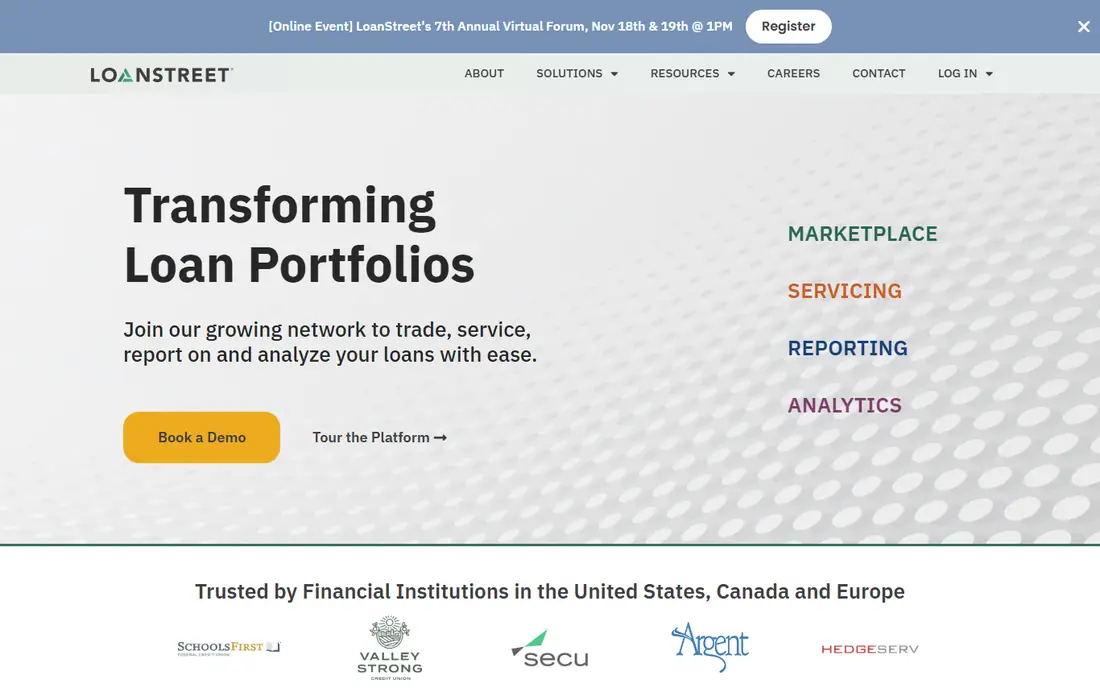
LoanStreet is for the operations side. It focuses on servicing, management and agency after close, and it supports bilateral, club and syndicated loans. Its AI credit agreement reader extracts and imports loan terms so the loan can be boarded without hand entry, and the company says each term shows how it was derived, which makes review easier.
Once a loan is on the system, the platform tracks financial covenants, organizes the related documents, and produces invoices and payment files. Fund administrators and third-party agents are named users, so it can fit if you outsource part of the back office.
Do not buy it expecting origination or credit memo tools. LoanStreet picks up where the deal team stops. For funds that already have a research tool and need a clean servicing record, that division can be a plus.
What we like- AI reader boards loans from the executed credit agreement
- Tracks financial covenants and generates invoices and payment files
- Serves private credit lenders, fund administrators and agents
Watch out for- Centered on the post-close loan lifecycle, not underwriting
- Pricing is not public
Starting priceSee website
Free planNo
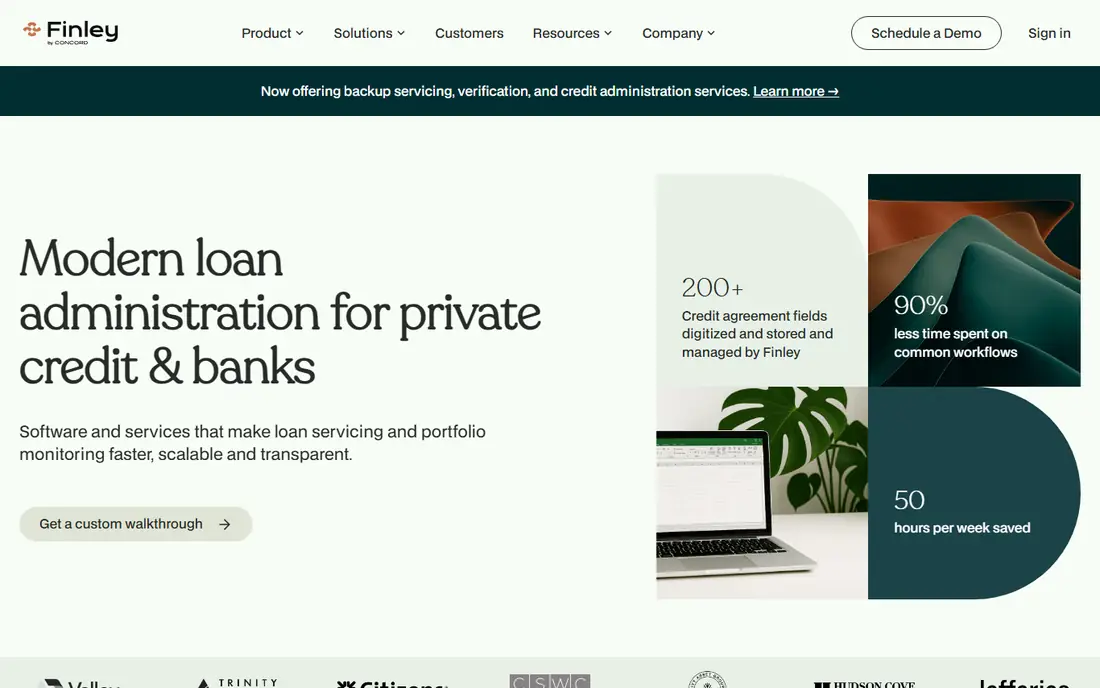
Finley is built around the idea that a long credit agreement should become structured logic. Its platform includes a Digital Credit Agreement, a Calculation Engine, Deliverables and Portfolio Monitoring modules. The aim is to digitize rules, then surface compliance updates so teams catch problems before a reporting date.
That makes it a good match for facilities with many moving parts, such as borrowing bases, collateral calculations and compliance certificates. Finley says it sits on top of core banking and loan management systems rather than replacing them, so it can be added without ripping out your servicer. Public reporting from early 2023 noted a $17 million Series A, so it is a venture-backed company rather than an old incumbent.
Because the value comes from modeling each agreement carefully, setup is not a same-week task. Smaller funds with simple term loans may not need that depth, and should compare it with lighter monitoring tools.
What we like- Turns agreement rules into programmatic compliance checks
- Calculation engine for collateral and covenant tests
- Works on top of existing loan and banking systems
Watch out for- Implementation effort is real for complex facilities
- Pricing is not public
#7
CovenantIQ
Best for: Covenant and KPI monitoring from borrower financial data
Visit covenantiq.io
Starting priceSee website
Free planNo
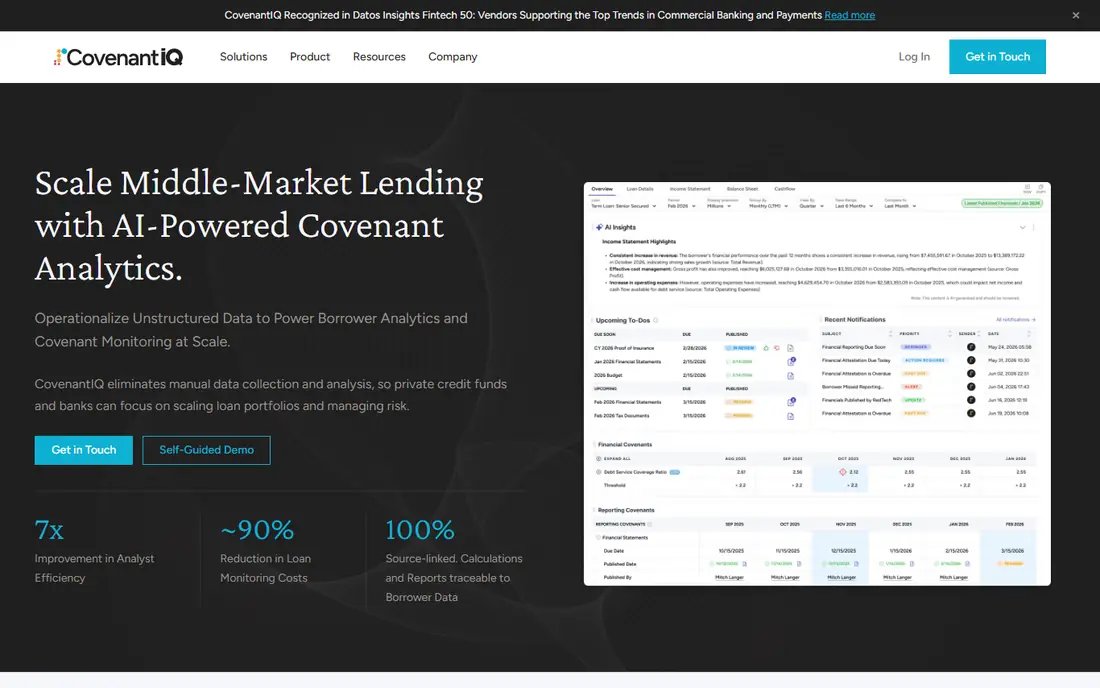
CovenantIQ targets the quarterly scramble to collect borrower numbers. It turns a credit agreement into mapped covenant definitions, then connects to a borrower's accounting software through an API so financials arrive normalized and ready to test. Analysts see compliance and headroom in a dashboard instead of piecing it together from PDFs and emails.
It also publishes a lot about how it handles cash-flow-based loans, including a multi-step AI process for extracting covenants and EBITDA definitions. That is a good sign for lenders whose agreements contain heavy add-backs.
It does not try to be a general portfolio accounting system, and it has a separate offering for community banks, so confirm the private credit version fits your reporting needs. The API approach also depends on borrowers agreeing to connect their books, which not every middle-market company will do.
What we like- Connects to borrower accounting systems by API
- Normalizes financial data and maps it to covenant definitions
- Covers covenants and KPIs in one dashboard
Watch out for- Narrower than a full portfolio platform
- Pricing is not public
How we chose
We built this list from public information, not hands-on trials. For each vendor we read product and pricing pages, documentation and company blog posts, then checked public reviews and roundup coverage where available to see how buyers describe the tools. We looked at what the software does with a credit agreement, how it handles covenant monitoring or servicing, and which kinds of lenders it names as users.
We included tools that handle credit agreement data for private credit and direct lending, and left out general contract software that has no credit-specific features. None of the seven publishes a list price, so every price field says See website rather than a guess. Vendor claims are described as claims, and you should test them on your own documents.
Start with the job, not the feature list
Write down the single task that costs your team the most hours. If it is reviewing and comparing terms during underwriting, you want document intelligence. If it is collecting borrower financials and testing covenants, you want a monitoring platform. If it is boarding loans and sending notices, you want servicing software.
Most funds end up combining two tools. That is fine, but check that agreement data can move between them through an export or API, so nobody retypes terms.
Test on your own agreements
Ask each vendor to run a live demo on two or three of your real credit agreements, including one with unusual definitions. Look at how it handles EBITDA add-backs, baskets with grower components and cross-references to defined terms. A tool that is great on clean templates can struggle on bespoke documents.
Ask about human review and audit trails
AI extraction is a first draft. Find out who reviews the output, how corrections are saved, and whether every extracted term links back to the page and clause it came from. Your auditors and investors will want that trail.
Check security, contract terms and exit
Credit agreements are confidential, so ask where documents are stored, which models process them, and whether your data is used for training. Clarify contract length, implementation fees, user limits and what you can export if you cancel. Since pricing is quote-based, compare quotes on the same scope: number of agreements, number of loans, and number of users.
Frequently asked questions
What is credit agreement software?
It is software that reads, structures and tracks the terms of loan agreements. Depending on the product, that means extracting covenants and key terms, benchmarking them against other deals, testing compliance with borrower financials, or servicing the loan.
Do private funds really need dedicated software for this?
A fund with a few loans can manage with spreadsheets and counsel summaries. Once the portfolio grows to dozens of bespoke facilities, manual tracking tends to miss amendments and reporting deadlines, which is when dedicated tools pay off.
How much does credit agreement software cost?
None of the vendors in this guide publishes pricing, so you will need a quote. Costs usually depend on the number of loans, agreements or users, and on how many modules you add.
Can AI accurately read credit agreements?
It can speed up extraction, but it should not be treated as final. Look for tools that cite the source clause, allow easy correction and include human review, then have your legal or credit team approve key terms.
Should I choose a platform or a point tool?
A platform like Allvue reduces handoffs but takes longer to implement. A point tool such as CovenantIQ or Ontra Insight for Credit is quicker to start and can work alongside your existing portfolio system.
Sources we checked (12)
- https://www.hebbia.com/blog/how-private-credit-teams-use-hebbia
- https://www.hebbia.com/resources/credit-agreement-software
- https://www.ontra.ai/products/insight-for-credit/
- https://www.allvuesystems.com/allvue-private-credit-monitor/
- https://www.allvuesystems.com/industries/credit-asset-managers/
- https://cardoai.com/solutions/by-product/deal-surveillance/
- https://cardoai.com/whats_new_in_product/introducing-document-reader-for-credit-agreements/
- https://loan-street.com/solutions/loan-servicing-software/
- https://www.finleycms.com/platform/overview
- https://techcrunch.com/2023/01/31/finley-debt-capital-software-series-a/
- https://www.covenantiq.io/
- https://www.covenantiq.io/resources/revolutionizing-loan-monitoring-with-ai-how-covenantiq-is-transforming-cash-flow-based-lending
Is your product missing or out of date?
We review this list regularly. Vendors can request a listing, send updated pricing or ask about featured placement.

Shihab Mia · Founder, Rankite
Shihab has 5+ years in B2B and SaaS SEO. He writes Rankite's software buying guides from pricing pages, documentation and public user reviews. More about Shihab.