How we make this list: we compare pricing pages, product documentation and public user reviews. Ratings come from G2, Capterra or Trustpilot, with the date we checked them.
Key takeaways
- CKEditor 5 is the commercial peer: enterprise features, real time collaboration and a licensing conversation of the same weight as TinyMCE's.
- Tiptap is the modern product team's favourite: headless, built on ProseMirror, with cloud collaboration priced from 49 dollars a month for stored documents.
- Quill, Editor.js, Lexical and Slate are free and open source, trading TinyMCE's finished product surface for control, smaller footprints and no per load pricing.
- The real fork is document model: HTML in, HTML out editors behave like TinyMCE, while schema and block based editors change what your content is, for better and for migration pain.
Quick comparison
| Tool | Best for | Starting price | Free plan |
|---|
 CKEditor 5 | Enterprise editing and collaboration | See website | Yes |
 Froala | Polished editor with simple licensing | See website | No |
 Tiptap | Custom editors in modern web apps | $49 per month | No |
 Quill | Lightweight free editor for apps | Free | Yes |
 Editor.js | Block based structured content | Free | Yes |
 Jodit | Fast free editor with an easy setup | Free | Yes |
 Lexical | High performance custom editor frameworks | Free | Yes |
 Slate | Fully custom editing experiences in React | Free | Yes |
Is your product missing or out of date?
We review this list regularly. Vendors can request a listing, send updated pricing or ask about featured placement.
The best TinyMCE alternatives
Starting priceSee website
Free planYes
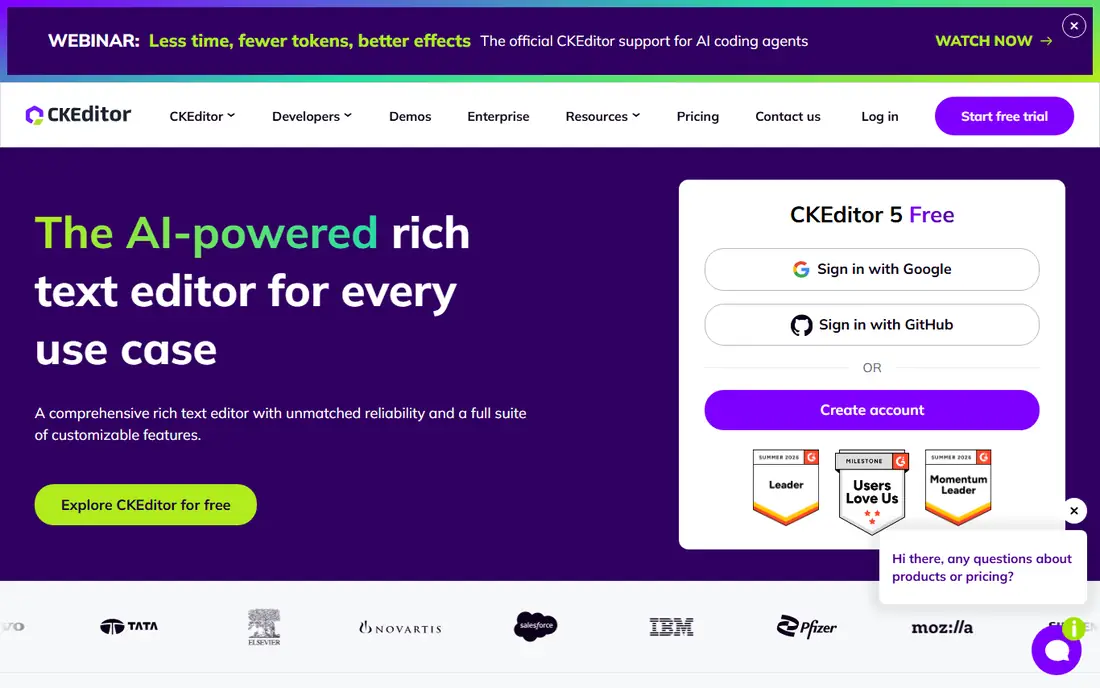
What we like- CKEditor 5 is the like for like commercial alternative: a ground up modern editor with a plugin architecture, strong accessibility work, real time collaboration, track changes, comments and revision history, and premium features such as enhanced paste from Office that enterprises actually buy editors for. Its open source core is free for small deployments under its licence terms, and Drupal and enterprise CMS ecosystems standardise on it. If your TinyMCE use is a CMS for serious editors, this is the peer to evaluate first.
Watch out for- Commercial pricing is custom and reported figures vary widely by user counts and features, so the quote is the price. Collaboration and premium features sit in commercial plans with usage terms. It carries its own framework opinions and learning curve, and migrating plugins and customisations from TinyMCE is a rewrite, not a port.
Starting priceSee website
Free planNo
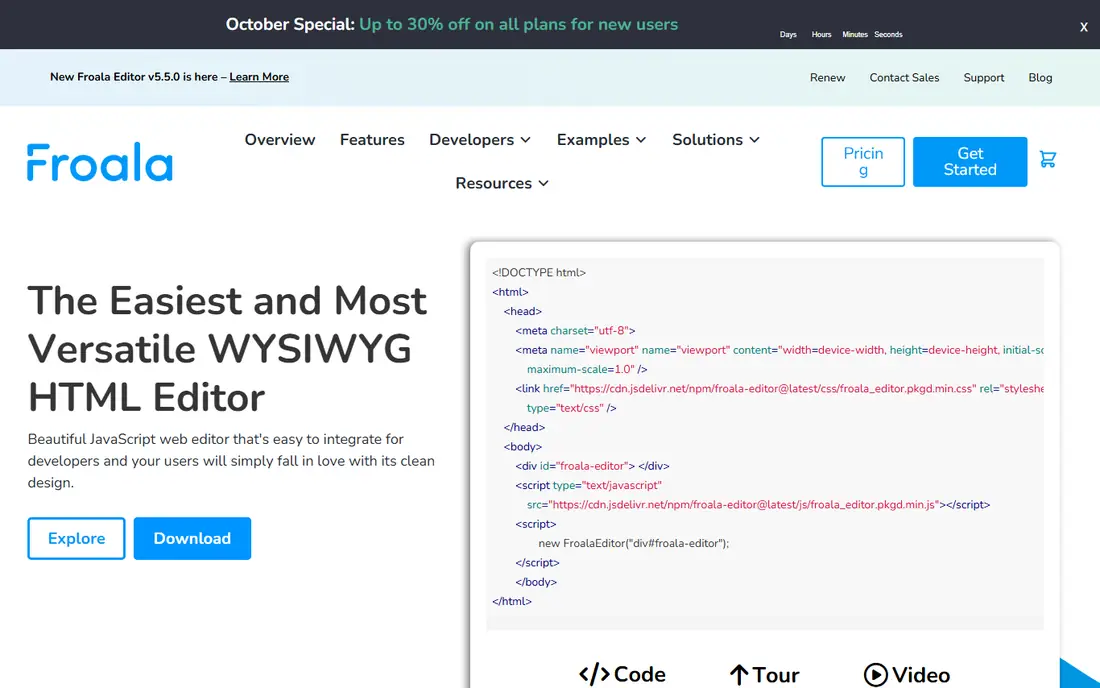
What we like- Froala is the design led commercial option: a fast, light editor with an interface users consistently rate as the prettiest in the class, every feature included on every paid plan including its AI assist, and licensing by products and domains, with annual Pro pricing reported at 899 dollars a year. Subscription and perpetual options give procurement a choice TinyMCE's load metering does not. React, Vue and framework wrappers are first class.
Watch out for- There is no free tier beyond a trial, so evaluation is time boxed. Prices and tier names have changed across generations
- Comparisons cite figures from 199 dollars a year to monthly equivalents several times that, so the live pricing page is the only safe source. Deep schema driven customisation is not its model
- It is a finished editor, customisable at the edges.
Starting price$49 per month
Free planNo
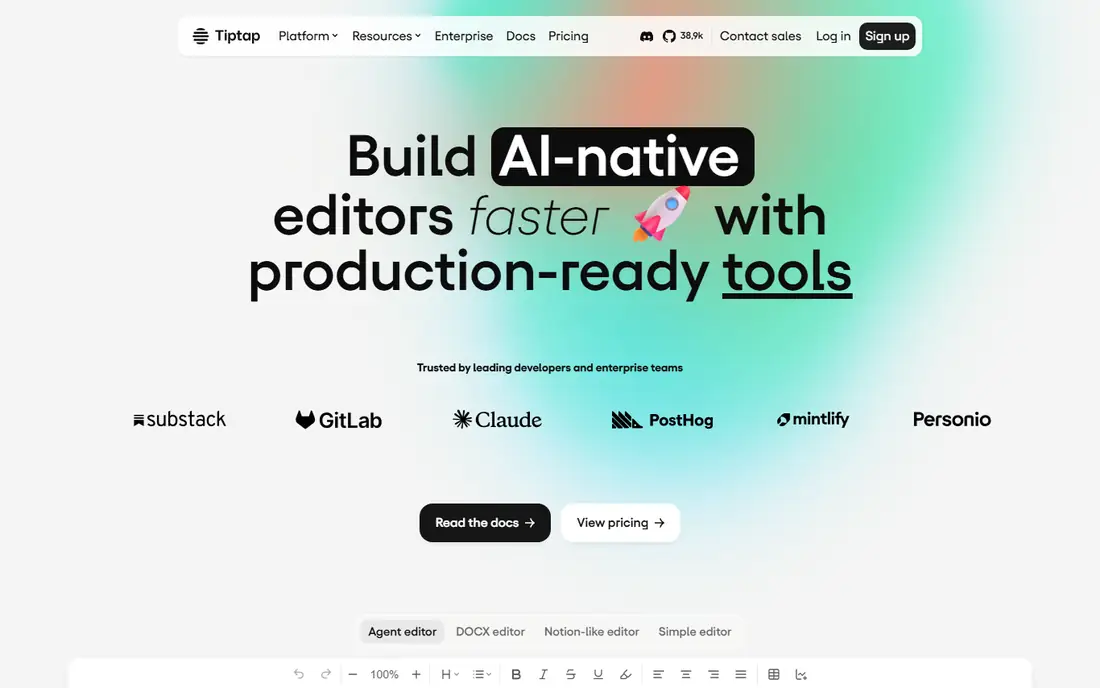
What we like- Tiptap is the headless editor built on ProseMirror that product teams adopted to build Notion shaped experiences: an open source core with more than a hundred extensions, your own UI entirely, and a cloud layer for collaboration, comments and version history priced by stored documents, Start at 49 dollars a month in the vendor's current published tiers. React and framework support is its home ground, and the developer experience is the best regarded in this list.
Watch out for- The free plan is gone for new users in its restructured pricing
- The core remains open source, but the commercial cloud and AI toolkit are paid layers with their own meters. Headless means you build the toolbar, the menus and the polish yourself, which is the point and also the budget. ProseMirror's model rewards engineers who learn it and punishes deadline improvisation.
Starting priceFree
Free planYes
What we like- Quill is the free editor a generation of apps embedded: a clean API, a modular architecture, its Delta format for content operations, and in version 2.0 modernised packaging and much faster large document handling. It powers comment boxes, support tools and content fields where a dependable, attractive editor with a toolbar is the whole requirement, at zero licence cost under its open source terms. Setup is an afternoon, including the snow theme most users picture.
Watch out for- Quill's development pace has slowed and quickened over its life, and its ceiling is lower than the schema frameworks: complex nested structures and real time collaboration are build your own territory. Deltas are not HTML, so content pipelines need a rendering decision. Paste fidelity from Office trails the commercial editors' paid features noticeably.
Starting priceFree
Free planYes
What we like- Editor.js is the block editor: content as clean JSON of blocks, headers, lists, embeds, images, quotes, each an independent plugin, rendered wherever you like. For publications and platforms that think in structured content rather than documents, it produces the cleanest data of any tool here and an editing experience readers of modern blogs already understand. Free, open source and framework agnostic.
Watch out for- Block content is not a document editor: free form layout, complex tables and long form word processing fight the model. Your stored content becomes block JSON, a one way architectural door for a TinyMCE estate full of HTML. The plugin ecosystem is uneven in maintenance, so core blocks are safe and exotic ones are a code review.
Starting priceFree
Free planYes
What we like- Jodit is the pragmatic free WYSIWYG: written in TypeScript with no framework dependencies, quick to integrate, a familiar toolbar interface out of the box and an open source licence for the core, with pro licences for support and extras. Teams replacing TinyMCE in a classic CMS or admin panel, same HTML in and out shape, find Jodit the lowest friction free landing. Its file and image handling covers the daily CMS cases without plugin archaeology.
Watch out for- The ecosystem, documentation depth and enterprise feature set, collaboration, track changes, accessibility auditing, trail the leaders. It is a smaller project commercially, so long term bets should weigh its bus factor. Advanced customisation means reading source more often than a commercial rival's plugin API would require.
Starting priceFree
Free planYes
What we like- Lexical is Meta's editor framework, built for the scale of Facebook and Instagram text: an extensible core designed for performance and reliability, framework agnostic with first class React support, and the foundation under a growing number of commercial products. Teams building an editor as a product feature with unusual requirements, mentions, rich embeds, custom nodes, get a modern, actively developed base that will not be abandoned next year.
Watch out for- Framework means framework: there is no finished editor to download, and the UI, toolbar and behaviours are your project. The ecosystem of ready plugins is younger than Tiptap's. Choosing Lexical is choosing to own an editor codebase, a decision for product teams with engineers to staff it.
Starting priceFree
Free planYes
What we like- Slate gives React teams total control: a plugin first framework where the schema, rendering and behaviours are all yours, used to build editors that look nothing like a word processor because the product should not. Its model suits documents as application data, collaborative canvases, structured writing tools, where TinyMCE's document assumptions are the problem rather than the solution.
Watch out for- Total control is total responsibility: tables, lists, paste handling and IME edge cases are engineering projects, and Slate's own documentation warns it is a framework for builders, not a drop in editor. Collaboration arrives through integrations rather than a hosted plan. Teams that simply need a good rich text field will spend ten times the effort of Quill for a worse first version.
How we chose
TinyMCE itself is excluded because this article covers its alternatives. We selected rich text editors and editor frameworks in active development in October 2026 that a TinyMCE user could realistically adopt, spanning commercial finished editors, a headless platform and open source options, and noting in each entry which content model it uses. Prices are vendor published where stable and marked see website where current sources conflict, which in this category is often. Nothing was hands on tested.
How to choose your TinyMCE alternative
Answer the content model question first, because it outlives every other feature. If your world is HTML documents, CMS articles, emails and descriptions, stay in the HTML family: CKEditor, Froala or Jodit by budget and collaboration needs. If your product thinks in blocks or schemas and developers own the editor, Tiptap is the balanced default, Lexical and Slate are the deeper control options, Editor.js is the clean data play and Quill is the fast, simple, free one.
Then count the unglamorous requirements before falling for a demo: paste from Word and Google Docs, because your users will; image upload and file management; accessibility of the editing surface itself; and the export path for your existing TinyMCE content, including a test conversion of your ugliest real article. Editor migrations fail on paste fidelity and legacy content, never on the toolbar.
Frequently asked questions
Why do teams move away from TinyMCE?
The recurring reasons are pricing shape, cloud plans that meter editor loads as your product grows, licensing care for self hosting, bundle weight, and design: product teams want editors that match their app's interface and behaviour rather than a recognisable third party component. None of this makes TinyMCE a bad editor; it remains a strong default, which is why its alternatives have to win on a specific axis.
Is CKEditor really free?
Its core is open source with licence terms that cover small deployments, historically up to a handful of users, free. Collaboration, premium features and larger deployments are commercial, with custom pricing. Read the current licence against your user count and distribution model, because the free boundary is exactly where growing products trip.
What is a headless editor?
An editor engine without a fixed interface: Tiptap, Lexical and Slate give you the document model, behaviours and extension points, and your team builds the toolbar and menus. The gain is an editor that feels native to your product and does exactly your jobs. The cost is building and maintaining that surface yourselves.
Can I migrate my existing HTML content?
Into the HTML family, CKEditor, Froala and Jodit, generally yes, with cleanup for editor specific markup. Into schema or block editors, content must be converted into their document models, HTML importers exist for Tiptap and Editor.js with fidelity limits on complex layouts. Budget a conversion and QA pass on real content; it is the largest hidden cost of switching editor families.
Which editor is best for a small project?
Quill for a free, capable editor running today; Jodit if you want the classic WYSIWYG shape with the least setup; Editor.js if the content is articles and clean structured data matters. All three are free and open source, so the choice is about shape, not budget, and any of them beats configuring a commercial trial you will never pay for.
Sources we checked (0)
Is your product missing or out of date?
We review this list regularly. Vendors can request a listing, send updated pricing or ask about featured placement.

Shihab Mia · Founder, Rankite
Shihab has 5+ years in B2B and SaaS SEO. He writes Rankite's software buying guides from pricing pages, documentation and public user reviews. More about Shihab.