How we make this list: we compare pricing pages, product documentation and public user reviews. Ratings come from G2, Capterra or Trustpilot, with the date we checked them.
Key takeaways
- Substack is free to start but takes 10 percent of paid subscription revenue, which grows painful as a publication scales.
- Beehiiv is the cleanest direct replacement, with no revenue share, a free tier to 2,500 subscribers, and built-in growth tools.
- Ghost suits publishers who want full ownership and custom design, at the cost of building their own growth engine.
- Kit suits creators who sell courses and products through email automation, while Mailchimp suits general email marketing.
Quick comparison
| Tool | Best for | Starting price | Free plan |
|---|
 Beehiiv | Growth-focused newsletters | Free | Yes |
 Ghost | Full ownership publishing | $9 per month | No |
 Kit | Creator automation and sales | $29 per month | No |
 Mailchimp | General email marketing | $13 per month | Yes |
 MailerLite | Low-cost campaigns | $10 per month | Yes |
 Patreon | Tiered membership perks | 8% of sales | Yes |
 Flodesk | Visually led creator email | $28 per month | No |
 AWeber | Simple creator email | See website | Yes |
Is your product missing or out of date?
We review this list regularly. Vendors can request a listing, send updated pricing or ask about featured placement.
The best Substack alternatives
#1Beehiiv
Best for: Growth-focused newsletters4.5/5 on
G2 (40 reviews, checked Oct 2026)
Visit beehiiv.com
Starting priceFree
Free planYes
Beehiiv is the closest thing to a direct Substack replacement. You own your audience, you pay no share of subscription revenue, and growth tools like referral programs, the Boosts marketplace, and an ad network are built in rather than bolted on. The free Launch plan covers up to 2,500 subscribers, and the Scale plan at $49 per month for 1,000 subscribers opens monetization features.
The honest gap is discovery. Substack's recommendation network sends readers between publications in a way no rival matches, so Beehiiv writers supply their own growth engine. If you already have an audience, or you plan to grow through referrals and ads, Beehiiv keeps more of every dollar you earn.
What we like- Free up to 2,500 subscribers
- 0 percent platform revenue share
- Referral program, Boosts, and ad network built in
Watch out for- Discovery is weaker than Substack's network
- Paid plans start at $49 per month for 1,000 subscribers on Scale
- Design options are narrower than Ghost
#2Ghost
Best for: Full ownership publishing4.0/5 on
G2 (40 reviews, checked Oct 2026)
Visit ghost.org
Starting price$9 per month
Free planNo
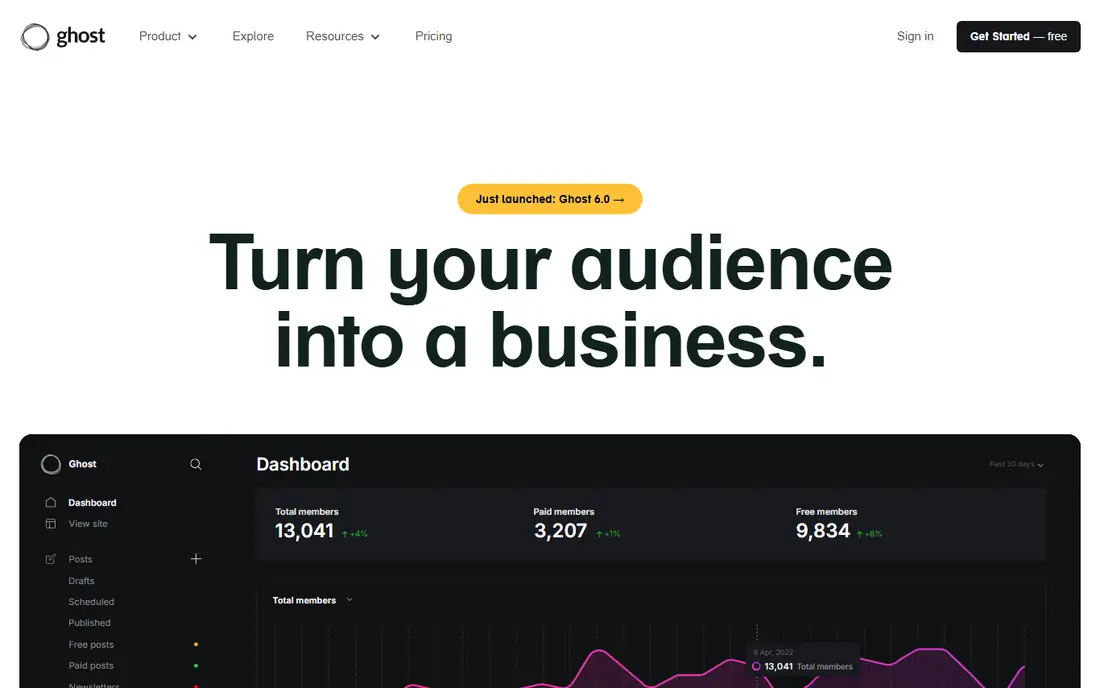
Ghost is the ownership pick. It is open source publishing software for newsletters and memberships, with custom themes, paid gating per post, and a content API for developers. Ghost(Pro) hosting starts at $9 per month, with the Publisher plan at $29 per month for 1,000 members, and you keep all subscription revenue after Stripe fees.
Ghost gives you no growth machine. There is no recommendation network, no ad marketplace, and no referral program out of the box, so sponsorships and discovery are your job. For established publishers with technical resources who want a site that no platform can shut down, Ghost is the strongest long-term home.
What we like- Open source and self-hostable
- 0 percent platform revenue share
- Custom themes and full design control
Watch out for- No built-in growth or recommendation network
- Self-hosting needs technical skill
- Hosted pricing scales with members
Starting price$29 per month
Free planNo
Kit, formerly ConvertKit, is the automation platform for creators who sell through email. A reader downloads a lead magnet, enters a welcome sequence, and moves between sequences based on clicks and purchases, all in a visual builder that no newsletter-first tool matches. Entry is $29 per month for up to 1,000 subscribers by recent guides, with a 0.6 percent revenue cut on its payments tool plus Stripe fees.
Kit is overkill if a newsletter is the product itself rather than a funnel for something else, and costs climb with list size. Its free plan ended for new accounts in 2026 according to recent guides, so confirm current terms on the vendor site. For coaches and course sellers, Kit remains the automation standard.
What we like- Mature visual automation builder
- Strong segmentation
- Built for selling courses and products by email
Watch out for- Free plan was discontinued for new accounts in 2026 by recent guides
- Costs rise with list size
- Discovery is weak
#4Mailchimp
Best for: General email marketing4.4/5 on
G2 (5,436 reviews, checked Oct 2026)
Visit mailchimp.com
Starting price$13 per month
Free planYes
Mailchimp is the generalist. It handles campaigns, segmentation, and automation for small businesses, with a free plan for small lists and paid plans from $13 per month. Its integration library is the widest here, which matters if email must connect to a store, CRM, or support tool.
Mailchimp is not a newsletter publishing platform in the Substack sense. Paid subscriptions need a third-party payment tool, and list-size pricing gets expensive as you grow. Pick Mailchimp when email is one marketing channel among many, not when a paid newsletter is the business itself.
What we like- Huge integration library
- Advanced segmentation
- Free plan for small lists
Watch out for- No native paid subscription tool
- Pricing climbs fast with list size
- Newsletter publishing feels secondary
Starting price$10 per month
Free planYes
MailerLite is the budget pick for straightforward email. Paid plans start near $10 per month, the editor is simple, and routine automations cover welcome sequences and basic segmentation. Small creators and local publishers get professional sending without a large bill.
It does not match Beehiiv on growth or Kit on automation depth, and paid newsletter features are thinner. If your needs are sending good emails on a schedule at low cost, MailerLite is the best value here. If you need referral programs or an ad network, look at Beehiiv instead.
What we like- Lowest-cost paid plans here
- Simple editor
- Free plan for small lists
Watch out for- Monetization features are thinner
- Automation is simpler than Kit
- Growth tools are limited
#6Patreon
Best for: Tiered membership perks4.2/5 on
G2 (63 reviews, checked Oct 2026)
Visit patreon.com
Starting price8% of sales
Free planYes
Patreon fits creators whose audience pays for membership, not just reading. Tiered perks, exclusive posts, and community tools turn fans into monthly supporters, and the standard model charges 8 percent of sales rather than a monthly fee. Podcasters, video makers, and writers with loyal fans use it as the money layer beside a free newsletter elsewhere.
For a pure newsletter, Patreon is awkward: email delivery and publishing are secondary to membership management. It works best paired with Beehiiv or Ghost for sending, with Patreon handling paid tiers. If membership perks drive your income, Patreon earns its cut.
What we like- Tiered memberships with exclusive perks
- Built-in paying audience habits
- No monthly fee on the standard model
Watch out for- 8 percent of sales on the standard tier
- Less suited to pure newsletters
- Platform rules govern the relationship
#7Flodesk
Best for: Visually led creator email4.8/5 on
G2 (311 reviews, checked Oct 2026)
Visit flodesk.com
Starting price$28 per month
Free planNo
Flodesk is the design-first email tool. Templates look polished with little effort, which suits visually led creators in food, fashion, and lifestyle. Pricing is flat by plan rather than strictly per subscriber at entry, with Pro plans from $28 to $79 per month by recent guides, and you can build a list free before paying to send.
Automation and analytics trail Kit and Mailchimp, so data-driven sellers may feel the limits. For creators whose emails must look beautiful and whose funnels are simple, Flodesk is the most pleasant tool to use daily.
What we like- Beautiful templates and easy design
- Flat pricing by plan, not list size at entry
- Free list building without sending
Watch out for- Automation is simpler than Kit
- Analytics are thinner
- Paid plans start at $28 per month by recent guides
#8AWeber
Best for: Simple creator email4.2/5 on
G2 (650 reviews, checked Oct 2026)
Visit aweber.com
Starting priceSee website
Free planYes
AWeber is one of the oldest creator email platforms, and it stays simple: lists, broadcasts, and basic automation without a steep learning curve. Its payments tool takes a 0.6 percent revenue cut plus Stripe fees, which is far below Substack's 10 percent, and a free plan covers small lists.
The interface feels older than Beehiiv or Flodesk, and growth features are limited. For a creator who wants reliable sending with minimal fuss and a low revenue cut, AWeber is a steady, unglamorous choice. Confirm current plan prices on the vendor site, since guides differ on recent changes.
What we like- Long-running creator email platform
- Simple automation
- 0.6 percent revenue cut on its payments tool
Watch out for- Interface feels older than rivals
- Growth tools are limited
- Pricing details need checking on the vendor site
How we chose
We compared platforms that replace what Substack does: publishing a newsletter, growing a list, and taking paid subscriptions. We checked free tiers, monthly pricing, platform revenue shares, and growth features from vendor pages and October 2026 platform comparisons, and we left out tools that only send marketing email without publishing or membership features. Where guides conflict on recent pricing, we say so and list See website rather than picking one figure.
How to pick a Substack replacement
Match the platform to the reason you are leaving. If the 10 percent revenue share is the problem, any owned-audience tool here fixes it, and Beehiiv or Ghost keeps the most revenue. If owning the subscriber relationship is the problem, only a full-ownership platform like Ghost fixes it completely. If Substack's discovery is what you value most, no rival matches it, so weigh that loss honestly before moving.
Model the bill at your real size
Platform fees, revenue shares, and Stripe processing add up differently at each size. Run the numbers at your current list and at twice that size: monthly fee plus platform cut plus Stripe fees on paid revenue. A free plan to 2,500 subscribers is generous until growth pushes you onto a paid tier, and a 10 percent cut is painless at $500 a month but heavy at $10,000. Pick the platform whose bill still makes sense at the size you aim for.
Plan the migration before you announce it
Export your subscriber list, including paid status, and test the import on the new platform with a small segment first. Set up payment handling and test a paid signup end to end before telling readers. Keep Substack running during the move so no issue is missed, and tell readers clearly where to find you next. A rushed migration loses subscribers that a careful one keeps.
Frequently asked questions
Can I move my Substack subscribers to another platform?
Yes. Substack lets you export your subscriber list, and Beehiiv, Ghost, Kit, and Mailchimp all offer import tools. Paid subscriber migration needs care: payment details do not transfer directly, so plan how paying readers re-subscribe or are carried over. Test with a small group before moving the full list.
Which platform is cheapest for a small newsletter?
Beehiiv is free to 2,500 subscribers, which covers most starting newsletters. MailerLite and Mailchimp offer free plans for smaller lists, and Ghost self-hosted is free apart from server and email costs. At 1,000 subscribers, Beehiiv Scale at $49 per month and Ghost Publisher at $29 per month are the common paid comparison points.
Do I lose Substack's discovery if I leave?
Mostly, yes. Substack's recommendation network is unique, and no rival matches it directly. Beehiiv's Boosts and referral programs help, and Ghost and Kit rely on your own promotion. Many writers keep a free Substack presence for discovery while running paid subscriptions elsewhere, though that splits attention.
What does the 10 percent Substack cut really cost?
On $1,000 a month in paid subscriptions, Substack takes $100 before Stripe fees of about $32. On $10,000 a month, Substack takes $1,000 before Stripe fees of about $320. That is why the cut feels small at first and heavy at scale, and why owned platforms with a flat monthly fee win as revenue grows.
Should I self-host Ghost or use Ghost(Pro)?
Self-hosting is free software but you pay for a server, email delivery, and your own maintenance time. Ghost(Pro) removes that work for a monthly fee that scales with members. Choose self-hosting only if you have technical skill and time; otherwise the hosted service is cheaper in total effort.
Sources we checked (8)
- https://www.beehiiv.com
- https://ghost.org
- https://kit.com
- https://mailchimp.com
- https://www.mailerlite.com
- https://www.patreon.com
- https://flodesk.com
- https://www.aweber.com
Is your product missing or out of date?
We review this list regularly. Vendors can request a listing, send updated pricing or ask about featured placement.

Shihab Mia · Founder, Rankite
Shihab has 5+ years in B2B and SaaS SEO. He writes Rankite's software buying guides from pricing pages, documentation and public user reviews. More about Shihab.