How we make this list: we compare pricing pages, product documentation and public user reviews. Ratings come from G2, Capterra or Trustpilot, with the date we checked them.
Slite vs Notion at a Glance
Slite is the top pick for teams that want a focused knowledge base with AI search and verification, while Notion is the top pick for teams that want one flexible workspace for notes, wikis, databases and projects. Slite keeps docs short, current and easy to find. Notion gives you more building blocks, so one workspace can hold almost anything. The price is the same at the entry tier, so the choice comes down to focus against flexibility.
Key takeaways:
- Slite Basic and Notion Plus both cost 10 dollars per user per month billed annually.
- Slite has no free plan, only a 14-day trial, while Notion is free for one person.
- Slite wins on AI search, document verification and keeping docs current.
- Notion wins on databases, templates and the range of things one workspace can hold.
- Confluence is the best alternative for Atlassian teams, and Coda is the best pick for docs with tables and automations.
Which is better for team knowledge, Slite or Notion?
Slite and Notion both hold team knowledge, but they organise it in opposite ways. Slite is a knowledge base first. It is built for short docs that answer a question, with Ask AI search on every paid plan, document verification that flags stale pages, and a clean editor. The Pro plan adds Slite Agent, which checks docs against connected tools such as Slack and GitHub, flags what has gone stale, and drafts a correction for a person to approve. Notion is a workspace first. A page can hold text, tables, boards, calendars and databases, so one workspace can replace a notes app, a wiki and a simple tracker. Choose Slite if your team keeps asking the same questions, if docs go stale without anyone noticing, or if you want AI search that cites the source doc. Choose Notion if you want one place for notes, projects and wikis, or if a free plan for one person matters while you try it out.
How much do Slite and Notion cost?
Slite and Notion cost the same at the entry tier. Slite Basic costs 10 dollars per user per month billed annually, or 12 dollars month to month, with unlimited docs, Ask AI search, document verification and API access. Slite Pro costs 20 dollars per user per month billed annually, or 25 dollars monthly, adding Slite Agent, cross-tool search, 50 agent credits per seat each month, and OpenID single sign-on. There is no free plan, only a 14-day trial with no card needed. Notion has a free plan for one person with unlimited pages and blocks. Plus costs 10 dollars per user per month billed annually, and Business costs 20 dollars. Over three years, a ten-person team pays 3,600 dollars for Slite Basic and the same 3,600 dollars for Notion Plus. Slite Pro and Notion Business both come to 7,200 dollars over three years for ten people. The difference is the free tier. A solo user pays nothing for Notion and must pay for Slite after the trial.
For small teams, Slite is the stronger pick when the main job is a shared knowledge base. Docs stay short, Ask answers questions with citations, and verification flags pages that need a review, so the wiki does not rot. The 14-day trial covers both paid plans. Notion is the stronger pick when the team wants one tool for several jobs. A five-person team can run meeting notes, a wiki, a task board and a content calendar in one workspace, and the free plan covers a small group trying it out. Coda suits teams that want docs with tables and automations, while Confluence suits teams that want a structured wiki with Jira integration. Evernote fits a team that clips web pages into shared notebooks, and Obsidian fits a team that wants local Markdown notes. Google Docs is the best free option for shared drafts, and Microsoft Word fits teams that exchange DOCX files with clients.
Slite vs Notion Compared Side by Side
The table below puts the eight tools side by side on starting price, free plan and best use, so you can shortlist in a minute.
| Tool | Starting price | Free plan | Best for |
| Slite | $10 per user per month billed annually | No, 14-day trial | Team knowledge base with AI search |
| Notion | $10 per user per month billed annually | Yes, free for one person | Notes plus databases and wikis |
| Confluence | Free up to 10 users | Yes, free for up to 10 users | Team wikis and documentation |
| Coda | $12 per user per month billed annually | Yes, free for small teams | Docs with tables and automations |
| Evernote | $14.99 per month or $10.83 billed annually | Yes, 50 notes and one notebook | Web clipping and PDF search |
| Obsidian | Free, Sync from $4 per user per month billed annually | Yes, full app free | Local Markdown notes and linking |
| Google Docs | Free | Yes, free with a Google account | Shared drafts and live collaboration |
| Microsoft Word | $9.99 per month or $99.99 per year | No, web version only with a free account | Deep formatting and DOCX compatibility |
Quick comparison
| Tool | Best for | Starting price | Free plan |
|---|
 Slite | Team knowledge bases with AI search and document verification | $10 per user per month billed annually (Basic plan) | No, 14-day free trial with no card needed |
 Notion | Notes plus databases, wikis and team workspaces | $10 per user per month billed annually (Plus plan) | Yes, free for one person with unlimited pages and blocks |
 Confluence | Team wikis, documentation and structured knowledge bases | Free up to 10 users, Standard from $7.15 per user per month | Yes, free for up to 10 users with 2 GB of file storage |
 Coda | Docs with tables, buttons and automations for teams | $12 per user per month billed annually (Pro plan) | Yes, free for small teams with limited doc size |
 Evernote | Web clipping, PDF search and personal note capture | $14.99 per month, or $10.83 per month billed annually (Personal plan) | Yes, limited to 50 notes and one notebook |
 Obsidian | Local Markdown notes with backlinks and a knowledge graph | Free, Sync from $4 per user per month billed annually | Yes, the full app is free for personal and commercial use |
 Google Docs | Shared drafts, live collaboration and free writing in the browser | Free, Google Workspace from $7 per user per month (Starter plan) | Yes, free with a Google account |
 Microsoft Word | Deep formatting, DOCX compatibility and offline desktop work | $9.99 per month or $99.99 per year (Microsoft 365 Personal) | No, web version only with a free Microsoft account |
Is your product missing or out of date?
We review this list regularly. Vendors can request a listing, send updated pricing or ask about featured placement.
The eight tools below cover focused knowledge bases, flexible workspaces, team wikis and free writing. Prices were checked 18 November 2026.
#1Slite
Best for: Team knowledge bases with AI search and document verification4.7/5 on
Capterra (42 reviews, checked Oct 2026)
Visit slite.com
Starting price$10 per user per month billed annually (Basic plan)
Free planNo, 14-day free trial with no card needed
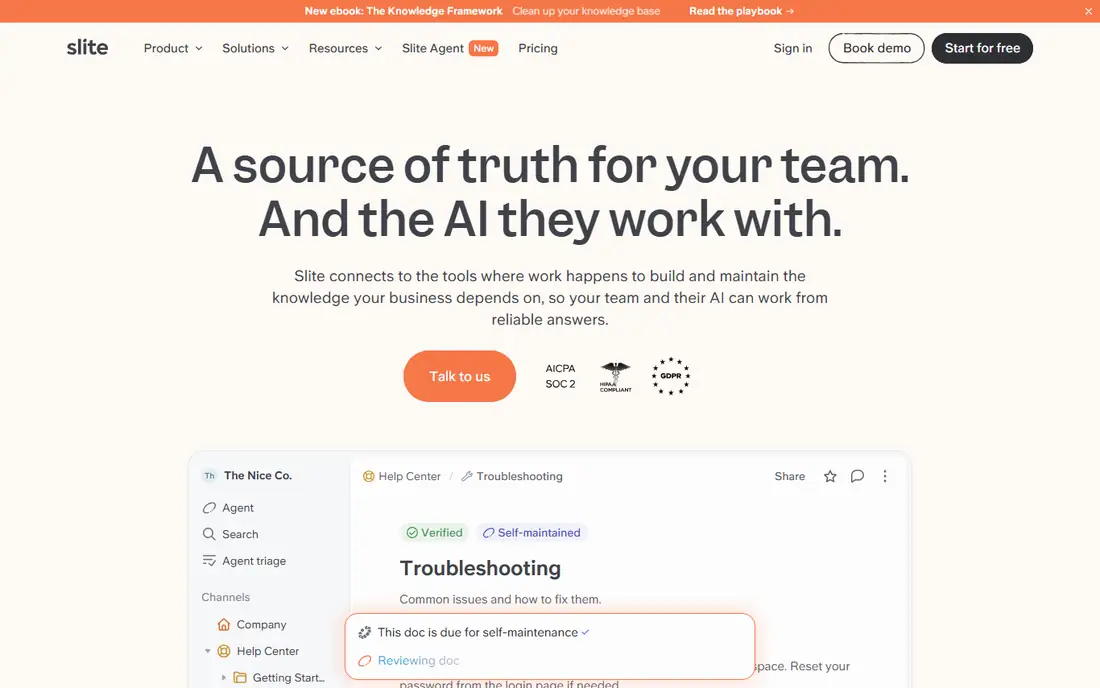
Slite is a knowledge base that keeps itself current. It is built for short docs that answer a question, with Ask AI search on every paid plan, document verification that flags stale pages, and a clean editor. Basic costs 10 dollars per user per month billed annually, or 12 dollars month to month, with unlimited docs, Ask, verification and API access. Pro costs 20 dollars per user per month billed annually, or 25 dollars monthly, and adds Slite Agent, which checks docs against connected tools such as Slack, Linear and GitHub, flags what has gone stale, and drafts a correction for a person to approve. The trade-offs are the missing free plan and the AI caps. There is no free tier, only a 14-day trial, and Basic limits Ask to 30 questions per user per month.
What we like- Ask AI search with citations, document verification, clean editor, Slite Agent on Pro, MCP and API access
Watch out for- No free plan, and the AI features on Basic are capped at 30 questions per user per month
#2Notion
Best for: Notes plus databases, wikis and team workspaces4.6/5 on
G2 (13,834 reviews, checked Oct 2026)
Visit notion.com
Starting price$10 per user per month billed annually (Plus plan)
Free planYes, free for one person with unlimited pages and blocks

Notion is the most flexible tool in this list. A page can hold text, tables, boards, calendars and databases, so one workspace can replace a notes app, a wiki and a simple tracker. The free plan covers one person with unlimited pages and blocks, which is enough for most personal use. Plus costs 10 dollars per user per month billed annually, and Business costs 20 dollars. The trade-off is that Notion is a cloud app first. Offline access is limited, and a big workspace with many linked databases can load slowly.
What we like- Databases, templates and wikis in one workspace, strong sharing, huge template library
Watch out for- Needs an internet connection for the best experience, and large workspaces can feel slow
#3Confluence
Best for: Team wikis, documentation and structured knowledge bases4.1/5 on
G2 (4,368 reviews, checked Oct 2026)
Visit atlassian.com
Starting priceFree up to 10 users, Standard from $7.15 per user per month
Free planYes, free for up to 10 users with 2 GB of file storage
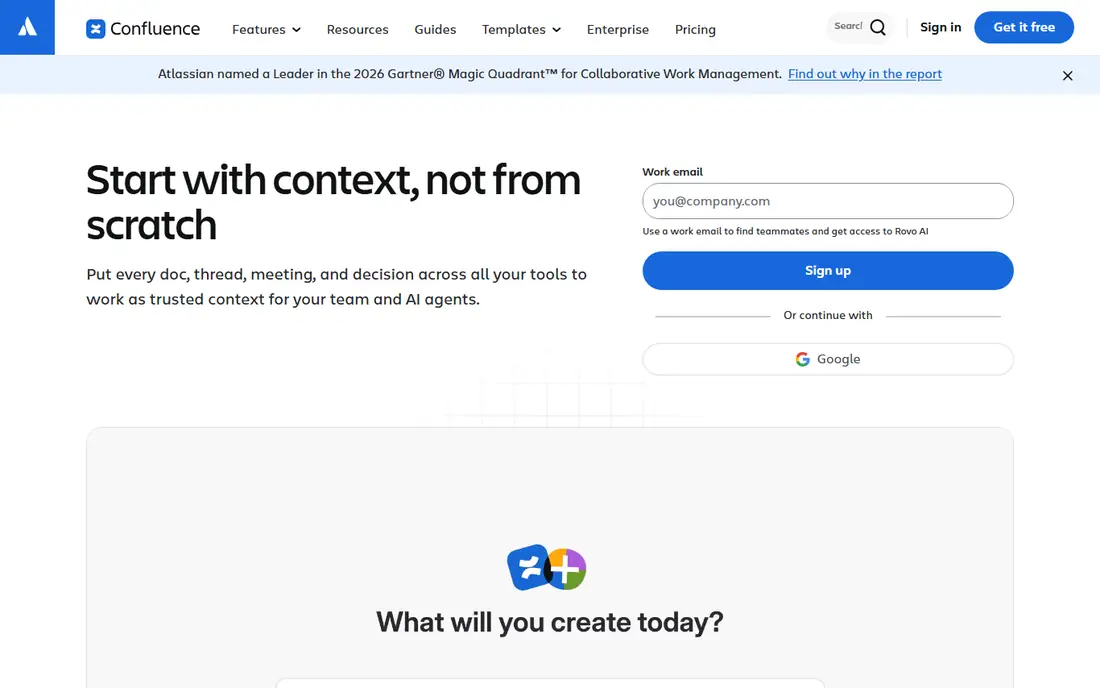
Confluence is Atlassian's team wiki, built for documentation that many people read and few people write. Spaces hold pages in a clear tree, permissions control who sees what, and version history keeps every change. It fits product docs, handbooks and knowledge bases that need structure, and it works well with Jira. The free plan covers up to 10 users with 2 GB of file storage. Standard costs 7.15 dollars per user per month on monthly billing for the first 100 users, after a price change on 13 October 2026, and Premium costs 14.10 dollars, adding analytics, unlimited storage and 24/7 support. The trade-offs are cost and weight. Per-user pricing adds up fast for large teams, and the interface can feel heavy for a simple shared document.
What we like- Structured spaces and pages, deep permissions, strong Jira integration, page version history
Watch out for- Per-user pricing adds up fast for large teams, and the interface can feel heavy for simple docs
#4
Coda
Best for: Docs with tables, buttons and automations for teams
Visit coda.io
Starting price$12 per user per month billed annually (Pro plan)
Free planYes, free for small teams with limited doc size
Coda turns a doc into a small app. Tables act like a light database, buttons trigger actions, and automations send reminders or update rows without anyone touching the doc. Packs connect Coda to tools such as Slack, Jira and GitHub, so a doc can pull live data instead of holding a stale copy. The free plan covers small teams with limited doc size. Pro costs 12 dollars per user per month billed annually, and Business costs 33 dollars. The trade-offs are price and learning time. Pro costs more per user than Slite Basic or Notion Plus, and the formula and automation features take longer to learn than a plain wiki.
What we like- Tables, buttons and automations inside docs, strong formulas, good templates, packs for other tools
Watch out for- Costs more per user than Slite or Notion at the entry tier, and the learning curve is steeper than a plain wiki
#5Evernote
Best for: Web clipping, PDF search and personal note capture4.3/5 on
G2 (2,034 reviews, checked Oct 2026)
Visit evernote.com
Starting price$14.99 per month, or $10.83 per month billed annually (Personal plan)
Free planYes, limited to 50 notes and one notebook
Evernote is the oldest note app in this list, and its strengths are capture and search. The web clipper saves pages cleanly, search reads inside PDFs and images, and notes sync across desktop and mobile. Personal costs 14.99 dollars a month, or 10.83 dollars a month billed annually at 129.99 dollars a year, with unlimited devices, offline access and 10 GB of monthly uploads. Professional costs 17.99 dollars a month, or 14.17 dollars a month billed annually, adding 20 GB of uploads and AI search. The trade-offs are the free plan and the price. Free is limited to 50 notes and one notebook, so almost anyone who uses it daily must pay, and the paid plans cost more than Slite or Notion for a team that mainly needs a shared wiki.
What we like- Web clipper, PDF and image search, tasks and calendar links, syncs across devices
Watch out for- The free plan is very limited, and the paid plans cost more than Notion or Slite for similar team use
#6Obsidian
Best for: Local Markdown notes with backlinks and a knowledge graph4.5/5 on
G2 (13 reviews, checked Oct 2026)
Visit obsidian.md
Starting priceFree, Sync from $4 per user per month billed annually
Free planYes, the full app is free for personal and commercial use
Obsidian stores notes as plain Markdown files in a folder you control, so your writing stays readable in any editor and survives any company shutdown. Links between notes build a graph that shows how ideas connect, and the plugin library adds calendars, task lists and daily notes. The app itself is free, even for commercial use. Sync Standard costs 4 dollars per user per month billed annually, or 5 dollars monthly, covering one vault and 1 GB of storage, and Sync Plus costs 8 dollars billed annually, covering ten vaults and 10 GB. Publish costs 8 dollars per site per month billed annually. The cost is a steeper learning curve. Obsidian ships plain, and you shape it with settings and plugins.
What we like- Notes are plain Markdown files on your own disk, powerful linking and graph view, large plugin library
Watch out for- Sync and publishing cost extra, and the interface takes time to set up well
#7Google Docs
Best for: Shared drafts, live collaboration and free writing in the browser4.6/5 on
G2 (114 reviews, checked Oct 2026)
Visit docs.google.com
Starting priceFree, Google Workspace from $7 per user per month (Starter plan)
Free planYes, free with a Google account
Google Docs is the simplest tool in this list, and that is its strength. It is free with a Google account, it opens in any browser, and several people can edit the same document at once with comments and suggestions. For short notes, meeting minutes and shared drafts, it is faster to open than any dedicated app. Google Workspace adds business features, with Starter at 7 dollars per user per month, Standard at 14 dollars and Plus at 22 dollars. The trade-offs are formatting and offline depth. Long reports with complex styles and tables of contents are harder than in Word, and offline use works through the browser extension, but the full feature set needs a connection.
What we like- Free, real-time collaboration, comments and suggestions, strong search, works in any browser
Watch out for- Formatting is weaker than Word for long reports, and it needs a connection for the full feature set
#8Microsoft Word
Best for: Deep formatting, DOCX compatibility and offline desktop work4.7/5 on
G2 (2,062 reviews, checked Oct 2026)
Visit microsoft.com
Starting price$9.99 per month or $99.99 per year (Microsoft 365 Personal)
Free planNo, web version only with a free Microsoft account
Microsoft Word is the standard that every other word processor is measured against. It has the deepest formatting in this list, from styles and section breaks to tables of contents, footnotes, mail merge and field codes, and it reads and writes the DOCX format that most of the world uses. Track changes is the strongest in this list, which is why editors, lawyers and publishers still ask for Word files. It comes with Microsoft 365 Personal at 9.99 dollars a month or 99.99 dollars a year, with 1 TB of OneDrive storage. The trade-offs are cost and the web version. The desktop app needs a paid subscription, and the free web version is weaker than the desktop app.
What we like- The deepest formatting in this list, track changes, mail merge, full offline use, DOCX is the world standard
Watch out for- The desktop app needs a paid subscription, and the web version is weaker than the desktop app
Frequently asked questions
Is Slite really the same price as Notion?
Yes, at the entry tier the two cost the same. Slite Basic is 10 dollars per user per month billed annually, and Notion Plus is 10 dollars per user per month billed annually. The higher tiers also match, with Slite Pro and Notion Business both at 20 dollars per user per month billed annually. The difference is the free tier, since Notion is free for one person while Slite has no free plan, only a 14-day trial.
Can I move my notes from Notion to Slite?
Yes, both tools export and import common formats, so a move is possible but not instant. Slite imports Markdown and HTML, and Notion exports pages as Markdown, HTML or PDF. A small wiki moves in an afternoon, while a large workspace with many linked databases needs more work, since databases do not map cleanly between the two.
Does Slite work offline?
Slite is a cloud app first, so offline use is limited. You can read docs you already opened, but creating, editing and searching the full workspace need a connection, and the AI features need the cloud. Notion has the same limit, with offline access restricted to pages you already loaded. If you write on planes or in places with weak wifi, Obsidian is the better pick in this list, since its notes live as local files on your own disk.
Which is better for a startup, Slite or Notion?
A startup that needs one tool for notes, wikis and project tracking should pick Notion, since databases, templates and the free plan cover the early days at no cost. A startup that already has a tracker and mainly needs a knowledge base that stays current should pick Slite, since Ask AI search and verification keep docs fresh with less manual review. Many startups start with Notion and add Slite later, once the wiki grows.
Should I pay for Slite Pro?
Pay for Pro if your team asks the AI a lot of questions or needs docs checked against other tools. Pro costs 20 dollars per user per month billed annually, adds Slite Agent with 50 agent credits per seat each month, and adds cross-tool search and OpenID single sign-on. Stay on Basic if your team mainly reads and writes docs, since Basic already includes Ask, verification and unlimited docs at 10 dollars per user per month billed annually.
Sources we checked (8)
- https://slite.com
- https://www.notion.com
- https://www.atlassian.com/software/confluence
- https://coda.io
- https://evernote.com
- https://obsidian.md
- https://docs.google.com
- https://www.microsoft.com/en-us/microsoft-365/word
Is your product missing or out of date?
We review this list regularly. Vendors can request a listing, send updated pricing or ask about featured placement.

Shihab Mia · Founder, Rankite
Shihab has 5+ years in B2B and SaaS SEO. He writes Rankite's software buying guides from pricing pages, documentation and public user reviews. More about Shihab.