How we make this list: we compare pricing pages, product documentation and public user reviews. Ratings come from G2, Capterra or Trustpilot, with the date we checked them.
Key takeaways
- Django suits Python teams that want batteries-included full-stack development, while Laravel suits PHP teams that want expressive rapid development.
- Express suits lightweight JavaScript APIs, while NestJS suits large TypeScript backends with opinionated structure.
- ASP.NET Core suits high-performance enterprise APIs on .NET, while Spring Boot suits Java enterprise systems and regulated industries.
- FastAPI suits high-throughput Python APIs with auto docs, while Phoenix suits real-time apps with massive concurrent connections.
- All eight frameworks here are free and open source, so the choice turns on language, team skill, performance needs, and ecosystem, not license price.
Quick comparison
| Tool | Best for | Starting price | Free plan |
|---|
 Django | Python full-stack, batteries included | Free | Yes |
 Laravel | PHP rapid development, SaaS | Free | Yes |
 Express.js | Lightweight JavaScript APIs | Free | Yes |
 NestJS | Large TypeScript backends | Free | Yes |
 ASP.NET Core | High-performance .NET enterprise | Free | Yes |
 Spring Boot | Java enterprise systems | Free | Yes |
 FastAPI | High-throughput Python APIs | Free | Yes |
 Phoenix | Real-time, concurrent apps | Free | Yes |
Is your product missing or out of date?
We review this list regularly. Vendors can request a listing, send updated pricing or ask about featured placement.
The best Ruby on Rails alternatives
Starting priceFree
Free planYes
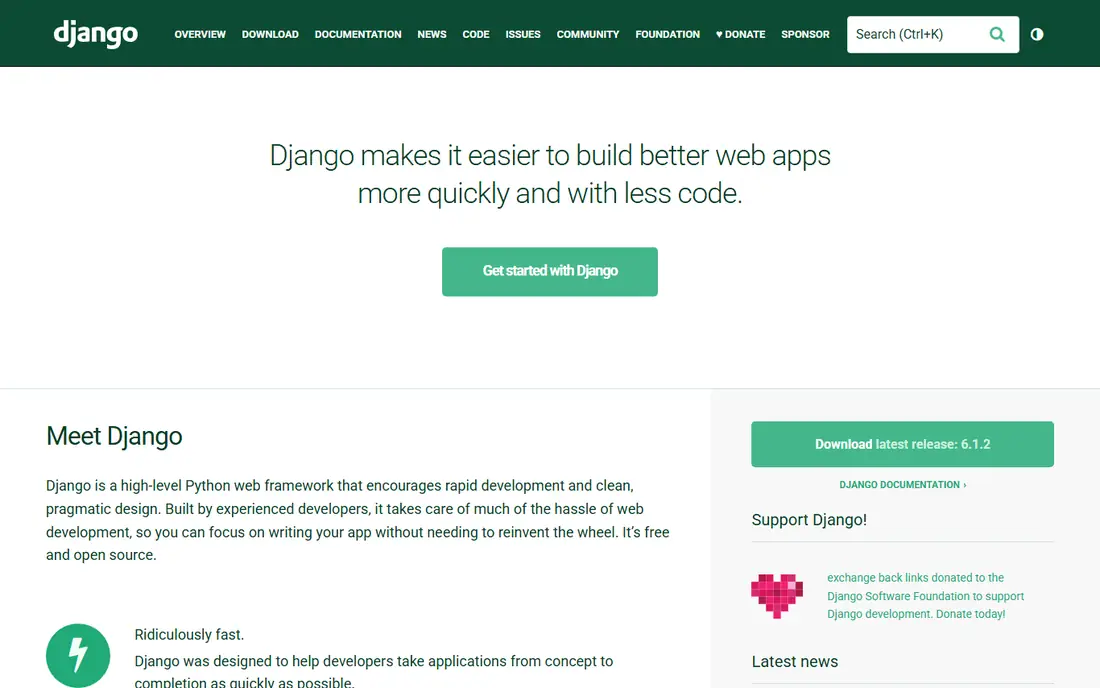
Django follows a similar philosophy to the target but uses Python instead of Ruby, emphasizing rapid development, clean design, and the DRY principle, with a batteries-included approach that provides everything needed without hunting for third-party packages. It includes a built-in admin interface for content management, advanced URL routing, an ORM, and strong security defaults against common vulnerabilities. Django suits content and CRUD apps, dashboards, and data-backed web apps.
The trade off is batteries against microservice weight. Django builds full-stack apps fast, but its monolithic structure is heavier for microservices. Django fits Python teams building secure data-driven apps quickly.
What we like- Batteries-included with ORM, admin, and auth built in
- Rapid development with clean design
- Strong security defaults
- Excellent documentation
- Moderate learning curve
- Version 5.1 in one August 2026 table
Watch out for- Monolithic structure is heavier for microservices
- Performance is moderate on sync WSGI, async still maturing
- Real-time needs Channels
- Type safety is not built in
Starting priceFree
Free planYes
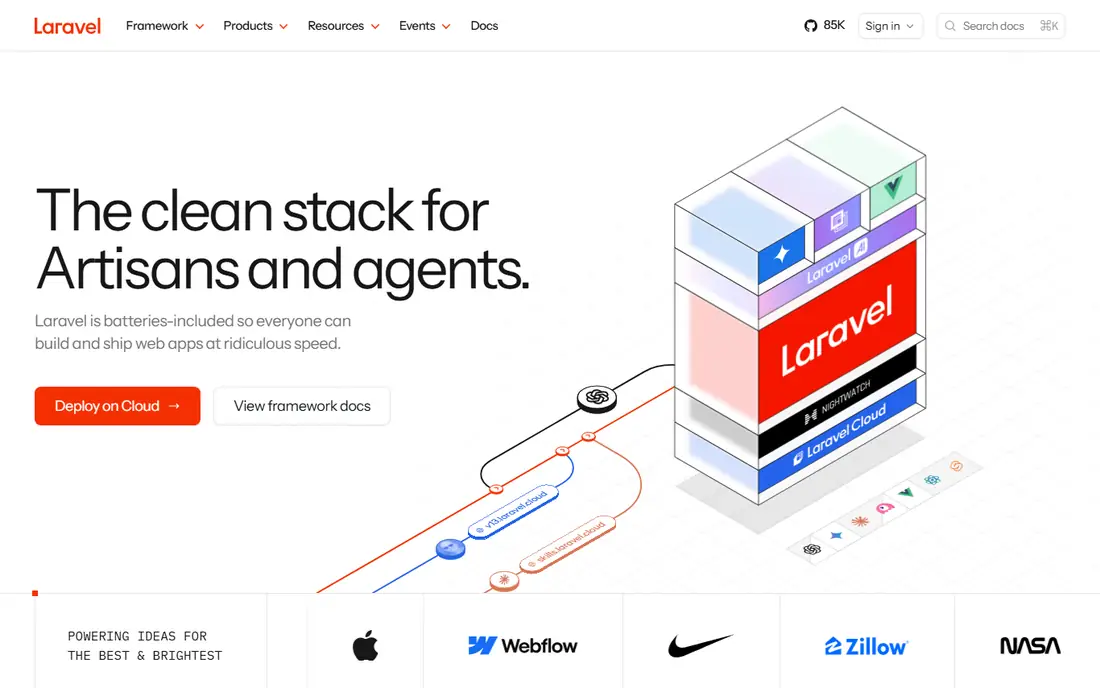
Laravel is the PHP rapid development pick, with an expressive syntax, MVC architecture, Blade templating, and a full ecosystem covering deployment through Forge and Vapor, plus a large community and tutorials. It suits web apps, SaaS, and content platforms with fast feature delivery, and its learning curve is low to moderate. Laravel is the closest PHP equivalent to convention-driven rapid development.
The trade off is productivity against PHP limits. Laravel ships features fast, but performance varies with large apps and PHP runtime trade-offs persist. Laravel fits PHP teams building SaaS and business sites quickly.
What we like- Expressive syntax
- Rapid development with MVC architecture
- Blade templating
- Full ecosystem with Forge and Vapor deployment services
- Large community
- Low to moderate learning curve
- Version 11 in one table
Watch out for- Performance may vary with large apps, though Octane helps
- PHP runtime trade-offs
- Laravel-centric patterns can lock teams into its conventions
- Type safety is not built in
Starting priceFree
Free planYes
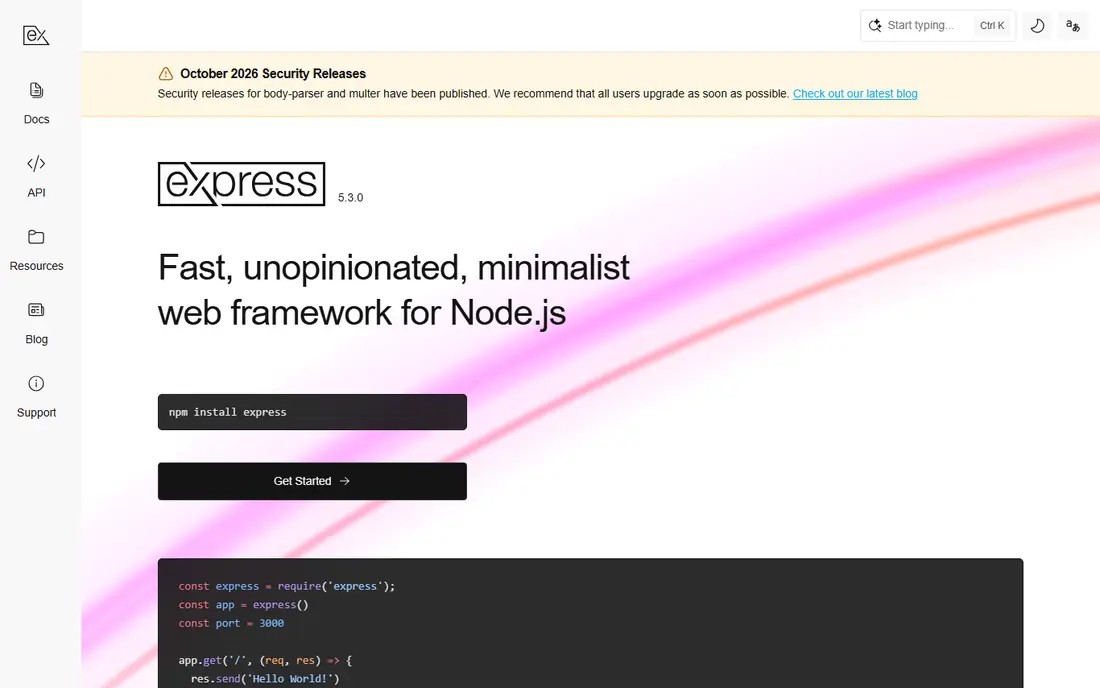
Express.js is the lightweight JavaScript API pick, offering a fast, minimal framework on Node.js with non-blocking I/O, a huge npm ecosystem, and full-stack JavaScript from front end to back end. It suits REST and GraphQL APIs, real-time apps, and I/O-heavy services, with a low learning curve and high performance for I/O work. Express is the simplest way to build a Node API.
The trade off is lightness against structure. Express stays fast and flexible, but large applications need extra structure and middleware that batteries-included frameworks provide. Express fits teams building lightweight Node APIs and real-time services.
What we like- Fast and lightweight
- Non-blocking I/O
- Huge npm ecosystem
- Full-stack JavaScript
- Low learning curve
- Version 5.0 in one table
- Great for REST and GraphQL APIs and real-time services
Watch out for- No built-in ORM
- Requires extra structure for large applications
- Callback complexity in older code
- Single-thread CPU limit for compute-heavy work
- Minimal batteries mean more assembly
Starting priceFree
Free planYes
NestJS is the large TypeScript backend pick, adding opinionated modular architecture and strong TypeScript tooling on top of the Node runtime, with type safety built in. It suits large TypeScript backends, enterprise Node applications, and microservices where structure matters more than prototype speed. NestJS gives Node teams the architecture that Express leaves to the developer.
The trade off is structure against prototype speed. NestJS scales large TypeScript backends well, but its structure slows tiny prototypes. NestJS fits TypeScript teams building large backends and microservices.
What we like- Opinionated modular architecture
- Strong TypeScript tooling and type safety
- Same Node runtime as Express
- Good for enterprise Node and microservices
- Growing ecosystem
Watch out for- Moderate learning curve for newcomers
- More structure than Express, which slows tiny prototypes
- ORM is not built in
- Enterprise patterns take time to learn
Starting priceFree
Free planYes
ASP.NET Core is the high-performance enterprise pick, topping benchmarks with very high performance, cross-platform support, a large Microsoft ecosystem, and great tooling. It suits enterprise APIs, high-performance services, and Microsoft-based enterprise apps, with type safety, a built-in ORM, and real-time features. ASP.NET Core is the fastest framework in this guide by benchmark position.
The trade off is performance against stack knowledge. ASP.NET Core performs best, but it needs Microsoft stack familiarity. ASP.NET Core fits enterprise teams building high-throughput APIs on .NET.
What we like- Very high performance, top of benchmarks
- Cross-platform
- Large Microsoft ecosystem
- Great tooling in Visual Studio and VS Code
- Type safety and built-in ORM
- Real-time features
- Version 9.0 in one table
Watch out for- Moderate to steep learning curve
- Requires Microsoft stack knowledge
- Enterprise patterns take time
- Smaller open source community than Node and Python in some areas
Starting priceFree
Free planYes
Spring Boot is the Java enterprise pick, offering production-ready applications with auto-configuration, Actuator for operations, and a very large enterprise ecosystem, plus type safety and a built-in ORM. It suits enterprise systems, regulated industries, microservices, and large teams where JVM maturity and concurrency matter. Spring Boot is the default Java choice for serious enterprise back ends.
The trade off is enterprise maturity against simplicity. Spring Boot runs large systems reliably, but it is heavy and steep for simple projects. Spring Boot fits Java shops building enterprise systems and microservices.
What we like- High performance on JVM with JIT and mature concurrency
- Very large enterprise ecosystem
- Production-ready with auto-configuration and Actuator for ops
- Type safety and built-in ORM
- Strong for regulated industries and large teams
Watch out for- Steep learning curve
- Verbose
- Heavier for simple projects
- JVM memory footprint
- Abstraction complexity can confuse newcomers
Starting priceFree
Free planYes
FastAPI is the high-throughput Python API pick, with very high performance through async ASGI, automatic OpenAPI documentation, Pydantic validation, and type safety from Python type hints. It suits high-throughput APIs, microservices, and AI and ML serving, where API speed and automatic docs matter most. FastAPI is the fastest Python option here for API-only work.
The trade off is API speed against full-stack breadth. FastAPI serves APIs brilliantly, but it is not a full-stack framework, so teams add a front end separately. FastAPI fits Python teams building APIs and ML endpoints.
What we like- Very high performance with async ASGI
- Auto OpenAPI docs
- Pydantic validation and type safety
- Low to moderate learning curve
- Great for AI and ML serving
- Modern Python type hints
Watch out for- No built-in ORM
- Younger ecosystem than Django
- Not opinionated for full-stack, so front end must be added separately
- Limited batteries versus Django
Starting priceFree
Free planYes
Phoenix is the real-time concurrency pick, built on Elixir and the Erlang VM, famous for fault-tolerant, distributed, and low-latency systems, with LiveView letting developers build real-time interfaces with less JavaScript. It suits chat, presence, IoT, and live dashboards where massive concurrent connections matter, with very high performance and a built-in ORM. Phoenix is the best choice when real-time scale is the core requirement.
The trade off is concurrency power against ecosystem size. Phoenix handles concurrent connections better than most, but its ecosystem and talent pool are smaller. Phoenix fits teams building real-time apps at scale.
What we like- Very high performance
- Excels at concurrent connections on the Erlang VM
- LiveView cuts JavaScript needs
- Built-in ORM
- Fault-tolerant distributed systems heritage
- Real-time features built in
Watch out for- Steep learning curve
- Smaller ecosystem than Django and Laravel
- Elixir talent pool is smaller
- Fewer third-party packages for niche needs
How we chose
We compared published 2026 backend framework comparisons, recording language, performance, learning curve, ecosystem, type safety, ORM, and real-time support separately, since a fast API framework and a batteries-included full-stack framework solve different problems. We favored frameworks with distinct strengths, Python batteries-included, PHP rapid development, lightweight JavaScript APIs, large TypeScript structure, high-performance .NET, Java enterprise maturity, high-throughput Python APIs, and real-time concurrency, and we noted that all eight are free, so license price does not decide. We weighed productivity, performance, and ecosystem separately, since no single framework leads on all three.
How to choose a Ruby on Rails alternative
Start with language: Python teams should shortlist Django for full-stack or FastAPI for APIs, PHP teams should shortlist Laravel, JavaScript teams should shortlist Express for APIs or NestJS for large back ends, Java teams should shortlist Spring Boot, and .NET teams should shortlist ASP.NET Core. Next, match job: MVPs and SaaS should shortlist Django and Laravel for batteries-included speed, APIs should shortlist FastAPI and Express, enterprise systems should shortlist Spring Boot and ASP.NET Core, and real-time apps should shortlist Phoenix. Then check hiring: smaller talent pools for Elixir and Ruby mean longer hiring, while Python, JavaScript, PHP, Java, and C# hire faster. Finally, prototype one real feature end to end, since framework feel matters more than benchmark tables. A framework that fits your language, your job, and your hiring market will ship faster than the fastest framework on paper.
Frequently asked questions
What is the best Ruby on Rails alternative overall?
Django suits Python full-stack speed, Laravel suits PHP rapid development, Express suits lightweight APIs, and ASP.NET Core suits high-performance enterprise work, so the best pick depends on language and job.
Is Django better than Rails?
Django matches Rails on batteries-included philosophy but uses Python, with a larger data and AI ecosystem, while Rails keeps a smaller Ruby talent pool and opinionated structure.
Should I use FastAPI or Django for a Python API?
FastAPI suits high-throughput APIs with auto docs, while Django suits full-stack apps with admin, auth, and ORM built in, so pick FastAPI for APIs and Django for full apps.
Is ASP.NET Core really the fastest framework here?
By benchmark position yes, with very high performance on .NET, though real-world speed depends on database, caching, and workload, not framework alone.
Does Phoenix need JavaScript for real-time features?
Less than most: Phoenix LiveView builds real-time interfaces with less JavaScript, which is a key reason teams pick it for chat, presence, and live dashboards.
Are all these frameworks really free?
Yes. All eight frameworks here are free and open source, so costs come from hosting, hiring, and ecosystem tools, not licenses.
Sources we checked (0)
Is your product missing or out of date?
We review this list regularly. Vendors can request a listing, send updated pricing or ask about featured placement.

Shihab Mia · Founder, Rankite
Shihab has 5+ years in B2B and SaaS SEO. He writes Rankite's software buying guides from pricing pages, documentation and public user reviews. More about Shihab.