How we make this list: we compare pricing pages, product documentation and public user reviews. Ratings come from G2, Capterra or Trustpilot, with the date we checked them.
Key takeaways
- Radxa Rock 5B is the strongest general Raspberry Pi replacement, with a faster multi-core chip and NVMe storage.
- ODROID N2+ suits media and emulation builds that need a fanless, powerful board without Wi-Fi built in.
- Libre Computer Le Potato is the best budget pick for learning, retro gaming, and light home-server work.
- NVIDIA Jetson Orin Nano is the pick for AI and robotics, not a general desktop replacement.
- Software support matters more than raw specs, so check OS images, community help, and GPIO compatibility before buying.
Quick comparison
Is your product missing or out of date?
We review this list regularly. Vendors can request a listing, send updated pricing or ask about featured placement.
The best RPi alternatives

#1
Radxa Rock 5B
Best for: High-performance desktop and server use
Visit radxa.com
Starting price$189
Free planNo
Radxa Rock 5B is the performance upgrade in this list. The RK3588 chip, up to 16 GB RAM on the original model and up to 32 GB on the 5B Plus variant, and a full set of I/O including M.2 NVMe, HDMI, and USB 3 make it suitable as a small desktop, a home server, or a development machine. Mainline kernel support has improved, which helps users who want a standard Linux experience rather than a vendor-only image. For Docker, databases, and multi-service home labs, the extra RAM and storage speed matter.
Price is the main drawback, with the Rock 5B Plus starting around $189 for common configurations, plus a power supply, case, and storage. That total can exceed a Pi 5 setup by a clear margin, so buyers should be sure they need the extra performance. Radxa also expects more Linux knowledge than Raspberry Pi, especially for GPU acceleration and peripheral setup. Rock 5B fits power users who want a Pi-sized board that can replace a small PC for many tasks.
What we like- RK3588 chip with up to 32 GB RAM on newer variants
- M.2 NVMe and strong I/O
- Good mainline kernel progress
Watch out for- Higher price than Pi
- Power supply and case are often separate purchases
Starting price$95
Free planNo
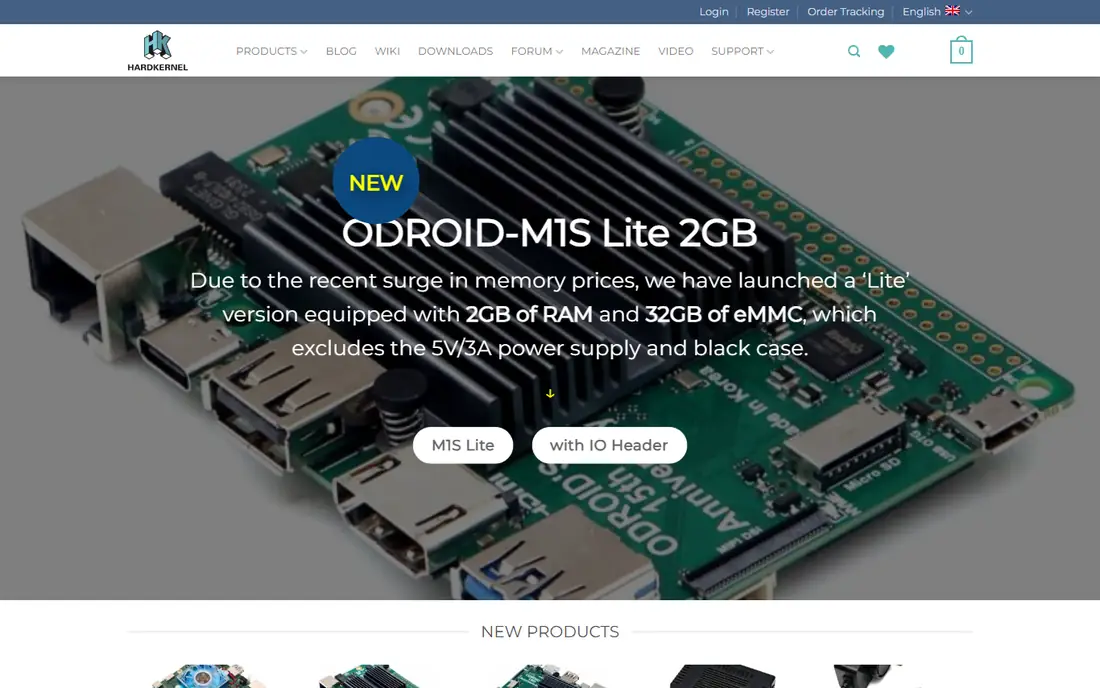
ODROID N2+ from Hardkernel is a long-standing Pi alternative with a loyal community. The Amlogic S922X chip with six cores delivers strong performance for media playback, emulation, and light server work, all without a fan, so the board runs quietly in a living room. Hardkernel's own Ubuntu and Android images are well maintained, and the board is a popular choice for Batocera and other retro gaming systems. Starting at $95 from the Hardkernel shop for the 4 GB model, it sits in the mid-range for single-board computers.
Two limits need attention. There is no built-in Wi-Fi or Bluetooth, so a USB adapter is needed for wireless use, and the 40-pin GPIO header does not match the Pi pinout, so Pi HATs cannot be assumed to fit. Buyers should also budget for a power supply, case, and storage, which are often sold separately. ODROID N2+ fits media, emulation, and quiet home-server projects where fanless operation and proven software matter more than Pi accessory compatibility.
What we like- Fanless design with strong CPU performance
- Good for media centers and retro gaming
- Stable Hardkernel support
Watch out for- No built-in Wi-Fi or Bluetooth
- 40-pin header has a different pinout from Pi
Starting priceSee website
Free planNo
BeagleBone Black is not a Pi 5 competitor on speed, but it remains a respected board for learning embedded Linux and building industrial prototypes. Its programmable real-time units, known as PRUs, handle precise timing tasks that a general-purpose CPU struggles with, such as motor control and sensor interfacing. Long-term availability and stable documentation make it suitable for products and university courses where a board must stay available for years. The BeagleBoard community also provides Debian images and a large set of tutorials for embedded work.
For media playback, desktop use, or modern AI tasks, BeagleBone Black is outmatched by Radxa and Jetson boards. Its CPU and RAM are modest by 2026 standards, and GPU support is limited. BeagleBone Black fits makers, students, and engineers who need real-time I/O, reliable GPIO, and a board they can learn deeply, rather than raw speed.
What we like- Strong real-time I/O and PRU units
- Long-term availability
- Good documentation for embedded work
Watch out for- Older, slower CPU than modern Pi rivals
- Not a media or desktop board
Starting price$35
Free planNo
Libre Computer Le Potato, model AML-S905X-CC, is the budget champion in this list. At about $35 to $45 depending on RAM, it offers a Pi-sized board for learning Linux, building a retro gaming console, or running a light home server such as Pi-hole or a file share. The form factor and 40-pin header make it familiar to Pi users, and Libre Computer provides Debian and Ubuntu images for common projects. For a first board, a classroom set, or a project where several boards are needed, the low price is a real advantage.
Performance is modest. The older Amlogic chip handles 1080p media and retro games well, but it will struggle with heavy multitasking, modern desktop use, or AI workloads. Community support is also smaller than Raspberry Pi's, so troubleshooting may take longer. Le Potato fits budget projects, learning, and single-purpose servers where cost matters more than speed.
What we like- Very low price, from about $35
- Pi-sized form factor
- Good for learning and light projects
Watch out for- Older chip limits performance
- Software community smaller than Raspberry Pi

#5
ASUS Tinker Board 2S
Best for: Pi-sized board with strong media support
Visit asus.com
Starting priceSee website
Free planNo
ASUS Tinker Board 2S is a Pi-sized board from a major hardware brand, which appeals to buyers who want vendor support and a polished product. The 2S model includes 16 GB of onboard eMMC storage, plus microSD expansion, and supports 4K media playback, making it a good fit for media centers, digital signage, and kiosk projects. The Rockchip RK3399 chip provides six cores, and the board includes Gigabit Ethernet, USB 3, and a 40-pin GPIO header for maker projects.
Tinker Board pricing is often higher than a Pi with similar CPU performance, and the community, while active, is smaller than Raspberry Pi's, so tutorials and third-party OS images are fewer. GPU acceleration and camera support also need checking for specific projects. Tinker Board 2S fits buyers who value brand support, onboard storage, and media performance in a Pi-sized board, and who do not need the largest possible community.
What we like- Pi-sized board with 16 GB onboard eMMC on 2S model
- Strong 4K media support
- ASUS brand support
Watch out for- Higher price than Pi for similar CPU class
- Smaller community than Raspberry Pi
Starting priceSee website
Free planNo
NanoPi R6S from FriendlyElec is built for networking, not for general Pi replacement. It offers three Ethernet ports, including 2.5 Gigabit ports, in a compact board that can run OpenWrt, FriendlyWrt, or Debian for router, firewall, and network monitoring projects. That port layout is rare on Pi-sized boards, and it makes the R6S a practical choice for a home router, a small office gateway, or a network lab. FriendlyElec provides images and a metal case option that helps with heat in always-on use.
As a desktop or media board, the R6S is less suitable. GPIO and display options are more limited than on Radxa boards, and the community is focused on networking rather than general maker projects. Buyers should also confirm power supply and case options, since the board is often sold in different bundles. NanoPi R6S fits network builders who need multiple fast Ethernet ports in a small, low-power device.
What we like- Three Ethernet ports including 2.5 GbE
- Compact metal case options
- Good for routers and firewalls
Watch out for- Not a general desktop board
- Networking focus limits GPIO and media use
Starting price$249
Free planNo
NVIDIA Jetson Orin Nano Super is in a different class from the other boards here, because it is built for AI at the edge. With up to 67 INT8 TOPS of AI performance, it can run vision models, robotics navigation, and local language models that would overwhelm a Pi. The NVIDIA software stack, including JetPack, CUDA, and robotics libraries, gives developers a mature path from prototype to product for cameras, robots, and industrial inspection. For a university robotics lab or a startup building a vision product, Jetson is often the default choice.
Price starts around $249 to $299 for the Super developer kit, and power, cooling, and carrier board costs add to the total. Jetson is also not a simple Pi replacement: GPIO, camera interfaces, and OS images differ, and general desktop or media use wastes its AI hardware. Jetson Orin Nano fits AI, robotics, and computer vision projects where on-device inference matters, and where the budget reflects a development platform rather than a hobby board.
What we like- 67 INT8 TOPS AI performance on Super variant
- Strong robotics and vision ecosystem
- NVIDIA software stack
Watch out for- High price
- Not a Pi drop-in for general projects
- Power and cooling needs are higher
How we chose
We compared vendor specifications, pricing pages, OS support, and community documentation, along with GPIO compatibility, storage options, and use-case fit. We favored boards that exist today, are sold in the US through the vendor or authorized sellers, and serve a distinct Pi use case, from budget learning to AI. Where board prices vary by RAM, bundle, and seller, we wrote See website rather than stating a single price as universal, except where a vendor list price was clear.
Choosing by project, not by specs alone
Start with the job, then check the board. A home server needs RAM, NVMe storage, and Ethernet, so Rock 5B is a natural fit. A media center needs video decoding and quiet operation, so ODROID N2+ or Tinker Board 2S make sense. A router needs multiple Ethernet ports, so NanoPi R6S wins. An AI camera needs a Jetson, not a faster general board. Buying the fastest board for a simple Pi-hole server wastes money and power, while buying a budget board for AI vision guarantees frustration.
Also check the full kit cost before ordering. Most boards need a power supply, case, microSD card or NVMe drive, and sometimes a Wi-Fi adapter, and those extras can add $30 to $80 to the board price. Check OS support for your exact model, because a board with a great chip but a stale OS image will cost hours in troubleshooting. A quick search for your project plus the board name, in forums and documentation, will reveal most compatibility problems before you buy.
Frequently asked questions
What is the best overall Raspberry Pi alternative?
Radxa Rock 5B is the best general replacement for most Pi users, with strong multi-core performance and NVMe storage. It also suits high-performance desktop and server use, while Libre Computer Le Potato is better for budget learning. The best board depends on whether the project needs speed, low cost, or specific I/O.
Can I use Raspberry Pi HATs with these alternatives?
Some boards have a 40-pin header that fits many Pi HATs, but compatibility is not guaranteed for every HAT. ODROID N2+ has a different pinout, and Jetson boards use different headers entirely. Check voltage, pin mapping, and driver support for each HAT before assuming it will work.
Which Raspberry Pi alternative is cheapest?
Libre Computer Le Potato is the cheapest board in this list, from about $35, and it suits learning, retro gaming, and light servers. For a general-purpose board, Radxa Rock 5B offers more performance than the cheapest option, at a higher price.
Do these boards run Raspberry Pi OS?
No, Raspberry Pi OS is built for Pi hardware, though some boards offer Debian or Ubuntu images with a similar experience. Radxa, Hardkernel, and FriendlyElec each provide their own OS images, and community images such as Armbian support many boards. Check the vendor download page for your exact model before buying.
Is a mini PC better than a single-board computer?
A mini PC with an Intel N100 chip is often better for a pure server, Docker host, or desktop, because it offers x86 software compatibility and stronger CPU performance. A single-board computer wins when GPIO, low power, small size, or embedded I/O matter. If the project needs no GPIO, compare mini PC prices before choosing a board.
Sources we checked (7)
- https://radxa.com
- https://www.hardkernel.com
- https://www.beagleboard.org
- https://libre.computer
- https://www.asus.com
- https://www.friendlyelec.com
- https://www.nvidia.com
Is your product missing or out of date?
We review this list regularly. Vendors can request a listing, send updated pricing or ask about featured placement.

Shihab Mia · Founder, Rankite
Shihab has 5+ years in B2B and SaaS SEO. He writes Rankite's software buying guides from pricing pages, documentation and public user reviews. More about Shihab.
 ODROID N2+
 BeagleBone Black
 Libre Computer Le Potato
 NanoPi R6S
 NVIDIA Jetson Orin Nano