How we make this list: we compare pricing pages, product documentation and public user reviews. Ratings come from G2, Capterra or Trustpilot, with the date we checked them.
Key takeaways
- Tableau and Power BI remain the default enterprise replacements, with the deepest visualization and ecosystem support.
- Looker suits organizations that want a governed semantic layer, now extended with Gemini-powered conversational analytics.
- ThoughtSpot fits teams that want business users asking questions in plain language instead of waiting for dashboards.
- Sisense and Domo lead for embedded and customer-facing analytics, while Metabase and Apache Superset are the open-source options.
- Every vendor now pitches agentic or AI analytics, so test AI answers against your own governed metrics before trusting them.
Quick comparison
| Tool | Best for | Starting price | Free plan |
|---|
 Tableau | Enterprise visualization | See website | Free trial |
 Microsoft Power BI | Microsoft-centric teams | See website | See website |
 Looker | Governed semantic layer | See website | See website |
 Sisense | Embedded analytics | See website | See website |
 Domo | All-in-one data platform | See website | See website |
 ThoughtSpot | Natural-language questions | See website | See website |
 Metabase | Open-source simplicity | Free | Yes |
 Apache Superset | Open-source scale | Free | Yes |
Is your product missing or out of date?
We review this list regularly. Vendors can request a listing, send updated pricing or ask about featured placement.
The best Qlik Sense alternatives
#1Tableau
Best for: Enterprise visualization4.4/5 on
G2 (3,787 reviews, checked Oct 2026)
Visit tableau.com
Starting priceSee website
Free planFree trial
Tableau pitches the speed of AI with the trust of Tableau, and its homepage backs that with agentic analytics: a knowledge engine and semantic layer for consistent metrics, natural-language questions, and dashboards that travel into Slack, Teams, Claude, and ChatGPT. Deployment spans Tableau Cloud, self-hosted Server, and Tableau Next for Salesforce customers.
For Qlik Sense teams, Tableau is the most like-for-like swap in visual analysis strength, with a far larger community for learning and hiring. Note that Tableau Desktop is now free, which lowers the trial barrier, but server and cloud pricing remains enterprise territory, so get a quote for your user count before assuming costs.
What we like- Best-in-class visual exploration and a huge community
- Tableau Desktop now free
- Agentic analytics with a semantic layer and knowledge engine
Watch out for- Full platform pricing is enterprise-level
- Salesforce ownership shapes the roadmap toward CRM and Slack integration
#2Microsoft Power BI
Best for: Microsoft-centric teams4.5/5 on
G2 (1,661 reviews, checked Oct 2026)
Visit microsoft.com
Starting priceSee website
Free planSee website
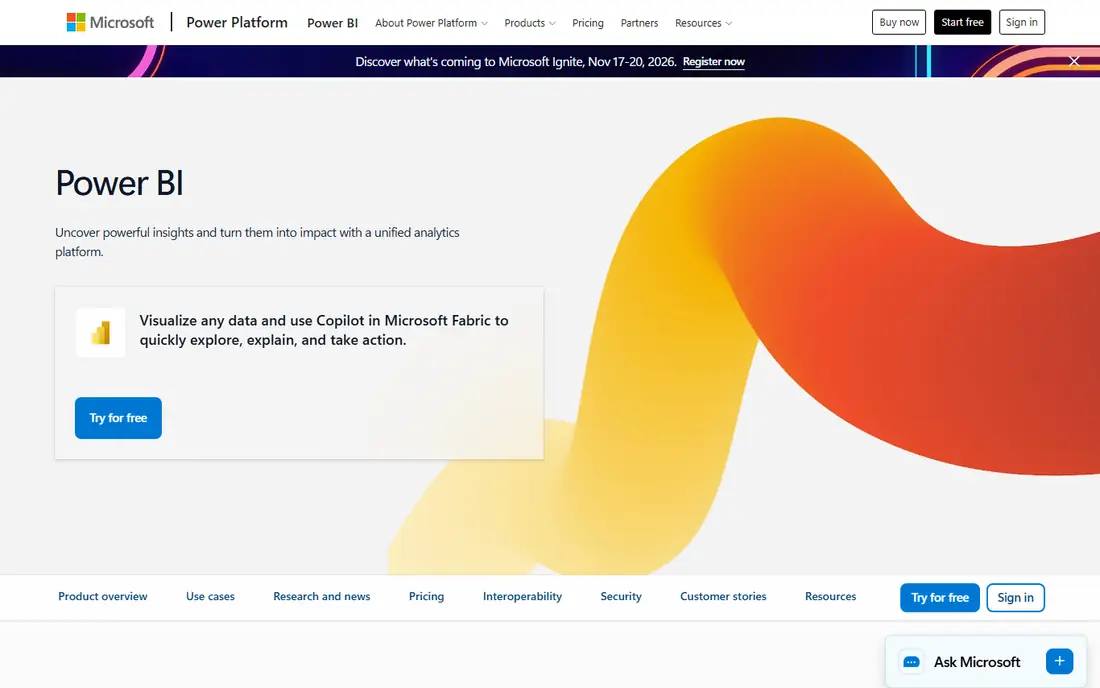
Power BI describes itself as a unified, scalable platform for self-service and enterprise BI, turning data into interactive dashboards inside the apps teams already use. Its homepage explains the licensing mix honestly: Premium or Fabric capacity for hosting popular reports, Pro licenses for creators, and Power BI Embedded as a pay-as-you-go service from $1 per hour for developers embedding reports.
If your company already runs Microsoft 365, Power BI is usually the cheapest capable choice, since many users already hold licenses through E5 or similar plans. The catch is licensing complexity: Pro, Premium per capacity, and Fabric SKUs interact in ways that need a careful quote, and non-Microsoft shops will find less value here than Tableau or Looker buyers.
What we like- Deep Microsoft 365, Teams, and Fabric integration
- Unified self-service and enterprise BI
- Embedded option from $1 per hour
Watch out for- Licensing is complex across Pro, Premium, and Fabric capacities
- Best experience requires Microsoft ecosystem commitment
#3Looker
Best for: Governed semantic layer4.4/5 on
G2 (1,654 reviews, checked Oct 2026)
Visit looker.com
Starting priceSee website
Free planSee website
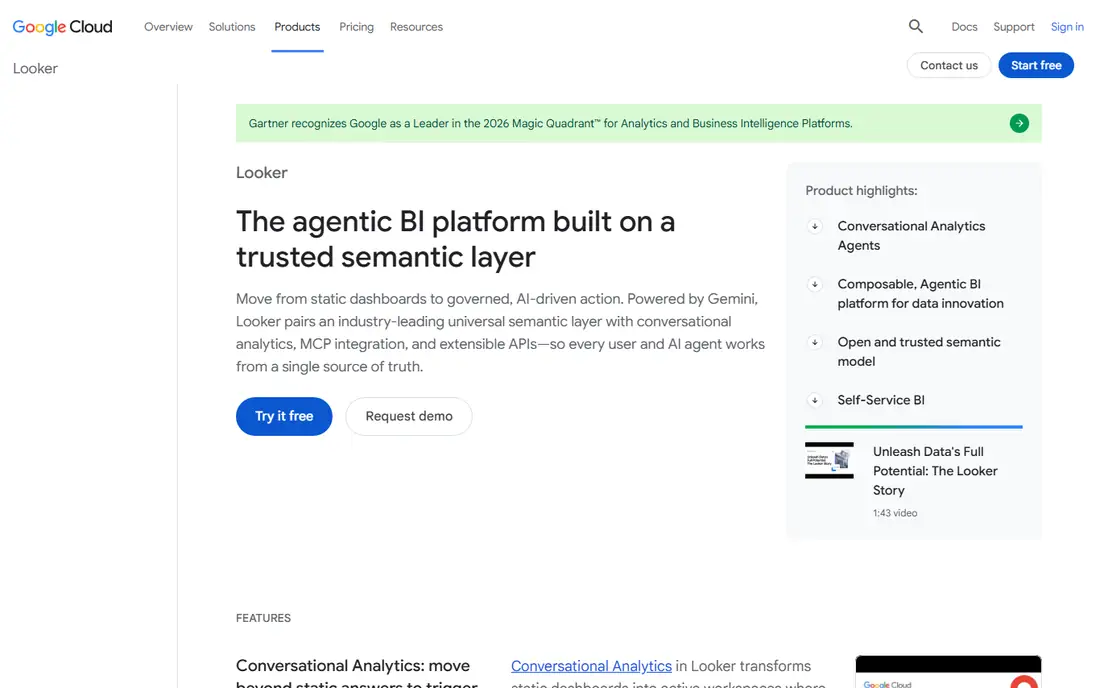
Looker, now part of Google Cloud, calls itself the agentic BI platform built on a trusted semantic layer. Its homepage explains the model: business logic defined once in LookML, then used by conversational analytics, dashboard agents, MCP-connected tools, and embedded apps, so humans and AI agents work from the same governed metrics. It also offers Looker on Google Cloud with single sign-on, private networking, and BigQuery integration.
For organizations burned by conflicting metrics across dashboards, Looker's semantic layer is the strongest governance story here. The cost is effort: LookML modeling takes real data-team investment, and pricing has two components, platform and user, both quote-led. Teams without a data team to own the model will get less from Looker than from a simpler tool.
What we like- Universal semantic layer in LookML gives one source of truth
- Gemini-powered conversational analytics and dashboard agents
- Strong BigQuery integration
Watch out for- Sales-led pricing with platform plus user components
- LookML learning curve for data teams new to modeling
#4Sisense
Best for: Embedded analytics4.2/5 on
G2 (1,063 reviews, checked Oct 2026)
Visit sisense.com
Starting priceSee website
Free planSee website
Sisense now calls itself the embedded AI analytics platform, and its homepage leans into that: AI inside your product, under your brand, grounded in your approved metrics and access rules. It stresses governed semantics with shared formulas, tenant-safe access at the query layer, and embed paths from lightweight widgets to custom builds with its Compose SDK.
If you ship analytics inside a customer-facing product, Sisense is purpose-built for that job, with multi-tenant architecture and AI experiences that respect each customer's data boundaries. For purely internal dashboards, its embedded machinery adds cost and complexity that Tableau or Metabase avoid, so match the tool to the job.
What we like- 20+ years powering customer-facing analytics
- Governed semantics with tenant-safe row-level security
- Flexible embed options via SDK and APIs
Watch out for- Embedded-first focus means internal BI buyers pay for product features they may not need
- Pricing is quote-led
#5Domo
Best for: All-in-one data platform4.3/5 on
G2 (1,086 reviews, checked Oct 2026)
Visit domo.com
Starting priceSee website
Free planSee website
Domo describes itself as the AI and data products platform, covering data connection and preparation, exploration, and data products with AI assistance at every step. Its homepage highlights AI agents for use cases such as HR benefits, competitive research, retail, insurance claims, and customer support, plus a hybrid architecture that partners with leading cloud data warehouses.
Domo fits organizations that want one platform from ingestion to dashboard rather than stitching together separate ETL, warehouse, and BI tools. That breadth is also its weight: teams that already own a warehouse and only need visualization will find Domo more platform than they asked for, and pricing reflects the enterprise buyer.
What we like- Connects and prepares data from any source in one platform
- AI agents for common use cases
- Hybrid architecture works with existing warehouses
Watch out for- Platform breadth can feel heavy for simple dashboard needs
- Pricing is enterprise-oriented and quote-led
#6ThoughtSpot
Best for: Natural-language questions4.4/5 on
G2 (340 reviews, checked Oct 2026)
Visit thoughtspot.com
Starting priceSee website
Free planSee website
ThoughtSpot calls itself the agentic analytics platform built on governed AI for analytics everywhere work happens. Its homepage explains the approach: business logic, joins, calendars, and security are governed before anyone asks a question, then users ask in natural language and get answers grounded in verified definitions, with anomalies and drivers surfaced automatically.
For Qlik Sense teams whose bottleneck is analyst time, ThoughtSpot changes the workflow: business users self-serve instead of queuing dashboard requests. The adjustment is cultural as much as technical, since search-first analytics rewards well-modeled data and trained users. It is also a 2026 Gartner Leader, which matters for enterprise procurement checklists.
What we like- Business users ask questions in plain language and get governed answers
- Liveboards and embedded apps share one governed foundation
- 2026 Gartner Leader
Watch out for- Search-first model differs from dashboard-first habits, so adoption needs training
- Pricing is quote-led
#7Metabase
Best for: Open-source simplicity4.4/5 on
G2 (147 reviews, checked Oct 2026)
Visit metabase.com
Starting priceFree
Free planYes
Metabase pitches open source AI analytics you can verify, and its homepage makes the trial trivial: one Docker command spins up a free self-hosted instance, and answers come guided by a semantic layer that lets users inspect the query behind every answer. AI features ship on all plans, and embedding supports multi-tenant SaaS apps with permissions built in.
For startups and small teams, Metabase is the obvious Qlik Sense alternative: free to start, easy to run, and genuinely pleasant to use, with a 14-day trial for its cloud plans. Larger organizations should check its enterprise governance, permissions, and SSO features against their requirements, since those sit on paid tiers, but for most internal dashboards, the open-source edition goes a long way.
What we like- Free self-hosted open-source edition deployable with one Docker command
- AI on all plans with a governed semantic layer
- Loved for ease of use
Watch out for- Advanced enterprise features require paid plans
- Large-scale governance lags the enterprise suites
Starting priceFree
Free planYes
Apache Superset is an open-source modern data exploration and visualization platform, and its homepage states the appeal plainly: fast, lightweight, and loaded with options, from simple line charts to detailed geospatial charts, with a no-code viz builder plus a SQL IDE. It connects to any SQL-based database, scales without another ingestion layer, and ships 40-plus visualization types with a plugin architecture for custom charts.
For engineering-led teams, Superset is the most powerful free option, and its price is zero. The cost is operations: installation, upgrades, security, and scaling are your team's job, and its AI story is thinner than Metabase's or the commercial suites. If you have the engineering capacity, it is hard to beat on value.
What we like- Fully open source with 40+ visualizations
- Connects to any SQL database at petabyte scale
- No ingestion layer required
Watch out for- Self-hosting and operations fall on your team
- AI features lag the commercial platforms
How we chose
We compared business intelligence platforms on vendor homepages, weighing visualization strength, semantic governance, AI features, embedding, open-source availability, and ecosystem fit. We favored platforms with live homepages and current offerings, and we included both enterprise suites and open-source tools because Qlik Sense buyers range from large enterprises to small engineering teams.
What to check before you commit
Start with your data model. If metric definitions already conflict across teams, prioritize a semantic layer tool such as Looker or ThoughtSpot. If dashboards are the deliverable and data is clean, Tableau or Power BI will move faster.
Next, test AI answers against governed metrics. Every vendor now promises agentic analytics, but an AI answer built on ungoverned data is a liability. Ask each finalist the same ten business questions on your data and check the answers against known figures before trusting the feature.
Finally, price the full deployment, not the headline tier. Count viewers as well as creators, check embedding and AI add-ons, and confirm whether self-hosting or cloud hosting fits your security rules. Open-source tools look free until you count engineering time, and enterprise suites look expensive until you count the analysts they replace.
Frequently asked questions
What is the best overall Qlik Sense alternative?
Tableau for enterprise visualization strength and community, and Power BI for Microsoft-centric teams. For governed metrics, Looker leads, while ThoughtSpot leads for natural-language self-service. The best pick depends on your stack and team shape.
Is there a free Qlik Sense alternative?
Yes. Metabase and Apache Superset are both open source and free to self-host. Metabase is easier to run, while Superset scales further for engineering-led teams. Both offer paid cloud or enterprise tiers for advanced features.
Which alternative is best for embedded analytics?
Sisense, purpose-built for customer-facing embedded analytics with tenant-safe security and flexible SDK options. Domo and ThoughtSpot also embed well, but Sisense's 20-plus years in embedded work give it the deepest track record.
Does Power BI work without Microsoft 365?
Yes, as a standalone platform, but its value drops outside the Microsoft ecosystem. Teams on Google Workspace or mixed stacks usually get more from Tableau, Looker, or Metabase, since Power BI's integrations favor Microsoft apps.
Which BI tool has the best AI features?
Looker, ThoughtSpot, and Tableau currently lead on governed AI, tying AI answers to a semantic layer so results stay consistent. Test AI answers on your own metrics, since marketing demos rarely show failure cases.
Can I migrate Qlik Sense dashboards to these tools?
There is no automatic migration for most Qlik Sense apps, since data models and expressions differ. Plan a rebuild of key dashboards in the new tool, and use the migration as a chance to clean up unused reports and conflicting metric definitions.
Sources we checked (8)
- https://www.tableau.com
- https://www.microsoft.com/en-us/power-platform/products/power-bi
- https://looker.com
- https://www.sisense.com
- https://www.domo.com
- https://www.thoughtspot.com
- https://www.metabase.com
- https://superset.apache.org
Is your product missing or out of date?
We review this list regularly. Vendors can request a listing, send updated pricing or ask about featured placement.

Shihab Mia · Founder, Rankite
Shihab has 5+ years in B2B and SaaS SEO. He writes Rankite's software buying guides from pricing pages, documentation and public user reviews. More about Shihab.