How we make this list: we compare pricing pages, product documentation and public user reviews. Ratings come from G2, Capterra or Trustpilot, with the date we checked them.
Key takeaways
- Patch Manager Plus is ManageEngine's dedicated patching product with a large third-party catalog. Alternatives split into cloud-native patchers, full RMM platforms, and focused deployment tools.
- Automox is the best cloud-native cross-platform pick, with one policy across Windows, macOS, and Linux.
- Action1 is the best free starting point, with the first 200 endpoints free forever.
- NinjaOne and Atera are the best full platform picks for teams that also need backup, remote access, and ticketing.
- PDQ is the best focused pick for Windows and macOS shops, with on-prem options for air-gapped environments.
- Heimdal and Lansweeper are indirect fits: Heimdal is a broad security platform with patching inside, and Lansweeper is asset intelligence that feeds patching workflows.
- Test patch success rates on your own fleet before committing, since vendor success claims come from vendor data.
Quick comparison
| Tool | Best for | Starting price | Free plan |
|---|
 Automox | Cross-platform cloud patching | See website | Free trial |
 NinjaOne | Full RMM with patching | See website | Free trial |
 PDQ | Focused Windows and macOS | See website | Free trial |
 Atera | MSP and small team platform | See website | Free trial |
 Action1 | Free small fleet patching | Free to start | Yes, 200 endpoints |
 Heimdal | Security platform with patching | See website | Free trial |
 Lansweeper | Asset intelligence | See website | Free trial |
Is your product missing or out of date?
We review this list regularly. Vendors can request a listing, send updated pricing or ask about featured placement.
The best Patch Manager Plus alternatives
#1Automox
Best for: Cross-platform cloud patching4.5/5 on
G2 (326 reviews, checked Oct 2026)
Visit automox.com
Starting priceSee website
Free planFree trial
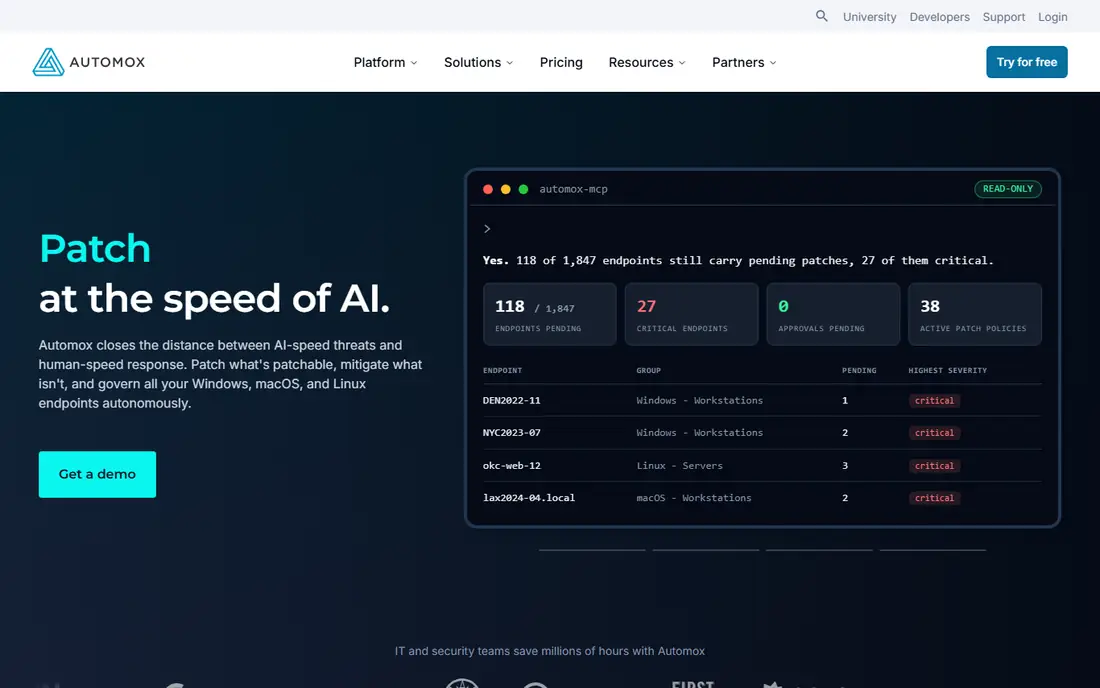
Automox is the best cloud-native replacement. Its homepage describes IT governance at the speed of AI: patch what is patchable, mitigate what is not, and govern all Windows, macOS, and Linux endpoints autonomously. One policy, one schedule, and one set of rollout rings cover all three operating systems, with reboot enforcement included, and Worklets handle zero-days with no patch yet, misconfigurations, and unsupported software by disabling protocols, locking settings, or quarantining software. Automox has been cloud-native since 2015, runs on one lightweight agent with no VPN or on-prem infrastructure, and draws policy blueprints from patterns across 1.6 billion policy runs.
The trade-off is price transparency. Automox prices by quote, and comparison sources list per endpoint pricing. For teams with mixed operating systems that want one cloud console and policy based patching, Automox is the top pick.
What we like- One patch policy across Windows, macOS, and Linux
- Worklets mitigate unpatchable risks
- 100 percent API coverage and hosted MCP server
Watch out for- Pricing by quote
- Enterprise positioning may be heavy for very small teams
#2NinjaOne
Best for: Full RMM with patching4.7/5 on
G2 (5,037 reviews, checked Oct 2026)
Visit ninjaone.com
Starting priceSee website
Free planFree trial
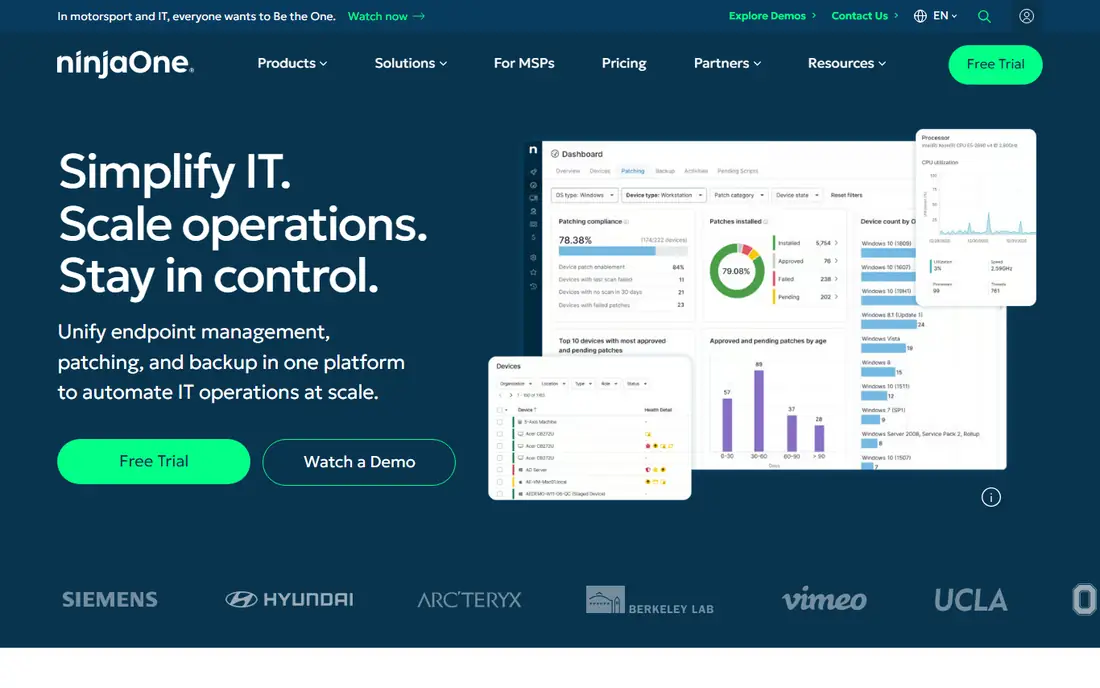
NinjaOne is the best full platform replacement. Its homepage describes a unified IT operations platform that unifies endpoint management, patching, and backup to automate IT operations at scale. Autonomous patch management uses Patch Intelligence AI to prevent bad updates and ensure reliable compliance, with customer stories citing patch cycles cut from 72 hours to minutes. The same platform adds mobile device management, device and SaaS backup, single-click remote control, and service desk ticketing. NinjaOne was named a Leader in the 2026 Gartner Magic Quadrant for Endpoint Management Tools and reports a 4.8 rating from 960 reviews.
The catch is scope and cost. NinjaOne is a full RMM, so patching-only teams pay for much more, and pricing is by quote. For IT teams and MSPs that want patching plus backup, remote access, and ticketing in one console, NinjaOne is the best pick.
What we like- Autonomous patch management with Patch Intelligence AI
- Endpoint management, backup, remote control, and service desk in one platform
- Gartner Leader 2026
Watch out for- Full platform pricing by quote
- More than patching-only buyers need
Starting priceSee website
Free planFree trial
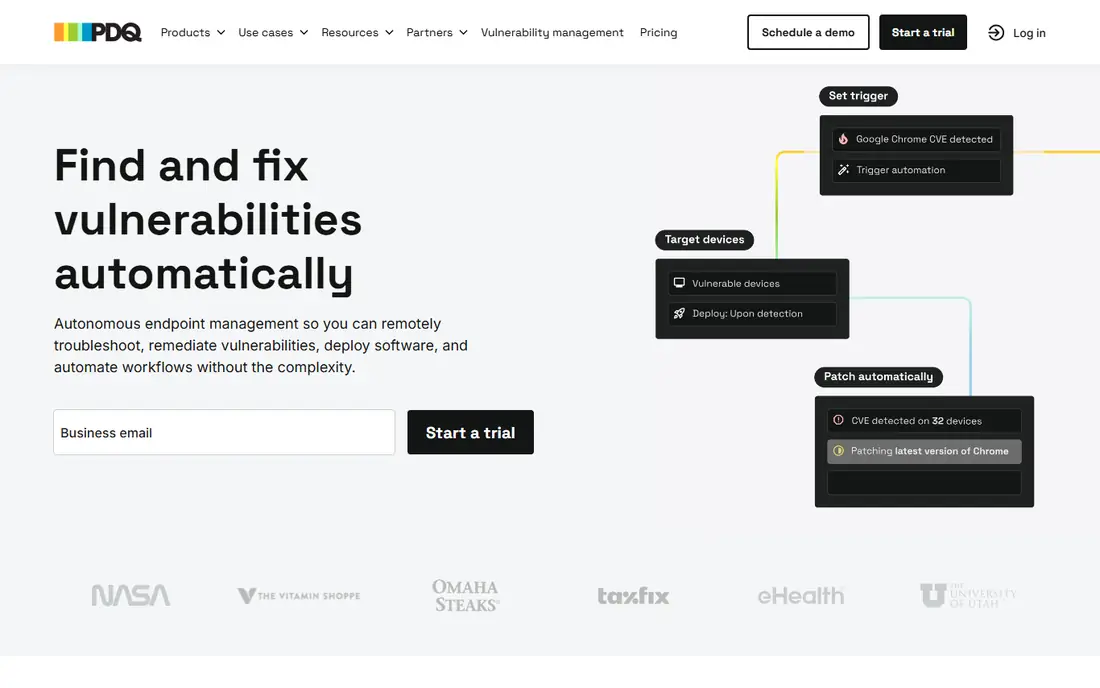
PDQ is the focused pick for Windows and macOS shops. Its homepage describes autonomous endpoint management to remotely troubleshoot, remediate vulnerabilities, deploy software, and automate workflows without RMM complexity. PDQ Deploy and Inventory remain ideal for on-prem or air-gapped environments, trusted by IT pros for over a decade, and the vendor reports 4.8 out of 5 stars on Capterra and 95 percent likelihood to recommend.
The trade-off is platform breadth. PDQ's strength is Windows and macOS endpoint management, so Linux heavy fleets should look at Automox or Action1. For sysadmins who want fast, simple patching and deployment without a full RMM, PDQ is the best pick.
What we like- Fastest way to see, patch, and protect every device
- On-prem Deploy and Inventory for air-gapped environments
- Loved by sysadmins with 4.8 on Capterra
Watch out for- Windows and macOS focus, limited Linux depth
- Per device pricing with a 100 device minimum in comparison sources
#4Atera
Best for: MSP and small team platform4.6/5 on
G2 (1,123 reviews, checked Oct 2026)
Visit atera.com
Starting priceSee website
Free planFree trial
Atera is the MSP and small team platform pick. Its homepage describes a full-stack IT platform to keep IT up and running, with built-in ticketing, RMM, service desk, patching, and AI agents, priced per technician with full value realization claimed in 5 days. Its AI agent Robin autonomously solves device and cloud issues end to end, with customer stories citing large technician time savings. Atera's per technician model suits MSPs managing many endpoints with few technicians.
The catch is focus. Atera now leads with AI agents, so buyers who only want patching should confirm patching depth on a demo. For MSPs and small IT teams that want one platform for patching plus support, Atera is the best pick.
What we like- Full-stack IT platform with ticketing, RMM, service desk, patching, and AI agents
- Priced per technician, not per device
- Full value in 5 days claimed
Watch out for- AI agent pitch now leads the homepage, so patching details are less prominent
- Per technician pricing can cost more for large technician teams
#5Action1
Best for: Free small fleet patching4.9/5 on
G2 (1,206 reviews, checked Oct 2026)
Visit action1.com
Starting priceFree to start
Free planYes, 200 endpoints
Action1 is the best free starting point. Its homepage describes autonomous patch management and vulnerability remediation for Windows, macOS, and Linux endpoints, deploying pre-tested patches from the cloud with no VPNs or on-prem infrastructure. Features include cross-OS patching, third-party patching, vulnerability detection and prioritization, ring-based rollouts, a private expert curated software repository, and peer-to-peer patch distribution to cut bandwidth. Action1 reports a 99 percent patch success rate, more than 10 million endpoints protected, and 5,000 plus customers, with the first 200 endpoints free forever and no expiration date.
The trade-off is scale pricing. Beyond 200 endpoints, Action1 charges per endpoint, so large fleets should get a quote early. For small teams, labs, and anyone wanting to prove value before paying, Action1 is the best pick.
What we like- First 200 endpoints free forever with full functionality
- Setup in 5 minutes
- 99 percent patch success rate claimed
- Peer-to-peer distribution
Watch out for- Free tier covers 200 endpoints, larger fleets pay per endpoint
- Newer vendor than ManageEngine
Starting priceSee website
Free planFree trial
Heimdal is the security platform pick. Its homepage describes one unified cybersecurity platform with AI powered detection, investigation, and response, bringing together prevention, detection, access control, and response across email, endpoint, identity, and cloud. The platform reports more than 3 million endpoints secured, more than 100 million cyber attacks prevented, and more than 270 million vulnerability patches deployed, with compliance alignment to NIS2, GDPR, NIST, CIS Controls, and ISO 27001.
The catch is fit. Heimdal is a security suite first, so teams that only need patching will pay for much more. For security teams that want patching inside a unified platform with threat hunting and compliance, Heimdal is the best pick.
What we like- Unified cybersecurity platform with 10 plus modules
- 270 million plus vulnerability patches deployed
- Trusted by 20,000 plus organizations
Watch out for- Patching is one module inside a broad security platform, not a dedicated patcher
- Pricing by quote
Starting priceSee website
Free planFree trial
Lansweeper is the visibility pick. Its homepage describes an AI cyber asset intelligence platform giving IT and security teams one shared, trusted view across IT, OT, cloud, and IoT, so teams can see what exists, know what matters, and act with confidence. Lansweeper continuously discovers and classifies every asset, normalizes duplicate records into one asset record, enriches each asset with lifecycle stage and vulnerability context, and delivers trusted data to ITSM, CMDB, and security tools. It is trusted by more than 30,000 environments, including universities, airlines, and manufacturers.
The trade-off is directness. Lansweeper does not patch endpoints itself; it provides the asset and vulnerability intelligence that patching workflows act on. For teams whose patching problem is really an inventory problem, Lansweeper is the best pick, ideally paired with a patcher like Automox or Action1.
What we like- Total asset visibility across IT, OT, cloud, and IoT
- 30,000 plus environments
- Device fingerprinting against 175 million plus devices
Watch out for- Asset intelligence platform, not a patching tool itself
- Patching happens through workflows and integrations
How we chose
We compared tools that replace Patch Manager Plus across its core jobs: OS patching, third-party patching, vulnerability prioritization, rollout control, and compliance reporting. Each vendor homepage was opened to confirm the product exists today and matches its category. We kept a mix of cloud-native patchers, full RMM platforms, focused deployment tools, and adjacent platforms, since Patch Manager Plus users range from small IT teams to large enterprises and MSPs. Where a tool is an indirect fit, we said so plainly rather than presenting it as a direct patcher. Pricing is taken from vendor homepages where published, and written as See website where vendors price by quote.
Patching without breaking production
The fastest way to lose trust in a patching tool is a bad rollout. Start with rollout rings: patch a small pilot group first, then a broader group, then the full fleet, with time to catch bad updates between rings. Schedule maintenance windows and reboot policies clearly, and communicate them to users before patches land, since surprise reboots cause more complaints than patches themselves.
Keep third-party patching in scope. Operating system patches alone leave browsers, runtimes, and business apps exposed, and most breaches exploit unpatched third-party software. Finally, measure patch success and compliance by device, not by policy: a policy that reports success while laptops stay offline for weeks is not actually protecting the fleet.
Frequently asked questions
What is the closest alternative to Patch Manager Plus?
Automox is the closest cloud-native replacement with cross-platform policy patching, while PDQ is closest for Windows and macOS focused teams. NinjaOne is closest if you also want a full RMM platform.
Which Patch Manager Plus alternative is free?
Action1 is free forever for the first 200 endpoints with full functionality. No other tool on this list offers a permanent free tier at that scale.
Do these tools patch third-party applications?
Yes, all seven support third-party patching in some form, though catalog depth varies. ManageEngine claims 1,100 plus third-party apps, while comparison sources cite 580 plus for Automox, 630 plus for Action1, and 350 plus for Heimdal. Confirm your specific apps are covered before buying.
Can I patch Linux endpoints with these tools?
Automox, Action1, and NinjaOne support Linux alongside Windows and macOS. PDQ is Windows and macOS focused, and Atera has limited Linux support, so check your Linux fleet needs first.
Is Patch Manager Plus still available?
Yes. Patch Manager Plus remains a ManageEngine product. This guide covers alternatives for teams that want cloud-native patching, a full RMM platform, a free tier, or a different pricing model.
Which alternative is best for MSPs?
NinjaOne and Atera are the best MSP picks, with multi-tenant management and full RMM features. Atera's per technician pricing suits MSPs with many endpoints per technician, while NinjaOne suits MSPs that also need backup and service desk features.
Sources we checked (7)
- https://automox.com
- https://www.ninjaone.com
- https://www.pdq.com
- https://www.atera.com
- https://www.action1.com
- https://heimdalsecurity.com
- https://www.lansweeper.com
Is your product missing or out of date?
We review this list regularly. Vendors can request a listing, send updated pricing or ask about featured placement.

Shihab Mia · Founder, Rankite
Shihab has 5+ years in B2B and SaaS SEO. He writes Rankite's software buying guides from pricing pages, documentation and public user reviews. More about Shihab.