How we make this list: we compare pricing pages, product documentation and public user reviews. Ratings come from G2, Capterra or Trustpilot, with the date we checked them.
Key takeaways
- ERPNext is the closest open-source alternative to Odoo, with a similar modular design and a much lower cost.
- Oracle NetSuite and Microsoft Dynamics 365 Business Central suit larger companies that need deep financials and scale.
- Dolibarr and Tryton suit small businesses and developers who want open-source ERP without licence fees.
- Zoho One bundles ERP-style apps with CRM, mail and HR in one low-cost subscription.
- Migration cost matters as much as licence cost, so check data import tools before switching ERP systems.
Odoo is popular because it bundles CRM, sales, inventory, manufacturing, accounting and HR in modular apps that a business can adopt gradually. Its alternatives split into two camps: open-source systems that copy that modular idea at lower cost, and established ERP suites that offer deeper financials and support. The eight tools below cover both camps, from free self-hosted systems to enterprise platforms.
ERP pricing is usually per user per month, with implementation and migration costs on top. Open-source systems remove licence fees but need hosting and setup help. Prices below are marked "See website" where editions and user tiers vary, so confirm the current figure on the vendor's pricing page and budget for implementation separately.
Quick comparison
Is your product missing or out of date?
We review this list regularly. Vendors can request a listing, send updated pricing or ask about featured placement.
The best Odoo alternatives

#1ERPNext
Best for: Open-source Odoo replacement4.3/5 on
G2 (51 reviews, checked Oct 2026)
Visit erpnext.com
Starting priceSee website
Free planYes
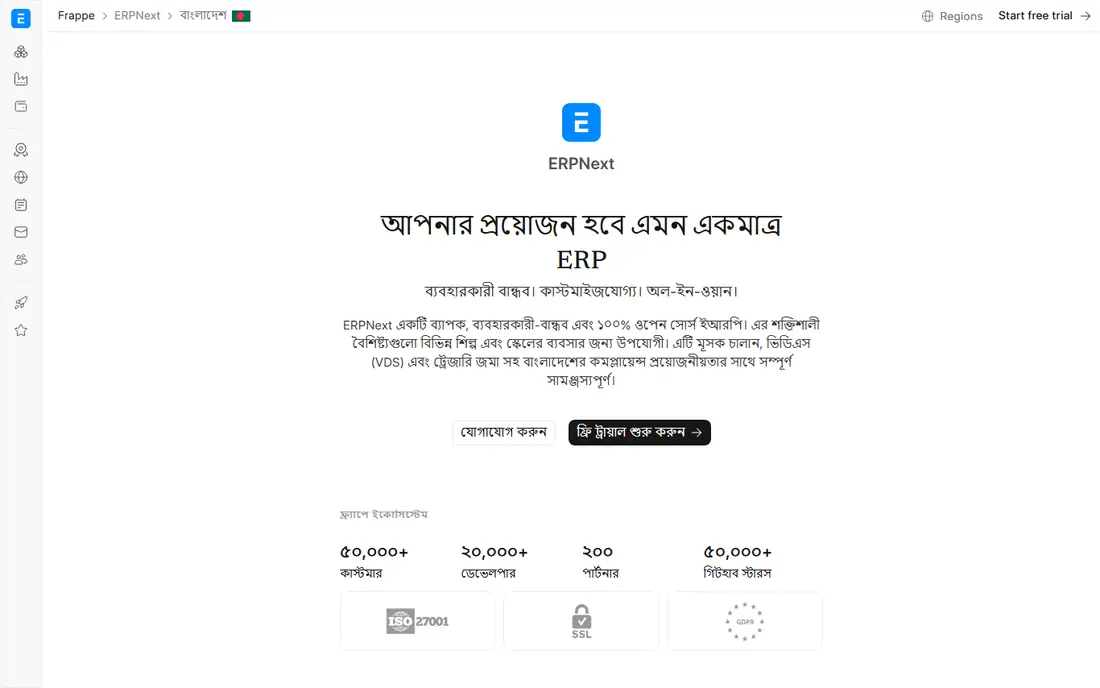
ERPNext is the most direct open-source alternative to Odoo. Its modules cover accounting, CRM, sales, purchasing, inventory, manufacturing, HR and projects, and the interface feels familiar to Odoo users. The self-hosted edition is free and open source, while the cloud version adds hosting and support for a per-user fee. A large community contributes apps and localisations.
Complex setups still need a partner or developer, and the partner network is smaller than Odoo's, so finding local help can take longer. For a small or mid-size business that wants Odoo-style modularity without licence fees, ERPNext is the first alternative to evaluate.
What we like- Modular apps like Odoo, including accounting, inventory and manufacturing
- Free self-hosted edition
- Active community
Watch out for- Implementation needs technical help for complex setups
- Smaller partner network than Odoo

#2Dolibarr
Best for: Small business open-source ERP4.5/5 on
G2 (32 reviews, checked Oct 2026)
Visit dolibarr.org
Starting priceSee website
Free planYes
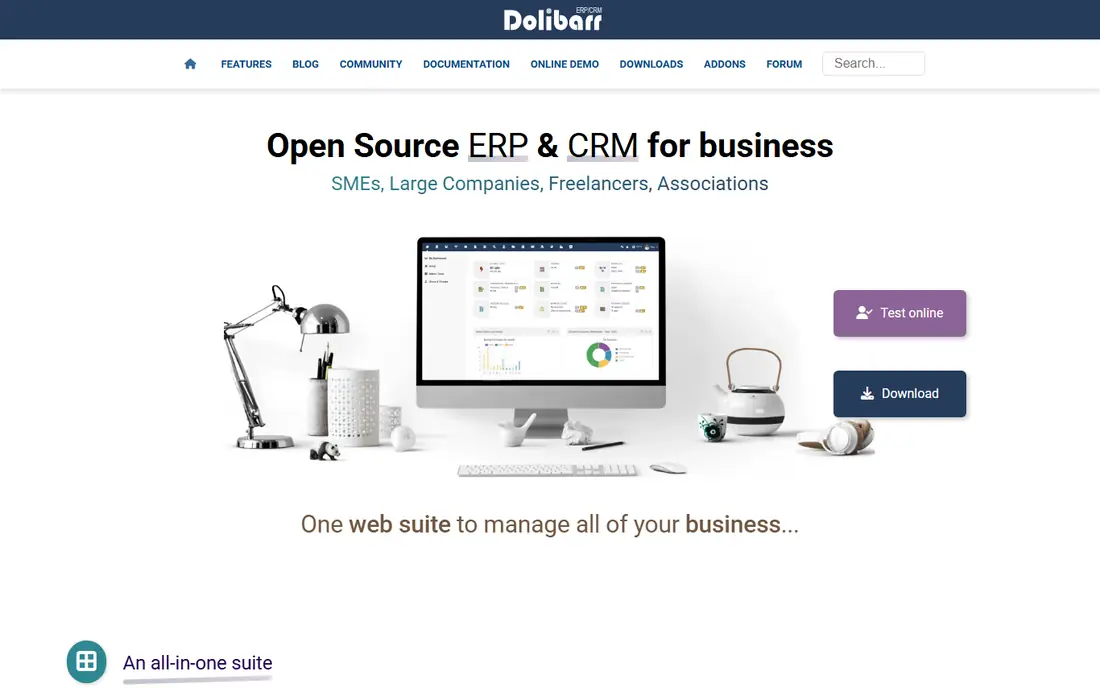
Dolibarr is a lightweight open-source ERP and CRM for small businesses, freelancers and associations. It covers customers, invoicing, orders, stock, projects and basic HR, with modules that switch on as needed. Installation is simple, and the system runs on modest hosting, which keeps costs low.
The interface is plain, and manufacturing depth trails Odoo and ERPNext. For a small business that needs invoicing, stock and customer management without a heavy implementation, Dolibarr is a practical free choice.
What we like- Lightweight and easy to install
- Covers CRM, invoicing, stock and HR basics
- Free and open source
Watch out for- Interface looks dated
- Advanced manufacturing is thinner than Odoo
Starting priceSee website
Free planYes
Tryton is a modular open-source ERP platform built for developers and technically minded businesses. Its core covers accounting, sales, purchasing, stock and projects, with a framework that makes custom modules straightforward to build. The architecture is clean and well documented, which appeals to teams that want to extend the system rather than work around it.
The community is smaller than ERPNext's, and ready-made modules are fewer, so businesses may build more themselves. For a company with developer resources that wants a solid, extensible ERP core, Tryton is a strong foundation.
What we like- Clean modular architecture
- Strong accounting and stock modules
- Developer-friendly framework
Watch out for- Smaller community and fewer ready-made modules
- Setup needs technical skill

#4Oracle NetSuite
Best for: Enterprise cloud ERP4.1/5 on
G2 (4,969 reviews, checked Oct 2026)
Visit netsuite.com
Starting priceSee website
Free planFree trial
NetSuite is the enterprise cloud ERP that growing companies move to when spreadsheets and small systems break. Financials, inventory, order management, CRM and ecommerce run in one system, with multi-subsidiary and multi-currency support for international operations. Reporting is deep, and the SuiteApp marketplace adds industry extensions.
Cost and implementation time are the barriers. NetSuite suits mid-size and larger companies with the budget for a proper rollout, not small businesses seeking a quick Odoo swap. For a company outgrowing Odoo and needing enterprise depth, NetSuite is the most proven cloud ERP here.
What we like- Full cloud ERP with financials, inventory, CRM and ecommerce
- Scales globally
- Strong reporting
Watch out for- High cost and longer implementation
- Overkill for small businesses

#5Microsoft Dynamics 365 Business Central
Best for: Microsoft ecosystem ERP4.0/5 on
G2 (917 reviews, checked Oct 2026)
Visit microsoft.com
Starting priceSee website
Free planFree trial
Business Central is Microsoft's ERP for small and mid-size businesses, and it fits naturally into a Microsoft 365 environment. Financials, sales, purchasing, inventory and projects integrate with Outlook, Teams and Excel, and the interface feels familiar to Office users. The platform scales through the wider Dynamics 365 family as a business grows.
Licensing has several tiers and add-ons, so costs need careful scoping, and implementation usually runs through a Microsoft partner. For a Microsoft shop that wants ERP without leaving the ecosystem, Business Central is the natural Odoo alternative.
What we like- Deep integration with Microsoft 365 and Teams
- Strong financials and supply chain
- Familiar Office-style interface
Watch out for- Licensing is complex
- Implementation needs a Microsoft partner
Starting priceSee website
Free planFree trial
Sage has served small and mid-size businesses for decades, with accounting, payroll, HR and ERP products across many countries. Sage Intacct targets larger companies needing cloud financials, while Sage 200 and Sage 50 serve smaller firms. The partner network is wide, so local support is usually available.
The product range can confuse buyers, since Sage sells several overlapping systems, and cloud capability varies by product. For a business that values an established vendor and local support, Sage remains a safe, well-understood choice.
What we like- Long track record with SMEs
- Strong accounting and payroll
- Wide partner network
Watch out for- Product range is broad and confusing
- Cloud migration varies by product

#7Zoho One
Best for: All-in-one business suite4.1/5 on
Capterra (134 reviews, checked Oct 2026)
Visit zoho.com
Starting priceSee website
Free planFree trial
Zoho One bundles more than 40 business apps, including CRM, Books for accounting, Inventory, People for HR and Desk for support, under one per-user subscription. For a small business, that bundle replaces several separate tools at a low monthly cost, and the apps share a single login and user directory. Mobile apps cover most functions for owners on the move.
ERP depth is thinner than dedicated systems. Manufacturing and complex supply chain features lag NetSuite and Business Central, and some apps integrate more loosely than others. For a small business that wants one affordable suite for everything, Zoho One is the best value bundle here.
What we like- Dozens of apps including CRM, books, inventory and HR in one subscription
- Low per-user pricing
- Good mobile apps
Watch out for- ERP depth is thinner than NetSuite or Business Central
- Some apps feel less integrated than others

#8Bitrix24
Best for: CRM plus operations4.1/5 on
G2 (612 reviews, checked Oct 2026)
Visit bitrix24.com
Starting priceSee website
Free planYes
Bitrix24 combines CRM, project management, HR, communication and basic business operations in one platform, with a generous free tier for small teams. The system includes telephony, video meetings and document handling, so a small business can run much of its day from one login. Self-hosting is available for teams that want control over data.
ERP depth is lighter than Odoo, with inventory and manufacturing handled at a basic level. The interface packs in many features, which can overwhelm new users. For a small team that needs CRM and operations together at low cost, Bitrix24 is a capable alternative.
What we like- Generous free tier
- CRM, projects, HR and communication in one place
- Self-hosting option
Watch out for- ERP features are lighter than Odoo
- Interface can feel crowded
How we chose
We compared systems on their published modules, pricing pages, documentation and public reviews from businesses that migrated from Odoo. We favoured systems with modular design, accounting and inventory coverage, and a clear migration or import story. Prices were marked "See website" because ERP pricing varies by users, modules and deployment. We did not claim hands-on testing.
Planning an ERP switch
Map your Odoo modules first. List every module you use, the custom fields you added, and the integrations you rely on, then check each alternative against that list rather than its marketing page. Data migration is the hidden cost: customer records, open invoices, stock levels and historical transactions all need mapping, and a trial import catches problems early.
Run a pilot with one department before a full switch. Finance or inventory usually surfaces the most issues, and a pilot gives staff time to learn the new system while the old one still runs. Budget for training as well as licences, since ERP failures usually come from adoption, not software.
Switching ERP systems succeeds or fails on migration planning. Before choosing an Odoo alternative, list the modules you actually use, such as invoicing, inventory, manufacturing or HR, and score each candidate only on those, since a system with fifty modules you never open adds cost and confusion. Export a sample of real data, including messy customer records and old stock items, and test the import during the trial, because clean demo data hides migration problems. Also confirm who handles support after go-live: a local partner, the vendor directly, or a community forum, since ERP questions arrive weekly in the first months. A phased rollout, starting with finance or sales before adding manufacturing, reduces risk compared with switching everything in one weekend.
Frequently asked questions
What is the best free Odoo alternative?
ERPNext is the best free alternative, with a self-hosted open-source edition covering accounting, inventory, manufacturing and CRM. Dolibarr is lighter and easier for very small businesses. Both need hosting and some setup, but neither charges licence fees for the core system.
Is NetSuite better than Odoo?
NetSuite suits larger companies that need deep financials, multi-subsidiary support and enterprise scale, while Odoo suits smaller businesses that want modular apps at lower cost. The right choice depends on company size, budget and complexity, not on one being universally better.
Can I migrate data from Odoo to ERPNext?
Yes, ERPNext provides data import tools for common records such as customers, suppliers, items and opening balances, and migration specialists handle larger moves. Plan the migration carefully, test with a sample import, and expect some manual cleanup for custom fields and historical transactions.
Does Zoho One replace an ERP system?
For small businesses, Zoho One covers much of what an ERP does, including CRM, accounting, inventory and HR in one subscription. For complex manufacturing or multi-entity financials, a dedicated ERP like NetSuite or Business Central fits better. Assess your most complex process before deciding.
What does ERP software cost?
Costs vary widely. Open-source systems like ERPNext and Dolibarr charge no licence fees but need hosting and setup help. Cloud ERP systems charge per user per month, with implementation fees on top. Always budget for migration, training and support alongside the subscription.
Is Business Central only for Microsoft users?
Business Central works standalone, but its value is highest for organisations already using Microsoft 365, Teams and Outlook, since integration is deep. Businesses outside the Microsoft ecosystem may get more value from ERPNext, NetSuite or Zoho One, depending on size and budget.
Sources we checked (8)
- https://erpnext.com
- https://www.dolibarr.org
- https://www.tryton.org
- https://www.netsuite.com
- https://www.microsoft.com/en-us/dynamics-365/business-central
- https://www.sage.com
- https://www.zoho.com/one/
- https://www.bitrix24.com
Is your product missing or out of date?
We review this list regularly. Vendors can request a listing, send updated pricing or ask about featured placement.

Shihab Mia · Founder, Rankite
Shihab has 5+ years in B2B and SaaS SEO. He writes Rankite's software buying guides from pricing pages, documentation and public user reviews. More about Shihab.
 Tryton
 Sage